
The Franklin Square Phenomenon
A Ghost Story: Part II

Part I:
Part II:
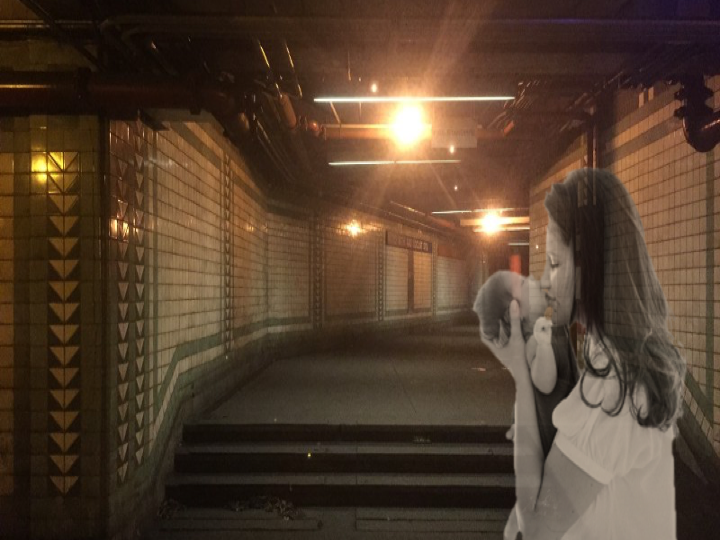
First, the sound of an oncoming train.
That sound of the train moaning as it slows down, squeaks and screeches around the curve, hitting the darkness of the underground tunnel. The brakes groan. In front of me, the rails vibrated as if alive — stirring awake after a ten-minute snooze.
What would the passengers think — spotting us in that ghost station? Would that artificial light — the yellow glow — make us appear as the undead?
A second later, Radcliffe screamed, “Madeleine!” Who? Then again, “Madeleine! Madeleine!”
It all happened so fast — Radcliffe racing toward the tracks — running so fast it seemed like he could jump through time, over the tracks, and through the wall like some knight errant.
He screamed her name — and said, “The boy! Yes! Is that the boy?”
The lights of the oncoming PATCO train paned the cavernous walls of concrete and wooded frames — the lights trained like a scope of a sharpshooter’s rifle or a spotlight on some final act of violence in an Italian opera.
The voices of the others all merged — “What — Stop!” And all I did — Aim — shoot! Snap! Click. Snap! Click. Snap? A photo burst. Get the story! Shoot the story! From the photos, I later saw Radcliffe running — the photos like stop action or cartoons flipping at one thousand per second — clutching his carry-on, reaching out to save the unseen woman and her child from suicide.
The engine smashed Radcliffe as he leaped in the perfect timing for the trio to catch the morning train. The photos did not reveal the screams and the screeching of wheels and the moans inside the train. I do recall the wallop and whump of flesh meeting metal, even at slow speed, and the shattering of glass. At first, I didn’t recall the blood — but the rails were no longer clean.
The PATCO suits claimed his last words — “I came back.”
Needless to say, “The Occurrence at Franklin Square Station” was a Page One story up and down the East Coast.
No one could make sense of it.
“The man was a mad man!” “This is what happens when journalists are under pressure and abused by the highest man in office.” “He was an alcoholic.” “There was always something strange about Roderick Radcliffe.”
Before the man was even cold in the morgue — not that much was left of him, the vulture reporters started digging into his past.
More people were just irritated about the two-day long stoppage of service on PATCO. Of course, I was interviewed. Editors took my photos — and used the ones that helped “tell” the story of “what happened” but also helped protect the memory of the deceased. No one on the train died that morning. Just a few minor injuries. The train conductor had a broken shoulder and fractured rib cage.
But of course, some of my horrific photos found their way online. Some even claimed under a microscope or some other type of high-resolution imagery, to see some other forms around Rory Radcliffe. I told reporters and the police what I knew at the time. “He was absent from work. He was acting strangely. I received a postcard. He thought he saw a woman and a child while on the train — and the image haunted him.”
I gave the police and the press my two drawings of the woman and the newborn. My artwork appeared all over the news.
But I didn’t share, yet, what I found at his apartment. The police had already been there — looking for clues — looking for a suicide note. Besides all of his books, alphabetized by author, the apartment was Spartan. From his window, I could actually see ghostly silhouettes of passengers on PATCO as the trains passed. Was he looking for this woman on the train, too? Was that why he moved here? On his nightstand, there was a small, clean rectangle in a sea of dust. As if a picture frame had once kept Rory company at night. What had been removed?
The second, smaller key opened a mahogany chest hidden beneath the sink in a cupboard with a sliding door. Gwenano was with me. She insisted. I was glad, after all. We went after the police lost interest or gave up on a reason for the death. We were thinking it would be ruled “momentary lack of sanity” rather than a desperate act of suicide.
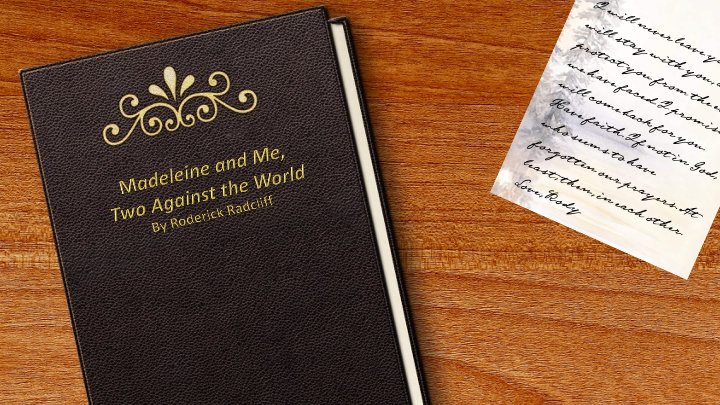
Inside we found a typed manuscript. It was called Madeleine and Me, Two Against the World. There were pictures of Madeleine when she was young — from the time she was a baby — to pictures of her like the one I drew from Radcliffe’s photographic memory. “This is eerie as all shit,” Gwenano said. There were even pictures of Rory Raddy — he was actually smiling and happy.
The same size picture frame from his nightstand was there, too. On the top. As if just recently added to the treasure chest. It was a lovely black and white photo of Roderick and Madeleine Radcliffe in their early teens.
His manuscript was over 400 pages — and proofed by one of the best in the business — Roddy himself. Not one comma out of place. As an editor, how could I improve this? The prose was luxurious. Lyrical, even. I wept over many lines — how could the beauty of the prose reveal the horror of his life?
I took the manuscript home. What would it seem like, caught in his apartment? Not that it was illegal or anything, I guess. Later, in my apartment, after reheating water for tea numerous times, I read the text out loud to Gwenano. Who needed tea? The text kept us awake with the dead voices.

In elegant handwriting, almost as if it belonged under protection at the National Archives in Washington for Historic Manuscripts, Radcliffe wrote of years of abuse. The brother and sister just had each other.
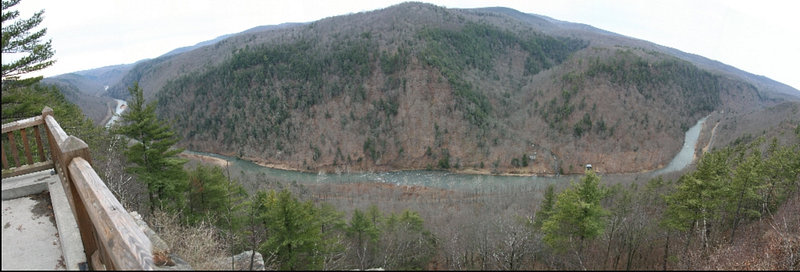
They lived in Forest County in Northwestern Pennsylvania, the poorest county in the state. Rory vividly describes the wilderness, the Allegheny River that flowed past the house their father made. A dirt road meandered off the main road — Rt. 62. The house resided somewhere between Tionesta, the county seat, and the town of President. Tionesta is a Native American word for “where the waters meet.”
As a side note, Rory said that some people misinterpret this word for “where the wolves meet.”
Their father died of unknown causes when the twins were just ten years old. Rory writes pages and pages of glowing prose about his father, but he was leary of his mother who saw visions and was preoccupied with cleanliness and “dark stains on the soul.” For weeks, the mother would remain in her bedroom. Rory seems to think his father kept his mother away from them because of some “shame” she kept talking about, heaping “verbal abuse upon her two poor bastards.”
Rory provides vivid depictions in the manuscript.
The father’s brother, James, lived up the road and ran a campground on the river, mostly for hunters and kayakers. “The Alleghany bends like a bottom of a horseshoe there,” Rory writes. When the father died, James moved in and married his sister-in-law and informally adopted the twins.
That’s when the physical abuse started happening — as well as a mother who would often find herself cleansing “her sins” in the Alleghany at all times of the day and night.
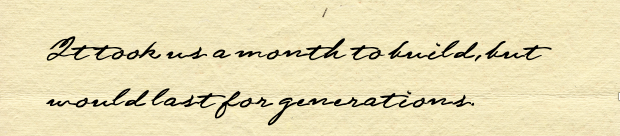
Rory and Madeleine would work at the campground. School, it seems, was not a priority, even though Rory would steal and borrow as many books as he could find and read to his sister at night. They also made a type of “retreat” deep in the woods — like something out of a Grimm’s fairy tale. “It took us a month to build, but would last for generations.”
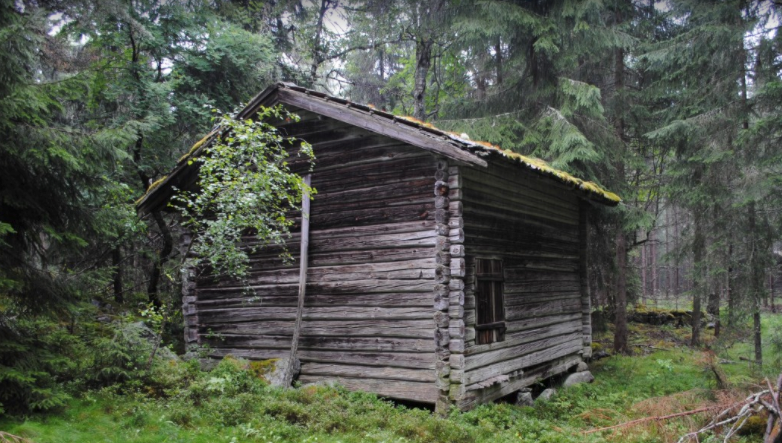
The mother soon died. She refused treatment for her illness, claiming the Lord would take her when the Lord was ready. Rory speculates that the mother was the one actually ready to leave “this wicked earth.” He underlined “ready” three times. Rory would hear ghostly musings from his mother behind her locked bedroom door as if she were reading to herself what she was writing. He didn’t know, yet, of her diary.
The step-father-uncle, an alcoholic, would often seek out Madeleine as soon as she started “ripening like a country peach.” Radcliffe protected her as much as he could, even using a baseball bat he whittled from a branch, busting his uncle’s leg once, and then his arm, each one, twice.
Rory wrote of his adventures with his twin sister. Of what they found in the woods and the cabin they made there. The manuscript, after all, is not all full of horror. There are chapters full of nature and observations and laughs and games between the siblings. They had no other family — no cousins that they knew, anyway.
The Radcliffe home by the river was simple — two or three rooms in a log-cabin type of thing. It seemed out of place for someone like Rory who seemed so city-modern-suave. The two of them tried to stay far away from their uncle — even moving, briefly, to Tionesta in the late 70s.
Radcliffe had a plan. He managed to secure a safe place for Madeleine with a second cousin in Titusville. The uncle had no idea. He fleed to Philadelphia and started hustling as a writer and read every book he could at the Free Library of Philadelphia. In a year or two, he could secure his sister. The two would be free of the uncle and phantoms that haunted the house and the memories of their mad mother and the poverty of Forest County. They wrote to each other every week, and then the letters stopped.
Rory returned to Forest County and found his sister living in a dilapidated cabin on the campground. He now had some money and perhaps, a budding career. Madeleine said she found their mother’s diaries hidden beneath the floorboards of her bedroom.
“Uncle James is our father,” she said, crying. “Our dad married her to protect her from James.” She managed to copy most of the diary by hand before James found her, burned the diary, and used his lighted cigar to burn the arms of Madeleine. He caged her in the cabin at the campground. On drunken nights, “he could come to me and rape me — like he said he raped our ‘whore’ mother because she was already ‘the Forest County sperm bank’.”
Madeleine then said she was pregnant. In tears, she started crying because she knew her child was her father’s child as well. But then Uncle James started using her as a prostitute for the hunters. In tears, she tried to escape but was shot in the foot which took “a long time to heal” because Uncle James just resorted to his local folks for medical help.
Rory wanted to kill Uncle James “then and there.” But being behind bars for murder wouldn’t help either of them. So he drove her to the nearest big town — St. Marys and paid for a motel for her. He gave her all the money he had — and his credit card. In a week, he would arrange things for them to leave together for good. She would meet him in Philadelphia at Franklin Square Station. “I’ll take care of you. This is the last time I will leave you.”
Rory and Madeleine had planned to run away — escape Pennsylvania, at least, and settle somewhere new. Rory wanted a city. She would have the baby, and no one would know. She would have no such shame as their poor “momma.” They would take Amtrak from 30th Street Station and head to Boston. They were to meet at Franklin Station on September 8, 1979.
“Wasn’t that a day before the station closed?” I asked myself — and Gwenano said she didn’t know. But I knew.
When Rory arrived, she wasn’t there. He remained in the station, looking for his pregnant sister. Tearfully, he wrote about her disappearance. The stains still blemish the handwriting, and that immaculate script of his feels rushed and frazzled — as if fighting spasms in his hand. He returned the next day, but there was still no Madeleine. The station was closed. He haunted the other stations, waiting with his carry-on with Boy Scout badges. He hoped to hear from her — a call, a letter.
But nothing came. He went back to the campground. It was closed. The old, small house by the Allegheny that his father had built had been burned to the primitive foundation. A few mementos of childhood he kept — wiping off the ash and dirt — like the photo of the two of them when young when “life was about splashing in running streams, dancing in rivulets of dappled sunlight, and fishing for that night’s dinner.”
There was no word about Uncle James or Madeleine. Rory filed missing person reports. He called back every month — but the two had vanished. For thirty years — he heard nothing from his sister or his sinister uncle.
Until one day he received a call from Forest County. The call came that Monday evening after the second time Rory saw his sister and nephew at the Franklin Square Station.
I turned to Gwenano. “I’m glad you’re here,” I said, “because I am getting freaked out right now.” She kissed me on the cheek.
It was from “a hunter who knows a thing or two” and overheard a “few things that quite upset this old man.” He had known his “old bastard” of an uncle for a long time. “Not friends, but I hunt — and hunters liked his campground,” he said. “He also liked his whiskey.” It seemed as if Uncle James had returned and was living in the campground again — as a squatter. One night Uncle James was drinking far too much at Ray’s Tavern and was talking about seeing things in the river — ghostly things — his dead wife — the dead brother — and the dead daughter dangling a crying baby from atop the Tionesta Lighthouse. The baby was crying, “Papa! Papa!”
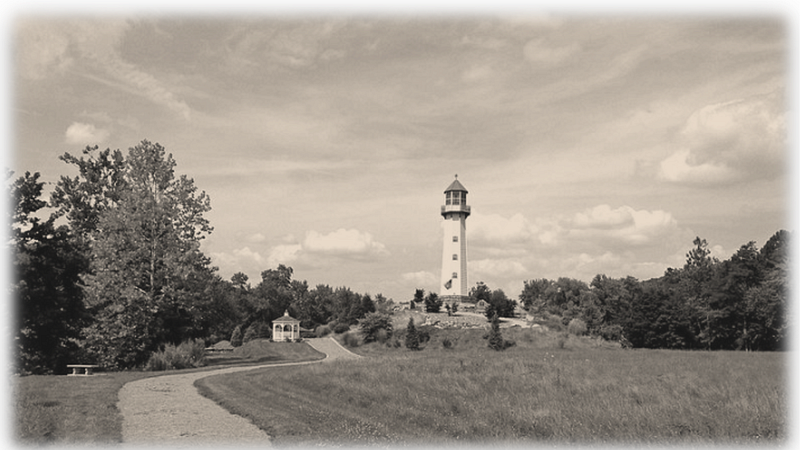

“‘And that baby wasn’t mine, I tell you,’” this man told Rory over the phone. “‘She was a whore like that whole side of the family — just a dark stain that the Lord can’t cleanse — but I cleansed it, you see — I drowned her and that demon baby in the river — and buried her — buried her in that cabin she made in the woods — where they used to go to hide from me. You see, I found out — I found out she was trying to escape — and I told her she couldn’t escape her destiny — that every man is a king, and I was king ‘round here, and that Forest County controlled her — like I controlled her — like God controls her.’”
Rory asked, “Is he still there?”
The old hunter said, “Yep. Right at his old campground, but he keeps a low profile. Not even sure how he got home, drunk as a monk on mead, but not at all holy. A few of us wanted to call the cops, or just go up there and shoot the demon ourselves, but we thought you should have top priority as to what to do,” he said, “since you are so famous and smart. The one and only Rory Radcliffe.”
I am greatly condensing this 400 page manuscript for this story. The whole of it will need to be published — even the parts I have left out that seem too fantastical to believe. The last few pages bring us up to date.
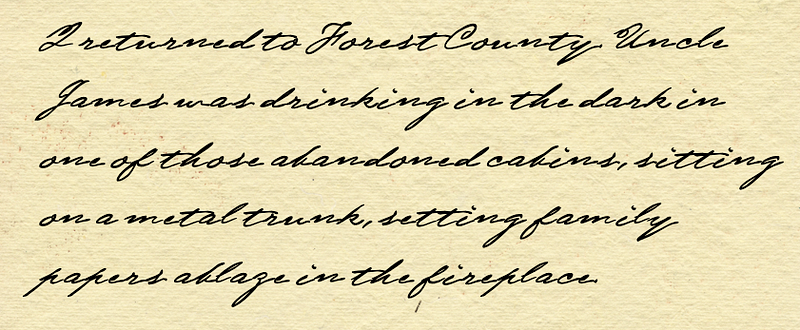
Here are some excerpts:
I returned to Forest County. Uncle James was drinking in the dark in one of those abandoned cabins, sitting on a metal trunk, setting family papers ablaze in the fireplace.
Uncle James thought that I was just another family ghost. He even smiled, and said, “Oh, Rory, my son, my son, my long, lost son, my famous son, a son of my own loins, my own seed, so nice of you to return home. Would you like a drink? So many have come back to join me, lately — in one form or another — living and dead. I’m expecting your uncle here soon — I mean, your daddy. But I’m your daddy. He still blames me, you know. For fixin’ her — tieing her up, body and soul. Your momma, I mean. So she couldn’t have any more like us — like us Radcliff’s.”
I told him I knew he raped and tortured his own daughter — and drowned his own son. Uncle James wanted to know how I knew all of this — and was I really sure of the identity of the baby daddy. “You two were close,” he said, smirking. “Too close.”
Uncle James started laughing. “Maybe it was my brother,” he said, “come back from the dead like some incubi to prove that he was a man, after all.”
“And God knows how many customers she entertained. And how do you know where I buried the two bodies?” Uncle James asked. “But where are my manners, son. Would you like a drink? You know, we Radcliffs cannot deny a drink. We should toast before we discuss the end of the line, here, right?”
“Madeleine told me,” I said, eager to finish, “and she asked me for help — one last time.” That’s when I plunged my shiv into my father’s neck — and then another wound — the fatal one — into his chest.
For a paragraph, he describes the sensation of the warm blood covering his cold hands and what it was like to watch the life pour out from a man’s eyes. He cleaned the blood from his shiv on his dad’s old plaid recliner and threw the defense weapon into the fire.
I took embers from the fire and set the old, wooden structures ablaze. He bragged that such a “hell-fire” had not been seen in Forest County since the Great Fire of 2002 that wiped out a whole downtown block.
I returned to our makeshift cabin near where the “two waters meet.” They were buried deep but buried like hogs. After all of this time, there was not much left of them — shoes, bracelets, parts of that white blouse she was wearing, and that blue blanket. His name was Rory. He did have a colored bracelet on his arm. She named him after her me. I started crying as if my tears could resurrect them like the tears from a Phoenix.
It seemed strange. Not much was left of the body, but I swore I sensed a smile on both — the mother and the child. The mother held her baby just the way I had seen on the train platform. Perhaps nothing can harm the spirit — not even the evil of Father James.
In my mania, I thought I heard the wind carry her voice, apologizing for being caught and not catching that last train together and not being as strong. I buried them, again, properly. I placed flowers from the fields around the grave and made a stone marker for the gravesite. I left the makeshift cabin stand. On a sign, I warned those who “tampered with the grave or the holy cabin” would be cursed.
Gwenano just turned to me. “Wow,” she said. “I believe it.”
With reluctance, I approached my editor with Radcliffe’s manuscript. Was this what he wanted me to do? Why else give me the key? I told her everything. After all, I was a very good intern. Needless to say, she almost swooned.
And with his estate bequeathed to me, in a late change to his will, a little more wealthy. After all, he was the last of the Radcliffe line. I paid homage by visiting that grave in the woods. On the top of the grave, I placed his ashes. Along with whiskey bottles and a fire-proof trunk that contained the family Bible, the authorities did find the body of Father James on the campground.
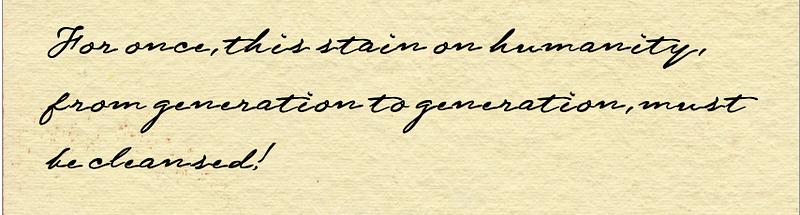
His last line, an epitaph, perhaps, read:
“For once, this stain on humanity, from generation to generation, must be cleansed.”
In pace requiescat, my friend.
Special thanks to Dan Norbury, Mary Jane Murphy-Bowne, and Peculiar Julia as early readers who greatly assisted with this story and the photographs.