
Overland to the World
The Last Breakfast
A short story
I.
In a darkened corner of the Oliver Twist Breakfast Room, Eleanor Rossano sat detached. She sketched on a paper placemat a pencil portrait of the man.
This man was seated at the middle of the long breakfast table. With the warm mug against her cheek, Eleanor didn’t like her drawing. His smile — all wrong.
She picked through scraps of conversation. The hotel was the Charles Dickens Inn in Lancaster Gate, London.
She tasted, suddenly, her husband in her tea; she forgot about the talk, the man, and the doodle, smelling instead the remains of hazelnut on the morning Dominick died.
He died of a heart attack at work.
The home was a museum to Dominick’s last morning. For months, his mug remained unwashed with the sip-stains, the Roman documentary still circled in the TV Guide. The travel magazines, a still life, waited by the toilet.
In the bedroom, his clothes remained sealed in a large box.
A few clothes she did keep — the shirt from his wedding day, ratty old boxers, and his infamous red plaid pajamas, full of holes. These, she stuffed behind her pillow.
Each Friday, she cooked their last breakfast: scrambled eggs, done well, almost brown, turkey sausage, orange juice with no pulp, and an English muffin, done well, with marmalade.
After two weeks, she no longer set a place for him. The morning sun no longer silhouetted her husband, a man who loved her but struggled with his faith and for not passing along his name and his genes. He blamed himself for his “lack of potency.
“Should I have been a eunuch or a priest?”
That tore her apart.
Her hands soothing him, her lips touching his neck and his ear and his lips would usually alleviate the shame and the loss of what both wanted so much.
“We may not have children,” he said, many times, “but we have each other, Eleanor, and for that, I’m blessed.”
Hearing these men at the Charles Dickens Inn, Eleanor knew what the others didn’t — death huddled like a child in the corners of all of us.
Eleanor only knew two: the man she was drawing — Michael Fadden and Marian Felson. They were all from the same Catholic church in South Jersey — Our Lady of Snows.
Dom used to complain: “You open one door, you discover ten doors to Eleanor, but why only open the door to me?” Like her desire to do more than doodle, she had left doors closed to her husband, too.
Coming on this tour was one door that opened.
Her friend, Marian, worried about her “babies” — her cats.
Earlier that morning, Michael Fadden had insisted Eleanor and Marian join them the next time at the pub.
“I don’t like to stay out too late,” Marian said.
But wasn’t this vacation? “I’m sure there’s a song in your heart that’s aching to get out.”
Eleanor didn’t want to hear, even though Patsy Cline’s “Crazy” reminded her of Dom pulling the car over and them dancing by the side of the road.
Travel would open her eyes. And it was Eleanor who pleaded with Marian to join her. She didn’t want to pay the single room supplement, but then Michael Fadden broke in. You didn’t need travel to open one’s eyes.
“Well, it’s better than sitting alone in an empty house,” Eleanor replied.
Black and white caricatures from the novels of Charles Dickens lined the yellow walls of the bistro — Sam Weller, Miss Havisham, Clara Peggotty, Charles Darnay. Michael Fadden’s back faced the portrait of “The Single Gentleman.”
Michael Fadden, meanwhile, chattered, his voice calming the room.
Looking for inspiration, she studied the sketches on the walls — familiar with only Miss Havisham — the crazed and jilted bride from Great Expectations. Since high school, Havisham had always haunted her. But why?
Eleanor had met Michael Fadden during bereavement therapy. The enigma — as she labeled him — would glance at Eleanor. Such glances made her uncomfortable. Eleanor had lost her husband, and Michael had lost two parents, a terrier, a younger brother, his career, and his faith.
All within a year.
Marian, too, sometimes joined when she lost a cat. She had twelve, so she was familiar with loss.
When not glancing at Eleanor, Michael Fadden would rock back in the rusty aluminum chair, tilt back his head, his long brown hair reaching down his lower back, and stare at the pale, water-stained drop-ceiling.
Was she examining him just as much? Did he sense her eye? He commanded that group therapy room, too. The laughter, however, alleviated the pain and kept the stains from springing forth fangs from the ceiling.
Losing one’s faith, after all, is one thing, but for a priest, leaving the church must be something totally different. What would Dom think — associating with a former priest?
“I just couldn’t play the role anymore,” Michael confessed to Eleanor. This was months ago — in the winter. They were the last in the darkening parking lot. Marian awaited as the car heated up. She honked twice — what was keeping her so long?
Light snow started falling and swirling — the snow constantly shape-shifting on the lot. He talked briefly about his awakening from his “long, dark night of the soul.”
“I may have retired my vest — well, no, I actually buried my vestments and my collar,” Michael Fadden said, “Dramatic, yeah, I know, but I still needed to belong to something familiar. Some day, perhaps, I will tell you more about how I wrestled with my decision — and then —ahhh — when I awoke one day, as I said, I had another life — a second life I wanted to live — and not in isolation or in denial — about my truth.”
He shook his head when Eleanor asked if Father Thomas— the progressive pastor of their large church — knew of his “former profession?”
“No one knows around here except you, Eleanor,” he whispered as if the bats above the broken lights were either angels or minions. “Ever wonder why I crack jokes during the group talks?”
One cannot, actually, leave the priesthood, right?
In the therapy basement, whenever she saw him, Eleanor had blushed over the stale powdered donuts and tepid Lipton tea that always tasted — tasted like coffee — the urn having once been used for Maxwell House. An urn — she laughed mordantly. The same word for ash and for coffee.
The lack of windows kept anyone from seeing the color, shifting on her face. One night, they lingered, as usual, talking, in the darkened hallway.
“Why me?” Eleanor asked. “Why tell me?”
Without hesitation, he said he simply liked her a lot. “And for some widows, especially a Catholic widow, dating a non-practicing agnostic priest may not go over too well in the singles scene. Can you imagine me on Christian Mingle? Who really wants to kiss a priest? On the cheek, sure, but you know what I mean, right?”
He lived modestly, renting a room by a lake, working at a local craft brewery, and in his rental wood shop, making things, selling them on Etsy. He thought about teaching.
“Two weeks after your husband’s funeral, Eleanor, you were back,” he said.
“So you were watching over me?”
Whatever he replied sounded genuine and flattering. Slightly creepy, yes.
Dominick was an electrician and did well, very well. It was his own business. Every night he prayed the rosary — and even went to daily mass, at times, for God to grant him a child. Boy or girl. It didn’t matter. He was not “on board” with adoption. It was one point of contention, but holding each other each night was its own reward and heaven and comfort against the darkness.
Now, Eleanor was in that bed alone, cold, lonely — smelling his cologne on the pillows — and reaching out into the darkness to catch his jokes, his whispers, his sighs during lovemaking, and any atoms that remained.
After so many years of marriage, breathing was easier with two — but no one mentions the struggle when reduced by half.
II.
It was the first day of the tour.
Eleanor had pleaded with Dom to join, reinforcing nights in Italy and the Vatican. It was a fourteen-day trip — England — France — Switzerland — and then Italy. When Dom wanted to rest, that meant the same Jersey beach rental in Belmar, New Jersey. He loved traveling but only in travel magazines.
As soon as Dom died, Eleanor placed a deposit. “If it’s Belgium,” they say, “it must be Tuesday.”
The British host, Geoffrey Snow, was, again, comforting Marian. She was sixty-seven, but behaved like seven. By the entrance of the bistro, Geoffrey patted her on the back. Her tears must have stained Geoffrey’s blue blazer.
Geoffrey had already called the States because she worried “the cat-sitter had the wrong house key.” But the cats were fine. Marian sat with her big black bag on her lap, fiddling with a black ribbon in her pants pocket.
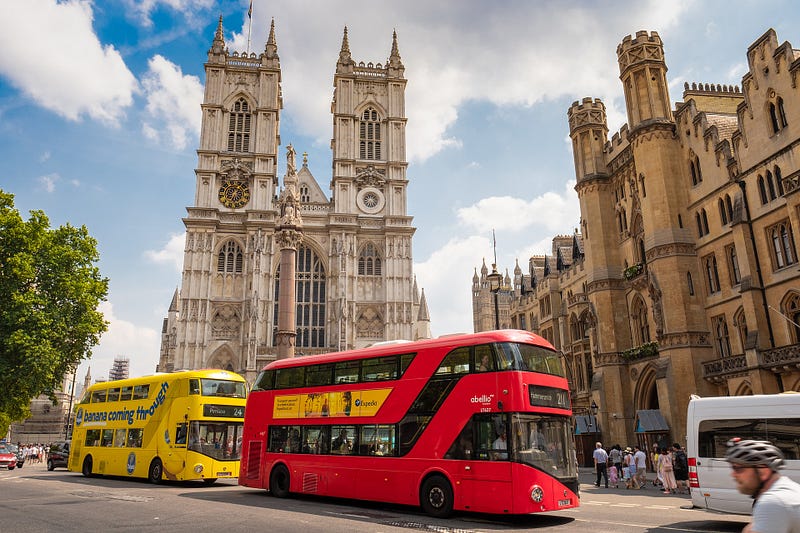
“Just wait until you see Westminster Abbey,” Geoffrey Snow said. “It concentrates the mind’s eye inward after drawing it heavenward.”
Somehow the conversation around the table brought up the question: what “every woman desires.” Michael Fadden said that came from “The Wife of Bath’s Tale” in The Canterbury Tales.
Could Eleanor “venture a guess?” What did every woman want? What does every woman want? Is there such an answer? Why did she feel so dumb, Eleanor thought, in the company of men?
Geoffrey had to leave. “Arrivederci, signore. Li vedrò presto,” Geoffrey said.
Dom used to say “arrivederci, il mio amore” when he left for work. Was he still whispering it to her? Did she need a new whisper from him? A suggestion. An okay — but an okay for what? To move on? Move on to what? She closed her eyes and prayed to Dom, asking, what should I do now, my love?”
Michael Fadden told Eleanor, after a bereavement meeting: “Could you ever think about having dessert with me?”
Eleanor agreed.
That — and coming on this tour was opening a new door — a new mansion.
Michael Fadden’s Italian was beautiful. He was from New York, well, Brooklyn, but not the slightest accent. “The Jesuits took care of that,” he said.
He promised to teach a few Italian words but claimed a smile and polite hand gestures work well too. “Wait until you experience Italy!”
How could this former priest smell of musk and spice and vanilla — such worldly scents? No incense or holy water or oil. Imagine Michael behind the altar! What were his homilies like? Huh — so lively and full of stories and anecdotes. He harbored a deep and melodious voice — like a podcaster — or one of the alluring Audible book narrators.
Such husky voices lulled her to sleep during frequent bouts of insomnia.
III.
Dom was right. He would have hated some Geoffrey Timetable parading him around. Eleanor also suspected Michael signed up when he saw her name on the list in the rectory.
“I hope my cats are fine,” Marian said. “I can’t have any more die!”
Eleanor placed her arm around Marian. Her cats were lucky to have someone who cared for them so much, she whispered.
Michael Fadden was the last passenger in the Bistro. A second delicious scone needed negotiation — as well as an apple fritter. If this was his last breakfast, after all, he wanted to savor the last crumbs. And, for after, why not show Eleanor and Marian the famous Serpentine? Maybe even hire a boat for rowing. Or buy some art supplies — you know — “for you, Eleanor.”
As Eleanor walked toward her traveling companion, she turned for Michael and spotted him picking up her placemat sketch. She flushed. In her fantasies, she had totally forgotten the sketch. The widest smile appeared on Fadden’s face — as if the sun just struck some stained glass.
“Am I really that handsome?”
What could she say? Not the truth — of course. How could she possibly flirt with anyone at fifty-two — and with a former priest? He pocketed the placemat as a souvenir, after asking politely if he could keep it.
“Are you aware, Eleanor, how gifted you are?”
IV.
The motor coach crossed Vauxhall Bridge. London Eye was the largest observation wheel in the world. On the allotted twenty clear days per year, one could see Windsor Castle to the Thames Barrier. To the north of the river, a shadow descended over Big Ben. Along the Thames, the coach turned left on the Albert Embankment.
Eleanor urged Marian to ride, but Marian was afraid of heights.
As Eleanor gazed at The London Eye — an enormous Ferris wheel, Eleanor recalled Dom’s first kiss in Ocean City, New Jersey, and how the car rocked, but his hand — his voice comforted her. His hand found its way to her, and she shuddered and surrendered to his touch. She missed being touched. She missed no one around the house. She missed the noise that kept what preyed upon her for sounding so deafening. No one even left underwear on the recliner! Later, after that wonderful day in Ocean City, with cotton candy stuck to his beard, they made love, trying for the baby.
Dominick never wanted to take this tour. “I even begged to get passports ten years ago,” she told Marian, “but they sat in our drawer. Why wouldn’t an Italian man want to see Italy?”
“I never had a boyfriend,” Marian said. She looked at her new black sneakers — bought for the trip. “I kissed a boy once — and he said my lips tasted like pond scum.”
“How would he know what pond scum tasted like?”
Marian didn’t know, but she was better off with her cats and her piano and the tips as a waitress. Her father had died — how many years ago? She didn’t know. For forty years, she worked at the same Jersey diner.
Eleanor remembered Monet’s various hues of the Houses of Parliament from the History of Art book. At the kitchen table, when young, her greatest joy was drawing picture books.
The light on the top of Clock Tower was turned on whenever Parliament was in session. “Technically,” Geoffrey said, “Big Ben is simply the name of the largest bell in the Tower.”
Marian stared out the window. “I’m having trouble following him with that accent and his fancy words.”
It terrified Marian, away from the familiar: the cats and the piano and the rhododendron and the spider plants. During their flight, Marian complained about work and the low tips, the food and beverage manager, the competitive waitresses, and how her nerves made her pour coffee on people.
As they were re-crossing the Thames, Geoffrey recited:
“Dull would he be of soul who could pass by a sight so touching in its majesty.”
After Westminster Abbey, the balance of the afternoon was free. In the evening they would attend a West End performance of The Constant Wife by M. Somerset Maugham at the Apollo. It was about a wife, who wants to be constant, faithful, but her husband isn’t and everyone knows, and then this guy from Japan returns home and the constant wife drifts.
“Let’s dress up,” Eleanor said. “And buy new outfits on Oxford Street.”
“Oh, Eleanor.”
“Call me Ellie.”
“You’re too old to be called Ellie.”
“No, really, we’ll be two American ladies dressed for a night on the town.”
“Oh, I don’t want to stay out too late.”
“And I’m too tired of staying inside! Maybe Michael Fadden can take me!”
V.
With the voices in Westminster Abbey evaporating into the vast expanse, Eleanor whispered prayers to her husband. She stood next to the red velvet framed gravesite of the Unknown Soldier. The beautiful stained glass, illuminated by the bright day, reminded her of how her husband complained the new Catholic Churches didn’t have stained-glass or any beautiful statues for a sense of the sublime on earth.
The Abbey tour guide, Julia, raised her yellow flag.
Marian was getting too old for this.
“You can sit down. Don’t feel like you have to do everything.”
“If I can’t walk, I can’t work,” Marian complained. “And I need to work. I’m a cuppa years away from Social Security. I ain’t lucky — like you.”
Julia moved her way through the group as the word “lucky” seeped its way to the pockets without holes of such financial security. Eleanor took such finacial security for granted.
“If you turn around, you will see the delightful West Window,” Julia said. “It was designed by Sir James Thornhill and William Price in 1735, about forty years earlier than your Declaration of Independence. If you will look to the left…”
“Take a seat and relax, Mar. I’ll come back to get you.”
“No, no, I’ll be okay.”
“Enjoying the Abbey, ladies?” Geoffrey Snow asked. Michael Fadden was with him.
Marian had trouble hearing. No one seemed to hear her. She sat on a wooden pew in the South Transept while Eleanor stood next to her, her hand on her shoulder, her eyes marveling at a marble grooved ionic column, as thick as a redwood tree. The design was meant to draw the eye heavenward. The ribs of heaven were perfectly structured. Julia’s yellow flag rose toward the north transept to see St. Edward the Confessor’s Chapel, “the founder of Westminster.”
Living is what should matter. That’s what’s so dear. Marian wasn’t living. She would just sit, wait, and play with the black ribbon again. Having time alone was a selfish joy, though.
In the Sanctuary, the heart of the Abbey, Eleanor stared at the High Altar depicting a mosaic of The Last Supper. My last supper with Dominick, she thought — baked turkey with mashed potatoes. The shrine was a pilgrimage site, according to Julia, for many of the weak and sick who came to be cured. Michael Fadden approached Eleanor.
“I wonder what our society would be like if, and this was a thought echoed by Joseph Campbell,” Michael Fadden said, “that instead of skyscrapers, cathedrals were still our tallest buildings. You see, commerce is our God now.”
They ascended the stairs from the Ambulatory.
What would be the significance of Mother Mary if she never bore Jesus? What would be the meaning in her life?
After only who knows how much time alone, standing, there, Eleanor felt the tug on her paisley peasant skirt. It was one of two daughters from a widowed mother on the trip. Eleanor suddenly recalled her name. Sarah. She asked if she was all right. Eleanor said yes.
“Where is your husband?” the youngest daughter said.
“With God, my dear.”
“Who takes care of you?”
“I take care of myself, dear,” Eleanor said. “And I hope you know you can, too. Women need to stick together, you know, and maybe even create a new tribe of Amazonian women warriors.”
Sarah laughed. She said the words “Amazonian women warriors” over and over like a mantra. “I don’t know what that means,” she said, “but being a woman warrior sounds fun. Could I fight against the boys at school?”
“That’s a question for your mother,” Eleanor said.
Eleanor and Sarah stood before the beautiful bronze gates in the Lady Chapel. Julia commented on the “lovely vaulted roof” so “delicate and intricate” that was completed in “1519 in the great Tudor style.” It looked like lace. The light illuminated the floating atoms from everywhere from everywhere.
The tour guide Julia appeared with her raised yellow flag. How did she get ahead of the group? “We’ll see perhaps the most endearing corner of the Abbey to the British people,” she said, “Poet’s Corner…”
Michael Fadden appeared. Sarah ran toward her mother and older sister. Wherever he went, Eleanor’s eyes followed. She would occupy a square on the floor where he had stood, close her eyes, and breath him in. She felt her body grow warm. She tightened her arms around her bosom and closed her arms like a vice, feeling the pleasure of what she so missed.
Michael Fadden gave Eleanor too much distance on the trip. Is he protecting me? Giving me time to think? Such a gentleman. But I want him to kiss me. I want to touch those hands, even those hands hardened by all the woodwork he does. She saw pictures on Etsy of his work — and almost bought a few under an assumed name. Would Dom want her living alone?
There is freedom in death, after all. But freedom to life, too.
Light poured through the double semi-circle windows. The image would have to linger in order to put it down on paper — and more than just a paper placemat.
Was it a betrayal to Dominick? Were these shadows of the possible the ones that preyed upon her — even during prayer?
Standing alone made her consider remarrying. She never kissed another man romantically, let alone — her life was so enmeshed in his — she could — well — disengage herself, even from his memory.
She whispered the line, “Till death do us part.” At church, there must have been single, older gentlemen, but she didn’t mix too well because the social interactions. Church bulletins posted single gatherings, but she was not, until now, one to mingle. Now a handsome, intelligent, and single man commented on her doodles.
Could she be reborn?
In spite of loving me, Dom never asked what I wanted, outside of deciding on restaurants and wallpaper. What would I tell Geoffrey if he asked again what every woman wanted? Was there an answer? Did women know what they really wanted? If he asked when she was seventeen, her answer would have been to have a good husband.
And her prayer was answered. If he asked it when she was twenty-one or twenty years after that, she would say to have children. If he asked the question when she was forty-five, with her prayers unanswered, she would say to remain a devoted wife. But now the answer to the question was unclear; the normal progression uprooted. Was not she going to choose to live by watching TV alone, nor looking through photo albums, or making obligatory runs to church every week without fully swallowing?
Bringing Marian on the trip, trying to open up Marian’s eyes, may have been a good excuse to justify the selfish reason of not wanting to be alone. Marian was not adventuresome. Dom wasn’t either. Marian was happier with her cats. It was a lack of foresight, using Marian as a crutch.
Now, instead of leaning on her, she would have to carry her. Eleanor raced to catch up with the tour.
Catching sight of Marian brought back reality. Would Marian even make it to Paris?
In Poet’s Corner, Eleanor found a spot next to Geoffrey. The lady who organized the trip — Ava Hargrove — was Geoffrey’s constant companion — or leech. She wasn’t sure yet. Ava seemed annoyed Eleanor was so close. Was she jealous? But proximity with smart people equaled greater access to knowledge.
Eleanor read the inscription on the T.S. Eliot memorial. “The communication of the dead is tongued with fire beyond the language of the living.” Even though she couldn’t interpret the secret knowledge of that line, repeating it made her shiver.
Geoffrey saw Eleanor and repeated the question from Bistro breakfast — that question from The Wife of Bath. He said he has heard women want the right to choose. Another passenger said something to the effect of “women be given real choices, not choices to be everything all at once without the option of saying, “No” or at least, “Not right now.” Another declared “self-determination.”
So did she think? Michael Fadden, who had just arrived from a solo wander around the Abbey, also seemed eager to hear.
“I don’t know about that, Mr. Snow,” Eleanor said. “I would say the simplest answer is to ask. It varies from woman to woman.”
“Yes — one does not apply to the whole!” Geoffrey said. “Logic! Brilliant!”
“And keep asking,” Eleanor said. “It’ll change. Or it may change. Just listen.”
“Dash it, that’s brilliant!” Geoffrey exclaimed. “Listening! Listening! Asking!”
Michael Fadden placed his hand on her shoulder. She shivered. The small group formed a detached, semi-circle ring. Julia officially ended the tour. Where had he gone?
“I wanted to leave you in prayer.”
“How did you know I was praying?”
“The way you looked at the windows.”
Eleanor fell silent, thinking of him, as yet another lovely and lonely human in the world. Could there be more than one?
Eleanor swept her arm around the room. “I guess you have read most of these authors.”
“A single gentleman has so much time on his hands,” he said. “But books are only one type of comfort. I’m tired of reading about life. The letter kills, you know. I’ve been tired of examining life through a two-thousand-year-old microscope.” He pointed at Eleanor’s feet. “You’re standing on Charles Dickens.”
“Oh, Miss Havisham!”
Michael Fadden laughed.
“Would I make a good Dickens character?”
Dickens didn’t write women well. “Mostly two-dimensional. Sentimentalists. So I’m not sure he’d get all of your depths and dimensions, but can any man?”
“As long as I’m not Miss Havisham!”
Where did Marian go? He was concerned. Eleanor was concerned too, like a mother. Marian needed the attention and reassurance of an anxious child.
Eleanor grabbed him by the hand, away from the tour group. She led him back to the privacy of Poet’s Corner. The souls of some of Britain’s best writers and luminaries swirled around them as if to sanctify her decision. And by the statue of John Milton, she kissed him.
It was soft. They looked at each other for the longest time. Her body grew warm. There was still fire there. There were still flames. Such flames would not consume her until she, too, passed into the next world. Then he kissed her longer. He kissed her with his eyes open.
That was weird, but when she asked why, he said, “It was as if I was kissing heaven, but my feet are on solid ground. And I just needed to see if you were indeed real.”
“Can you take me out tonight to see The Constant Wife?” Eleanor asked.
“Isn’t the whole group going?”
“Yes, but I want to be with you. I want to sit next to you, and I want to discuss the play over a drink together — if that’s okay? I was a constant wife, you know . . . until death parted us . . .”
He smiled. “Miracles may happen. When you least expect.”
“Is that a yes, Eleanor?”
She kissed him.
“No, Michael, call me Ellie!”
“And me being a former priest . . .?”
She kissed him again and again and again, and after each kiss, she said, I’m sorry, Dom, I’m sorry Dom, Dom —I’m sorry — but you’re still with me. You helped make me — me. This new — feeling — you’re still part of it — this new, odd — trinity.
Marian arrived. Her gasp stopped the kisses. How upset would Marian be? Would she feel betrayed? An outsider? Would she bring up Dom again and again and again?
“Eleanor! Eleanor!” sighed Marian. “Oh, no, Eleanor. No!”
Eleanor just gripped Michael Fadden’s hand tighter — to hang on for as long as life and will and fate would allow. Life is just too precious to share it alone with memories. I can now share those memories with someone real.
Then she told him: “On our free afternoon in London, I want to buy an artist sketchbook and some pencils and I will draw as I used to as a kid.” They would visit Regent’s Park and Marian could sit and feed the pigeons. And he could come, too, if he wished.
He smiled. “I’m sure God loves to see that talent put to use!”
“How do you know?’
“God just told me,” he said “— ironic, I know. And you cannot prove me wrong, right?”
Revised 13 December 2021. Cheers! For more from Overland to the World, check out on Lit Up:


