The Enchantment of the Heart — Part I
A short story from Overland to the World
I.
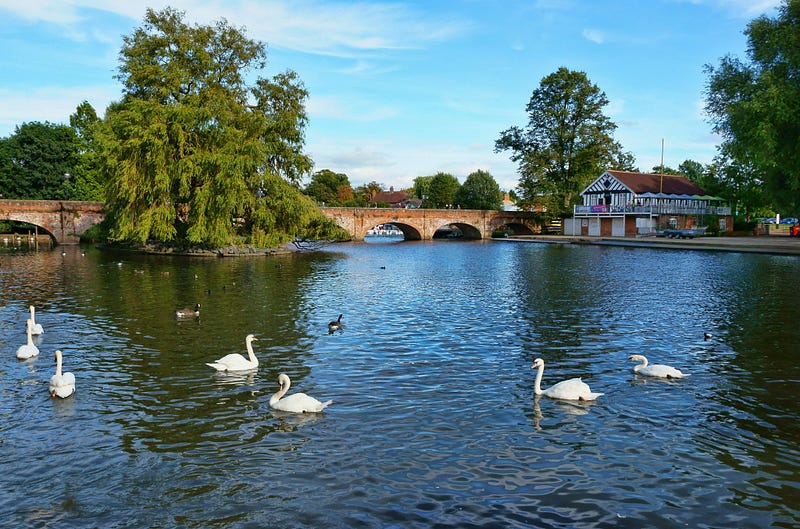
The statue of Falstaff served as a sundial, protecting Sheri O’Malley from the transit of the sun. The monument, one of five at the Gower Memorial in Stratford-upon-Avon, also served as a backrest. Her sun-screened legs warmed on the slabs of York stone at the northeast corner of Bancroft Gardens.
The tour director said the sandstone was quarried only in the Yorkshire Dales. “The expensive stone has been mined since time medieval,” he said.
On the pedestal, Sheri read the inscription: “I AM NOT ONLY WITTY IN/ MYSELF, BUT THE CAUSE/ THAT WIT IS IN OTHER MEN.”
Why was humor missing in my life? It was there, I swear, once, in my soul. What power to infect others with natural humor! For her humor to return, she considered rubbing Falstaff’s bronzed belly. Oh, and what historic facts must be lodged in that belly? I’m sure Geoffrey would know!
After lunch at the Pen and Parchment Pub, Geoffrey Snow, the British host, had assembled the church tour group at Bancroft Gardens. “The townspeople used to graze their animals on this piece of England’s Green,” he said. As the tour crossed Bridge Street, Snow declared, as if he had actually engineered the road, that it started “way back in 1196 as a former Roman road that ran down to cross the Avon. It was kept wide to work as a marketplace with stalls.”
“Now those stalls are Marks and Spencer, Laura Ashley, Boots, and Barclay’s Bank,” he said. “Some things never change here in jolly old England!”
Sheri was so tired. If she walked any more, she would limp, slightly, and then the awkward questions — What happened to you? Are you a sun worshipper? Didn’t you use sunscreen? And a stupid response, like, “Well, God only gives us what we can handle.”
If true, what an awful God!
For all the tour pilgrims from South Jersey, whose accent had been voted in some poll as the unsexiest accent in the United States, Geoffrey’s “received BBC pronunciation” made Sheri embarrassed and self-conscious about her speech. Some of Geoffrey’s words, she actually practiced — even recording herself on her phone, saying, “water versus wooter.”
Geoffrey joked that his accent would sometimes ascend to Northern England, especially after a pint, or four pints of stout. Sheri learned through ‘Crazy’ Jane Reynolds, her tour roommate, that Geoffrey Snow was from Durham.
“From what I’ve heard,” Jane said, “the town is known for four things: its cathedral, castle, university, and Geoffrey Snow. His braggadocio may charm you Yanks,” Jane said, “but he may just be a Tosser Royal.”
What did that word mean? No, no — not tosser, she knew that. Sheri was too embarrassed to ask, but she later found the definition and laughed — an arrogant boaster. It was first coined by Edmund Spenser in The Fairie Queen. At times, feeling uneducated intensified Sheri’s insecurities as fear forced her not to pump her own wells of secret knowledge. Boasting was verboten for Sheri and the O’Malley clan — what remained of the clan.
At the start of the Cultural Capitals of Sophistication tour, Sheri met her sister-in-law, Kaela O’Malley, and her young two nieces, Laura and Sarah, in London. Kaela O’Malley had married Sheri’s older brother, Jonathan, who had died two years ago of lupus, devastating both sister and wife and daughters.
Kaela must have guessed how good the retreat had been for Sheri as Sheri convalesced and merged into the folds of the Scottish Highlands.
The timing was perfect — that’s what Kaela said. Would Sheri be available to share a room with ‘Crazy’ Jane Reynolds at the end of her Scotland trip?
Over an uncharacteristic phone call, Kaela claimed it would give her a chance to bond Laura and Sarah — the nieces. “You may really like Crazy Jane, too. She’s younger, but I know you need a friend. She’s British — half British — and my half-sister — from my father’s second wife. Yes, I know, it’s very, very confusing! And she’s not really ‘crazy,’ but that’s just been her nickname.”
She didn’t know, then, how painful saying “yes” could be, leaving Scotland.
That afternoon in Stratford, Crazy Jane and Sheri had been drinking pints at the Pen and Parchment. Of course, its most famous guest was none other than “William Shakespeare.”
“The wisteria in front of this historic landmark is over 150 years old,” Geoffrey had said, twining his fingers in the gnarled branches. Once inside, he said, “See that wooden pillar over there? Lord Horatio Nelson took that from a ship he plundered! Imagine!”
Geoffrey seemed to know everything, Sheri mentioned. “He just recites lines like an actor,” Crazy Jane said. “It’s all part of the program. So don’t feel intimidated by a wanker who plays a sage on the stage. We’re just his latest portable audience. And he must get a cut for bringing us poor pilgrims for this landmark to fleece.”
To Sheri that seemed cruel. Was that just cold reality? Was she that naive? She chuckled. Yes. I’ll add that to my list.
II.
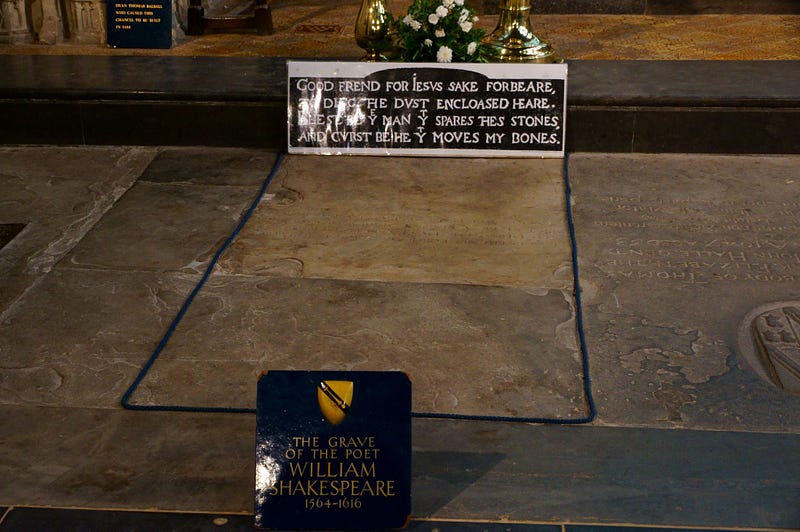
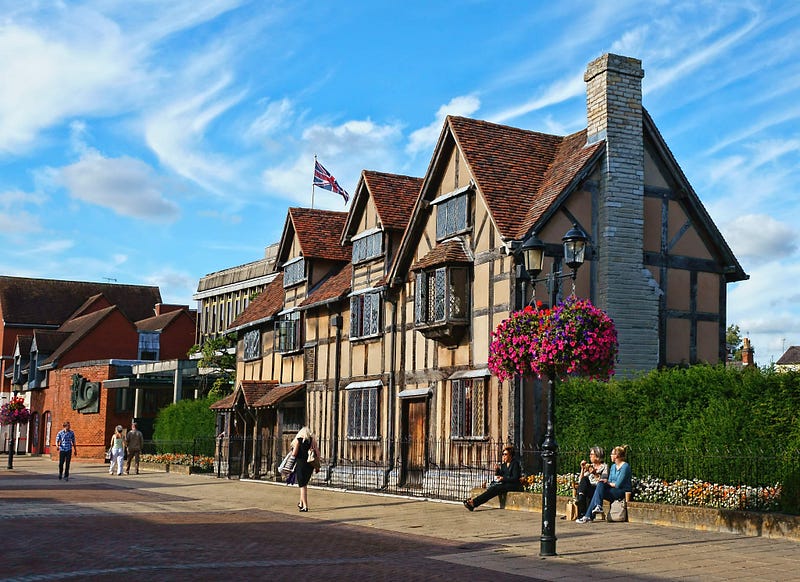
Day three of the tour had been squandered: a speeding checklist from one Shakespeare monument to another — Anne Hathaway’s Home, Shakespeare’s Schoolroom and Guildhall, New Place, The Shakespeare Centre, Tudor World, Hall’s Croft, and, Holy Trinity Church — with, of course, the required photo of the Shakespeare Grave.
Geoffrey had been all aflutter with information, which didn’t seem like an act. “There’s a curse on Shakespeare’s grave that warns:
Good friend for Jesus sake forbeare, To dig the dust enclosed here. Blessed be the man that spares these stones, And cursed be he that moves my bones.”
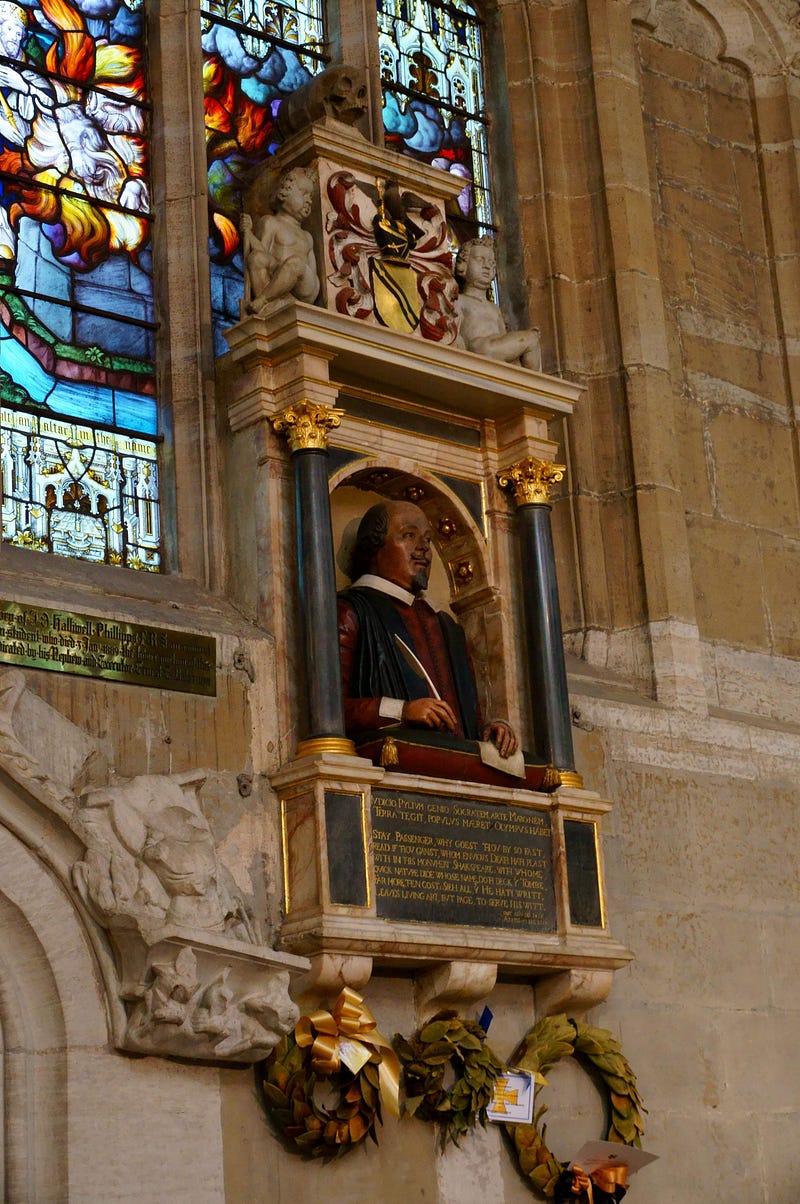
Unusual it was, Geoffrey said, for someone to be buried in the medieval church and that there was a scandal within the family and Sheri heard names like Judith and infidelity of some Thomas husband guy and the founding of the “The Holy Trinity Bust” in 1621 from The Bard’s son-in-law.
“The wife, Anne Hathaway, was still living,” Geoffrey had said, “and it’s said that the bust is a pretty good likeness of England's greatest writer. Nay, may I dare say the world?”
After a barrage of information, a whole two hours was “free” to purge so much intelligence. That’s when Sheri found her favorite location: privacy with Falstaff. Ahhhh. Finally. She turned her face to feel the brunt of the breeze, the air laced with pink double delight roses. Ahhh. Roses English. Isn’t the world filled with such delights unexpected?
What could be more delightful? Well, she knew. That’s what made her smile. What was alive, even short blooms were more precious than musty ancient homes and interactive exhibits and gift shops with the Bard on everything — ties, napkins, baby bonnets, condoms.
Only ghosts and myths and capitalism lived there. And “the second-best bed.”
Catching the wind, the rim of her straw hat inched up her forehead. Like renegade bangs, red ribbons dangled in front of her face. Her fair skin and thick cropped auburn hair, she was told, made her appear an eternal twenty-nine. The white poncho she wore with the black peasant skirt was not only comfortable but protective. She closed her huge, brown oval eyes. Fear, once again, fell like a mourning veil. What happened to that smile? Into the folds of her black skirt, Sheri wiped away tears that sprang from an unknown spring.
She rubbed the scars — feeling the circular indentation — the different texture of the wound — and thought about a tattoo to decorate the wound. Should the wound be a sun? A moon? An eye of God? A bullseye? Or the ripples from a thrown rock into the loch?
Crazy Jane Reynolds told her a story on their first night rooming together in London. She noticed Sheri was guarded about the scars and that circular wound.
“An old Native American story says that an old woman will eat your scars and heal them after you die,” she said, “but if you have no scars, she will eat your eyes, and you will enter heaven blind.”
What did that mean?
I only tell stories, she had said. “I don’t explicate. You do.”
The soreness made escaping incomplete. Only silently did she grumble. The lymph nodes had been taken from her left leg — the melanoma having had metastasized from the original mole. The upper thigh was numb. Was that all? What about the anxiety and the lingering fear of living with the specter of lupus — the disease that snagged her dear brother at such an unfortunate age.
He had such a fortunate life, too! What a musician! A pianist! She still listened to his songs as if the soundtrack to her life. She never had such patience to study and practice.
“I’m gonna create beauty while I can,” Jonathan had once told her.
Such a loss was a shutter — a shutter that an older brother could actually be a best friend, a father, a crutch, a therapist, and a lord high protector — and then, gone. Was he really all that? Was he really gone?
How could such a shutter be recovered? If I made better decisions in love, he would have been the one to walk me down the aisle, she thought, smiling — imagining such a fictional husband.
Sheri considered bringing her cane — but she really desired support that screamed style, not a geriatric prop, either an African walking stick or a Gandalf staff or maybe a decent man, a man with a fiber of steel and spirit. She laughed. Like those Wallaces in Scotland, right? Those warriors who fought against the odds and the British!
After moistening her finger, she rubbed her wound, her saliva like a balm, — and traced her finger along the scar. Such old friends after high school and college were scattered now to the four winds of red states and blue states and altered states and chiseled in stone on grave-like epitaphs: Facebook plights and holiday card charades.
Kaela was only seven years older than Sheri. Both largely on their own, each was unable to find an opening, a crevice, a fissure in the hours to connect with each other. Were such gaps guarded with repressed resentments? What kept the soil from collecting in such commonly controlled nooks and crannies? What kept new growth checked and controlled, and then yanked out by an invisible hand?
Was that angry hand a mere, misplaced sigh, or a cutting word, hastily formed and murmured in the unseen machinery of old wounds? Sheri didn’t know — or wish to acknowledge when truth broke in to say in another language, ‘Hello — you do know.”
After two months alone, however, with no clicks in time, no Wednesday or Friday or Sunday, just the transit of the silent clouds and the sun and the ripples on the loch, she was beginning to acknowledge the jealousy. Was she worthy enough of Jonathan? Why was Kaela married? And she not? Was Kaela an intruder in the O’Malley clan — a sister substitute?
Kaela had the added burdensome joy of raising two daughters. Sheri loved Sarah and Laura. Why am I not more a part of their lives? Do they see their father’s face in mine? Does Kaela? Or has it been me? Have I been that worried about following Jonathan to the grave — why add more suffering?
Yes. Yes, it was.
Since 1888 — the date stuck in her head — Sheri wondered how many had rested here? How many other pilgrims passed through these gardens of York stone? What was the tally? How many clouds had wandered without notice with Sheri resting by Falstaff? The Stratford excursion seemed out of time order — and what a difference between days with and without time schedules!
An hour full of thanks for the sixty moments and the surgeons and the dermatologists, thankful for trusting her gut about the peculiar discoloration. She was thankful, too, especially of that stolen time of heaven in the heather of Northern Scotland with glorious summer weather. She was thankful for the memories. So many. In such a short time —
Stafford Wallace. Ahhhh. Stafford Wallace.
After waking in a warm embrace, her body still tingling in the after-effects of love, she said, “I could be ready to die now — feeling this good, finally. But just one more day of this, please God.”
Stafford Wallace — that’s who she saw against her closed eyes — him moving toward her — like some motion picture projected against her inner eye — Stafford Wallace — Stafford Wallace — Stafford Wallace — This Scotsman. This very smart Scotsman. So taken with me, but why me? Stafford Wallace. A name so Scottish — was he actually real or just a bust?
III.
The Northern latitudes and the softer sun made her feel safer. She was created with Ireland in her DNA, after all, and not Philadelphia.
In Scotland, what a joy to throb in a good way — in a great way — in a divine way, as if God made sex a gift rather than a debt — a delight rather than a duty! That God was not so cruel or unkind after all. Ahhh. God. God. Stop with the personification of the Universe! But she felt the surge — dare she say a ‘big bang’ in an explosive way she never thought could happen! In a way, I would never let that happen! Selfish — that’s what it was — continuing the delusion without confessing the truth!
By the statue of Falstaff, still, Sheri tried to capture a fleeting glimpse of playing blind. She focused on the other senses, replaying the miniseries of those cool days and warm nights in the Highlands. Was that but a ride, a diversion, through heaven among history and the heather and herds of sheep and haggis?
There, she was not alone.
Love enters through the eyes first, she heard, but what if she had to rely on something else — something not as deceivable? Disappointed with her life, her career that turned into a job — her AWOL father, her dead brother, and her mentally checked-out mother, as well as the cherry-on-top cancer bonus.
During her extended medical leave, she flew alone to Glasgow. On a loch in the Highlands, she rented a small cabin. She half thought, like a wild animal who senses illness of death coming, hiding in the underbrush, with dignity and solitude, to decay naturally, away from the judgment of the world, she went there to die.
For a while, it was her retreat. Spiritual, perhaps, but she wanted to write in her journal. She wanted to set down her story for her. Would anyone who claimed to have loved her read it? No, no — especially now that Jonathan was mere scattered atoms across the universe. Would Kaela? Or was there still that edge, that edge of competition, still dangling in front of them?
Was it blame that formed the double-edge blade of that dagger?
That’s what she was writing in her diary, as a confessional letter to her younger self: Sheri at twelve years old. Before the father said that nasty line, maybe, just maybe a lie, that forever echoed in the deepest caverns of her insecurities. Right before the father departed with that one huge brown leather suitcase, slamming the front door with the mother crying, and Jonathan hunched over her, trying his best to console her that he could come back. He never did. “I’ll take care of both of you,” he told them.
In that Scottish solitude, she read over her letter to her stunted self, stunted at such a tender age. Am a damn good writer, she told herself through the tears. It wasn’t therapy. But she was much better with a pen on paper than her words on currents of air, able to change at any time. Deliberative — that’s what she wanted the writing — deliberative. Speaking was trouble —at all the wrong times — a tongue tangled.
Insecurities and worries are protective, like castle moats and keeps in castles, keeping one safe but alone. Insecurities are passive, too, she wrote. Like locking oneself inside a room in order not to be judged or shamed. Working as she did. Was that fine? It was socially fine, right? Part of the American success story. But is that all I have? Work? Here lies Sheri O’Malley: a very hard worker for Rohm and Haus. But that’s a job I do not want to do anymore!
She asked her twelve-year-old self, what shall I do? What advice would I give to me then? Jonathan said “everything would be all right” which was just a comfortable lie. But not malicious. He was just as scared, but the de facto man of the house could not show that. She wrote: parents lie. They need scapegoats. Even readily available children with nowhere to hide. They are burdened with invisible weights of shame and denial. Not even faith could lift such weight from the shoulder. But was such weight a blessing? Blaming and cursing are easier than disowning what was never wanted. Was it a convenient excuse to remain miserable? If Jesus couldn’t help, how could I help?
In her escape to Scotland, her forty days that were just under sixty, she waited for knocks on the door, like spirits arriving to test her. Some nights she thought she heard knocks on the cottage door. Was it Jonathan? Her mother — now dead five years — or her old boyfriend? God? A fairy? Her younger self, asking, “Why?”
Sheri knew she just needed “a while” to re-establish her base, her center of gravity. But that “while” needed even more “while” to vanish from the critical eyes of the world. The reality, at last, knocked on the cabin door at that rental on the loch with the next guests from Australia — two lovely women, newly married, from Perth.
It was all a “hello and a goodbye” and an exchange of keys. Talk of local places to know. Idle type of chatter with strangers that unnerved her. But keep your eyes off that fisherman!
“If he asks for me,” she wanted to say, “say I faded with the Highland mist or vanished in a Fairy Circle.”
But before that goodbye, six weeks earlier, and after two weeks of writing, walking, drinking, and crying, this man appeared, alone, with his fishing gear and his Irish setter. Would he have changed his fishing spot that summer holiday as a college professor of rhetoric at the University of Edinburgh if he knew what was hiding out of that dark Scottish loch?
Sheri would wave from the cottage window. He would wave back — the third time — the third day he finally spotted her.
Then he came back — perhaps more for that wave and that smile than for whatever he didn’t catch in the deep loch. A week later, she brought out a dish of homemade scones and tea. Stafford— Stafford Wallace — Scottish, of course, with long, wavy locks, extending below the neck — reddish in color — gave up his folding seat to allow her to rest.
He said most people ask why his face wasn’t painted blue. But she didn’t. “It’s the last name — Wallace. William Wallace — you know Mel Gibson!”
“Braveheart!” Sheri said. “Any relation?”
“This is Scotland,” he said in an accent that cast a net over her — as if she were some mindless North Sea haddock. “So, of course, I’m related. I can show you pictures of Great Great Great Great Great Great Great Uncle William — the ones appropriate enough to show before the English put a spike through his head!”
Wasn’t he missing a few “greats?” Aye— yes!
Did he have a crest? Aye— a Google image showed one arm in armor with a sword. A motto? Aye— Pro Libertate (For liberty). A tartan? Aye. He pulled down his pants and showed Sheri his tartan briefs: they were vibrant scarlet with black and yellow.
So he was actually serious. She knew none of her Irish history — O’Malley. When he spoke, he was usually playful and funny. Ironic. But he did not waste breaths on meaningless banter. She liked the company that didn’t ask questions or probe her mind or give unsolicited prescriptions for her litany of problems.
Those moments were comfortable without complicating the soft silence with the violence of words.
She was aware he walked with a slight limp. Was he club-footed? Was one leg shorter than the other? Sometimes he would arrive at the loch with his red Irish setter and his gear with a walking stick.
It wasn’t until later she found out the reason for the limp.
Then came that fortunate fury out of nowhere — rolling over the barren mountains and covering the loch in drenching rain and thunder and winds. It was a serious affair. They retreated to her cabin, dried clothes, and sipped hot tea on the floor. He wore blankets. She laughed at the milk in his tea, as well as the sugar. She loved black tea bitter and strong and straight and hot. A leather tongue she claimed to possess and left the teabag in for the duration. The warm tea bag would even be squeezed for that last bitter teaspoon.
By the third cup of tea, the storm now abating, and the Irish setter still asleep, guarding the threshold, she kissed him. Or he kissed her. Did it really matter to hormones mutual aligning like the planets? Underneath the woolen blankets, which didn’t make him itch at all, he claimed, she imagined his body — and watched for any changes underneath those fortunate red plaid woolens.
He was a widower. Forty. And no children. One child died when she was six months old. He was very much in love. The wife was a botanist and a brewer. His eyes moistened as he talked of them —the dead wife and the dead daughter — but he remained calm, having come to his own peace with loss and death.
Was it because of his long lineage? His ties to the land and the culture, a chain of links, but what or where was his link? How could he be happy alone with just his Irish setter? Where was the next Wallace?
The moon appeared as they made love the first time on that wooden floor. No one removed any clothing or woolen blankets. It was all conceived and carried out to mutual satisfaction like teenagers on the sofa, playing at getting to know the game of love.
It was tender and sudden. Sheri felt secure with someone who listened, who cared — or at least seemed to — and who made her laugh. The mornings and the afternoons at the lake made this late afternoon and night and morning — and all the other days and nights possible.
When was the last time that happened? Oh yes — the last minute of Jonathan’s life. The jokester until the end.
At the hospital, Kaela missed those last jokes. She was occupied in the bathroom with her own breakdown. Kaela still beats herself up about that cowardice — that wasn’t really. When does one actually know when the batteries will give out — suddenly — and then a laugh, and then nothing.
“I should have been there, Sheri,” Kaela said in tears.
Sheri confirmed that she was — always — always there.
“But I wasn’t.”
“Yes, but his last words to me were about the girls — you — your marriage. And that funny time when he — ”
“Yes. Yes. Of course. He told you.”
The Enchantment of the Heart is continued — Part II.