
The Abortion Debate | All Arguments and Responses
The Philosophical Debate of Life in the Womb.

- This article will not address medically necessary abortions in which the mother and/or fetus’s life are at imminent risk.
- Rape/Incest/Exigent circumstances will be addressed in their own section but not as a subsection of other distinct arguments.
- Format: Each section will begin with a “pro-life” claim or argument followed by one or more “pro-choice” objections and their respective replies and counters. This is for purposes of chronology and organization. This is meant to be a survey and collection of arguments. These are not my arguments nor am I advocating for either side.
- 1. Claim (Pro-Life)
- 2. Objection (Pro-Choice)
- 3. Response (Pro-Life)
- 4. Counter (Pro-Choice)
Contents
- Is a Fetus Human Life?
- Personhood & Moral Status
- Is Abortion Morally Permissible?
- Legal & Ethical Arguments
- Religious Arguments
- “Twitter” Arguments
Is A Fetus Human Life?
The strict conservative view is that human life starts at conception when the fetus’s unique DNA is created. It would seem there is no clear line where a non-human becomes human, any justification is arbitrary. Thus the only consistent position from within this view is full personhood from conception.
Conversely, the liberal view is that the fetus remains a part of the mother's body, and therefore subject to her body autonomy until birth, at which point it becomes a distinct entity. Pro-choice views of when human life or rights begin can range anywhere from a couple of weeks up until and including nine months.
The contention of this debate begins with the discussion as to whether a fetus in the womb is human life at all. We recognize morally and legally the intrinsic value and equality of all human beings, but does this include fetuses? The debate from this angle is best understood by examing something called the standard argument:
The Standard Argument:
1. The killing of human beings is prohibited.
2. A fetus is a human being.
Therefore, The killing of fetuses is prohibited
In response to critics who say the argument is invalid due to a false equivocation between human beings in premise one and human beings in premise two, the argument has since been modified to replace “human being” with “human life form” This is also used by some in an attempt to acknowledge a philosophical distinction between a stage of life development and personhood.
Updated Standard Argument:
1. The killing of human life forms is prohibited.
2. A fetus is a human life form.
Therefore, The killing of fetuses is prohibited
This argument is a valid logical syllogism, meaning, that if its premises are true then the conclusion must be true. In order to refute this argument, one must show one or both of the premises to be false. The sticking point of most abortion arguments is the second premise: the claim that a fetus is a human life.
Objections to The Standard Argument
Claim: The standard argument demonstrates that abortion should be prohibited.
- Inconsistent View on Death
Objection: Premise 1 is not true. The killing of human beings is sometimes permitted (Self-defense, the death penalty, warfare, etc.)
Response: Our society can clearly distinguish between justified killing and murder. There are cases in which killing is neither illegal nor morally wrong. However, concepts like self-defense, retribution, and warfare cannot be plainly applied to the fetus in the womb.
The argument can be modified thusly:
The killing of innocent human life is prohibited.
A fetus is an innocent human life.
The killing of fetuses is prohibited
Counter: This standard could be said not to account for situations in which it may be ethical to end an innocent life such as euthanasia or assisted suicide.
2. “Potential” Life
This is one of the most popular answers to the pro-life accusation of “child murder.” A fetus is not human life but rather is a lifeless object (see: “bundle of cells”) that is within a process, which if left uninterrupted, will become human life. The fetus does not yet possess any properties that an ordinary person would associate with being human.
Objection: Premise 2 is false. A Fetus is a “potential” or a “possible” human life, not a real and existing human life.
Response 1: The immediate result of fertilization: the fusion of sperm and the oocyte, is a single-cell human zygote with its own unique DNA. This is human life in the beginning stages of development.
Response 2: What is human must be human from the beginning. Something nonhuman does not become human by aging or growing.
Counter 1: A zygote may be a human life form, but is not recognizable as a human being, and should not enjoy the same protections. (See: Personhood).
Counter 2: A fetus may be human but it is not yet living until it is viable. Therefore, abortions before viability do not end a life.
3. The Fetus is a Part of the Mother’s Body
One may genuinely believe that a fetus can be both a human life and subject to the mother’s autonomy. However, this view is virtually nonsensical from within the pro-life framework, which includes intrinsic human value beginning at the moment of conception. Thus the key to arguing bodily autonomy is being able to demonstrate that a fetus is not a human life or else not a “person.”
1. A woman has a moral right to decide what happens to her body
2. A fetus is part of the woman’s body
Therefore a woman has a right to an abortion.
Objection: A fetus is not a human because it is a part of the mother's body. Abortion is no different than having an appendix removed.
Response 1: A body part is defined by the common genetic code it shares with the rest of its body. A fetus possesses its own unique genetic code and its own body parts distinct from its mother. We do not consider pregnant women to have two hearts or to be chromosomal mosaics (having two sets of genomes), or hermaphrodites (male and female tissue) while carrying a male fetus.
Response 2: The child may die while the mother lives, or the mother may die while the child lives. This proves that they are two separate individuals and distinct entities.
Counter 1: Though a fetus may have its own body parts and genome it is still a part of and inside the mother’s body and is, therefore, subject to her autonomy. (See: Personhood).
Counter 2: Other conditions such as parasites would see a distinct life-form ethically removed from a woman’s body. While it consists of human cells a fetus is not yet a person and when it is unwanted abortion is kin to the removal of a parasitic organism. (See: Personhood)
4. “Just a Clump of Cells”
Objection: A fetus is not a baby, it is just a clump of cells undergoing chemical reactions.
Response: Any organism (including you and I) can be described as such — a clump of cells undergoing chemical reactions. Human value is not determined by complexity.
Response 2: Like toddler or adolescent, embryo and fetus simply refer to particular stages of human development. They are not used to refer to non-humans.
Counter: While a fetus may share our genetic makeup, it is distinct from human life because it does not possess the properties we associate with humans such as consciousness, autonomy, and self-interest. (See: Personhood)
Conclusion in Regard to The Standard Argument
As we can see the standard argument in its current form is quite difficult to confront. That is, to demonstrate specifically that a fetus is not a human life form at all. The view seems to contradict medical and biological consensus and is often quickly labeled unscientific. For this reason, the crux of the debate comes not to demonstrate that the standard argument is flawed, but that it is irrelevant. Fetuses may indeed be a type of human life form but they do not enjoy human equality or have grounds for moral status because they are not “persons” and thusly do not share in our intrinsic rights.
Personhood: Does A Fetus Have Moral Status?
Most now accept that a fetus is indeed a human life form but may still assert that it lacks personhood and therefore, even though it is living, does not have grounds for moral value. Thus, abortion is permissible to meet the needs of the mother. As we have seen most human life arguments very quickly become personhood arguments.
Claim: Fetuses have moral status by virtue of being a human life form. They have intrinsic value from the moment of fertilization.
1. The embryo or fetus is a person.
2. Persons have a right to life.
Therefore, the embryo or fetus has a right to life.
Objection: Fetuses are of course human, as in members of the homo sapien species, but they are not “persons.” As such, they are not equal in moral value.
1. Only persons have a right to life.
2. An embryo or fetus is not a person.
Therefore, an embryo or fetus has no right to life.
Objections to Fetal Personhood
1. Viability
Objection: The fetus is not a person until such a time that it is viable (has a reasonable chance of survival) outside of the womb. Fetuses that rely on the mother for survival have not yet achieved personhood.
Response 1: Vague standard — The point of viability can vary drastically and is based on technology. Does a fetus in the US achieve personhood at a faster rate than a fetus elsewhere with less advanced medicine?
Response 2: With advancing medical technology, fetuses may one day be viable at conception. In this case, the standard makes for a compelling argument to abolish abortion.
Counter: Regardless of location or technology a fetus that cannot survive outside of the womb without intensive medical intervention is not viable and is not a person worthy of rights. If it cannot survive without the mother’s body it is subject to her autonomy.
Response: Medical intervention cannot be a standard for personhood or justified killing because it would not apply to born persons who cannot live without medical intervention (ie. life support, dialysis, etc.) A human infant can also not survive without the mother’s body or medical intervention.
*Medically, a fetus is said to be “viable” around 24 weeks.
2. Legal Status
Objection: Legal status and recognition of personhood does not begin until birth (ie. citizenship, taxes, child support). Therefore, we should not consider a fetus a person in other instances.
Response: Citizenship being established at birth does not speak to the value of human life. Legal/governmental recognition is an improper standard for personhood. An illegal immigrant does not have legal recognition (citizenship, taxes, licenses) within a foreign territory, yet we can still recognize that they have value and human rights.
3. Conscious Awareness
Objection: Fetuses, are not persons because they do not have consciousness, self-consciousness, or the ability to reason. Similarly, adults who are severely disabled are not considered full “persons” and are not able to exercise all the rights that others may be able to.
Response 1: Even where some rights are tied to the notion of personhood, it is clearly still prohibited to kill disabled people. All human life is equal in moral value regardless of inferior capacities or legal status. The right to life extends to all humans.
Response 2: Consciousness is an improper standard for personhood. Human infants do not become fully conscious/self-aware until several months after birth. The consciousness standard could allow for infanticide.
4. Ability to Feel Pain
Objection: It is permissible to terminate a pregnancy because a fetus in the womb cannot feel pain.
Response: Inconsistent standard — Pain on its own is not a proper standard for human value as there are already born humans with conditions that prevent them from feeling pain.
Counter: Before the fetus can feel pain it does not have consciousness or any experiences. Ending a pregnancy is inconsequential because it doesn't hurt anyone or destroy human consciousness and experience.
*Pain standard applies to abortions prior to 20 weeks when the fetus develops the nerves necessary for pain transmission.
5. “Brain Birth”
While the heartbeat is the hot talking point of today, others have invoked the Uniform Determination of Death Act (UDDA) and the internationally accepted medical standard of brain death to posit a “brain birth” argument for abortion. Just as the brain-dead person is no longer living the fetus without a developed brain is not yet living.
Objection: A fetus is not a living person because there is no function of the brain or brainstem and thus it is subject to the same ethics as a brain-dead individual (not living).
Response: The standard for brain death requires “irreversible cessation” of all brain functions including the brain stem. The human fetus will have brain stem activity as early as seven weeks. This is not an irreversible condition and does not meet this standard for death.
6. Properties of Personhood
Author Mary Anne Warren provides a cluster of characteristics that pertain to personhood:
- Consciousness
- Reasoning
- Self-motivated activity
- Capacity to communicate
- Self-awareness
Warren reasoned that because a fetus perhaps only meets one of these criteria (consciousness) and that is only after developing necessary pain receptors then a fetus is certainly not a person.
Objection: A Fetus is not a person because it does not possess enough of the essential features of personhood.
Response: This standard would exclude comatose patients and human infants from the right to life as they are not self-conscious, do not communicate, etc.
Counter: The reversibly comatose do satisfy the criteria because they “retain their unconscious mental states.”
- **Warren admits that infants are not persons under her criteria.
Argument From Uncertainty
Some argue that because there is so little consensus and a striking lack of consistent standards surrounding fetal personhood then it would be reckless and dangerous to continue abortion. As we are consciously taking the risk of killing another person.
Claim: If there is uncertainty about when human life begins, the benefit of the doubt should go to preserving human life.
Objection 1: Just because one could be mistaken in agreeing with certain arguments does not mean that we must assume those arguments to be wrong or act contrary to them.
Objection 2: If this argument were true then it would include plants and animals because some are uncertain whether they have a right to life.
Response: The medical and scientific consensus is that life begins at conception. We should not risk human rights violations/murder on such a massive scale based on a subjective and changing standard of personhood.
Contraception and the Begining of Life
Some philosophers have argued that life cannot begin at conception and that the conceptus should not be conflated with the embryo that may develop from it. For two weeks after fertilization, its existence is as undifferentiated cells, any one of which may become an embryo.
These “pre-embryo” cells, none of which are particularly the embryo itself, may still split into triplets or twins or may combine into one fetus. The cells are non-differentiated and no single one is clearly a human person.
However, this period is often complete well before pregnancy is detectable in the vast majority of cases. This line of thinking may provide a sound justification for contraception and things like Plan B or the morning-after pill. However, as it stands, will likely not impact the abortion debate.
Is Abortion Morally Permissible?
These arguments attempt to demonstrate that abortion is permissible even if the fetus is both a human life form and a person.
Mentally or Physically Disabled Fetuses
Objection: it is permissible to abort mentally or physically disabled fetuses or fetuses that will have chronic illnesses because their lives would be short and painful.
Response: If a fetus is a person then disability is not a justification to kill. Just as we don’t euthanize adults with mental or physical incapacities. If a fetus is not a person then its disabilities are irrelevant because it could be aborted either way. (See: Personhood)
Rape, Incest & Exigent Circumstances
Most of the arguments mentioned here can be modified (and often are) with the inclusion of “what about rape?” The most common response from the pro-life view is to point out the exceedingly small number of abortions that are the result of rape or incest. However, these statistics are sometimes thought to be misleading considering that there are hundreds of thousands of abortions per year, that up to 1 in 20 rapes result in pregnancy, and that it is often the case that rape goes unreported. However, regardless of the figures- rape, incest, and other extreme circumstances of pregnancy must be considered and addressed.
Unfortunately, rape and other circumstances are more often used as a red herring amongst other arguments rather than addressed appropriately as a distinct category, the exchange most often occurs thusly:
Pro-Life: I object to abortion because…
Pro-choice: That argument is invalid because it does not account for rape
Pro-life: Are you in favor of restricted abortions outside of rape?
Pro-choice: No, all women should be free to choose.
Pro-life: Then it is not about rape. The majority of abortions still need to be justified.
Most pro-life and pro-choice advocates agree that there are some situations where abortion is appropriate. Many of the pro-life view accept rape and incest as sufficient to make abortion permissible and it seems that most life-leaning states will maintain this exception post-Roe v. Wade. However, there are some less giving views. Even if the pro-choice advocate falls into the “it's not about rape” trap there are still ways in which these circumstances are used to justify the right to choice overall. Though. These claims are often accused of relying on emotional appeal, as they are attempting to apply a small number of sensitive cases to a widespread phenomenon.
Claim: Rape and incest Cannot justify abortion because they account for such a small number of cases.
Objection: Because abortions are always necessary when desired in the case of rape and incest abortions should not be restricted in any case because it will affect these most vulnerable groups and lead to more unwanted children and child pregnancies. Many cases of rape go unreported. By restricting abortion we will unwittingly force victims of rape to carry their pregnancy to term.
Response 1: “Two-wrongs”: Abortion does not remove rape and may even add to the trauma and pain of the victim's experience.
Response 2: There is no other circumstance in which it is acceptable to punish a child for the crimes of their parents.
Conclusion in Regard to Rape
The solution to rape and other exigent circumstance when it comes to justifying abortion takes us back to the argument of personhood and moral value. The dilemma is described concisely by Stanford Students for Life:
“Consider the following scenario. A woman is raped and conceives a child. She either decides to carry the child to term or, for whatever reason, is unable to obtain an abortion. Stuck with the baby, and unable to bear the thought of adoption, she raises him for seven years. Eventually, she decides that he is too painful a reminder of the traumatic experience and suffocates him to death…it is unacceptable to kill him for the crime of his father. If a fetus is just as much a person as a seven-year-old, then the same is true of him. The key question, therefore, is not the circumstances under which the fetus was conceived but whether he ought to be considered a person”
The Violinist Argument

Imagine you wake up one morning in a hospital bed and your kidneys have been connected to a famous unconscious violinist. It turns out the Society of Music Lovers has kidnapped you and has connected you to this violinist in order to filter the rare blood type you both share. They must do this for nine months and only then will the violinist recover and no longer need your assistance. The hospital director apologizes for what the Society of Music Lovers has done to you, but insists that the violinist is a person with a right to life and therefore you cannot unplug yourself from him without killing him and violating his right to life.
Objection: The story of the violinist is analogous to abortion. It demonstrates the importance of bodily autonomy and why abortion remains morally justified in spite of fetal personhood. The violinist does not have the right to use your body to sustain himself, and neither does a fetus.
Response: There are several popular responses to the violinist thought experiment:
- There is a difference between failing to save someone and deliberate killing. The violinist was already dying before you were medically attached to him. Detaching yourself is more similar to refusing to make a life-saving organ donation than an abortion.
- People do not have the same moral obligation to strangers as they do to their children or those in their care. You are not morally or legally obligated to feed a beggar but if you do not feed your child you will be criminally liable.
- The scenario when altered slightly yields different results. What if a stranger or madman has committed the kidnapping? What if detaching would kill you rather than the violinist? Does his autonomy allow him to kill you? If the first person who is detached gets to live but the other dies, does the faster party’s right to life outweigh the others?
- The kidnapping and assault by the violinist's camp were forced whereas accepting the risk of pregnancy is consensual and yields predictable results.
Unequal Rights
The violinist argument has become extremely popular and many variations, as well as presentations of its implications, are used. The basic reasoning for this off-shoot is very similar.
A) a fetus does not have more rights than the mother
B) a fetus does not lose rights when born
C) a fetus has the right to use a mother's body for its own needs
A, B, and C cannot all be true. Therefore, the pro-life view is logically inconsistent
Objection: If everyone including a fetus has equal rights then no one including a fetus has the right to use another person’s body for anything, including survival, without that person's consent.
Response: Consent cannot be rescinded retroactively. The consensual act of becoming pregnant has already occurred. Both the mother and the fetus have an equal right to life, only the circumstances in which that life is sustained change. Further, only in the pro-choice view are there inconsistent rights, insofar that the expecting mother now has the right to end another life.
Objection 2: I can choose to donate my kidney and rescind my consent up until the kidney is removed from my body. This is how pregnancy should be viewed. The fetus does not become a distinct entity until birth, and pre-birth it is fully subject to the mother’s bodily autonomy.
Response 2: Rescinding consent to pregnancy after fertilization is more akin to changing your mind about your kidney donation after it has already been transplanted to the recipient. It violates the body of another unwilling person.
The argument again comes back to personhood.
Legal & Ethical Arguments
These arguments appeal to legal precedent and analogy
Claim: Abortion should be legally prohibited because it is unjustifiable from within America’s legal framework.
Human Rights
Objection: Reproductive freedom is a basic right. Forced pregnancy is a human rights violation.
Response: Women have reproductive rights insofar that they control when they have sex, can choose when to start a family, and can take measures to prevent pregnancy. If the fetus is a human life form then it is not a matter of controlling one’s own body.
Counter: While the fetus may have its own body it is still subject to the mother’s autonomy and right to choose because it is inside and relies on the mother’s body for survival. (See: Violinist)
The Right to Privacy
No State shall make or enforce any law which shall abridge the privileges or immunities of citizens of the United States; nor shall any State deprive any person of life, liberty, or property, without due process of law; nor deny to any person within its jurisdiction the equal protection of the laws. — US Consitution 14th Amendment Section 1
Objection: As first officially recognized in the Roe. v Wade decision, abortion is a protected activity under the constitutional right to privacy and by meeting the standards for the fourteenth amendment's protections of personal liberties.
Response: The right to privacy is not expressed in the constitution. Protections for abortions were not the intention nor are contained in the original meanings of the constitution. The original Roe v Wade decision is erroneous and has since been overturned.
Counter: We cannot remain beholden to a centuries-old document that no longer fits our societal standards. The constitution was created to be interpreted and amended to society’s needs.
Abortion & Slavery
Neither slavery nor involuntary servitude, except as a punishment for crime whereof the party shall have been duly convicted, shall exist within the United States, or any place subject to their jurisdiction. — US Consitituion, 13th Amendment.
Objection: Banning abortion would violate the 13th amendment’s abolition of slavery by forcing women into 18 years of involuntary servitude. -Suggested by Bill Myers
Response 1: Consent cannot be rescinded retroactively. The woman willfully engaged in acts of which pregnancy is a potential outcome. ( see: Rape.)
When you board an airplane you understand that you can experience turbulence or delays. The airline does not become criminally liable if they refuse to turn around for a passenger who has changed their mind. Regret does not turn the remainder of your flight into kidnapping and regret does not turn pregnancy into slavery.
Response 2: Birth is the natural result of becoming pregnant, birth is not forced on a pregnant woman just as adolescence is not forced on the mother if she is prevented from killing her toddler.
Counter: Banning abortion/forced birth is a “badge and incident” of slavery which is also prohibited by the 13th amendment.
Response: Forced pregnancy was a badge and incident of slavery because fetus and children of slaves were treated as items of property. The badges and incidents doctrine is meant to be applied specifically to slaves and their descendants.
“Abortions Will Happen Anyway”
Objection: Restricting abortions will not lessen occurrences of the act but only serve to drive women into the shadows to seek illegal and highly dangerous alternatives.
Response: That something will happen anyway is a poor argument for having no law against it. This standard could not be applied to other crimes (rape, murder, robbery). Further, the law can help educate and guide people against an action.
Counter: Prohibition is not the solution to reducing a behavior. Abortion bans will lead to crime and societal instability much like alcohol prohibition and the war on drugs.
Abortions Prevent Poverty and Suffering
These arguments often appeal to the utilitarian principle: “The greatest good for the greatest number.” Abortion prevents unwanted children, the suffering of ill infants, and the emotional and physical strain on unwilling mothers. Therefore, unrestricted abortion improves the aggregation of positive experiences in the world and is the more ethical course.
Objection: Abortion is permissible because restricting abortion will lead to more children in foster care, living in poverty, and going to prison.
Response: We cannot assess the value of a person by their economic status or family dynamics. This is similar to saying “Orphans and the poor are better off dead.” Further, an American orphan will live in relative wealth and comfort compared to most children throughout world history.
Abortion Prevents Overpopulation
Objection: Abortion helps alleviate the overpopulation problem. Restricting abortions will damage the environment, harm society, and could be detrimental to global health.
Response 1: The world is not overpopulated. The current birthrate in the US is below the replacement level. Further, population control measures have, historically, been racist and imperialist.
Response 2: Human life is the reason for caring for the Earth and future welfare. It would be illogical to harm humans to protect the planet.
Response 3: Given that overpopulation is more important than individual human life: We do not know which unborn children will become scientists or leaders that could help solve overpopulation. Why not kill those who lend to the issue without contributing to the solution like the handicapped or those in extreme poverty rather than promote abortion?
Religious Arguments
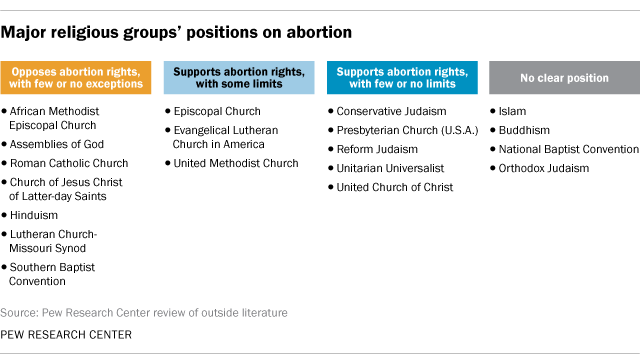
Religious views, and particularly the Judeo-Christian views of abortion have oscillated dramatically throughout history. Aristotle supported certain abortions, the Hippocratic oath prohibited them. Hebrew and Christian texts do not explicitly condemn abortion and the implications of scripture on the matter have been interpreted in many different ways.
Roman Catholics long believed that a fetus was a fully human person at conception, but In 1312, inspired by Aristotle and endorsed by Thomas Aquinas, the official position became that a fetus could not have a soul until several weeks after conception. In the later 19th century the position shifted back again claiming “ensoulment” happens at conception.
Religious arguments are a double-edged sword. If abortion is so abhorrent why isn't it expressly forbidden in the Torah? Why was it not mentioned by Jesus? The 10 commandments say “You shall not murder” and prescribes death as a punishment for said crime. Yet just a few verses later the “causing of a miscarriage” is to be punished only by a fine.
Religion can serve both sides of the debate and the approach will not bear fruit but for the most meticulous of interlocutors. Religious language and discussion should be avoided in political and legal arguments about abortion.
This may lead some to believe we cannot use or discuss values such as “created equal” or “intrinsic rights.” However, these are no longer just the tenets of a certain religion. Many values that were once considered purely religious have become the bedrock of the American legal and political system and have transcended any personal belief or creed. Appeals to religion are unnecessary to the conversation and should not be the sole basis of any justification for a political position.
“Twitter Arguments”
(Misc.)
Twitter arguments are what we will call these common retorts that are less credible and not so philosophically sound. Most you encounter will be based on false dichotomies, emotional appeal, “Whataboutism” and misdirection. Including the world-famous “If you really thought that, then you would think this.”
“Fetuses are Not Insurable” (The HOV argument)
Objection: If a fetus were really a person I would be able to take out an insurance policy or qualify for the carpool lane.
Response: Insurance companies and traffic authorities should not dictate the value of human life.
“No Uterus, No Opinion”
Objection: Those who wish to prohibit abortion are simply incapable of understanding the issue because it is not something they can directly experience. Those who cannot get pregnant should not share opinions on the issue.
Response: Things are illegal/immoral regardless of identity. Gender does not exclude one from grasping morality. This implies that there are humans who inherently have lesser capacities based on their gender/race/ background.
“Masturbation is Genocide”
Objection: If a fetus is a living thing then so is sperm. Masturbation would be prosecuted if the law viewed the sexes equally.
Response: Sperm and eggs are a part of the body, they do not contain their own unique DNA and do not have the potential to grow into a child before fertilization.
“Mandatory Vasectomies for all Men.”
Objection: If all rights were equal, Mandatory reversible vasectomies for all men would be a safer alternative to abortion restrictions. The targeting of women's reproductive rights is based on sexism.
Response: Compelling surgery to prevent natural bodily processes is not the same as intentional killing. Mandating vasectomies invokes eugenics and is clearly not a “pro-choice” argument in support of bodily autonomy.
Acorns vs Oak Trees
Objection: The fetus is not a person just as the acorn is not an oak tree.
Response: A toddler is not an adult but it is still a person. Acorns and oak trees are of the same species. These terms simply refer to different stages of development.
“If You Were Really Pro-life/Pro-Choice…”
Objection: If you really supported life/choice, then you would support (program or policy.)
Response 1: “Pro-life” and “Pro-choice” have become the most culturally relevant terms to describe one's position specifically in regard to abortion. Pro-life persons can support dangerous activity/retribution and a pro-choice person can oppose certain types of choices. The designation used to communicate a group of views or a position does not speak to the value or consistency of that view.
Response 2: Holding a position on one social issue does not demand certain views on others.
Did I miss something? Bias or poor wording? Misrepresented argument? Leave a comment and I will update the story where appropriate!


