
Explaining The Giant Alien Heads of Ancient Egypt
Aliens, Incest, and Bold Art.
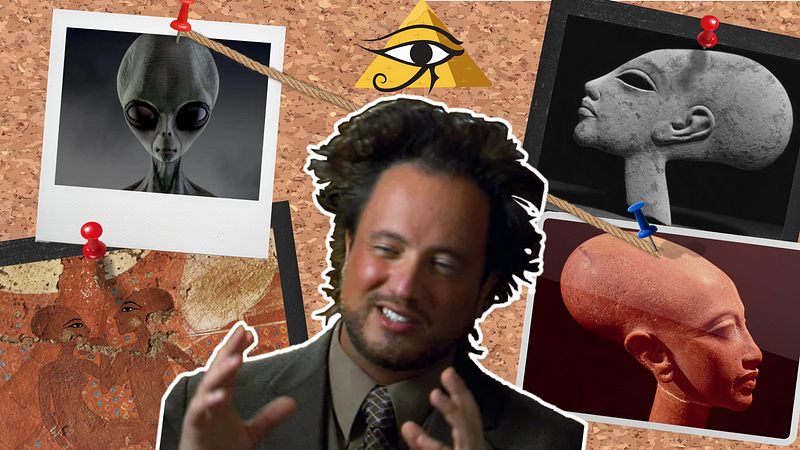
The Amarna period is one of the most exciting and studied times in ancient history. The radical and highly polarizing Pharaoh Akhenaten, during his 17-year reign in 14th century Egypt, instituted a new national religion, a new approach to symbology, and left a massive impact on Egyptian art. Akhenaten himself is most famous for his strange and androgynous depictions in sculpture, including exaggerated facial features and an elongated head. The depictions of Akhenaten’s daughters with his royal wife Nefertiti have been an equal cause for debate. The first three of which, most famously their oldest Meritaten, were depicted in inscriptions and sculptures with massive bulbous skulls. What can archaeological evidence do to explain the cause of the elongated skulls of Akhenaten’s daughters and Amarna art?
Ancient Aliens
The infamous History channel pseudo-science series Ancient Aliens frequently cites elongated skulls as evidence of extra-terrestrial visitors in Ancient Egypt. Not only do they claim Akhenaten himself to be an Alien-hybrid creature, but in a slightly less outrageous line of thinking contend that the elongated skulls of the Ancient world were the result of a purposeful ritual meant to emulate that Alien visitors who assumed the identity of old-world deities. Ancient Aliens actually does contain some accurate information and manages to relay some of it in useful ways despite its central premise. However, outside of the whimsical and far-fetched television series, the school of ancient aliens is an intrinsically problematic (some say racist) approach to history. Putting aside conspiracies and sensationalism, what do scholars actually say caused the otherworldly appearance of the Amarna princesses?
Cranial Deformation
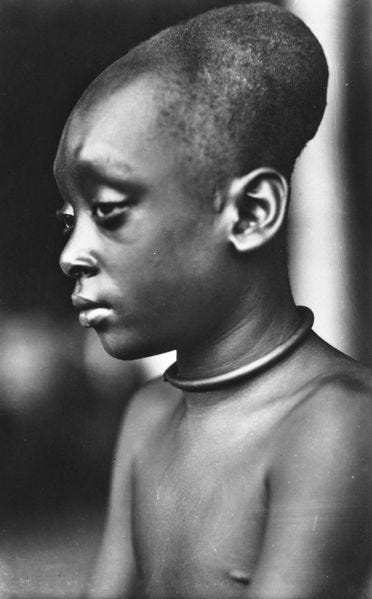
One proposed explanation for the phenomenon is that these artifacts accurately depict the true physical characteristics of the princesses caused by what archaeologists call artificial cranial deformation, the most likely method, in this case, being head binding. While the heads of Nefertiti’s first three daughters bear quite a resemblance to the results of head-binding in other parts of Africa, there does not seem to be much evidence that the practice was prominent in Egypt’s history, and if it did occur evidence suggests it was limited to the Amarna period. It also may seem unlikely that head binding was practiced by the royal elites but only evidenced in these particular members of Akhenaten’s family and not emulated by others. Archaeologists have yet to discover or excavate any artificially deformed skulls from Ancient Egypt.
Genetic Mutations & Inbreeding
A more likely and widely accepted hypothesis is that these works of art are indeed accurate depictions, but of familial characteristics or genetic defects, perhaps due to inbreeding. Incestuous marriages were a common occurrence in Akhenaten’s family. Many scholars accept the cause of hydrocephalus, a condition where fluid builds up in the skull. Akhenaten, Tutankhamun, and many other members of the royal family are known for their unique physical characteristics and medical historians have diagnosed the clan with a bevy of diseases. Akhenaten's mummy revealed that his skull was indeed misshapen and some believed Nefertiti shared this condition. Tutankhamun aka King Tut, Akhenaten's successor and most famous of his children, was discovered to have a club foot and severe overbite among other genetic defects.
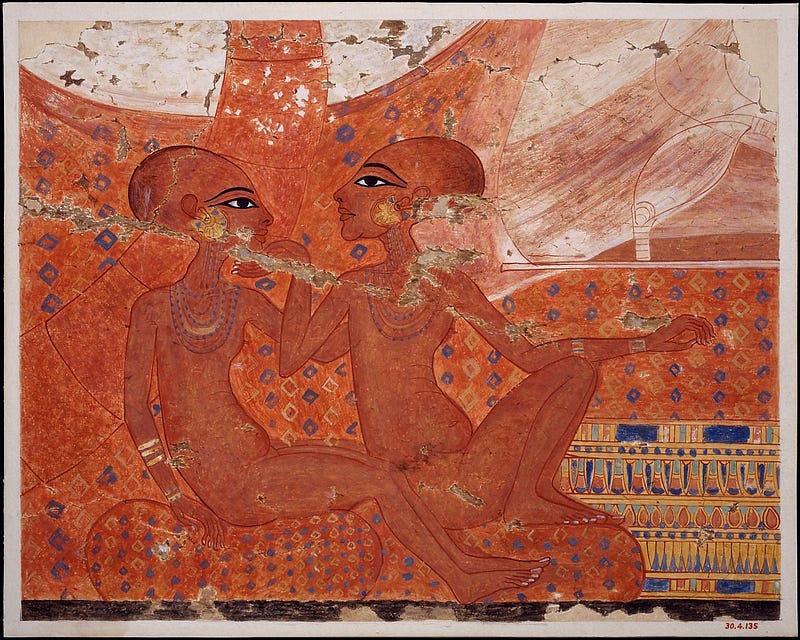
There is archaeological evidence for these genetic phenomena elsewhere in Egypt as well. Rivero and Tschudi in “Peruvian Antiquities” discuss the discovery of an Egyptian mummified fetus with mutations, including an elongated skull not unlike the daughters of Nefertiti. Further supporting the theory that these depictions are accurate is the tendency of Amarna artists to focus on detail and realism, many works show physical traits and environmental details not yet seen in Egyptian art. This may lead one to believe that their heads too were detailed and accurate. However, a genetic disorder cannot entirely explain this distinct and uniform feature occurring amongst the representations of only these three princesses, and why they were not depicted this way later in their lives.
Art of Amarna

Akhenaten was a radical religious zealot who imposed his new monotheistic religion “Atenism” by force and law. As with many things of the ancient world. This inquiry may be answered by religion. Besides his elongated and exaggerated facial features, Akhenaten’s artwork stands out as depicting him with characteristics that were traditionally female: slim shoulders, wide hips, and long legs. He is known for taking liberties with artistic depictions, due to his specific features appearing in various ways, as well as the more toned down and “realistic” depictions of his youth. Akhenaten’s appearance in art is more likely the result of his royal dictation rather than his true-to-life attributes. Archaeologists are not entirely certain of Akhenaten’s motivation in displaying these features in his art, (perhaps something akin to today’s speculation of alien-hybridity was the desired effect) but it shows the eccentric character of his kingship and may lead one to be skeptical of the accuracy of the art he produced, despite the artist’s new attention to realism.
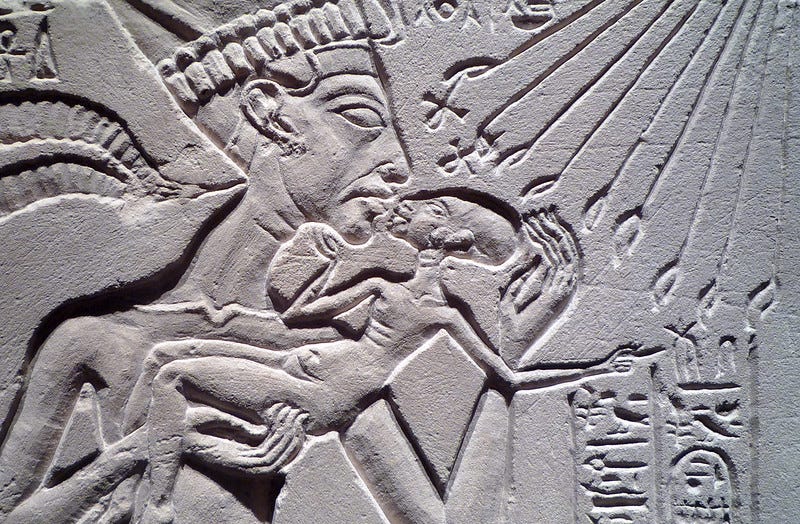
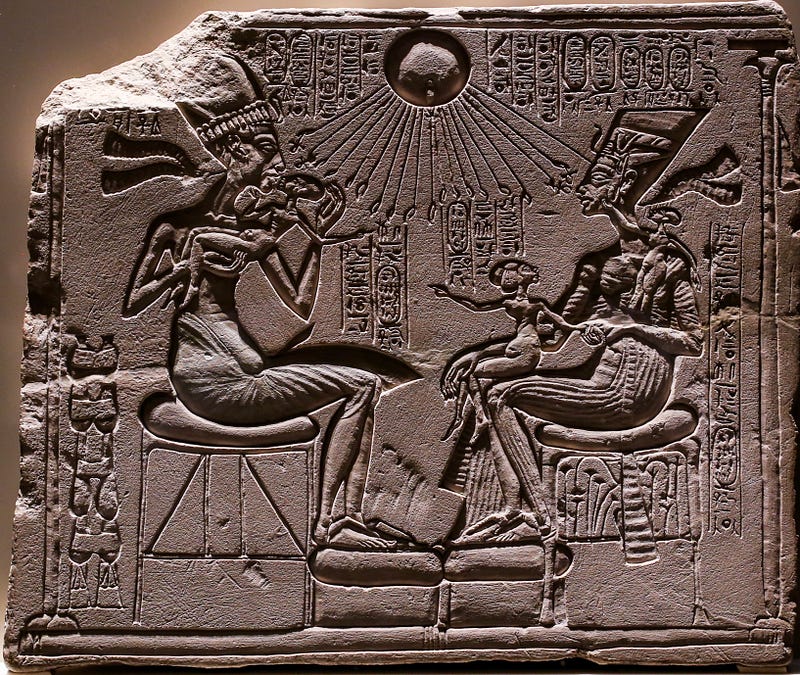
The famous altar inscription “Akhenaten Nefertiti and their three daughters” housed at the Neues Museum in Berlin shows the emergence of not only a new supreme god in Egypt but a new conception of the divine trinity. Akhenaten and Nefertiti’s prominence in Amarna art would eventually lead to them becoming conflated with the gods Shu and Tefnut respectively. Their image was even used in places such as tombs in the area and positions that Shu and Tefnut traditionally would be. This shows that symbology can transcend literal depiction and that Akhenaten had a more loose and abstract approach to art. The divine trinity of Egypt consists of the creator god (now Aten) and his children Shu and Tefnut, who have now become personified by the Pharaoh and his Queen. Effectively, though temporarily, replacing the divine trinity of Egyptian religion in some respect.
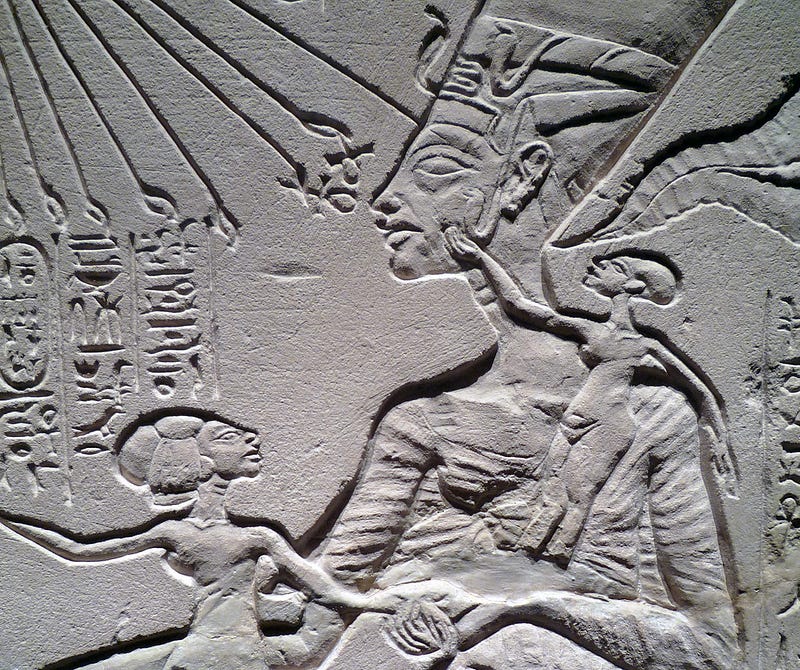
In many early depictions, Akhenaten and Nefertiti were shown to be almost identical, perhaps as a means of emphasizing their trinitarian co-equality with Aten. This equality may show that the prestige of Aten, now the one true god of Egypt, extends to Akhenaten which, in turn, extends to Nefertiti. Leaving no question that the three are co-equal in their divinity. This conception of shared divinity may also explain the androgynous nature of Akhenaten’s appearance, who wanted to show the authority of Nefertiti and the equal power they shared by muting their physical differences.
Symbolism & Prestige
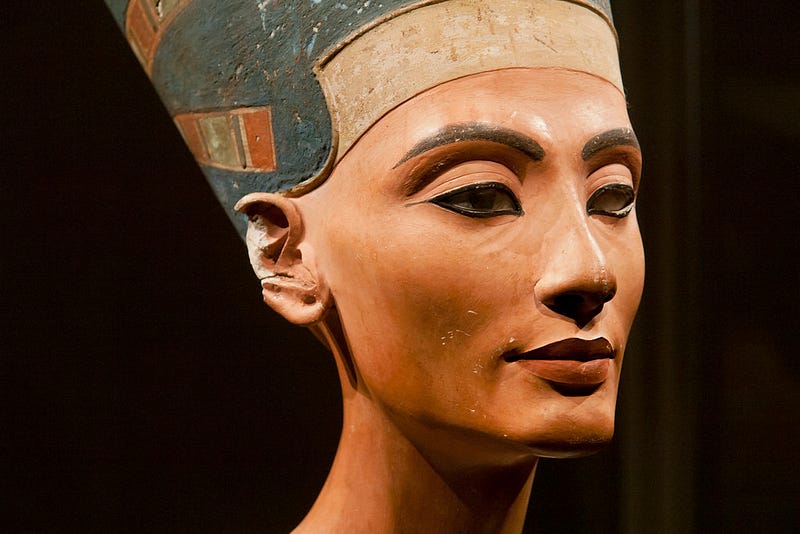
The artistic habits of this era suggest there is a third and even simpler (or supplementary) explanation: religious symbolism. It stands to reason that this philosophy of extending prestige and taking symbolic liberties would extend to the depictions of Akhenaten’s daughters. Akhenaten had ten children in all including six daughters with his royal wife Nefertiti. Yet, the three first-born daughters are known to share this unique head shape. It is possible that the sisters share this distinct feature in three to symbolize them as part of their own divine trinity, much like the one their father and mother had entered into with Aten.
This still leaves the question of why elongated skulls were the trait chosen to distinguish the three Amarna princesses. The shape of the three daughters’ heads may have been an artistic decision made to resemble the cap-crown of Nefertiti and associate the daughters more strongly with their mother. By showing the daughters of Nefertiti as small children bearing this proposed ancestral crown the art depicts their birth rite as royalty. Further, the crown appearance represents the extension of prestige and divinity, as well as through uniformity, a trinitarian co-equality, onto the three daughters.
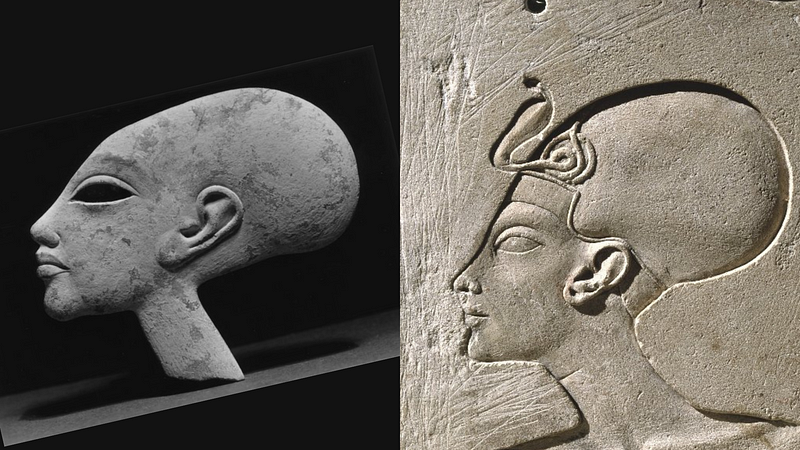
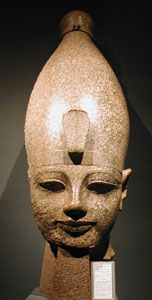
The Wilbour Plaque at the Brooklyn Museum shows Nefertiti’s crown drawn in the exact shape of the heads of the Amarna princesses. Particularly when compared to the stone profile Daughter of Akhenaten housed at the Walters Art Museum. The quartzite bust of Akhenaten’s daughter would seem to perfectly fill the preferred cap-crown of Nefertiti most prominently featured in her infamous bust at The Neues Museum. Further, The head shape of these princesses also bears striking resemblance to the white crown worn by Amenhotep III the father of Akhenaten and grandfather to the 3 princesses. The resemblance is especially recognizable when compared to the red granite head taken from a colossal statue of Amenhotep III, now held at the Luxor Museum in Egypt.
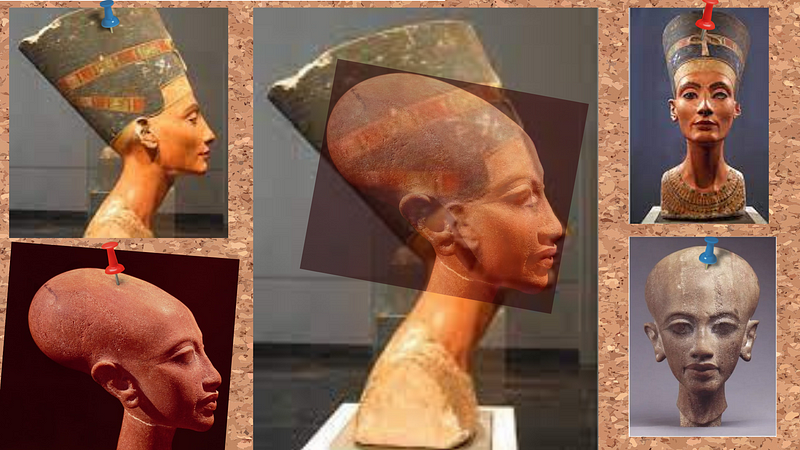
Consider Akhenaten’s tendency to break artistic norms and take radical symbolic liberties. As well as earlier examples of conflating identities, extending prestige, and tendencies towards forming trinities. It is not unreasonable to assume this philosophy continued with the art of Nefertiti’s daughters. It is possible that these radical depictions that have sparked so much controversy over elongated skulls are not part of some grand conspiracy but rather simply an artistic choice explained by Egyptian religious symbolism.
Thanks for Reading!


How The Bible Is Used to Justify Capital Punishment
Does Jesus Support The Death Penalty?
medium.com
References :
Dawson, W. R. (1932). 151 [Review of Artificial Cranial Deformation., by E. J. Dingwall]. Man, 32, 126–127. https://doi.org/10.2307/2790976
Ertman, Earl L. “The Cap-Crown of Nefertiti: Its Function and Probable Origin.” Journal of the American Research Center in Egypt, vol. 13, 1976, pp. 63–67, https://doi.org/10.2307/40001119. Accessed 19 Apr. 2022.
Fazzini, Richard. “ART from the Age of Akhenaten.” Archaeology, vol. 26, no. 4, 1973, pp. 298–302, http://www.jstor.org/stable/41685327. Accessed 19 Apr. 2022.
Gontcharov, Igor. “ Elongated Skulls in Utero: A Farewell to the Artificial Cranial Deformation Paradigm?” Ancient Origins (2015): n. pag. Print.
“Hydrocephalus.” Mayo Clinic, Mayo Foundation for Medical Education and Research, 3 Sept. 2021, https://www.mayoclinic.org/diseases-conditions/hydrocephalus/
Laboury, D. 2011. Amarna Art. In Cooney,K. & Wendrich, W. (eds.), UCLA Department of Egyptology 1:1–20. Published by the University of California. http://www.escholarship.org/uc/item/0n21d4bm (26 August 2013
McLaughlin, Elsie. “The Art of the Amarna Period.” World History Encyclopedia, World History Encyclopedia, 5 Apr. 2022, https://www.worldhistory.org/article/1110/the-art-of-the-amarna-period/.
Snorrason, Egill. “Cranial Deformation in the Reign of Akhenaten.” Bulletin of the History of Medicine, vol. 20, no. 5, 1946, pp. 601–10, http://www.jstor.org/stable/44441101. Accessed 17 Apr. 2022.
Staatliche Museen zu Berlin. “Discovery and Partage.” Staatliche Museen Zu Berlin, https://www.smb.museum/en/museums-institutions/aegyptisches-museum-und-papyrussammlung/collection-research/bust-of-nefertiti/discovery-and-partage/.
Staatliche Museen zu Berlin. “The Queen.” Staatliche Museen Zu Berlin, https://www.smb.museum/en/museums-institutions/aegyptisches-museum-und-papyrussammlung/collection-research/bust-of-nefertiti/the-queen/.
Wenke, Robert and Deb Olszewski, 2007. Patterns in Prehistory: Humankind’s First Three Million Years, (5th Edition), Chapter 9: The Origin of Complex Society in Egypt, pages 368- 404
Zahi Hawass, PhD. “Ancestry and Pathology in King Tutankhamun’s Family.” JAMA, JAMA Network, 17 Feb. 2010, https://jamanetwork.com/journals/jama/fullarticle/185393.
Zhao, Zhenxiao. “The Time Period and Artistic Style of Amarna Art.” American Journal of Art and Design, Science Publishing Group, 29 Dec. 2016, https://sciencepublishinggroup.com/journal/paperinfo?journalid=106&doi=10.11648%2Fj.ajad.20160101.11.