
An Existential Critique of The Heart
The Value of Human Instinct & The Absurdity of Love
“Following your heart is easy. Following your brain is tough. Especially after years of following a much smaller third organ”. — Dr. Gregory House
Setting the Stage
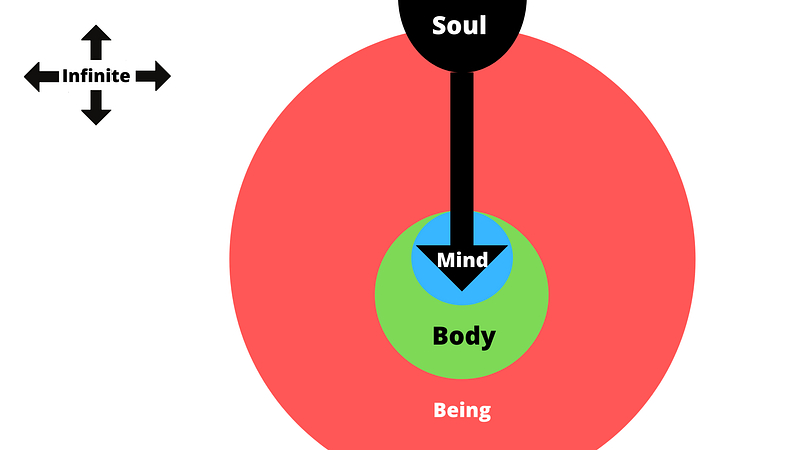
The traditional religious view as well as the widespread underpinning of most art and culture is the mutual understanding that the wet robots which inhabit this planet contain substances in addition to what can be seen and measured empirically, namely: a mind and a soul.
If we exist as the culmination of three substances: mind, body, and, the soul then what of this oft mention “heart”? from whence comes our moral instinct? Is it learned of the body, formed in the mind, or passed down from on high?
Soren Kierkegaard, starting from this religious premise, regarded the self as “the self-interacting with the self” the second self in this interaction is the “infinite self,” higher self, soul, spirit, etc. -the part of us that is of God. We can plainly apply this distinction to our instincts. Humans possess an “infinite” moral instinct ie. sacrifice, truth, justice, and our “finite” or survival instinct, which tells us to avoid danger and protect our genes.
To reconcile our physical selves with these additional components we can conceive of two subcategories, assigning the immaterial mind as arbiter between this infinite and finite interaction. In essence, a two-minded person, whose consciousness is a result of the internal conflict between these minds: the mind of the heart (soul) and the mind of the body (brain). In this interconnected state of being, the question becomes which of these two influences are to be followed and which is to be disregarded when the conflict cannot be intuitively resolved.
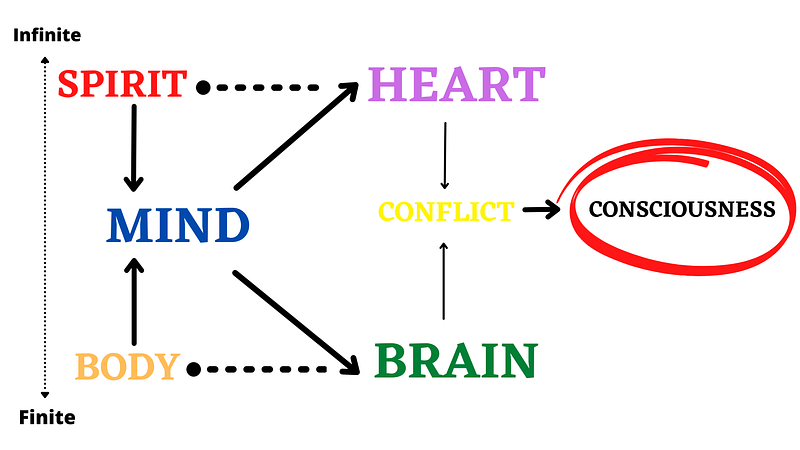
Is the heart a guide to be followed, or an obstacle to be conquered? What are the implications of the material reason engulfing the religious “higher” mind and crushing it under the weight of ever-present empiricism? Truth is revealed through scrutiny, but rather them demonstrating that the human heart is illusory or needlessly complicates material explanations, let us consider a less popular approach: that if indeed we do possess an immaterial heart that it is a detriment to our being rather than a gift.
A Critique of The Heart
Listen to your heart — Celine Dion
Say we are to find that those guiding instincts, the fire in the pit of your stomach, our proclivity towards higher meaning, were not virtues to be satiated, but rather corruptions to be overcome. “Love conquers all” becomes, no longer an uplifting platitude, but a statement of humanity’s attitude of entitlement: The righteous assertion that if you want something bad enough it will happen despite all odds. As if the universe itself must bend to your unfounded and fleeting emotions because there is a divine decree, an objective destiny, a karmic payoff, or cosmic fate that dictates the romantic and the just. “Because I know it in my heart to my true, then it must be true! If it is proven to be untrue, then it is just not yet true!”
To discover and accept the absurdity of this phenomenon does one little good in rising above it. The heart is steadfast in its desire. The amount of rationalization and sheer power of will it would take to truly reciprocate influence on our fragile but overbearing little navigators is all but insurmountable. Thus, those who become aware of this stark duality must still succumb to it. For we cannot rid ourselves of our irrational, and over-romanticized chemical self. even those most elevated in consciousness must simply compartmentalize their objectively calculated and surgical actions and cover them over with the illusion of blessed virtue and achieved purpose. Lest they collapse under the raw existential dread of being thrust alone onto an expansive and meaningless void. A result that many have proposed is the only prize waiting beyond the observer's invented poetic meaning.
In this rationale, the mind of the heart becomes a foregone conclusion. It is the wind resisting your sails. it is the friction slowing progress, it is the “return 3 spaces” card you draw from the chance pile. Therefore, the achievement of romantic or “true” love becomes simply the sheer luck of finding a logical conclusion that is also able to provide illusory satisfaction to our uniquely human need for emotional fulfillment through meaning.
The Authentic Instinct.
Perhaps the heart can lead us astray, but does that mean it is to be disregarded? If following this instinct, even into a travesty, is our authentic state of being, then it is still “good” right? We must then ask ourselves which one of these two influences is truly authentic? Unfortunately, this distinction will also be made through the conflict of body and soul and is, therefore, equally biased.
Although, perhaps it is obvious which of these personalities is more prone to influence and corruption. It is quite common for a song to move one to tears while any force convincing you to change a long-held belief a rare form. It is much easier to accept things that are driven by emotional response than to question your grasp on logic and reason. How many times have you believed something out of hope? reacted out of fear? Justified your actions through love? I believe most of us would concede that moments like these are much more frequent and easily occurring than some outside force undermining your mechanical thought process or causing you to adjust your inner rationale without first appealing to emotion.
If we are products of our environment, blank slates, authentic beings in a constant struggle to avoid the specter of our false selves. Then how are we meant to trust this “instinct”? How are we meant to justify the satisfaction of these inexplicable desires when the mechanism that dictates them can be altered beyond recognition by a single musical note, a forgotten smell, or a small white pill?
Practical Implications
To approach the issue pragmatically, which of the influences presents a better risk/reward ratio if to be followed over the other? If you make the wrong decision you may feel negative emotions. The same is the outcome of the “right” decision if it was difficult to make or wrought tangible consequences. Either way, we remain vulnerable to the chemical assault that we spend most of our lives taking measures to avoid. It is difficult to say that the outcome of negative emotion can present a greater risk than the outcome of manifest changes that can in turn also lead to similarly negative emotion. Decisions and emotions exist in a continuous loop. However, events and existence logically precede emotion (you must first exist to feel). Thus we have a justification upon which to select a victor. A manifested occurrence holds the power to drive the emotions of others and affect change, while our own experiential feelings can only do so when focused outward into such an event. In other words, we are better off making the logical decision that will more likely lead to longer-lasting emotional fulfillment rather than “following our hearts” into impulsive tragedy.
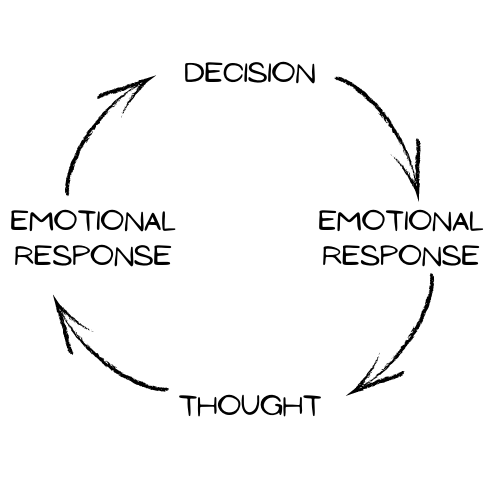
You will notice that logical thought is cocooned by an emotional response. An emotional response leads to introspection or reconciliation which leads to additional emotional responses based on a changed perspective and self- evaluation. The moments in which you may be able to think objectively are fleeting. In this game of whack-a-mole, the inner-self thrusts desperately at reason, even sometimes connecting, but for every rational thought, you have managed to catch you have already, dozens of times, slammed into the rigid unshakable platform of emotion under which they hide. Even if we are to snap to a decision when we feel we are in that brief lucidity free of influence then we are still making that decision from a latent emotion, fear- a fear of our own choices.
The “right” decision is one that you made because you have correctly identified your authentic desires that exist beyond temporary emotions and pursued that path to the best of your knowledge. In other words, measuring by no stick but your own. In making this “right” decision, emotion can only take precedent over reason when reason is already satisfied, therefore any “right” or practical decision that is believed to be made by the guidance of the heart is illusory. So, why is it that this process is so difficult to achieve?
Here is where we begin to reveal the one-sidedness of any potential substance interaction. The process of thought and habit influencing emotion is tedious and time-consuming when compared to the effortless force with which our emotions rag-doll our thoughts and fears within us. If emotion and instinct can exist without rationality and logically precede it, then our cherished reason exists only in spite of our emotions.
On introspection, the heart and the brain do not seem to exist as an inseparable and intelligently designed synthesis of perfected consciousness. Rather, this interaction more resembles two men sprinting away from each other at full speed, not realizing they are tethered together at the hip. neither gaining ground but perhaps haphazardly shifting back and forth, digging their heels into the soil. At times, it may feel that the only hope of progress is to cut the tether or worse to eliminate one of the runners altogether.
CS Lewis once wrote that the only true states of happiness are the moments just before we have what we truly desire. This is because the romantic longings of your “infinite instinct” have yet to be faced with the evidential confirmation of the sheer absurdity of such desires. The logical brain is appeased by the technically unknown and the emotional heart is fueled to continue by the intrigue of possibility. Love, meaning, beauty, and fulfillment all thrive and come to resemble objective existence in these moments of uncertainty and unfounded optimism. The runners are at a stalemate, and their vigorous efforts are mistaken for progress.
Romantic Love & Biological Absurdity
In an evolutionary sense, romance can serve as an unspoken agreement of altruism, providing a vague deterrent against unfaithfulness. Love and romance provide higher background meaning to mating and companionship. Love and romance are what, culturally and beyond religion, leads us to the “moral” conclusion of monogamy. Love in the social lens becomes a mechanism of safe and assured mating, deterring the spread of disease, and securing more time to procreate.
The implication of love and romance is also used in acquiring a mate. The interest of women and mating desirability is a powerful tool in ascending social hierarchy. Perhaps second only to violence and grand displays of competition. Franz Kafka’s The Trial makes no secrets about Josef Ks. views towards women, little more than rungs used for climbing the hierarchical ladder as he conceives it. Certainly no small factor in the justification of his existential arrest.
If emotions exist purely as an evolutionary mechanism to initiate quick and predictable reactions in the wild, then they have no practical bearing on the selection of a mate in modern society. If certain emotions reflect guidance from a higher power or wisdom accessed by an infinite self then how are we to reconcile free will with claims of personal revelations of God’s infallible will?
If consciousness has developed as a mechanism for improved survival then what of romance? Perhaps just as religions have developed their sexual views with the goal of preventing disease and broken homes. romance has evolved along with our consciousness to keep this mutation in check and prevent these now self-aware beings from using their higher reason to abandon their biological imperative to procreate.
Poetic Love
The definition of insanity is repeating actions in anticipation of different results. Yet, the tenant of romantic love is eternal sacrifice. The absurdity of love has been recognized and celebrated since civilizations' origins. All desire, initiative, or action, by man or any other organism, can be filed under the umbrella of procreation. It is even beyond survival, for the reason we have a primal instinct to fight death and prolong our time, the purpose of survival, is to expand our opportunities to spread our genes. Even followers of Abrahamic religions and evolution deniers live under God's divine command to “fill the earth.”
The modern love story finds its origins in tragedy. Romeo, Oedipus, and Creon all face horrible travesties and illogical horrors under the justification of “true love.” The early Western writers and shapers of our modern culture more clearly recognized the absurd tendency for love and submission to emotional imperatives to suspend our very nature in favor of a vague and unverifiable impulsion.
The reason we have an emotional aversion to physical (ie. “real”) pain is that pain is usually caused by forces that bring death: hunger pain, wounds, disease, etc. Perhaps more plausible than a mystical knowledge of the vague is that our primal animal instincts, now paired with an egoistic consciousness, have confused our emotional pain with actual pain. We are hard-wired to attribute meaning to everything, we implicitly label things as imminently right or wrong. The things we cannot quickly identify as one of the two are the very same that fuel our sleepless nights.
The only thing more absurd than spending a life attempting to breathe meaning into a meaningless world is to forfeit that life in the face of perceived ultimate meaning. Yet, this is what the heart asks us to do, to suspend ethics for morality, logic for meaning, and truth for complacency.
The premise that we access some higher consciousness or objective understanding when we “listen to our heart” becomes even more absurd when you consider the wider implications. If my heart is telling me an objective truth then how can it be contradictory? If access to destined truths is within all of us then why can't I follow someone else’s heart? If there is a higher meaning to our romantic desires beyond our personal emotional satisfaction then why could someone else not impose on us our true destiny? Could it not be that they are better at following their heart? That they have a better grasp on the supernatural truth revealed within the human mind? What if two hearts, of equal clarity and sincerity, come to conflicting conclusions?
True love is the exemplary root of absurdity because it gives us the power to feign an objective standard by which to measure our decisions. The brain is satisfied, the heart is quieted, and we revel in the false illusion of a unified self, allowed to fester and spread within a volatile vat of hormonal instinct and vaguely rooted literary sentiment.
The only thing more absurd than the absurd is the absurd existing for the sake of absurdity.


