
The Hidden Meanings in Franz Kafka’s The Trial
Existentialism & The Duality of Self
Summary
“Someone must have slandered Josef K., for one morning, without having done anything truly wrong, he was arrested.”― Franz Kafka, The Trial
Franz Kafka’s The Trial shows the story of Josef K. a seemingly ordinary banker who is abruptly arrested in his home without cause. K. becomes engrossed in the process of the mysterious court and the “Law” it represents. K. (and the reader) descend into a vague and maze-like dreamscape of bureaucracy and non-sequiturs. K. wages psychological warfare with the court, keeping score of in the hierarchy as he perceives it in his mind. A successful and desirable man, Josef K. laughs in the face of his accusers. However, we watch the slow weakening of K.’s control by the court as it eventually overwhelms him, carrying out his death sentence.
An Existential Lens
The Trial is layered with metaphors and meaning. An exploration of consciousness and social hierarchies through the lens of existentialism, and absurdism. The reason for the dream-like atmosphere (or the reason we interpret a dream-like atmosphere) is the most frequently occurring theme of the book: contradiction. What's more, it is a thing of literary beauty that the book itself is a contradiction; An unfinished work of misdirection and contrary information, that yet, demands to be heard clearly.
Many existentialists consider our own consciousness a contradiction, insofar that we are creatures who long only for meaning whilst thrown into a meaningless world. The Trial is a unique experience because just as Josef K. navigates through this illogical landscape the reader is equally in the dark, trying to grasp the rules (or lack thereof) in Kafka’s world. The experience of reading The Trial parodies one’s own conscious experiences as it is described by the existentialists: battling influence and corruption, accepting the absurd, and reveling in contradiction.
Fascism & Freedom
There are two levels upon which to interpret Kafka’s novel, existential consciousness, and through his commentary on society and government. The court most prominently represents authoritarian oppression. However, The pyramid of hierarchy presented in The Trial is turned on its ear, rather than a small pinnacle reigning down power and controlling behavior, it is portrayed as an abstract entity, a bottom-up structure the masses willingly submit themselves to, fueling their own oppression. Perhaps as a means of escaping their own existential choices. An effort to avoid the accountability of conscious freedom, or dispel the dizziness of anxiety.
We should never allow our fears or the expectations of others to set the frontiers of our destiny. — Martin Heidegger
Many stories could be written for The Trial’s commentary on authoritarianism. For this one, I would like to expand this theme of willing submission and try to illustrate what The Trial says about conscious freedom and the novel’s place in existential philosophy.
The Duplicity of Self
“The deepest form of despair is to choose to be another than himself.” — Soren Kierkegaard.
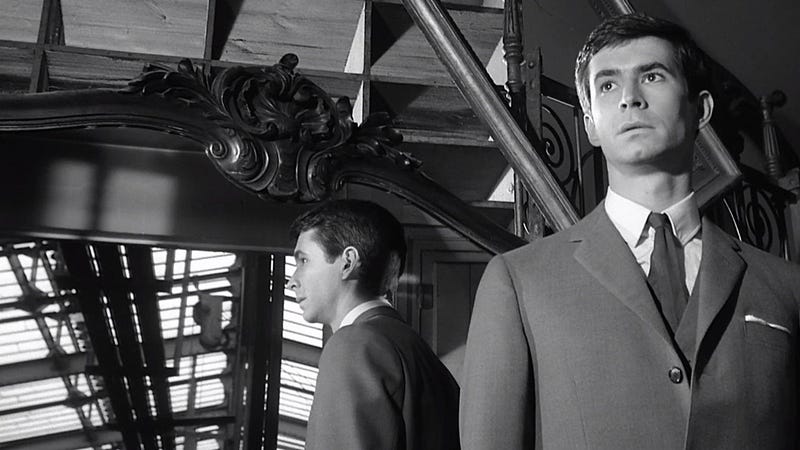
The court in the trial is not only a representation of fascism, seeping into the freedoms we leave unattended or the slow water torture of bureaucracy, eroding individuality. The court is a representation of Joesef K.’s false self. In other words, the court does not exist but by the collective conception of K., as well as the other characters in the novel. K. never takes action that he does not desire. The court does not give him commands rather, they present him with suggestions of choices K. himself would have already made. No tangible consequences are ever presented to K. No action is enforced on his will. K. is in total control of his life and remains so even until his execution. K. represents a conscious despair of the self, what Soren Kierkegaard would call a Despair of Weakness.
K.’s Interaction with the court
The court holds K. accountable for being “late” to his initial hearing, even though the time of his expected arrival is one K. had set in his own mind, and that only he knew. In addition, K. chooses the location of the court. He knocks on many doors in the complex under the false intention that he is searching for a fictious plumber, in an effort to gain unintended information or some slight advantage in his battle with the court. However, it is only when K. was ready to authentically seek the court and proceed to his hearing that the court then existed behind the door he opened. A testament to the deeply-rooted and omnipresent nature of the court and its Law.
Early in the novel, while working, K. finds two men who are to be flogged for comments that he had made about them during his hearing. This twisted and oddly-venued punishment is presented as an unavoidable evil of the court. Yet, K. lists several ways he could help the accused or prevent the lashing and chooses not to. The flogging is because of K’s complaint, it is on his order, and K. allows it to continue. The flogging scene is one of the many examples of a “conflict” that is actually the result of K. and the court’s shared interests.
“The court want’s nothing from you, it receives you when you come, and dismisses you when you go.” — The Trial
K.’s Execution
Even in the final chapter, K. recognizes his own will in the matter, though he chooses to further otherize his authentic ability to act through embracing the metaphor of a stage play: a set of circumstances in which he is helpless to the outcome. K. admits that he is leading the direction of his executioner’s steps. K. even points out his opportunities to escape his situation. I believe the metaphor of the dualistic self has been recognized, particularly in this chapter. In George Orwell’s film adaption of The Trial, he filmed an alternate ending in which K. escapes the two men and takes his own life. Whether the court kills K. or K. kills himself, the act and meaning are the same.
“They’ve sent old supporting actors for me. They want to finish me off cheaply… Which theatre are you playing at?” — Joesf K. to his executioners
Why Was Josef K. Arrested?
“I find it odd, to be forced to forbid you to do something your own conscience should forbid..” — Frauline Burstner, The Trial
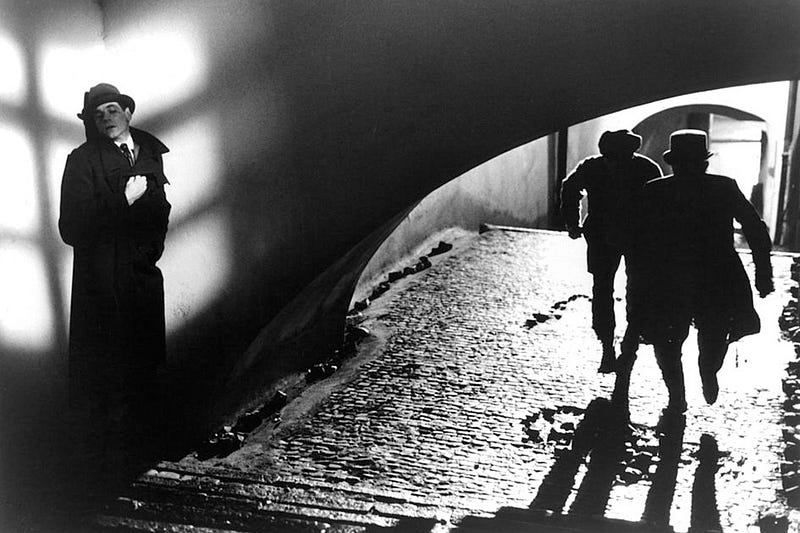
Everyone K. meets after his arrest carries out the bidding of the Law, all in loyalty to some unmet superior or vague shadow of higher order. No true authority is ever presented, if such authority exists. Each person is able to displace their actions and therefore their accountability onto an other. “The Law dictates my behavior, my lawyer advises this action, the court demands my obedience.” Similarly, K. himself lived a life of minimal accountability. He did not own a home, had no family or close friends, was successful at work yet maintains a job of relatively low importance. The most obvious example of K’s aversion to accountability is his views and treatment towards women: Little more than objects of pleasure, tokens of power, and signifiers of his place in the hierarchy as he conceives it.
K’s desire to be controlled and to submit his will (accountability) to the other is spelled out early in the novel when Fraulein Burstner says “I find it odd, to be forced to forbid you to do something your own conscience should forbid..”. K’s arrest was his defeat, his final subject change, the rest of the events were out of his hands. This passage explains K’s arrest. K’s crime was his implicit desire to be controlled, to be unaccountable, an attempt to refuse his existential choice. Josef K. committed the philosophical crime of denying his freedom and ignoring the gift of his life’s control. We do have a pre-determined destiny, but only if we so will it, that is the absurd conclusion of existential individuality Kaffka is teasing.
Dreams & Nightmares
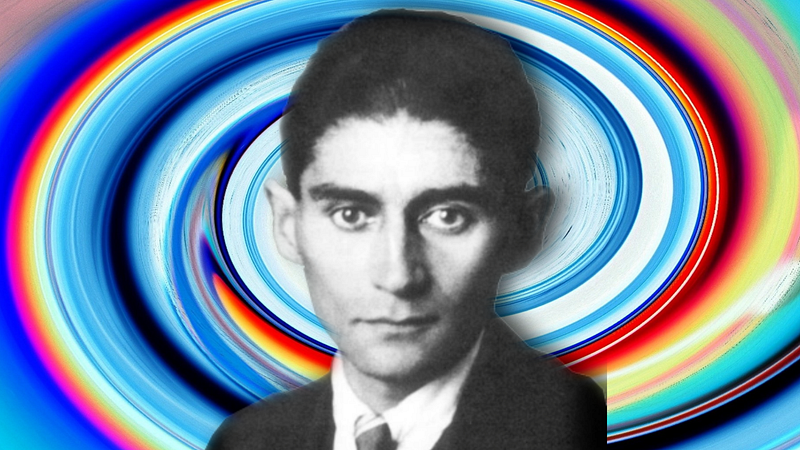
After his arrest or the creation of his false self, K. is forced into a dream-like state. While entangled with the court he is still the one performing his actions, he is the one observing them, yet he no longer feels in control and there is no rationality to the events occurring. Much like in a dream, you experience events as yourself, yet “you” are not there in that moment, you are not conscious and responsible for your actions. When you refuse the existential choice to embrace your life as its whole, along with your actions and their consequences, you may as well be living in a state of unconsciousness, where some undefined other dictates your life. Much like the mysterious higher-ups of the court, the unconsciousness which takes control of your mind is part of you, a part of the they, and yet of no one in particular.
“Logic may indeed be unshakeable, but it cannot withstand a man who is determined to live.”― Franz Kafka, The Trial
The actors within the court system, who are not low-class fodder engulfed in their operation, are akin to lucid dreamers. People pursue a state of awareness while sleeping to take advantage of the absurdity of imagination. They become lucid within their dreams. In my opinion, the excitement and appeal of this practice lie in the promise of acting in a world without consequences. You can do whatever you please in a dream and no one could ever know, and even if they did, how could you be blamed for your thoughts? This is how the actors of the court behave. When the young student grabs the women exclaiming in sexual desire, the untamed and primal behavior of those present at the first hearing. These officials are still little more than cattle to the faceless system of control, yet they have been granted some level of lucidity by whatever perceived power or knowledge the court has granted them. They gain a peak beyond the facade and revel in the absurdity of the reasonless world they create for themselves.
K. was interrupted by a shriek at the other end of the hall…K. Saw only that a man had into a corner by the door and pressed her against himself. But she wasn't shrieking it was the man; he had opened his mouth wide and was staring up toward the ceiling. A small circle had gathered around the two of them.
A Struggle of Unconsciousness?
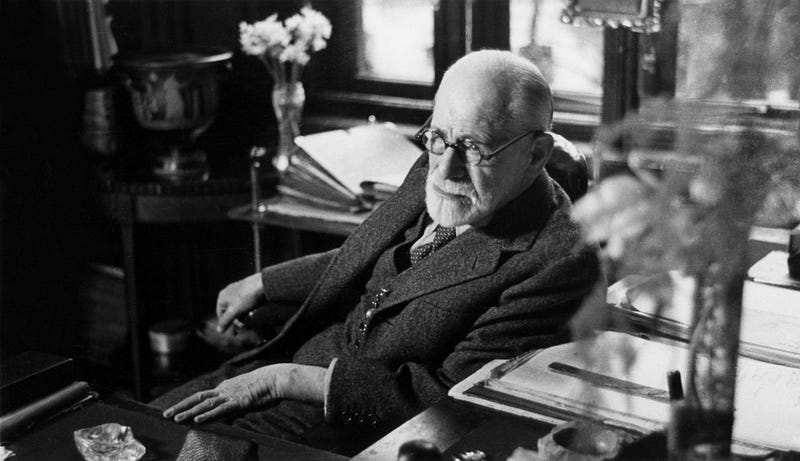
Perhaps the simplest explanation is that K. represents the conscious self and the court represents the unconscious psyche presented in Sigmund Freud’s theories. It would seem that Kafka was indeed familiar with Freud. This would explain the court’s ultimate knowledge of K. while K. is unable to learn even the simplest processes of the system, this would explain K. and the court’s shared interests, the dream-like atmosphere. It shows why the actors in the court act as illogical animals choosing instinct over reason. The total submission of will, the feeling of unguided floating through events or becoming an actor in the play of your life. K.’s arrest and execution could be the story of K. attempting and ultimately failing to conquer this inner psyche and become his authentic self by breaking the shackles of implicit corruption.
Existentialism & Literature
Existentialism is not just concerned with existence, it is concerned with personal experience, with human identity. The sprawling message written behind all these works of existentialism is that no matter how many people we have around us, no matter our social status, no matter how powerful our God, we are, in the end, hopelessly and helplessly alone. It is only when you understand the true solitude of your conscious experience that you can attempt to ward off the corruption of the experienced world. An authentic being lives by no measure but their own, To revel in the absurd, to accept your life as a dim whisper in an infinite void and to realize the total separation of your oneself, your one life, from everything else in existence, might be the only way to head the existentialist’s warning.
Thanks For Reading!


