
WOMEN IN LEADERSHIP
Thank the Women Who Crashed into Politics & Leadership
In honor of Sandra Day O’Connor, Rosalyn Carter, Diane Feinstein and more

Former President Obama’s statement on the passing of retired Supreme Court Justice Sandra Day O’Connor found its way into my ‘Everything Else’ email recently.
I normally don’t like to write about breaking news and views unless I think my perspective can add to the discussion. Things change rapidly, but death has a certain finality. I didn’t finish a piece on California Senator Diane Feinstein's passing on September 29, 2023, though I gave it serious thought. Former First Lady Rosalyn Carter died on November 29, 2023. Tributes to former President Jimmy Carter’s wife impressed me, but I’m not inspired to rehash news reports.
As the trailblazing women’s deaths hit, I felt their loss as though they were the first leg of a 4-person Olympic relay race. It could be I relate to being the second or third sprinter and want those who will carry the baton to an elusive finish line to appreciate the first few laps and the terrain.
Society owes these women a debt of gratitude for their agility and determination, whether we supported their views or not.
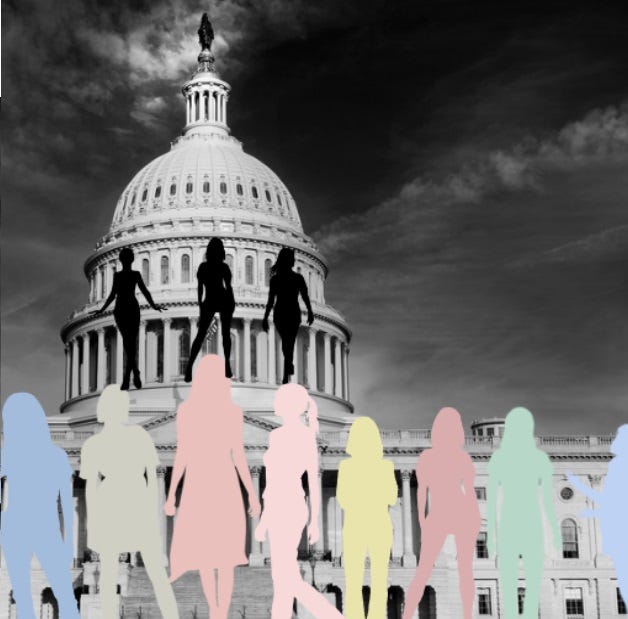
Normalizing previously invisible women in different roles
When women aren’t seen in specific roles, people believe they don’t belong there. This follows our impression that if a thing doesn’t exist, or hasn’t been done before, it’s not feasible.
I certainly felt this in the 1980s, 1990s, and since, as I joined various groups of male-dominated programming and tech management arenas.
I frequently heard, “You don’t look like a computer person.” Breaking from programming into consulting brought stronger suspicion of my abilities. My sports car, cute suits, and slightly edgy hair could have played a part. But the speaker and I both knew it was because I didn’t present as a studious middle-aged man.
I wasn’t the first female studying programming but was outnumbered by about 15 to 1 by mostly white young males who resented the competition. Sadly, evidence of competition between genders is still common.
This mirrored my father’s earlier assertion that his head-of-household male employees be paid more than single women.
Invisible women have at various times been quietly credited with work.
The old adage, “Behind every successful man is a good woman,” was true. It didn’t necessarily mean a subservient housewife efficiently cleared dust bunnies and kept the children quiet to allow their husbands time for important work.
Fortunately, male and female roles evolved to a more equal footing and women began to expect and receive similar levels of career support from their partners. My best advice to those who aren’t getting the notice they deserve is to itemize and respect the value of your contributions. Self-promotion and confidence matter.
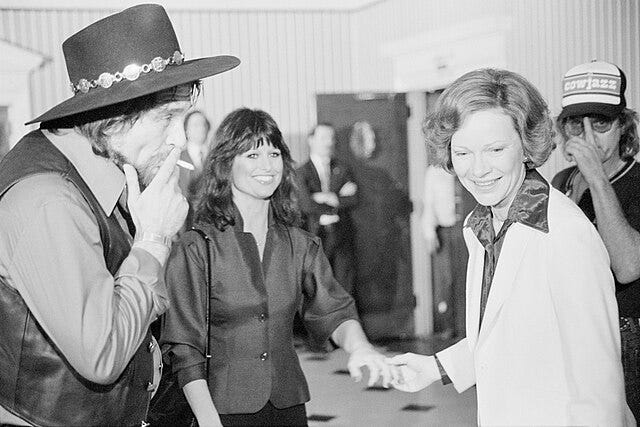
Rosalyn Carter’s impact during President Jimmy Carter’s term
President Jimmy Carter’s wife Rosalyn was her husband’s most valued advisor. She attended cabinet meetings, reviewed policy, and had to assure voters she wasn’t a co-president. I suspect it wasn’t a coincidence her work with mental health, veteran’s affairs, and homelessness was quickly undone by presidential successor Ronald Reagan.
Jimmy and Rosalyn Carter were limited to one term in the White House as political unrest, a coup, and hostage-taking unfolded in Iran. The Iranian Hostage Crisis played for 444 days on the nightly news as anxious Americans hoped for the release of 52 Americans captured in the Tehran American Embassy.
An investigation into Presidential rival Ronald Reagan’s campaign staff’s involvement in thwarting negotiations and delaying the release followed, but confirmation of the cover-up wasn’t fully disclosed until March 2023 when some of those involved in the October Surprise confessed.
In the Smithsonian magazine article “From the Governor's Mansion to the White House and Beyond, Meilan Solly writes about Rosalyn’s time in the White House.
Before Rosalynn could address the social causes close to her heart, she had to learn a lesson the hard way: As first lady, she was now the nation’s hostess, expected to entertain dignitaries and support homegrown designers through her fashion choices. So, when she wore an old dress to the inaugural ball for “sentimental reasons” instead of buying a new gown, public sentiment was not on her side.
Rosalyn Carter soon established her place in serious politics. She reshaped the role, office, and budget for the First Lady and got down to business.
One of Jimmy’s first acts as commander in chief was establishing a President’s Commission on Mental Health at his wife’s behest… The commission’s work culminated in the passage of the Mental Health Systems Act of 1980; Rosalynn testified in front of Congress in support of the bill, becoming the first first lady to do so since Eleanor Roosevelt.
In addition to advocating for the causes she cared about most, Rosalynn served as Jimmy’s representative on the global stage, visiting seven Latin American countries in the spring of 1977 to discuss such weighty issues as nuclear warfare, human rights and drug trafficking.
Without Rosalyn Carter’s unorthodox behavior, many social and political gains may not have been realized as quickly as they were.
The first lady’s level of influence over the president garnered criticism from those who felt that “someone unelected to public office should hold such sway over the leader of the world’s most powerful democracy,” the Observer reported in August 1980… Though she “made scores of phone calls and speeches,” she was unable to secure the passage of the Equal Rights Amendment — “a failure she [called] her ‘greatest disappointment.’”
Rosalyn Carter married Jimmy Carter when he was in the Navy, so was accustomed to running the household during his long deployments. When former President Carter’s father died he left the military and moved his family back to Plains, Georgia where they took over the family peanut farm. Rosalyn was credited with much of the success of their operation.
Women in elected political positions
The analogy of Justice O’Connor, First Lady Rosalyn Carter, and Senator Feinstein as sprinters in the first lap of a relay race excluded all of the women who were forced to be spectators, ran cross-country slowly or were injured and weren’t able to leave a discernible mark on history.
Women weren’t allowed to vote until just over 100 years ago. My grandmother’s mother was deprived of the opportunity to pull a voting lever for a representational government.
Historically, women have been the family nurturers and peace keepers. They were raised to be effective homemakers, teachers, and caregivers.
Women’s roles involved raising unruly children, dealing with financial constraints, juggling schedules, and trying to keep harmony. These skills transferred well in dealing with self-serving politicians and special interests, budgeting, multi-tasking and delegating, and effective diplomacy.
The 118th Congress has 535 voting members with 100 senators and 435 representatives. About a quarter are women and they are predominantly Democrats. There are only 15 female senators.
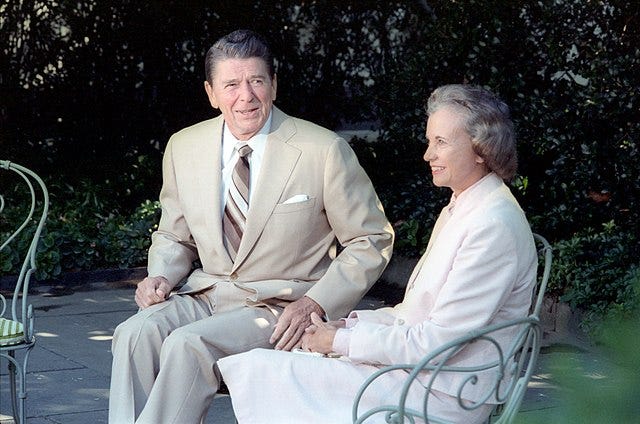
Sandra Day O’Connor
Sandra Day O’Connor was offered a job as a legal secretary upon receiving her law degree.
Then-President Ronald Reagan nominated Sandra Day O’Connor to the Supreme Court in 1981. Though Justice O’Connor was a conservative Republican, she often sided with individual rights while promoting limited government.
Sandra Day O’Connor passed away on December 1, 2023, at the age of 93. The former state senator from Arizona served five years, led the Republican Majority, and remained a politician throughout.
Sandra Day O’Connor, who died on Friday, is forever linked to the word “first” — the first woman to serve on the Supreme Court. But especially when thinking about today’s court, the word that may describe her best is “last” — the last former politician to be a justice.
She discussed her appointment to the Supreme Court in a 2004 interview with 60 minutes, referencing the “incredible ripple effect” for the future of women in politics.
Despite Senator O’Connor’s personal views on abortion, she voted to uphold Roe v. Wade in support of Planned Parenthood.
The New York Times’s subtitle to Sandra Day O’Connor, First Woman on the Supreme Court, is Dead at 93 reads, “During a crucial period in American law — when abortion, affirmative action, sex discrimination and voting rights were on the docket — she was the most powerful woman in the country.”
This lady ran with a particularly heavy baton during a critical time.
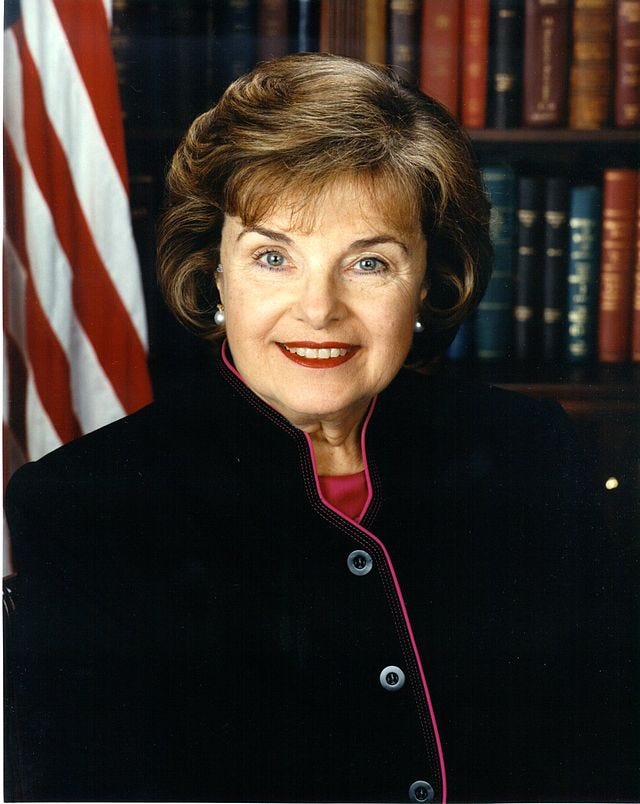
California Senator Dianne Feinstein
The San Francisco Senator led a long and storied life in politics, thrust onto the stage when she announced finding Supervisor Harvey Milk and Mayor George Moscone assassinated on November 28, 1978.
At the time, Feinstein was president of the Board of Supervisors and a confidante of Dan White, the ex-supervisor who quit his seat only to want it back. Moscone had plans to appoint someone else and told Feinstein the morning of the slayings. She tried to track down White to explain the decision. She never got the chance.
Feinstein became the acting mayor, then ran twice and lost before winning and serving two terms.
Dianne Feinstein’s influence in politics was possibly felt most profoundly by the closed doors she opened for women.
Senator Feinstein’s troubles weren’t limited to politics. Death threats and attempted bombings forced her to learn to shoot. A history of personal tragedy and family struggles forged her resolve and tenacity.
Most admirably, Senator Feinstein was dedicated to learning more, uncovering facts surrounding CIA torture during wartime and questionable business dealings in her own state. Unlike many representatives, Feinstein pushed back against the wishes of powerful leaders in her party. She wasn’t afraid to change her public position on different issues.
Some say Feinstein was hard on staff and fellow senators. Research indicates she was efficient and focused — traits that would have been appreciated in her male counterparts.
Bias against women in leadership roles
Geraldine Ferraro. Condoleezza Rice. Hillary Clinton. Kamala Harris.
According to Wikipedia, Geraldine Ferraro was a New York native who worked as a teacher before receiving her law degree. She joined the Queens County District Attorney’s Office in 1974, heading the new Special Victims Bureau that dealt with sex crimes, child abuse, and domestic violence. In 1978 she was elected to the U.S. House of Representatives.
She was around 40 when she became an attorney heading NY’s SVU.
Geraldine Anne Ferraro (August 26, 1935 — March 26, 2011) was an American politician, diplomat, and attorney. She served in the United States House of Representatives from 1979 to 1985, and was the Democratic Party’s vice presidential nominee in the 1984 presidential election, running alongside Walter Mondale; this made her the first female vice-presidential nominee representing a major American political party. She was also a journalist, author, and businesswoman.
I remember the arguments against having Ferraro in such a position of power. “Women are emotional. They can’t help it — their hormones make them unreliable and unpredictable.”
Variations of this assertion have haunted my life.
Walter Mondale’s campaign did not go well and he lost to Reagan. Most believed choosing a woman as his Vice Presidential candidate weakened his chances.
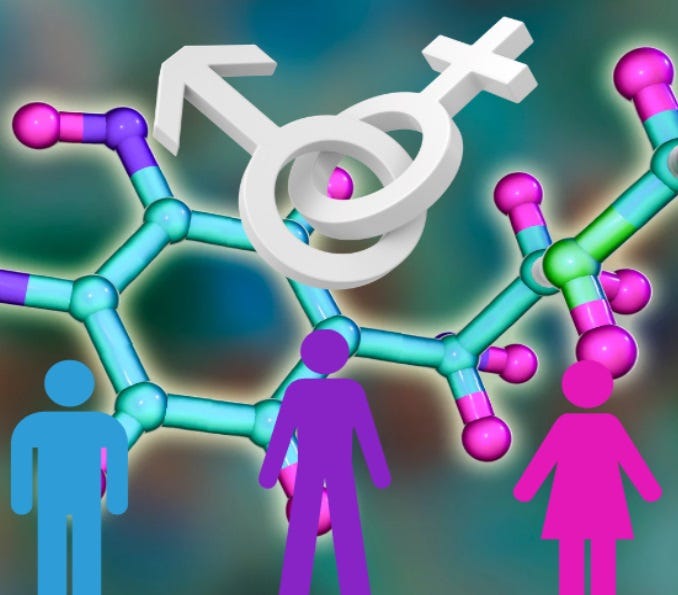
We are all hormonal, or we’d be dead
Men also have mood fluctuations and cannot live without adrenalin, cortisol, or estrogen. Hormones typically labeled male or female exist in us all at varying levels. The balance is unique to each of us.
Hormones are released into the bloodstream and travel to various parts of the body, including the brain, where they can have a variety of effects, including influencing neurotransmitters. Balancing the “male” and “female” hormones is accomplished via inhibiting, exciting, and modulation. This balance mirrors the Yin and Yang ancient Chinese principle represented in much of philosophy and medicine, symbolizing the interconnected and complementary nature of opposing forces.
The absence of female reproductive hormones has significant effects on men’s physical and sexual characteristics, development, and daily function.
If estrogen was removed from men the key changes would include an imbalance affecting bone density, muscle mass, libido, cardiovascular efficiency, mood regulation, cognition, and personality. The same thing would happen if women didn’t possess testosterone.
Men who have severe estrogen reduction may suffer from abnormal levels of growth hormones, hypogonadism, and mood disorders. The imbalance is usually found and corrected as a result of abnormal neural or other hormone-related functions.
Without a balance of hormones commonly known as male or female, neither gender would lead normal lives.
The argument that women are governed by maternal instinct and therefore cannot effectively lead negotiations in times of conflict is as offensive as maintaining men are at their core vicious animals who can’t be trusted to use reason. Both ideas are nonsensical.
Andrew Rodwin has an excellent piece that addresses testosterone in both males and females.
Final Thoughts
We need more women in politics and need men to join us in allowing them to serve. While roles and views of women’s abilities evolve, there is still a great disparity in education and career opportunities for women.
If a woman is denied an abortion and becomes a mother before she finishes college and is established in her career, she will likely not realize her full potential professionally. Women with many children were denied agency outside of the family for much of history.
The limited number of women in high political office has raised the glass ceiling a bit, but it has not been broken.
Queen Elizabeth, Angela Merkel, Indira Gandhi, Golda Meir, and Margaret Thatcher have proven it’s possible. Nancy Pelosi has the distinction of being the first and only female Speaker of the House in America, though several other women in traditionally less progressive countries have held similar titles.
Each of the women I’ve named has at one time or another been referred to disparagingly as “ball breakers.”
I was once complimented by a male VP of Engineering as having “massive balls.” Since it would have been problematic to confront him, I brought him two basketballs the next day as gifts and insisted he keep one in his office to celebrate the completion of a tough project. I added he should “drive the other ball’s reference home,” with a gentle smile.
Sorry, it was 25 years ago.
If women aren’t soft enough they’re threatening — Hillary Clinton. If they’re not assertive enough they’re ineffectual — Kamala Harris.
We need more women in leadership and we need more men and women to support them. In my experience, women often have rigorous, higher standards for others they wish to represent them. Rather than choose based on presentation, we need to look more closely at the results each individual brings to their efforts.
We all need to work together to do the heavy lifting of making our government representative of the people.
Thanks for reading. I welcome your comments.
Copyright © 2023 Patricia Jeanne
Recent works —
and a silly piece