
Shadow of American Inequality: Jordan Peele’s “Us”
Jordan Peele’s Multilayered Portrayal of Race in America, Part 2
Read “Part 1: Get Out” here.
The discourse around race in America is omnipresent in Jordan Peele’s work, whether it be overtly so or more subtly. Indeed, it is often in the more subtle and almost unnoticeable ways that the filmmaker makes his most powerful statements on the subject. Let’s see how Peele accomplishes this in each of his movies:
Warning: Spoilers Ahead!
Part 2: Us
Both Us (2019) and the most recent Nope (2022) take a much more subtle approach to themes of racial discrimination in America as opposed to Peele’s first feature film.
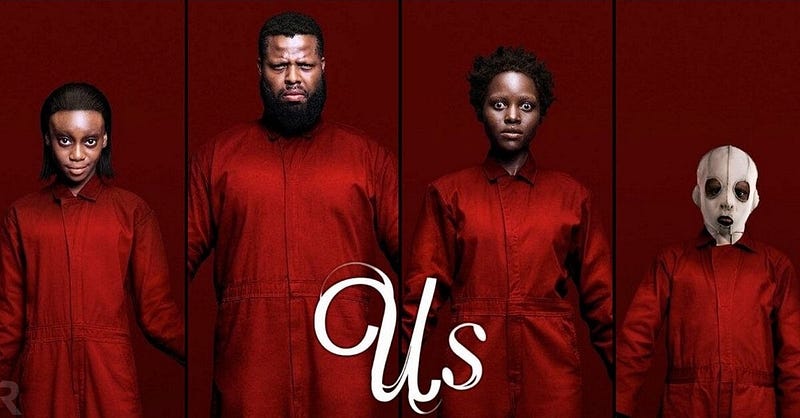
In Us, the Wilsons, a family of four, are terrified by the sudden appearance of their individual “doubles,” creatures referred to as “the Tethered,” which exist as “dopplegängers” confined to an underworld, each one sharing a connection to their “surface counterparts,” which live and rule on the surface while the Tethered populate the Shadow World.
The Wilsons are an upper-middle-class American family comprised of Adelaide, her husband Gabe, and their two children, Zora and Jason. The family seems to enjoy a comfortable lifestyle as a “privileged” American family. Such a “status of privilege” is hinted at multiple times throughout the movie and starkly juxtaposed to the general living conditions of the Tethered; as Adelaide’s dopplegänger explains, the Tethered exist as “shadows” of their human counterparts and are relegated to a much bleaker version of their lives:
When the Girl ate, her food was given to her warm and tasty, but when the Shadow was hungry, she had to eat rabbit, raw and bloody. On Christmas, the Girl received wonderful toys, soft and cushy. But the Shadow’s toys were so sharp and cold, they’d slice through her fingers when she tried to play with them.
Therefore, the comfortable life of the Wilson family is paralleled by a much more sinister, much more painful reflection of itself in the Shadows’ lives.
And when asked, “Who are you people?” by Gabe, the Shadows reply:
We’re Americans.
Us expands the discourse previously initiated by Peele in Get Out beyond race by bringing class and social status into the equation, while at the same time taking a more stylistic and symbolic approach to its social commentary than its much more literal predecessor.
As Adelaide’s Shadow explains, the Tethered are no different than their human counterparts: biologically speaking, they are the same. And, given the same life circumstances, they might even evolve to become just like ordinary humans, a hypothesis which is corroborated by the final revelation that the original Adelaide was “swapped” with her Shadow and that it is her Shadow, by now perfectly blending among other humans, which we have been observing from the very beginning.
Being relegated to the underworld has turned the original Adelaide into a vicious killer that hardly even resembles a human anymore, while Shadow Adelaide’s comfortable life circumstances allowed her to thrive into the role of privileged upper-middle-class American we’ve seen so far.
As argued in The Take’s analysis of the film, the Shadow World is yet another version of the Sunken Place from Get Out: a dark realm of mental and physical enslavement that “the Other” is forced to inhabit while somebody else takes the lead and control in the real world. The balance of power requires that one section of the population — in this case, the Surface People — maintain supremacy over the other — the Tethered.
Interestingly enough, Us is the only one of Peele’s movies to have an ending that is, if not outright “unhappy,” at least extremely morally incongruous: while Adelaide defeats her “Shadow” (as we know by now, it’s actually the other way around), is reunited with Jason, and drives away to, presumably, rejoin her family, the remaining Shadows have de-facto won their War against the “Surface People.” The film ends with a glorious aerial shot of the human chain that the red-clad Shadows have built, indicating that their perseverance and unity have triumphed against their Surface enemies and broken the chains that had been enforced on them.
The ending is intentionally puzzling and even frustrating: on the one side, the Tethered, Adelaide included, seem to have “won,” and yet this isn’t a typical “the bad guys won” horror ending: the mother is reunited with their son, they drive away toward safety, and, instead of the world being destroyed by the Tethered, we get a view of a beautiful sunny landscape with the Tethered united and at peace. And that is without taking into consideration the fact that, as we know by now, Adelaide herself is “the enemy,” the original “evil entity” that robbed the real Adelaide of her childhood and family. As an audience, we are confused as to how we are supposed to morally react to this ending: are we supposed to cheer for the Shadow Adelaide? Are we supposed to cheer for the Tethered as a whole?
Peele deliberately places us in a place of discomfort and moral ambiguity. The filmmaker skillfully leads us astray by initially portraying the Tethered as the “stereotypical bad guys” in a horror movie: half-human creatures who are thirsty for blood, make weird-sounding grunts, smile creepily, and don’t hesitate to gratuitously attack the “heroes” of the movie. It is only then that he forces us to confront the truth about the Tethered and their origins, exposing the injustice they had to endure, and challenging us to take a “moral stance” on the film’s final resolution.
Thus, Peele takes a decidedly more “abstract” and occasionally cryptic approach to his social commentary in Us, while also enlarging the scope of the social discourse to include class division and general inequality.
Follow for Part 3: “Nope.”
Want to keep reading? Check out these similar articles:
Sign up for Medium through the author’s affiliate link and get instant access to unlimited articles, or show the author your support and appreciation by buying her a coffee!