
‘Possum’ and ‘Martyrs’: Cinema Visualizing Trauma
Spoilers Ahead!
Pascal Laugier’s 2008 Martyrs and Matthew Holness’ 2018 Possum are popular titles among the niche community of cinephiles with a penchant for so-called “disturbing movies”. As the name explains, this subgenre focuses on flicks that are known to be particularly disturbing, either for their graphic content or for their more subtle and yet equally disturbing psychological content. A number of such titles are horror movies, but that is not a prerequisite for a title to be dubbed “disturbing” (Todd Solondz’s Happiness being a prime — and infamous — example).
Among the fans of the genre, you can find all sorts of tastes: there are people who simply wallow in the gore and excess they are gratuitously offered, such as die-hard fans of the franchise Human Centipede. There are also the “artsy” ones: true cinephiles who will delight in the heightened drama and vibrant cinematography of The Cook, The Thief, His Wife & Her Lover. Some are in between: lovers of gore who don’t mind more substance in the storyline. Some are simply after new, more original forms of cinematic storytelling. The combinations are almost endless.
Among the many titles that lovers of the “disturbing” will be familiar with, Possum and Martyrs grabbed my attention for specific reasons.
Both can be shocking films at first sight. So much so that it is arguably to the detriment of the films themselves: few people can get over the extreme, unprecedented gore of Martyrs — which has been dubbed by some as the most disturbing movie ever made — or the explicit discussion and portrayal of pederasty in Possum. But if enough attention is devoted to the analysis and deconstruction of both films, rich and meaningful symbolism will emerge and truly enrich one’s understanding and appreciation of both movies.
Both films essentially deal with the idea of trauma, specifically that of history of trauma (past trauma) and of the consequences that those who have endured such experiences have to face.
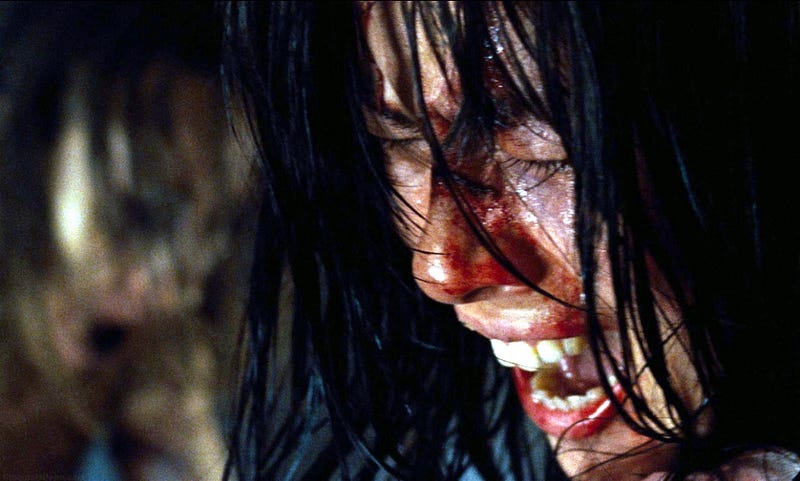
In both films, the trauma faced by the protagonists is both physical and psychological. In the case of Martyrs, the trauma experienced by the protagonist, Lucy, is clearly and viscerally physical, as the graphic nature of the movie makes unequivocally clear. But the psychological trauma that emerges as a consequence of the experience of being tortured as a child has a much more problematic impact on adult Lucy.
Lucy suffers from hallucinations that lead her to self-harm in gruesome ways even a decade after the traumatic experience is over. The intensity of her suffering convinces her that the only way to get rid of her demons is by tracking down the people who did this to her and punishing them.
She succeeds in finding them and punishing them. What she doesn’t succeed in is getting rid of her demons.
Even after she has slaughtered all the culprits and bears their blood on her hands, repeating the phrase “I did it!” over and over, her imaginary demons won’t leave her alone.
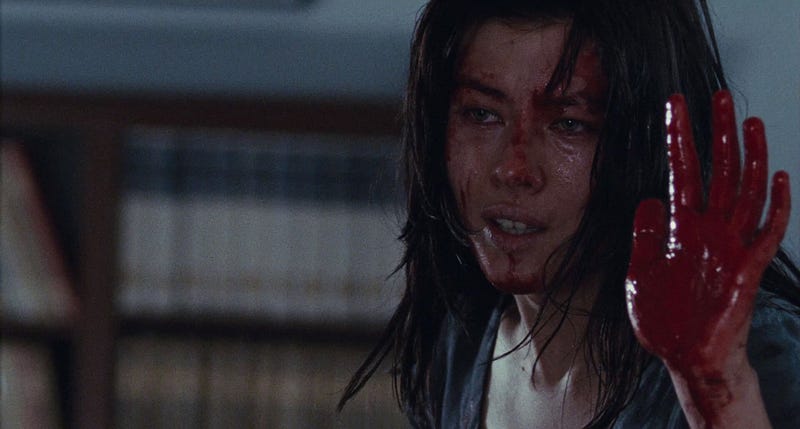
Lucy’s “demons” horribly mutilate her in a way that mimics the endless cycle of physical trauma she’s had to endure. And yet, her greatest pain is not physical, it is mental and emotional. Lucy’s hallucinations take the visual form of a naked woman covered in cuts and scars, a hideously mutilated being that torments and attacks Lucy at any given chance. Not even the blood sacrifice of those responsible for Lucy’s abuse is enough to appease the “demon”, whose ferocity knows no mercy. And the “demon” cannot be defeated because it is in Lucy’s head.
In the end, this proves to be too much for Lucy, and she slits her own throat.
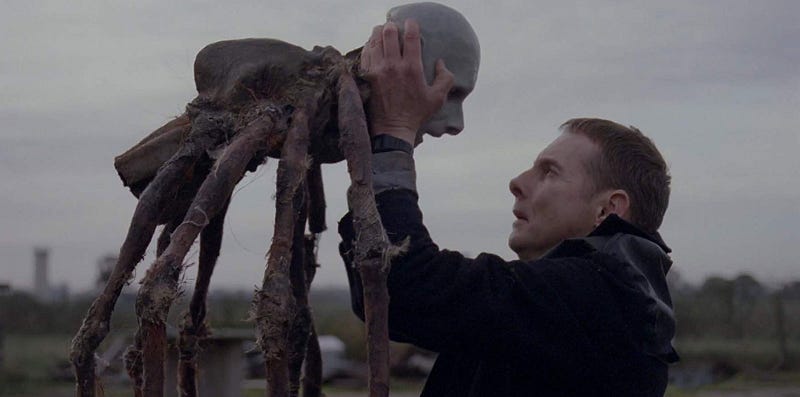
In Possum, the trauma is of a sexual nature. Hints are scattered throughout the film, but the filmmaker chooses to rely on rich symbolism and mood in lieu of traditional exposition. It is only at the very end that the picture becomes clear: Philip was sexually abused by his uncle as a child. Unlike Lucy, however, his memories seem to be deeply repressed and only really resurface through creative expression: Philip is a puppeteer, and his performances revolve around the use of a ghastly puppet named Possum”, who resembles a giant spider with long, hairy legs and a human face. Along with the puppet, there are also verses in the style of nunnery rhymes that Philip uses to tell the story of Possum:
Bag is open, growing wider. What’s inside it, man or spider? Little boy, don’t lose your way. Possum wants to come and play.
Possum, with his black balloons, will eat you up in bed. Happy valley, painted black. All the children in a sack. Wave goodbye to sun and moon. Say hello to black balloon.
Philip has clearly sublimated the trauma he experienced as a child through the use of creativity and synthesized his repressed memory in the figure of the disturbing creature he calls Possum. Additionally, as the puppeteer that he is, he symbolically carries Possum around with him wherever he goes.
As an adult, Philip is a highly introverted person, extremely awkward in his social interactions, timid, and, on top of everything else, he is ostracized by everybody around him in response to what seem to be accusations of sexual misconduct towards younger men — although the details are never made clear.
At the beginning of the film, Philip announces to his uncle, whose memories of abuse he has long suppressed, that he is “going to destroy” the puppet. And, in a rather Shakespearean way, the majority of Possum is dedicated to Philip’s unsuccessful attempts at fulfilling this task.
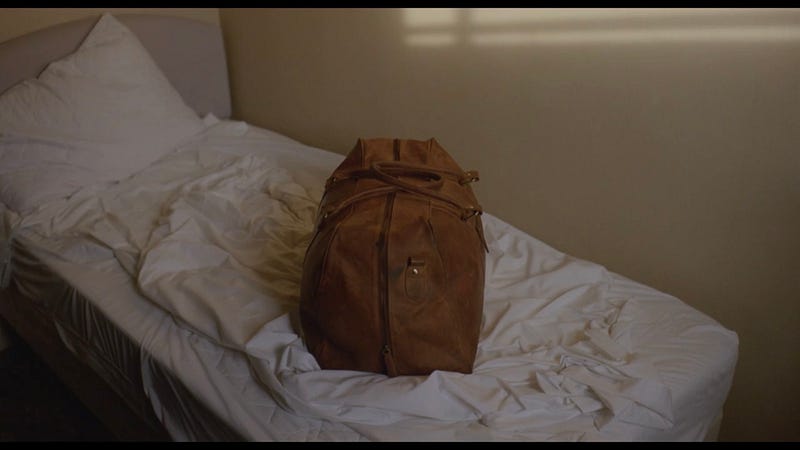
The almost ritualistic way in which every attempt takes place is the following: Philip has Possum stuffed in a brown leather bag, he attempts to get rid of the bag by hiding it in the forest, throwing it in the river, dumping it into the garbage can, and numerous other ways, only to have Possum magically show up again momentarily after. In some cases, Possum also appears, unbagged and yet still partially concealed to the viewer, in random places that Philip frequents. Not to mention the fact that, occasionally, it will literally show up in Philip’s bed.
The symbolism is clear: Philip is attempting to stuff Possum, the symbolic representation of his repressed trauma, inside a bag and to get rid of it.
Throughout the movie, we get very rare looks at Possum itself, and when we do, it’s usually only for a few seconds. The sight of Possum — or direct confrontation with it — is so disturbing to Philip that he won’t even look at the puppet and chooses instead to keep it concealed.
Additionally, a particularly interesting feature of Possum, as Uncle Maurice points out numerous times, is that of its “impressive legs”, which are extremely long, hairy, and seemingly sturdy. The “nasty” legs — as they are referred to in the nursery rhyme — are by far the most noticeable aspect of Possum. This particular stylistic choice wouldn’t make much sense if it wasn’t for one final clue at the end of the movie: as Maurice attempts to sexually assault Philip — as he has done many times in the past — he slowly and dramatically takes off his black leather gloves, revealing his hands to Philip, and taunting him: “Do you like my fingers, boy? Have you missed them?” before forcing Philip to open his mouth wide and sticking his fingers deep inside it, in what is arguably the most disturbing scene of the entire movie. Possum’s long legs are a subconscious simulacrum of Uncle Maurice’s fingers.
It is also worth noticing that this final “reveal” scene occurs in a room of Philip’s decrepit childhood home that Philip has avoided at all costs since his return home. It is only now that he has the courage to confront his fears and enter it. In a traditionally Freudian sense, it would make sense to view this room as Philip’s id, the place where the repressed trauma has been “contained” all these years and where Philip is finally confronting it. It is all the more symbolic that, upon attacking Philip, Maurice traps the man’s head into the very brown leather bag that Philip previously stuffed Possum in, thus making the confrontation all the more unavoidable.
Possum haunts Philip in the same way that Lucy’s imaginary demons haunt her. Both are visible reminders of their past trauma that keep tormenting them throughout their adult lives. Philip’s inability to get rid of Possum reflects Lucy’s inability to get rid of the woman-demon persecuting her. Both are haunted by the shadows of their past trauma and unable to free themselves from them.
Another element that both films share is that of the transmission and durability of trauma. In Martyrs, Lucy dies during Act I, but the story progresses with Anna and her own tale of survival. What was done to Lucy and to so many others before her is done again to Anna and, as we are left to believe, to many other women after her. Lucy’s tale is but a part of the story of trauma that we are told. Her story may be over, but there will be more “martyrs”. Similarly, in Possum, not only does Uncle Maurice continue his streak of abuse by kidnapping another child — and we can be fairly certain that this isn’t the first time he has done so — the experience of sexual trauma is further re-enforced by the fact that, as the film leads us to believe, Philip himself might have been involved in the sexual abuse of minors.
People who have endured trauma, especially at an early age, know all too well that simply because the traumatic experience is over, it doesn’t mean that one is “freed” from it. As a matter of fact, in most cases, the trauma survivor will find themselves being a prisoner and a slave to their trauma. The consequences of trauma on an individual’s psyche can be dire and lead to a number of complications over the years, complications that are both psychopathological and physiological, as countless examples of medical literature prove.*
Martyrs and Possum are possibly the most accurate representations of the nature of trauma that I’ve ever seen on film. Both films are detailed studies of the complexities of dealing with trauma and its psychological consequences. Both succeed in conveying the terrifying nature of past trauma, albeit in very different ways: whereas Martyrs relies on the use of extremely graphic and bloody imagery, Possum chooses to employ what Sigmund Freud would define as “the uncanny” and create a general atmosphere of uneasiness through the use of symbolic imagery and mise-en-scène.
In other words, although the two films may look vastly different at first, they are thematically similar, and, most importantly, they both succeed in portraying trauma in a way that is ruthlessly and viscerally real. The major difference is in the stylistic choices made by the filmmakers: while Laugier opts for the visually extreme, not sparing any spilled blood or torn flesh as he does so, Holness chooses subtlety, mood, and visual symbolism.
Whatever the stylistic choice, both films are haunting experiences because they manage to visually portray the otherwise invisible and unspeakable nature of trauma and do so in a way that is deeply unsettling. They are both exercises in the extent to which cinema can represent the unrepresentable and give tangible form to what is, by definition, intangible.
*In most recent years, The Body Keeps The Score: Brain, Mind, and Body in the Healing of Trauma by author and psychiatrist Bessel van der Kolk has gained great popularity, but it is worth mentioning that similar conclusions had already been made by Swiss psychologist and psychoanalyst Alice Miller about ten years earlier in works such as The Truth Will Set You Free: Overcoming Emotional Blindness and Finding Your True Adult Self and The Body Never Lies: The Lingering Effects of Hurtful Parenting.
Want to keep reading? Check out these similar stories:
Sign up for Medium through the author’s affiliate link and get instant access to unlimited articles, or show the author your support and appreciation by buying her a coffee!


