
Breaking Down Japan’s Most Dreaded Horror Film
Sion Sono’s “Suicide Club” just won’t stop shocking, horrifying, and stirring controversy
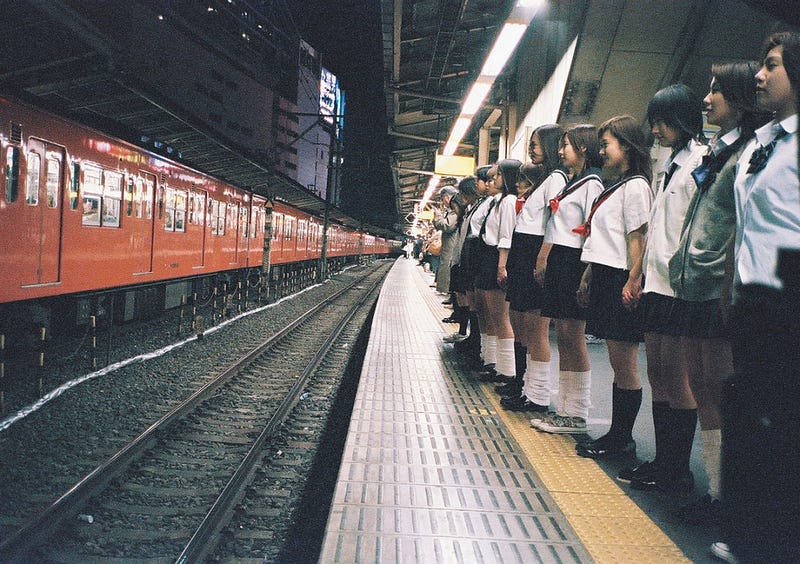
Sion Sono’s 2001 Japanese horror film Suicide Club will probably be unknown to most of you. It was only years after its controversial release that the film gained a cult following, and yet, most horror aficionados will probably only know the title from it being featured in the infamous “Iceberg of Most Disturbing Movies”, which ranks it at Tier III, right next to Martyrs, Cannibal Holocaust, and The House That Jack Built.
The film follows a group of detectives from the Tokyo Police Department who investigate a series of mass suicides involving young teenagers, mostly females. And although many twists and turns happen throughout the movie, the search for the root cause of the suicides and the mystery of it all remain the major focus of the story.
The film's controversial nature can be traced back to three separate elements: the first is a thematic one, and it needs no further explanation. The second one is, as is the case for most modern horrors, its extremely graphic nature. And the third and final element is that of the dense ambiguity of the film itself, which makes the movie something of a jigsaw puzzle (more on that later) that neither critics nor audiences have been able to solve. This last element isn’t too controversial in itself: cryptic and ambiguous films have been around since practically the birth of cinema itself, and yet Suicide Club’s intentional ambiguity leaves the viewer feeling particularly disturbed, because the moral and thematic implications of the film (violence, death, and suicide) are simply too taboo for the audience to be left without a definitive answer as to the film’s ultimate message.
The film’s controversial nature can be traced back to three separate elements: a thematic one, a graphic one, and that of the dense ambiguity of the film itself. […] The moral and thematic implications of the film (violence, death, and suicide) are simply too taboo for the audience to be left without a definitive answer as to the film’s ultimate message.
Let’s break down each and every one of these elements:
The S Word:
It is quite interesting to see how different cultures perceive the idea of suicide: in most Western societies, the notion of suicide is shrouded in centuries of deeply secular Christian tradition. Christianity essentially views suicide as a sin, not because it is explicitly framed as such in the Bible, but because of Saint Augustine’s quite far-fetched argument against it and subsequent condemnation of it in his De Civitate Dei.
Augustine’s arbitrary condemnation of suicide led to suicide being criminalized and perceived as an abominable sin against God himself. Thus, in most Western societies, the taboo surrounding the idea of suicide and of its inherent “moral wrongness” persists to this day. Even those of us who are not religious can’t help but feel that the notion of self-inflicted death is simply wrong and somehow morally abhorrent.
Japanese culture, however, has historically viewed suicide through quite a different lens. Traditional and ritualistic suicides such as seppuku have been historically perceived as examples of “honorable suicide”, which may have contributed to a more “tolerant” and less morally outraged view of suicide in Japanese society.
In what may or may not be a direct correlation, Japan has also historically experienced a high rate of suicides, particularly from the 1990s onward. From 1997 to 2003, Japan experienced a spike in suicide rates, with the annual number of suicides increasing by 34.7% from 1997 to 1998. The economic recession of 1997 is often cited as a catalyst for the social phenomenon. Victims range in gender and age, but an increase in young people (age 20 or younger) has been observed since the year 1998. It was in 2001 that Sono wrote and directed Suicide Club.
From 1997 to 2003, Japan experienced a spike in suicide rates. It was in 2001 that Sono wrote and directed Suicide Club.
Spoilers Ahead!
The Gore:
When talking about the graphic nature of Suicide Club, one ought not to make the mistake of comparing the goriness of the film to modern horror blockbusters such as Saw or Hostel. Suicide Club is not too far from Pascal Laugier’s Martyrs in terms of its brutal and relentless portrayal of physical brutality: it is a movie that was meant to be a deeply uncomfortable, physically revolting experience.*
The way that the movie portrays goriness is, in itself, quite ambivalent: occasionally, the violence portrayed on screen has a Tarantino-reminiscent quality of extremely cartoonish, highly stylized, intentionally poorly crafted goriness.
In other instances, however, the graphic content of the movie appears rather realistic and, therefore, much more disturbing. While witnessing the police detectives inspecting the content of the sports bag found at the train station, some of us can’t help but think of real-life criminals such as Ed Gein, whose “endeavors” bear a disturbingly similar resemblance to the gore staged in the film.
The film alternates between two radically different ways of portraying gore: one that doesn’t take itself too seriously and almost satirizes the horror genre itself and one that appears so horrendously realistic that one can hardly bear to keep watching. It is almost as if the filmmaker wanted to lull the viewer in by reassuring them that what they’re seeing is simply stagecraft before betraying their trust by showering them with a brutality that reminds us that the world we live in is, indeed, that brutal and savage.
The film alternates between two radically different ways of portraying gore: one that doesn’t take itself too seriously and almost satirizes the horror genre itself, and one that appears so horrendously realistic that one can hardly bear to keep watching.
Making Sense of “Suicide Club”:
Many are the interpretations that critics and audiences have proposed throughout the years. Some have interpreted the film through a traditionally socio-political lens that focuses on Japan’s suicide rates. Others have drawn attention to the way that Japanese youth seems to be easily influenced by media and the ever-increasing power of the Internet (may I remind you that this film was released in the early 2000s). Thus, the power of conformity and the need to belong would appear to be the primary social force behind the string of suicides.
Although the film explicitly acknowledges the role of a “cult” in the series of mass suicides, it fails to identify the nature and specific intention of such a cult — assuming that there was, in fact, one. At the beginning of Act III, we are led to believe that the truth has finally been uncovered: that it was “Genesis” and his followers who were behind the ordeal. But the viewer almost instinctively feels that this “explanation” is too plain and simple to be the truth. And in fact, after Genesis and his followers are arrested, more suicides occur.
At the same time, a private informant tells the police that there isn’t any Suicide Club. And to further complicate things, Mitsuko, a high school girl whose boyfriend was one of the suicide victims, begins to notice eerie messages in the posters and music of the J-Pop ensemble “Dessert”. It is with the bubbly, carefree music of the female ensemble that the movie begins and ends, and their music — specifically the song Mail Me — is a leitmotif throughout the entire movie.
Thus, the film offers us multiple “explanations” and no explanations at once. It’s just like yet another song by the group Dessert, which is aptly called Jigsaw Puzzle:
“The world is like a jigsaw puzzle. Somewhere there’s a fit for you, a place where your puzzle piece belongs”.
“Reality is invisible to the naked eye,” says Genesis upon being captured by the authorities, “It’s like that Dessert song, Jigsaw Puzzle”.
The film offers us multiple “explanations” and no explanations at once.
The lyrics “Somewhere there’s a fit for you, a place where your puzzle piece belongs” also seem to disturbingly allude to the “composition of skin grafts” belonging to the victims that the police keep finding on the crime scenes, with each “piece” belonging to a different victim, all stitched together to create a “symbolical unity”. The film's original title is, after all, Suicide Circle — a reference to the “circle” or “roll” of skin grafts — and not Suicide Club.
Another possible explanation arises when we take into account the prevalent gender among the suicide victims: roughly speaking, about 80–90% of the suicide victims in the film are female. At the same time, when Genesis and his followers come into the picture, we explicitly see them only targeting young females. It is during this scene that we witness the only explicit instance of sexual assault in the movie when one of Genesis’ victims is raped before being stabbed to death.
This is a scene that stands out among other visualizations of rape in media because, somehow, it almost draws little to no attention to itself: while the girl is being raped, Genesis is singing a song with cryptic lyrics about “the dead shining all night long”, and the camera mostly focuses on Kiyoko and her reaction of shock and terror. The girl being raped is deliberately “cut out of the picture,” as if the world that the story is taking place in has been so desensitized to the idea of rape that it perceives it as being no big deal at all.
The fact that the rape scene goes almost unnoticed by the characters or the camera seems to hint at the fact that such cases of sexual abuse are so common that society has become blind to them. And if that is the case, it would make sense to assume that many are instances of veiled or unnoticed sexual violence in the film and that this just might be the reason — or at least one of the reasons — behind the string of (mostly female) suicides.
And, finally, in what is possibly the most disturbing part of the film, Mitsuko, who thinks she has finally found the masterminds behind the Suicide Club, gets to the “lair” of such an organization, only to be greeted by a group of children. The kids then proceed to question her as to why she’s come here. “Did you come to restore your connection with yourself? Or did you come to sever that connection?”. The voice of the secret police informant was, after all, that of a child. And the children seem to be almost the same age as the pop ensemble Dessert. “Even if you die,” they reassure her, “your connection to the world would remain.”
Sono ultimately denies the audience an unequivocal explanation as to the meaning of the film or the ultimate “culprits” responsible for the series of suicides. This particular choice, which is in line with the director’s transgressive filmmaking style, has something of an unethical element to it: even the most “hardcore” movies, including Lars Von Trier’s Dogville, “grant” the audience a cathartic ending after having subjected them to more than an hour of disturbing and grotesque content. But Sono denies us that catharsis. We are forced to deal with the disturbing content and the many disturbing questions that arise from it without any form of reassurance. Not even the old adage “it’s just a movie” can comfort the spectator because we know all too well the veracity of Japan’s suicide crisis, as well as the general problem of suicide among youth in countless other countries.
Suicide Club ends with multiple unanswered questions. It is an uncomfortable experience that’s meant to haunt the audience long after the credits are over with many disturbing questions.
* For the sake of clarity, let me specify that by saying this, I do not mean that this was the filmmaker’s only intention in making this film. Gratuitous violence and/or vulgarity — often referred to as torture porn or simply “exploitation films”— of any kind have no place in auteur cinema and are usually not deserving of anyone’s attention.
Special thanks to Chiara Verrecchia for her input on Japanese culture and society.
Want to keep reading? Check out these similar articles:
Sign up for Medium through the author’s affiliate link and get instant access to unlimited articles, or show the author your support and appreciation by buying her a coffee!