
Forgotten Lessons from ‘Wolf Creek’ (2005)
The Australian horror classic twists the tropes and conventions of the genre — and it does so masterfully.
Generally speaking, two are the types of horror movies that make history: the ones that are so original and unprecedented that they end up setting a bunch of trends for mediocre copycats to follow and cheaply rely on, and the ones that, unlike such copycats, stand out by breaking the many rules of the genre and by defying tropes that audiences have grown accustomed to. Psycho belonged to the first category, setting the bar for all future horror flicks to come,¹ whereas Scream is an example of the second type, and so is Wolf Creek.
Spoilers Ahead!
The Merry Backpacking Group of Friends:

Wolf Creek essentially relies on the horror movie trope of a group of friends merrily embarking on a backpacking trip. There are countless examples of this basic storyline in modern horror cinema (The Texas Chainsaw Massacre, The Hills Have Eyes, Wrong Turn, House of 1000 Corpses, Hostel, The Descent, etc.). The inevitable twist of the premise is that, somewhere along the way, something goes terribly wrong, and the group goes from having the best of times to running for their lives.
This is exactly the case in Wolf Creek. Two young girls from England, Lizzie and Kristy, set out to explore the Australian outback with their friend Ben. As is usually the case, their car breaks down in the middle of nowhere, and they have no access to mobile phones to call for help. Luckily, a “savior” happens to come around and saves the day: his name is Mick Taylor, he’s the stereotypically jolly and affable countryman, a Crocodile Dundee-reminiscent character, constantly cracking jokes with his distinct Aussie accent, and he offers to rescue the group without demanding any form of compensation. Almost too good to be true.
After welcoming the stranded group to his camp, Mick proceeds to drug the three friends. He then ties one of them up, crucifies (quite literally) the other, and proceeds to slowly torture the remaining one. As we come to understand, he is no stranger to this dynamic: he has done this time and time again, kidnapping tourists, barbarically torturing them, sexually assaulting them, and killing them.
Now, let’s analyze the many ways that Wolf Creek breaks the established tropes of traditional cinematic horror narratives:
“Based on a True Story”:
Anyone familiar with films such as The Texas Chainsaw Massacre, Fargo, and The Blair Witch Project will be familiar with this smart trick that storytellers sometimes use: professing the veracity of the story when, in reality, that is not the case at all; or, as is the case in The Texas Chainsaw Massacre, when the film only bears a minimum resemblance to the real-life story it is based on.² This is a clever storytelling tool that engages the spectator by convincing them that the brutality and absurdity of what they’re seeing is actually true. And while you may think that this is technically “cheating the audience,” it does highly intensify and enrich the experience of watching the film.
This is why, upon watching Wolf Creek for the first time, I was initially skeptical of such a “claim,” and, upon finishing the movie, I immediately opened Google expecting to find out that at no point in Australian criminal history was there a man such as Mick Taylor.
I was wrong.
Wolf Creek is indeed based on real-life events, specifically the crimes of Australian serial killer Ivan Milat, which occurred between 1989 and 1993. However, the filmmakers did take a certain amount of artistic liberty in handling the story and specifically did so in a way that narratively enriched the story in a number of ways.
Mick Taylor is a charming old fella who easily gains the sympathy and trust of his victims before making his “move.” As far as we know, he doesn’t have a criminal record and has been able to escape the law for years. At the end of the film, he is not apprehended by the authorities but instead “vanishes” in the Australian outback without leaving a trace.
That is not the case with the real-life killer, who was arrested multiple times during his lifetime and even spent time in juvenile hall. He was eventually sentenced to seven consecutive life sentences in 1996 and died in prison in 2019.
Wolf Creek makes its villain, Mick Taylor, an almost mythical creature who is one with his environment, not only able to navigate it skillfully and expertly, but also able to vanish inside its iconic vastness like a spirit haunting the land.
The film’s ending perpetuates the legend of Mick Taylor: the legend of the psychopathic, sadistic serial killer luring his victims into the frightening Australian wilderness with no possibility of escape.
Any other real-life-based horror movie might have simply recounted the story as it happened in real life and even allowed the audience to experience the catharsis of the villain’s arrest and/or undoing, but in the case of Wolf Creek, reality is manipulated to become a haunting legend which is all the more frightening because we know that part of it is true.³
The Final Girl Trope, Reversed:
In the first hour and a half of the movie, we are led to believe that Lizzie, one of the two main female protagonists, is going to be our “hero,” the savior of her other female companion, and, in all likelihood, the final girl of the story.
Lizzie shows all the qualities of the traditional “final girl”: resourcefulness, intelligence, physical and mental resilience, bravery, fearlessness, and altruism in choosing to help her friend rather than simply escape. It is, therefore, not surprising for the audience to assume that she’s going to carry on the action from this point forward.
But after the viewer has been skillfully misled in this direction, Lizzie is swiftly gotten rid of when Mick paralyzes her by severing her spinal cord. It is the last time we see her in the movie.
In the following scene, we cut back to Kristy, the secondary female character, thus jumping back to her previously abandoned storyline. While Lizzie was back at the camp, Kristy was waiting for her out in the wilderness. Once we understand that Lizzie is done for, our attention — and hopes — turn to Kristy.
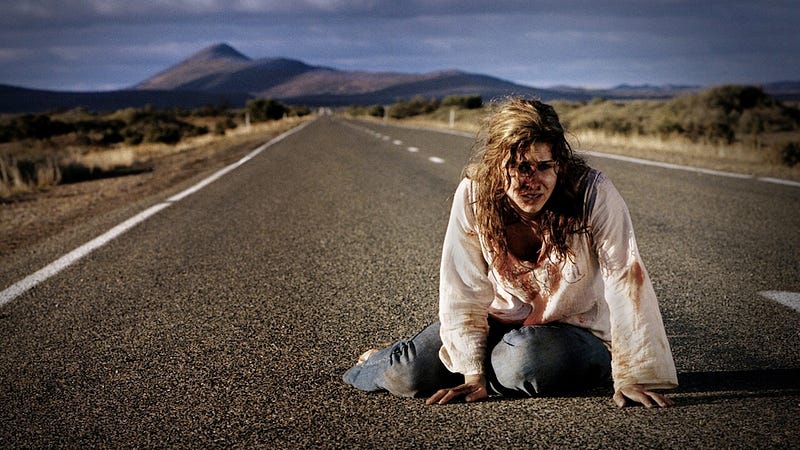
Kristy has already been physically tortured and possibly sexually assaulted by Mick, but the moment Lizzie is out of the picture, and Kristy herself understands that her friend is not coming back to rescue her, she goes from being a “damsel in distress” to being an active fighter, and runs away, barefoot and covered in blood, along a seemingly endless asphalt road in the middle of the desolate Australian outback. She eventually runs into a passing car, but before she can be “rescued,” Mick is back in her tracks, gunning down her rescuer.
At this point, Kristy seems to be our only hope. We haven’t heard or seen anything about Ben since he passed out from the drugged water, and we assume he is dead, not only because he is intentionally left out of the plot but also because, as seasoned viewers of horror flicks that we are, we know that, when it comes to surviving in a horror movie, females tend to stand a much better chance than males. Additionally, Mick’s sadistic “games” show an overt sexual interest, which further minimizes the role of Ben in the development of the story.
Kristy drives away, with Mick chasing her down. At some point, Kristy even manages to get the better of him before he eventually blows one of her tires. As we cling to the hope — our last hope, indeed — that Kristy might make it, she desperately but determinately crawls out of the car in a last attempt to survive. Finally, in a memorable static wide shot, she is gunned down by Mick like an animal.
Now that all hopes seem lost, we surprisingly cut back to Ben, at exactly ten minutes before the end of the film. We get ready for what seems like the inevitable final slaughter of the movie to take place. After all, if the two incredibly resourceful and resilient girls couldn’t save themselves in more than an hour of screen time, how can Ben, a secondary character who’s been absent and unaware of what’s been going on for most of the film, have a shot at survival?
Instead, we witness Ben’s unlikely escape and ultimate survival. Even more surprisingly, Ben has none of the resources that the two girls had, he simply wanders aimlessly in the Australian desert before eventually collapsing to the ground, right before a German couple providentially runs into him and saves him. After the brutality and mercilessness of what we’ve seen, it is a baffling yet cathartic experience to see Ben emerge as the last survivor of the group, or final man, a title that, to memory, has never been bestowed upon a male character in a group-survival horror movie (the only exception being Ash from The Evil Dead).
The Setting as a Primary Character: the Australian Outback

Very few horror movies throughout history have been able to successfully use their setting as an actual, active, relevant character in the story. The Shining is probably the most masterful example, with the Overlook Hotel being, in some ways, the real protagonist of the entire film: a character whose eerie presence and dramatic history play an active role in twisting the minds of those who inhabit it.
Wolf Creek does something similar: instead of the remote, snow-covered, Colorado-based site of the Overlook Hotel, we get the even more remote, bare, and unfriendly Australian wasteland. Our characters are trapped by the vastness of the space they inhabit, not its tightness. The reason they cannot escape is not because they are physically trapped in a confined space but because they are stranded in an open, boundless space. They are lost in a desolate wasteland stretching for thousands of miles. They might as well be lost in outer space, with no access to means of escape or even basic resources such as water. Their primary adversary is not Mick, it’s their environment.
Not surprisingly, a lot of the shots in the movie are wide establishing shots, giving us a clear view of the frightening vastness of the Australian wilderness, and forcing us into the POV of the main characters.
In a way, Wolf Creek cleverly succeeds in doing what Eli Roth’s Hostel failed to accomplish: using a foreign environment as a character in a way that enhances the frightening nature of the situation at hand. The main difference is that Hostel does so in a way that is traditionally American: by viewing such a foreign land through the lens of racism and xenophobia. In the 2005 American film, the eeriness of the general environment does not come from Slovakia itself or the town of Bratislava, it comes from the overused, decades-old American stereotypes about Eastern Europe being a frightening place with a hostile population and a bloody history.
In other words, Wolf Creek uses the frightening potential of its location at best without ever resorting to racist stereotypes.
The main difference is that Hostel does so in a way that is traditionally American: by viewing such a foreign land through the lens of racism and xenophobia. In the film, the eeriness of the general environment does not come from Slovakia itself or the town of Bratislava, it comes from the overused, decades-old American stereotypes about Eastern Europe being a frightening place with a hostile population and a bloody history.
With the advent of many gory horror movies since the early 2000s, a lot of people seem to have forgotten the groundbreaking nature of Wolf Creek and the film’s general brilliance. And yet, even the most seasoned viewers of 21st-century horror flicks wouldn’t be able to predict the many subversions of expectations or the intense — and yet never cheap or gratuitous — brutality of the Australian classic.
Wolf Creek is a masterclass in the horror genre and one that should not be forgotten.
¹At the time that Psycho was released (1960), horror cinema was not an established genre yet, and definitely not in the way that we know horror cinema to be today. That is what I mean by “setting the bar”: Psycho single-handedly created all of modern horror cinema.
² The Texas Chainsaw Massacre, like Psycho before it and Silence of the Lambs after it, was originally based on the story of real-life American murderer Ed Gein.
³ It is worth noticing that the now infamous 2011 film Megan Is Missing takes a similar approach by taking inspiration from actual cases of abduction while also stirring the original material into a much darker direction.
Enjoyed this article? Check out:
Sign up for Medium through the author’s affiliate link and get instant access to unlimited articles, or show the author your support and appreciation by buying her a coffee!