
Beau is Afraid of Sex: The True Meaning of Ari Aster’s Visionary Masterpiece
A Freudian interpretation
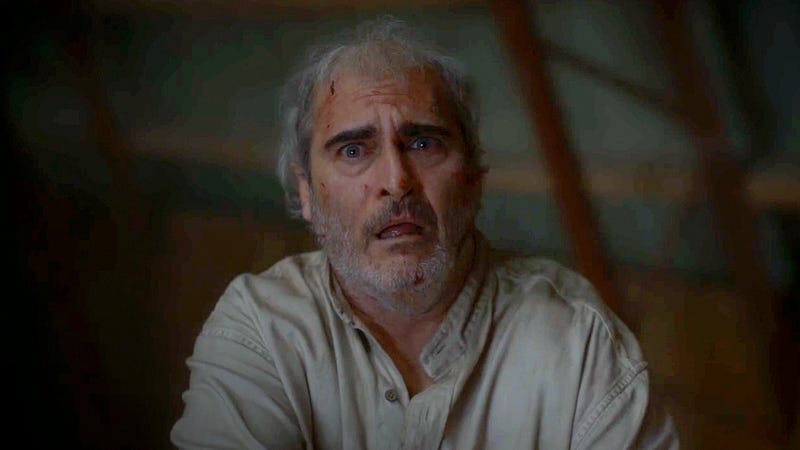
It would be unfair of me to claim to have “cracked the code” of Ari Aster’s latest, surrealistic and hallucinogenic movie in a way that can’t be further disputed. That is rarely the case for any artwork in general. The possible interpretations of a great artwork are virtually endless, and I believe that to be precisely the case for Beau is Afraid. However, that won’t deter me from advancing my own conclusions after a lengthy, detailed, and rather uncomfortable analysis of Aster’s latest work.
Spoilers Ahead!
I personally see Aster’s work as the Freudian representation of a man who’s deeply afraid of his own sexuality. The entire action of the movie is a symbolic representation of Beau’s deeply-rooted phobia when it comes to exploring his sexuality. This is first and foremost evident in Beau’s deeply Oedipal relationship with his mother and in her warning that if he is ever to have sex, he will die just like his father did. The fear of a congenital disease which, in the end, turns out to be completely false, deters Beau from engaging in any sort of sexual activity, thus almost taking the form of a castration complex in Beau’s terrified psyche.
The idea of masculine sexuality is omnipresent in the movie, taking many different forms, some more symbolical, some more explicit. But in all cases, it is an idea that appears to be shrouded in discomfort, mistrust, and fear.
In the first half of the movie, we witness a number of negative images that reinforce the idea of masculinity and sex as something inherently negative and life-threatening: a naked (circumcised) man roams the streets of Beau’s neighborhood and stabs random people; Beau lives just above a porn store (“Erectus Ejectus” — no further explanation needed), around which other random lunatics (all males), crack addicts and other questionable characters wallow in violence, degeneracy, and squalor. Among the many details that saturate the frame, there is also a dead man whose lifeless body lies right in the middle of the street, with nobody bothering to remove it.
The context is clear: the threat of violence and death surrounds Beau all around. As does the reminder that his father died because of him. This is where the concept of guilt emerges and seeps throughout the movie: in yet another Oedipal way, Beau feels responsible for his father’s death, which not only deprived him of a father but also deprived his very lonely mother of a man in her life — which she has made sure to remind him of throughout the years.
Beau is crippled by feelings of guilt and anxiety, both of which are inherently linked to his sexuality.
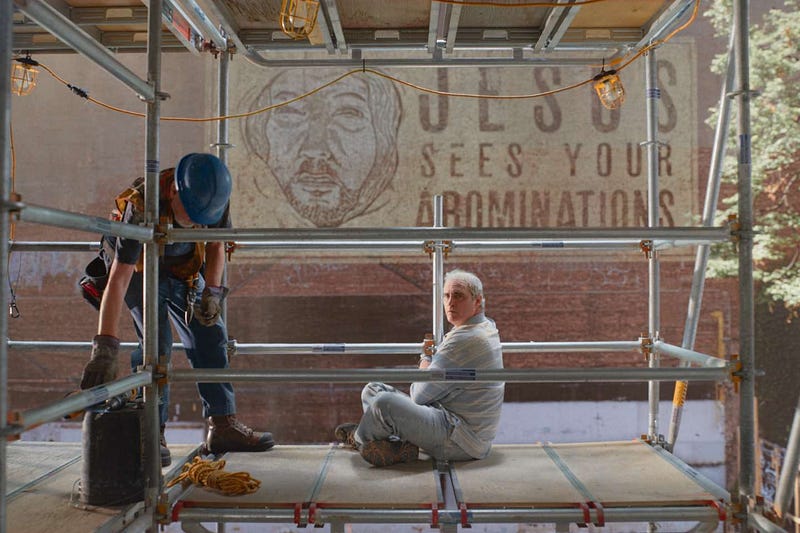
Other scattered “hints” that point to the theme of male sexuality are an advertisement about men’s health which Beau watches on television before falling asleep, a drawing of a man ejaculating with “CUM” written in capital letters on the wall of Beau’s apartment after the home invasion, and the billboard right outside of Beau’s apartment, which reads: “Jesus sees your abominations”.
The Mother
In Beau’s mind, the thought of “disobeying Mother” and/or upsetting her has a Norman Bates-reminiscent quality. He is already hesitant about visiting her because it just so happens to be the anniversary of his father’s death — a dark reminder that Beau is to never have sex. When his keys and luggage are stolen, Beau seems to give up on the idea of visiting Mother, and that is when all hell breaks loose.
Having been raised solely by Mother, Beau naturally displays a very strong attachment to her. And she to him. Their problematic Oedipal relationship is hinted at during the resort flashback scene when Beau sees Elaine for the first time, and his red-haired mother points out that “he seems to like a certain type of girl,” implying girls who have the same shade of hair color as her. “There’s nothing to be ashamed about,” she reassures him.
Oh, and, of course, there’s a body of a dead man floating in the pool (no explanation provided).
The Attic Scene
In the attic scene, Beau finally confronts his fears by accessing the mysterious place that “nobody was allowed into”: the attic. The attic seems to not only represent Beau’s subconscious — that inaccessible part of our mind where memories and trauma are stored — but also his very sexual nature, a “dangerous” and “frightening” place that Mother warns him never to explore. Here, Beau finally comes face to face with what has been his fear all along: his very sexuality, which is aptly presented in the form of a monster in the shape of male genitalia. He also confronts his twin brother, that is, the version of himself that was “punished” for his curiosity and who’s now laying emaciated and chained to the floor. After the initial confrontation, Jeeves, the psychotic war veteran, breaks in and viciously attacks the Sex Monster, as if Beau’s mind was trying to protect him by “killing the beast” that’s been tormenting him all along.
The Symbolism of Water
Freud viewed water as a symbol of the unconscious and the fear of the unknown, and water just so happens to be a major symbol throughout the film.
Beau’s last name is Wasserman. “Wasser” is German for “water”.
Of the many memories that Beau has of his childhood, the one that haunts him the most is that of his mother bathing him and his brother before eventually punishing the latter for inquiring as to the whereabouts of his father and locking him in the attic.
After the final confrontation with Mother, Beau leaves on a boat and departs toward a seemingly boundless body of water before finding himself in the “arena” where Mother puts him on “trial” for his “crimes” against her. At the very end, Beau is found guilty and is swallowed alive by the waves, ultimately drowning.
Joaquin Phoenix’s Incredible Performance
And, finally, I would be remiss if I didn’t praise Joaquin Phoenix’s flawless performance in this film. Phoenix is an artist whose talent speaks for itself, but I’d like to specifically draw attention to how much subtlety is present in his performance of Beau: throughout the film, it is oftentimes the smallest details, gestures, and facial expressions that make Beau feel like such a real and authentic character. Phoenix never overdoes his performances; instead, he lets his characters organically grow and express themselves in the most subtle ways, which is what makes his performances so authentic, particularly that of Beau. His performance in this film is absolutely spot-on, touching, and simply beautiful.
Aster’s Beau is Afraid is a unique cinematic experience that delves into a man’s fear of his own sexuality and Oedipal relationship with his mother, and it does so by using highly stylized elements of Freudian symbolism. It’s a film that bends and twists the language of film to portray the complexity of a man’s inner conflicts and his ambivalent relationship with sex and women, all the while never taking itself too seriously by employing dark humor and metafictional commentary. It is yet another proof that Aster is an extraordinary storyteller with a unique voice.
Want to keep reading? Check out these similar articles:
Sign up for Medium through the author’s affiliate link and get instant access to unlimited articles, or show the author your support and appreciation by buying her a coffee!