
How Ari Aster Singlehandedly Redefined the Language of Cinema with ‘Beau is Afraid’
Aster’s latest film expands the limits of cinematic storytelling
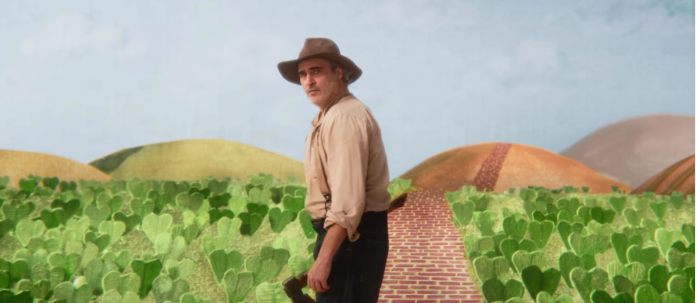
(Limited spoilers, proceed with caution!)
Beau is Afraid is a movie that will leave audiences confused and divided. As it should.
It is a controversial work by a controversial artist¹, and it is meant to shake the audience and take them to very uncomfortable places. That, by itself, is not new. One need only look at David Lynch, Lars Von Trier, or Harmony Korine to see similar instances of provocative cinema.
The true difference is in the way that Aster reshapes cinematic storytelling, bends it, and twists it into a new, unprecedented form.²
It is quite a task to try to sum up Beau is Afraid as a story. It is more of an experience and one that could be brought to its fullest potential by film alone and no other medium.
The premise of the movie is pretty straightforward: Beau, an elderly man living in a bad part of town, sets out to go visit his mother.
And then… life happens.
Indeed, numerous things happen after that. And they don’t make much sense. Beau embarks on a nightmarish, semi-psychedelic odyssey, which brings him to meet new friends and foes (mostly foes).
The entire bulk of Act II is a long journey through kafkaesque adventures, Lynchian wonderlands, and oneiric visions, through which Beau tries to decipher the meaning of some broken childhood recollections concerning his first love and his complex relationship with his mother.
What characterizes Aster’s unique cinematic language in Beau is Afraid is his use of what I shall call multiple “reality-scapes”, meaning different levels of “reality” structured into the story, each more absurd than the other, that ultimately leave the viewer unable to distinguish between what is actually taking place in reality and what is a product of Beau’s imagination. Mind you, this has nothing to do with the old storytelling trick designed to blur the lines between dream and reality (Inception’s spinning top being perhaps — and sadly — the most famous example of this trope). And that is because, to a certain extent, all of Beau is Afraid, from beginning to end, is a questionable story.
It is not even a matter of discerning whether Beau is a reliable or unreliable narrator because the story is not told by him. We, as an audience, experience the story in the same way that Beau’s fractured mind does. We are projected into the story and have no more clue as to what is going on than he does.
Several different realityscapes pile on top of each other throughout the film: we have the more or less ordinary setting in which the story begins, which is — again, more or less — realistic and ordinary. A decaying urban center plagued by crime and drug use, where Beau lives alone in a squalid apartment.
The first “rupture” with the established realityscape begins when Beau forgets to take water with his newly prescribed medication. I’m calling this the first rupture because, even though there are no immediate signs of a “shift in reality”, this is when things start to get increasingly strange. And, looking back, one might as well assume that everything that comes afterward in the movie is, in fact, a hallucinogenic side effect of Beau’s incorrect use of his medication (the interpretations of Beau’s “voyage” are virtually endless).
After that, we jump into the third realityscape when Beau is hit, in the nude, by a truck. Here, in a location not otherwise specified, Beau is taken care of and almost “adopted” by a lovely couple with one unstable teenage daughter and a psychotic war veteran living in the backyard. After things take a dark turn, Beau runs into the woods and just so happens to find a nomadic community of artists setting up camp for the night. This is the fourth realityscape.
After Beau is welcomed by yet another “family”, he witnesses a theatrical performance that seems to describe his entire life until he becomes an active part of it. This is the fifth realityscape. Beau then “switches back” to the previous realityscape, the one where he’s simply enjoying the show before things turn dark again.
And finally, somehow, Beau makes it back to his mother’s home, his primary destination from the very beginning. And, even though things seem to “have gone back to reality”, it is only a temporary — and fragile — illusion. This is where we enter the sixth realityscape. What seems like a more or less ordinary funeral service is interrupted by the sudden appearance of Beau’s childhood sweetheart. And, as we’ve seen multiple times by now, things end up turning extremely dark.
It could be argued that at this point, we are entering a seventh realityscape, since what’s about to happen next is, in a way, even more, absurd than what we have just witnessed. Or you could consider this and the previous realityscape to be two separate parts of the same unit.
In any case, what follows is a plot twist that turns the so-far abstract story into a much more “realistic”³ and elaborate plot. And, in my opinion, this is where the story dies a bit: by turning something symbolic and abstract into a well-planned execution of revenge, the film arguably loses its “magic” in favor of a more literal explanation for the events we’ve been witnessing.
Fortunately, this is not the end of it. An eighth realityscape occurs when Beau is forced into the attic of his childhood home, a place that has been a recurring locus in his adult dreams. Here… some more dark things happen. Examining what happens and why it happens would take too long, which is why that’s a story for a different day and a different article.
At this point, and just when Aster lulled us into the safety of a realistic setting, the lines between reality and fantasy blur to a point of no return. What we are witnessing is definitely not realistic, thus making us question, once again, the veracity of what we’ve seen so far, even in the most “realistic” sections of the film.
The ninth and final realityscape occurs when Beau flees the scene and escapes on a boat, seemingly heading nowhere. To his bewilderment, he is welcomed into an arena of spectators, staring at him from their seats in a rather metafictional way, and he is put on trial.
And we shall not talk about the ending for now.
I remember one of my film school professors telling our class, when talking about David Lynch’s Mulholland Drive: “Try to experience this as a dream, not as a film.” It is my opinion that this is exactly the way that Beau is Afraid should be experienced, although — and I hope David Lynch will forgive me for this — I think it is immensely superior to Mulholland Drive or any other antiplot⁴ film I have ever seen.
The level of structure, symbolism, and intricacy in Aster’s Beau is Afraid make the film stand out from nearly anything that has ever been projected onto a movie screen before. It is a successful experiment in the expansion of the filmmaker’s storytelling tools.
In other words: Ari Aster has singlehandedly redefined the language of cinema by creating a new form of storytelling, one that blends not one but several different layers of realistic and abstract segments, with the two constantly flirting with each other, and the spectator cannot help but to abandon reason and just experience the film with their senses, rather than their logical reasoning.
¹ For those who are not too familiar with Aster’s works, I suggest you watch one of his earliest films, The Strange Thing About the Johnsons (at your own risk).
² This statement takes into account other non-conventional and experimental examples of cinematic storytelling.
³ It felt right to put this expression in quotes since we are talking about Ari Aster, and defining his movies as “realistic” is a bit of a stretch…
⁴ An antiplot film is defined by author and professor Robert McKee as a type of plot that completely breaks the established language and form of classic cinematic storytelling and instead showcases a seemingly disconnected, nonlinear plot with a protagonist that is oftentimes passive and inconsistent realities.
Want to keep reading? Check out these similar articles!
Sign up for Medium through the author’s affiliate link and get instant access to unlimited articles, or show the author your support and appreciation by buying her a coffee!