avatarRich Sobel

Free AI web copilot to create summaries, insights and extended knowledge, download it at here

6698

Abstract

living conditions that eukaryotic cells are known to inhabit. As you might remember, the Greek word <i>philos</i> means loving so these guys are acidophiles and extremophiles.</p><p id="deb2">I mention this because it is important in some of the previously mentioned biotechnology applications. And I’ll talk more about that a bit further on.</p><p id="4f14"><i>Galdierian</i> cells are fairly small (3 to 10 µm) and are surrounded by a thick and rigid cell wall.</p><p id="c80d">Ok, back to Galdierian sex.</p><p id="570b">So here’s these extremophile red algae that biologists have been looking at for a long time (it got the genus name <i>Galdieria</i> in 1899) and 123 years after it was given its name we finally find out that can it reproduce sexually!</p><p id="c47d">So why did that take so long?</p><p id="2d98">One of the reasons why sex in <i>Galdieria</i> hadn’t been observed is that each of the cells in the most common form found in nature contains duplicate sets of chromosomes. If you explored sex in Tetrahymena with me in <a href="https://readmedium.com/what-do-gender-identity-and-this-tiny-critter-have-in-common-ace202e2e716?sk=d08e9a76988977bf63abf2153e3126ae">this article</a>, you’ll remember that is called the 2N or diploid number. To get a cell with a diploid number of chromosomes, you need 2 cells with only 1 set of chromosomes each, the haploid number, N, to merge.</p><p id="1da5">And that’s what sex at the molecular DNA level is, the merging of 2 haploid cells to form a diploid.</p><p id="b255">That’s how it works in people, too! The haploid male sperm fertilizes (enters and merges with) the female’s haploid egg cell.</p><p id="417c">Bingo, the diploid human embryo!</p><p id="8d8d">So, in <i>Galdieria</i>, no one had seen haploid cells.</p><p id="1272">Until Hirooka and colleagues published their paper in October 2022.</p><p id="da5d">What did they do that let them see the sexual forms?</p><p id="fbd8">Diploid <i>Galdieria</i> cells are usually grown in the laboratory at pH 2.0 where they go merrily along dividing and making more diploid cells.</p><p id="fa5d">But when they further acidified the culture conditions to pH 1.0 by adding sulfuric acid — hey I told you these guys were acidophiles! — something new happened.</p><p id="1f69">The diploid cells started making haploid cells inside of themselves, discarded their rigid cell walls, and released the haploid cells into the culture medium.</p><p id="6a73">Not only that but many of the haploid cells developed a kind of tadpole-shaped structure that helped them swim around and presumably find other haploid cells to mate with.</p><p id="9457">From the authors,</p><blockquote id="d093"><p><i></i>A motile tadpole-shaped cell transformed into a nonmotile spherical cell, which grew and multiplied by successive cell divisions during haploid asexual reproduction. Eventually, the spherical daughter cells detached and again transformed into motile tadpole-shaped cells. No obvious differences in the number and morphology of intracellular organelles were observed between the diploid and haploid cells other than the presence or absence of a cell wall...”</p></blockquote><p id="e281">Here’s a few figures from their paper so you can see all that.</p><figure id="67bb"><img src="https://cdn-images-1.readmedium.com/v2/resize:fit:800/1*MfD2jRRKezQqHbREsWtekQ.png"><figcaption>The 2N above the left column indicates the diploid cells and N on the right column shows cells that are haploid.</figcaption></figure><p id="4d1d">There are a couple of really interesting details in this figure so let’s examine it a bit further.</p><p id="de8a">In the top 2N image, you can see large cells that look kinda like donuts and are encased in a fairly rigid cell wall. The 2 black arrows point to cell walls that have been discarded by the cell. The bottom photomicrograph images show the components of this cell wall, labelled <b>cw </b>(cell wall)<b> </b>and <b>mcw </b>(mother cell wall). They show up as being very thick, dark and dense.</p><p id="85e1">In the N images on the right the black arrowheads show the haploid cells and you can see 3 of them with tail-like extensions that make them look a bit like tadpoles. The bottom photomicrographs show they no longer have any cell wall components, just a cell membrane, labelled <b>cm.</b></p><p id="7936">Here’s a cartoon that shows how this all comes about.</p><figure id="c2e6"><img src="https://cdn-images-1.readmedium.com/v2/resize:fit:800/1*c_2fnyHMq_vS9wFjteqWyA.png"><figcaption></figcaption></figure><p id="ddb6">In this figure, you can see that 2N and N cells can divide to make more cells.</p><p id="e33e">So either form, 2N or N can go happily along making lots of copies of themselves with sex being the furthest thing from their single-celled minds.</p><p id="087b">When does sex happen? And are there any special requirements?</p><p id="25f8">They found that in the <i>G. partina</i> species, there were 2 complementary mating types, type 1 and type 2, required for sex. When members of the two mating types were mixed, mating occurred. No mating was observed within either single mating type.</p><p id="519d">Just like lots of other single-celled organisms (yeast, <a href="https://readmedium.com/what-do-gender-identity-and-this-tiny-critter-have-in-common-ace202e2e716"><i>Tetrahymena</i></a>, etc.), at least 2 different mating types were required for the sexual program to proceed.</p><p id="2d20">And interestingly, when specific harsh conditions were imposed, clones of both mating types could asexually transition from haploid to diploid. Since no mating occurred, they suggest that the clones simply duplicated the genome without dividing to produce two new cells, thus becoming diploid.</p><p id="4ce3">And after they became diploid the formed cell wall structures.</p><p id="9969">For fun, if you go to the source paper, you can watch a few videos of the cells doing all these things.</p><p id="3ebf">Ok, this is all a lot of fun and interesting but why should I care?</p><p id="2e27">I’m glad you asked.</p><h1 id="e856">Why sex matters</h1><p id="5969">Actually, it’s not the sex that matters. The critical feature is the discovery of haploid cells without cell walls!</p><p id="67d9">Why is that?</p><p id="5032">Remember that I mentioned that these single-celled red algae were being used in biotechnology applications?</p><p id="14b6">Nowadays, one of the things we often seek to do is alter a genome to optimize the economics of production.</p><p id="4262">When Hirooka and colleagues sequenced <i>Galdieria</i> DNA, they found that they have a very small genome. They also sequenced its chloroplast and mitochondrial gen

Options

omes. They found its nuclear DNA only encodes around 7,800 proteins. For comparison, the human genome codes for 25–30,000 proteins!</p><p id="b058">Because the 2N cells have such a thick cell wall, it was difficult to alter the genome. But since the haploid cells lacked this cell wall, they were able to devise tools for simpler, more efficient and less costly genetic manipulation. You can read the paper for the nitty gritty details.</p><p id="b8e5">Another great feature is they grow at very high densities which makes them commercially viable and because of the extreme conditions they grow in, contamination by other organisms is not a significant problem.</p><p id="b0e0">Again, from the authors:</p><blockquote id="2125"><p>Cyanidiophyceae, and especially the genus Galdieria, are attracting attention in studies of photosynthesis, metabolic plasticity, and microbial environmental adaptation. <b>Galdieria shows remarkable metabolic capabilities</b> and grows photoautotrophically, mixotrophically, and heterotrophically <b>by using more than 50 different carbon sources, including organic wastes.</b></p></blockquote><blockquote id="dadf"><p>Moreover, <b>Galdieria is a polyextremophile</b>, <b>tolerating higher salt (up to 1.5 M NaCl) and heavy metal concentrations than the other cyanidialean genera</b></p></blockquote><p id="b536">(Bolding for emphasis is mine.)</p><p id="b867">Because of these and several other wonderful features, <i>Galdieria</i> species are currently being grown commercially and used to treat wastewater, produce food and make pigments (their chloroplasts have phycocyanin, a lovely blue colour pigment).</p><p id="4875">The paper describes a lot more work by the team and since it’s open source which means anyone can read it, you can too!</p><p id="0e51">I could go on and on but that’s enough for a brief intro to these fascinating creatures.</p><p id="ac18">Don’t you agree?!</p><p id="6322">Until next time,</p><p id="2060"><i>Rich</i></p><p id="b6c7">If you liked this article, you might also enjoy these articles by me 😄</p><div id="b389" class="link-block"> <a href="https://readmedium.com/how-plants-say-ouch-9670d964b072"> <div> <div> <h2>How Plants Say Ouch!</h2> <div><h3>One way plant cells talk to each other.</h3></div> <div><p>medium.com</p></div> </div> <div> <div style="background-image: url(https://miro.readmedium.com/v2/resize:fit:320/1*Th049K3sFjf8ABpXltKFnA.png)"></div> </div> </div> </a> </div><div id="efe6" class="link-block"> <a href="https://readmedium.com/fungi-that-eat-insects-make-a-powerful-medicine-5d1115d366f5"> <div> <div> <h2>Fungi That Eat Insects Make a Powerful Medicine</h2> <div><h3>Using nature to help heal humans</h3></div> <div><p>medium.com</p></div> </div> <div> <div style="background-image: url(https://miro.readmedium.com/v2/resize:fit:320/1*KrCQyhPGpDNvAj2mTXUuVw.png)"></div> </div> </div> </a> </div><div id="da9c" class="link-block"> <a href="https://readmedium.com/a-couple-of-cool-creatures-f89eadf25b58"> <div> <div> <h2>A Couple of Cool Creatures</h2> <div><h3>A really small, rare lizard and a really large ray fish</h3></div> <div><p>medium.com</p></div> </div> <div> <div style="background-image: url(https://miro.readmedium.com/v2/resize:fit:320/0*3Gu4NS-o5PtyYxY8.jpg)"></div> </div> </div> </a> </div><div id="4c85" class="link-block"> <a href="https://readmedium.com/are-there-fungi-living-inside-me-b7ad2b992b36"> <div> <div> <h2>Are There Fungi Living Inside Me?</h2> <div><h3>And if there are, should I be worried?</h3></div> <div><p>medium.com</p></div> </div> <div> <div style="background-image: url(https://miro.readmedium.com/v2/resize:fit:320/0*_ZAcHo9Sem02MxZ3)"></div> </div> </div> </a> </div><div id="9143" class="link-block"> <a href="https://readmedium.com/what-do-gender-identity-and-this-tiny-critter-have-in-common-ace202e2e716"> <div> <div> <h2>What Do Gender Identity and This Tiny Critter Have in Common?</h2> <div><h3>How does the single-celled organism, Tetrahymena, manage to have 7 different sexes and tell them apart?!</h3></div> <div><p>medium.com</p></div> </div> <div> <div style="background-image: url(https://miro.readmedium.com/v2/resize:fit:320/1*dIRWIqKQ5r2XEuuhrjCK-Q.jpeg)"></div> </div> </div> </a> </div><p id="51a2">If you’d like to get Updates from Biology4Everone, sign up <a href="https://www.biology4everyone.com/">here</a>. The updates come out every few weeks and include short pieces about naturalist topics and what I’m reading.</p><h1 id="cd4b">Sources</h1><ol><li><a href="https://doi.org/10.1073/pnas.2210665119">Life cycle and functional genomics of the unicellular red alga Galdieria for elucidating algal and plant evolution and industrial use</a> by Shunsuke Hirooka, et al., in <a href="https://www.pnas.org/">PNAS</a> (Oct 2022).</li><li><a href="https://www.researchgate.net/publication/284206744_Algae_Biotechnology_-_Green_Cell-Factories_on_the_Rise"><i>Algal Biotechnology — Green cell-factories on the rise</i></a>, by Armin Hallmann, in Current Biotechnology (2015).</li><li><a href="https://en.wikipedia.org/wiki/Ostreococcus_tauri">Wikipedia: <i>Ostreococcus tauri</i></a><i>.</i></li><li><a href="https://en.wikipedia.org/wiki/Macrocystis_pyrifera">Wikipedia: <i>Macrocystis pyrifera</i></a><i>.</i></li><li><a href="https://doi.org/10.1111/nph.15694"><i>Origin and evolution of sex-determination systems in the brown algae</i></a>, by Susana M. Coelho, Laure Mignerot, J. Mark Cock, in <a href="https://nph.onlinelibrary.wiley.com/journal/14698137">New Phytologist</a> (Jan 2019).</li><li><a href="http://dx.doi.org/10.1017/S1551929520001534"><i>Red Algal Extremophiles: Novel Genes and Paradigms</i></a><i> </i>by Julia Van Etten in <a href="https://www.researchgate.net/journal/Microscopy-Today-1551-9295">Microscopy Today</a> (Dec 2020)</li></ol></article></body>

Sex and the Single Red Alga!

It’s not so much the sex; it’s the loss of their crusty barriers that really matters.
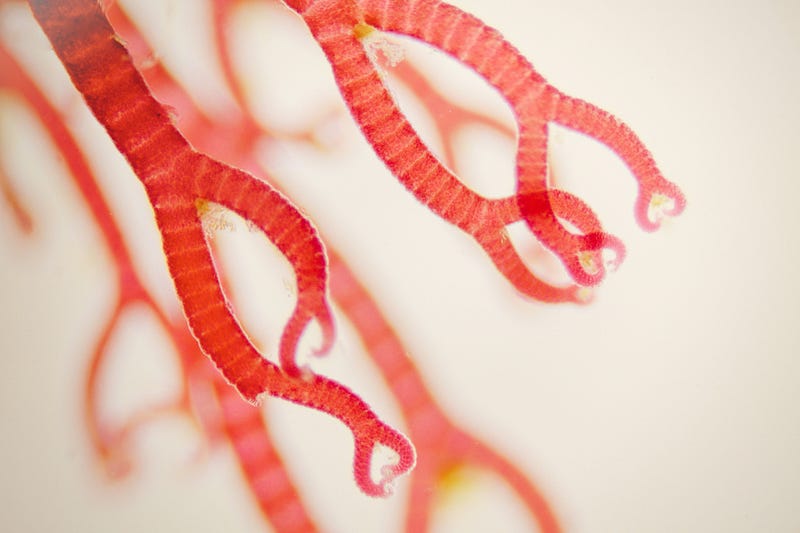
Photo by Ivan Bachev on Wikimedia Commons

Ok, if you’re like me, you probably don’t know a whole lot about the organisms we call algae.

If you have pet fish, you know that algae are not a good thing to have growing in your tank. And those guys are usually green algae.

But red algae?

And algal sex?

How much do you know about algal sex? Specifically, how the red algae go about it.

Is that something I need to know about?

Well, it turns out that it’s pretty exciting stuff. Not X-rated, mind you, but pretty engaging nonetheless.

In these times of climate crisis and reduced biodiversity, every little bit we can learn about the organisms that inhabit this planet with us and to whom we ultimately owe our survival is to our advantage.

Algae can be found in almost all of Earth’s aquatic and terrestrial environments. And some of these can be quite harsh and extreme.

We also use lots of algae to make bioproducts including biofuels and bioenergy. And we can use them to help rehabilitate damaged environments.

So let’s take a bit of time to learn about red algae and why learning about their sexual nature works to our benefit.

Algae

First, a bit of taxonomy.

There are six kinds of algae; red, green, brown, blue-green, diatoms and yellow-green. And although we call them blue-green algae, these are cyanobacteria, a more primitive kind of organism than true algae.

Here’s a very simplified picture of the tree of life which features algae and several other closely related organisms.
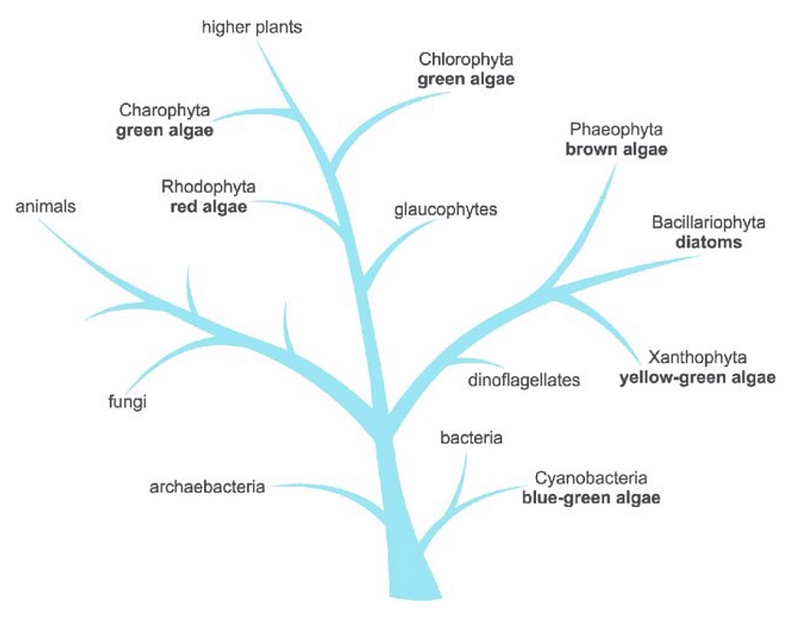
Taken from this article. And a caveat; these trees and classification assignations change pretty often these days so don’t be surprised if this is considered out of date soon!

In this particular tree of life, the simpler life forms are closer to the base of the tree and more complex organisms are higher up and further out.

Thus, you can see that the red algae or Rhodophyta, are higher up than the yellow-green, diatoms, and brown algae, and are below the two kinds of green algae.

Does that matter? Well, not to us for this article.

But now you know that and you can use it to impress your friends!

Algae are not considered to be higher plants because they lack roots, true stems and leaves.

Algae come in various sizes, ranging from single-celled organisms to giant plants. The marine green algae Ostreococcus tauri has a cell diameter of about 1 μm and is the smallest free-living single-celled eukaryotic organism known. It also has the smallest known eukaryotic genome.

In contrast, the brown alga Macrocystis pyrifera we refer to as giant kelp can reach 60 metres in length!

Like many other organisms, algae can reproduce both with and without sex.

But no one had ever seen it in certain forms of red algae.

Were these species somehow different?

Nope.

Read on to discover what it took to uncover their sexual relationships.

Sex

The sexual cycle of brown algae has been rigorously studied for many years. Here’s a little diagram to indicate some of what we know about that.
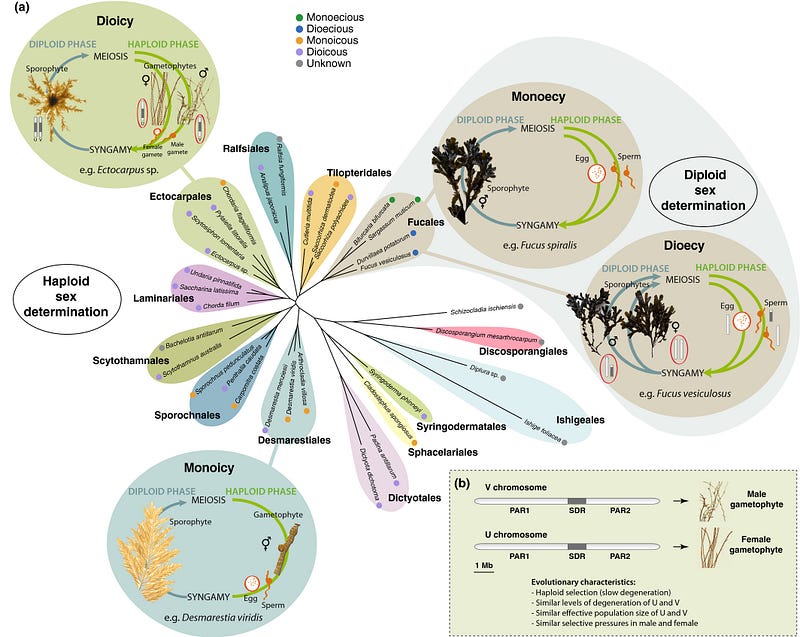
This figure was taken from this article

As you can see, it’s not simple! And that’s all I really want you to get from this figure because this article is about red algae, not brown!

So what about sex in the red algae?

Red algae are one of the largest groups of algae with over 7,000 known species. Most of these are multicellular, marine algae and include many of the seaweeds you find as you walk along a beach or coastline. And unlike other kinds of algae, reds are only aquatic, not terrestrial.

Sex in the multicellular species has been known for many years, is quite well documented and while interesting, it’s not what we’re focusing on here!

We want to know about sex in single-celled red algae!

Well, it turns out that sex hadn’t been observed in any of the single-celled red algae…until this past year!

In this paper by Shunsuke Hirooka and colleagues, they describe their discovery of it in the genus Galdieria.

Galdieria

A little bit about the biology of the red alga, Galdieria.

There are several species of Galdieria with sulphuraria being designated what taxonomists call the “type species”, the species name with which the name of a genus or subgenus is considered to be permanently taxonomically associated.
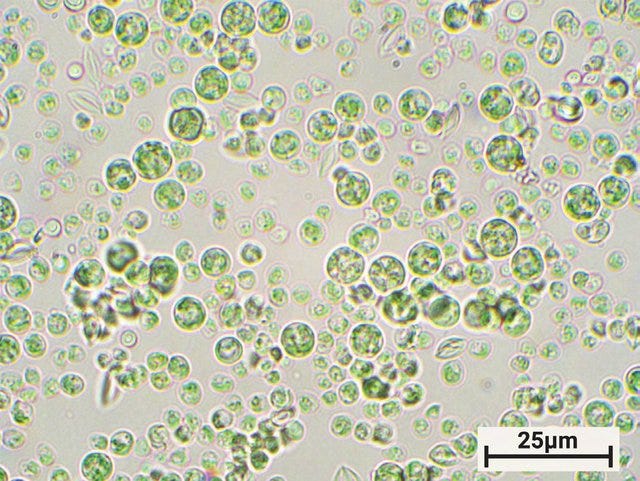
Taken from this article by Julia Van Etten

Galdieria species are some of the most acid-loving organisms known. They thrive in waters ranging from pH 0–4.0 (pH neutral is 7.0 and the lower the number, the more acidic) and temperatures as high as 56 °C.

These are some of the most extreme living conditions that eukaryotic cells are known to inhabit. As you might remember, the Greek word philos means loving so these guys are acidophiles and extremophiles.

I mention this because it is important in some of the previously mentioned biotechnology applications. And I’ll talk more about that a bit further on.

Galdierian cells are fairly small (3 to 10 µm) and are surrounded by a thick and rigid cell wall.

Ok, back to Galdierian sex.

So here’s these extremophile red algae that biologists have been looking at for a long time (it got the genus name Galdieria in 1899) and 123 years after it was given its name we finally find out that can it reproduce sexually!

So why did that take so long?

One of the reasons why sex in Galdieria hadn’t been observed is that each of the cells in the most common form found in nature contains duplicate sets of chromosomes. If you explored sex in Tetrahymena with me in this article, you’ll remember that is called the 2N or diploid number. To get a cell with a diploid number of chromosomes, you need 2 cells with only 1 set of chromosomes each, the haploid number, N, to merge.

And that’s what sex at the molecular DNA level is, the merging of 2 haploid cells to form a diploid.

That’s how it works in people, too! The haploid male sperm fertilizes (enters and merges with) the female’s haploid egg cell.

Bingo, the diploid human embryo!

So, in Galdieria, no one had seen haploid cells.

Until Hirooka and colleagues published their paper in October 2022.

What did they do that let them see the sexual forms?

Diploid Galdieria cells are usually grown in the laboratory at pH 2.0 where they go merrily along dividing and making more diploid cells.

But when they further acidified the culture conditions to pH 1.0 by adding sulfuric acid — hey I told you these guys were acidophiles! — something new happened.

The diploid cells started making haploid cells inside of themselves, discarded their rigid cell walls, and released the haploid cells into the culture medium.

Not only that but many of the haploid cells developed a kind of tadpole-shaped structure that helped them swim around and presumably find other haploid cells to mate with.

From the authors,

A motile tadpole-shaped cell transformed into a nonmotile spherical cell, which grew and multiplied by successive cell divisions during haploid asexual reproduction. Eventually, the spherical daughter cells detached and again transformed into motile tadpole-shaped cells. No obvious differences in the number and morphology of intracellular organelles were observed between the diploid and haploid cells other than the presence or absence of a cell wall...”

Here’s a few figures from their paper so you can see all that.
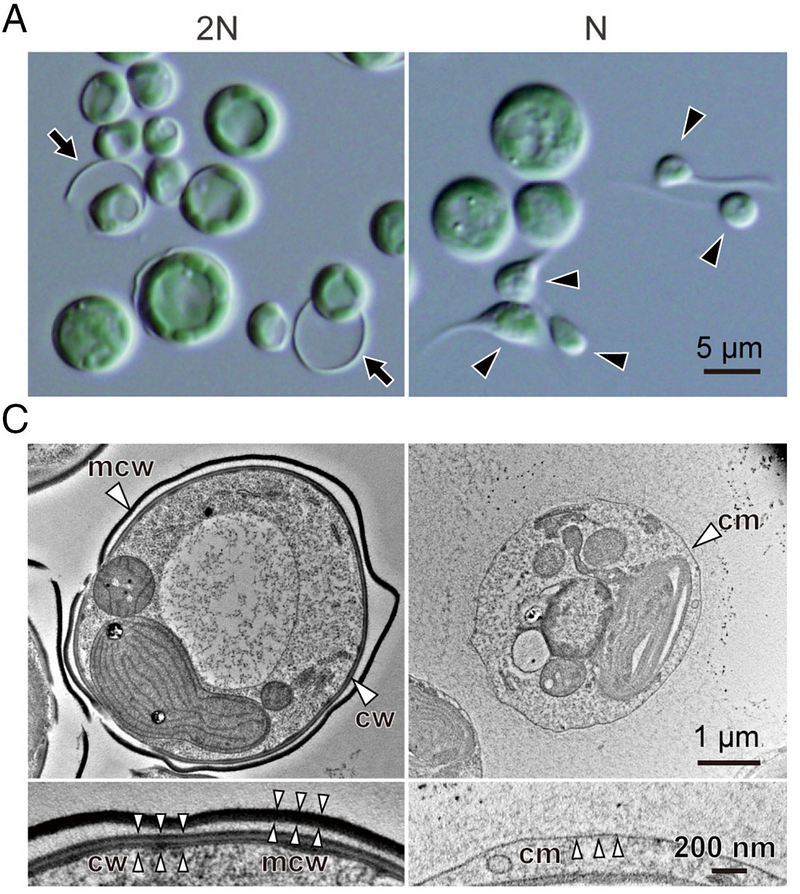
The 2N above the left column indicates the diploid cells and N on the right column shows cells that are haploid.

There are a couple of really interesting details in this figure so let’s examine it a bit further.

In the top 2N image, you can see large cells that look kinda like donuts and are encased in a fairly rigid cell wall. The 2 black arrows point to cell walls that have been discarded by the cell. The bottom photomicrograph images show the components of this cell wall, labelled cw (cell wall) and mcw (mother cell wall). They show up as being very thick, dark and dense.

In the N images on the right the black arrowheads show the haploid cells and you can see 3 of them with tail-like extensions that make them look a bit like tadpoles. The bottom photomicrographs show they no longer have any cell wall components, just a cell membrane, labelled cm.

Here’s a cartoon that shows how this all comes about.
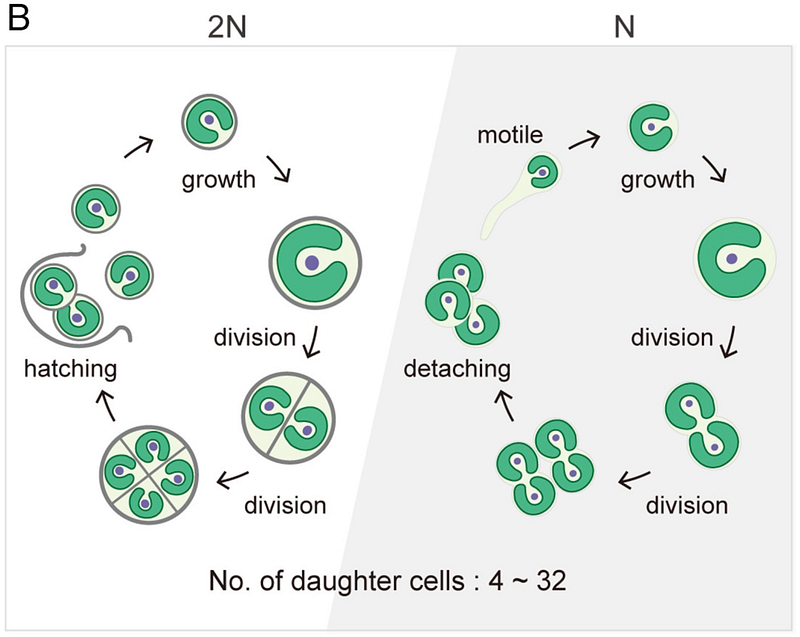
In this figure, you can see that 2N and N cells can divide to make more cells.

So either form, 2N or N can go happily along making lots of copies of themselves with sex being the furthest thing from their single-celled minds.

When does sex happen? And are there any special requirements?

They found that in the G. partina species, there were 2 complementary mating types, type 1 and type 2, required for sex. When members of the two mating types were mixed, mating occurred. No mating was observed within either single mating type.

Just like lots of other single-celled organisms (yeast, Tetrahymena, etc.), at least 2 different mating types were required for the sexual program to proceed.

And interestingly, when specific harsh conditions were imposed, clones of both mating types could asexually transition from haploid to diploid. Since no mating occurred, they suggest that the clones simply duplicated the genome without dividing to produce two new cells, thus becoming diploid.

And after they became diploid the formed cell wall structures.

For fun, if you go to the source paper, you can watch a few videos of the cells doing all these things.

Ok, this is all a lot of fun and interesting but why should I care?

I’m glad you asked.

Why sex matters

Actually, it’s not the sex that matters. The critical feature is the discovery of haploid cells without cell walls!

Why is that?

Remember that I mentioned that these single-celled red algae were being used in biotechnology applications?

Nowadays, one of the things we often seek to do is alter a genome to optimize the economics of production.

When Hirooka and colleagues sequenced Galdieria DNA, they found that they have a very small genome. They also sequenced its chloroplast and mitochondrial genomes. They found its nuclear DNA only encodes around 7,800 proteins. For comparison, the human genome codes for 25–30,000 proteins!

Because the 2N cells have such a thick cell wall, it was difficult to alter the genome. But since the haploid cells lacked this cell wall, they were able to devise tools for simpler, more efficient and less costly genetic manipulation. You can read the paper for the nitty gritty details.

Another great feature is they grow at very high densities which makes them commercially viable and because of the extreme conditions they grow in, contamination by other organisms is not a significant problem.

Again, from the authors:

Cyanidiophyceae, and especially the genus Galdieria, are attracting attention in studies of photosynthesis, metabolic plasticity, and microbial environmental adaptation. Galdieria shows remarkable metabolic capabilities and grows photoautotrophically, mixotrophically, and heterotrophically by using more than 50 different carbon sources, including organic wastes.

Moreover, Galdieria is a polyextremophile, tolerating higher salt (up to 1.5 M NaCl) and heavy metal concentrations than the other cyanidialean genera

(Bolding for emphasis is mine.)

Because of these and several other wonderful features, Galdieria species are currently being grown commercially and used to treat wastewater, produce food and make pigments (their chloroplasts have phycocyanin, a lovely blue colour pigment).

The paper describes a lot more work by the team and since it’s open source which means anyone can read it, you can too!

I could go on and on but that’s enough for a brief intro to these fascinating creatures.

Don’t you agree?!

Until next time,

Rich

If you liked this article, you might also enjoy these articles by me 😄

If you’d like to get Updates from Biology4Everone, sign up here. The updates come out every few weeks and include short pieces about naturalist topics and what I’m reading.

Sources

  1. Life cycle and functional genomics of the unicellular red alga Galdieria for elucidating algal and plant evolution and industrial use by Shunsuke Hirooka, et al., in PNAS (Oct 2022).
  2. Algal Biotechnology — Green cell-factories on the rise, by Armin Hallmann, in Current Biotechnology (2015).
  3. Wikipedia: Ostreococcus tauri.
  4. Wikipedia: Macrocystis pyrifera.
  5. Origin and evolution of sex-determination systems in the brown algae, by Susana M. Coelho, Laure Mignerot, J. Mark Cock, in New Phytologist (Jan 2019).
  6. Red Algal Extremophiles: Novel Genes and Paradigms by Julia Van Etten in Microscopy Today (Dec 2020)
Sex
Biology
Biotechnology
Algae
Microbiology
Recommended from ReadMedium