
Fungi That Eat Insects Make a Powerful Medicine
Using nature to help heal humans
Fungi are one of the primary ways that nature recycles the nutrients found in dead organisms or the waste products of living beings. And in the past century, we have discovered that they are also a source of potent medicinals like the antibiotic penicillin, which is made by the Penicillium fungus.
Fungi can also act in many other ways; as pathogens that invade tissues, as important members of the human microbiome and as organisms that help form the Wood Wide Web by establishing networks between various trees that are used to send nutrients and other signals to members in that web.
The fungus I’d like to talk about in this article is one of the more interesting pathogens. Rather than decaying waste products or dead creatures, it attacks insects and devours them from the inside out.
Its name is Cordyceps and it specializes in eating insects. And while that is an interesting curiosity, the reason it has started to receive attention is that it produces compounds which have wonderful medicinal properties.
The compound featured in this article is called cordycepin and it is a powerful antiviral and anti-carcinogen.
Of course, we would love to be able to take advantage of this and make enough of these medicines to use in treating people that need them.
But that’s not a simple task.
Can you imagine large facilities growing billions of insects just to grow these fungi? I can’t and neither can the pharmaceutical industry.
What would be ideal is to figure out how to best grow them without the insects and have them make large amounts of the pharmaceuticals we’d like.
So let’s look at how that is moving forward. And of course, we’ll start off with a little bit of Cordyceps biology so we can understand how the work is proceeding.
Biology of Cordyceps
First, a little bit about fungi in general.
There are two main taxonomic categories of fungi, Basidiomycetes and Ascomycetes; Cordyceps is one of the Ascomycetes. Most of the mushrooms and other fungi that you commonly come across are Basidiomycetes. What separates these two groupings is the structures they form to produce the spores which form new fungal colonies.
Ascomycetes make structures called asci to produce and disperse their ascospores and Basidiomycetes do the same with their basidia and basidiospores. Really, that’s more than you need to know but hey, sometimes it’s fun to be able to tell your friends these kinds of interesting facts! You know, you’re in a restaurant with your friends and they’re eating mushroom soup and you can say something like, “hey, tasty Basidiomycetes, eh?!” (the author refuses to accept responsibility for any responses your friends may make! 😄
So how do Cordyceps and other fungi grow?
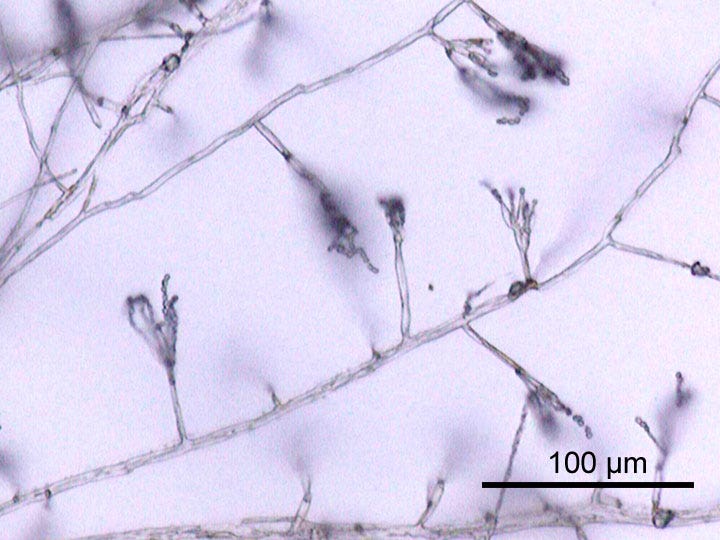
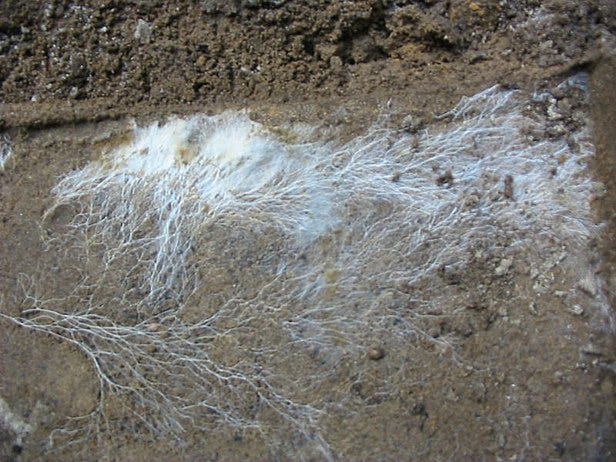
When Cordyceps fungal spores germinate, they produce what are called hyphae — long strands of attached cells as seen above in the microphotograph on the left. Hyphae aggregate to form mycelium, shown in the photo on the right. These fungal tissues are what seek out and attack a host organism. The mycelia invade the organism and eventually digest the host tissues.
Fun facts!
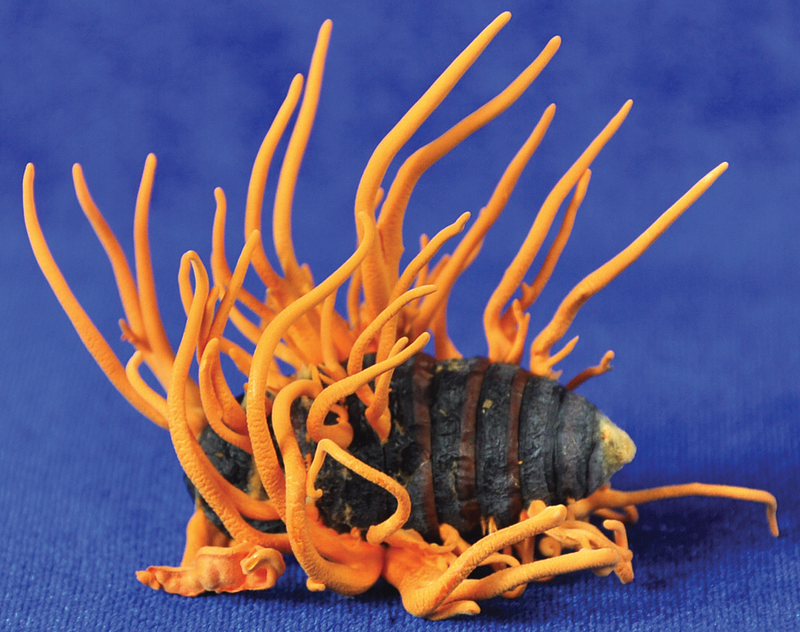
Because of its invasive nature, the Cordyceps fungus has entered popular culture as a villain in the video games The Last of Us (2013), The Last of Us: Left Behind (2014), and The Last of Us Part II (2020), in which a mutated form of the fungus infects humans and causes the collapse of civilization.In the video game Bug Fables: The Everlasting Sapling, Cordyceps infected bugs are enemies that can be encountered. Cordyceps also serve as a major plot point in the story.When a Cordyceps species finishes its insect meal, it grows through the outer skeleton of the insect and produces the fruiting body structures shown in the feature image of this article. These orange stalks produce the asci which make and disperse new spores and the whole cycle starts over again.
Actually, it’s a bit more complicated than that but that’s the gist of it!
Producing cordycepin
Ok, back to the main story, growing more Cordyceps in the lab to produce more cordycepin.
That’s what this team set out to do.
The labs of Mi Kyeong Lee, from the Chungbuk National University in South Korea and Mohamed A. A. Abdelhamid, from Minia University in Egypt collaborated on research that resulted in a paper by Ayman Turk, et al., entitled “Cordyceps mushroom with increased cordycepin content by the cultivation on edible insects” just published in Frontiers of Microbiology.
Fortunately, prior work by other investigators had already shown that Cordyceps species could be grown in the lab. A popular one is C. militaris.
These other investigators grew the Cordyceps fungus on petri dishes with food containing grains or insects and showed that growth in these cultures containing its natural diet, insects, yielded more product than growth on grains but which insects were best was still unknown.
There are so many insects! So where do you start?
How about testing insects that are already grown for human consumption?
These are readily available — in Korea there are 6 species grown for people to eat — and so that’s what they did.
Currently, Bombyx mori (silkworm pupae), Tenebrio molitor (mealworm), Gryllus bimaculatus (cricket), Caelifera sp. (grasshoppers), Allomyrina dichotoma (Japanese rhinoceros beetle), and Protaetia brevitarsis (white-spotted flower chafer larvae) are permitted for edible use in Korea.
Eeeew! People actually eat these bugs!? I think I’m a bit too squeamish for eating them as part of my regular diet but if I was starving….
They cultivated the fungus on these 6 different insects to see which of them was best for growing Cordyceps and producing cordycepin.
Here’s a figure from their paper that shows the 6 insects used in making the growth media (top row), what the fungus looked like when it grew (bottom row), and the amounts of cordycepin they got from each of them compared to using brown rice grains as a control (the graph).
(clicking on the links in all the figures below will give you bigger pictures)
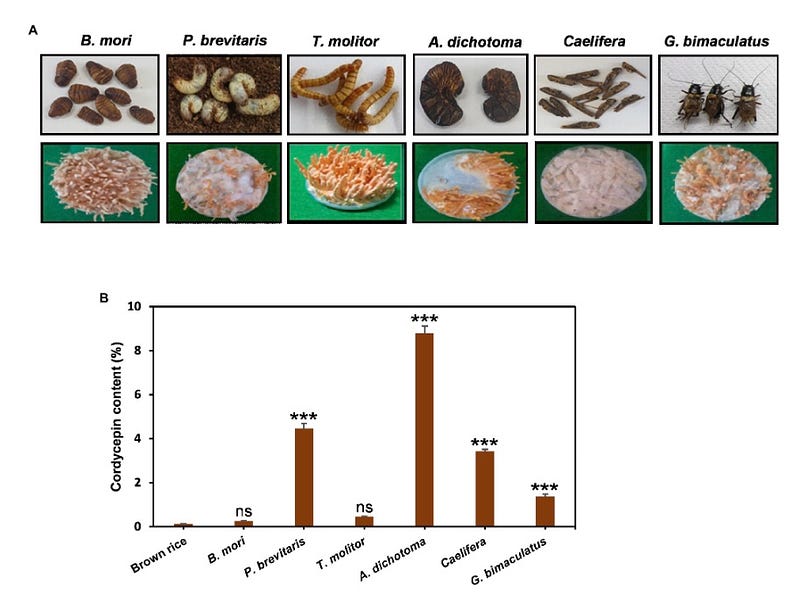
As you can see, culturing Cordyceps on media containing the rhinoceros beetle (A. dichotoma) yielded the most cordycepin — 34 times the amount of cordycepin as the silkworm (B. mori)!
That’s a pretty substantial increase!
What could be causing such a drastic difference?
To address this question, they analyzed the carbohydrate, protein and fat composition of the 6 insects. The results from this analysis are shown in the 2 graphs below.
The graph on top shows that A. dichotoma also had the greatest amount of fatty acid (the brown-coloured part of the bar) of the 6 insects. So they further analyzed the fatty acid components.
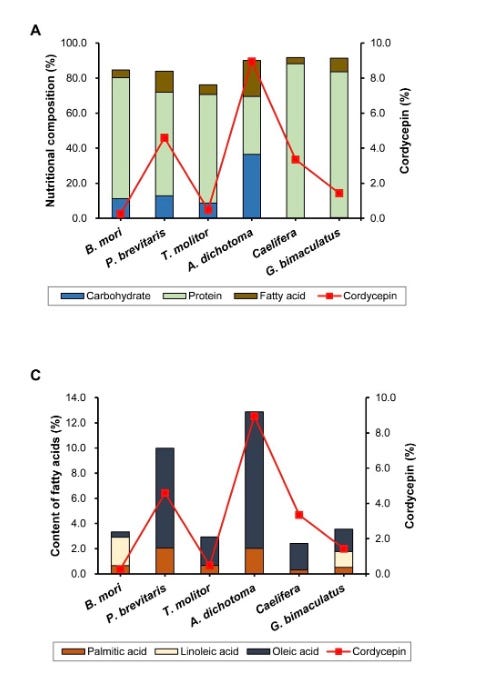
They analyzed 3 fatty acids found in insects; palmitic acid, linoleic acid and oleic acid. The results from this analysis, shown in the bottom graph revealed that oleic acid, the darkest part of the shaded bars, showed the highest correlation with cordycepin production.
This led them to their next question; is oleic acid used by these insects in the synthesis of cordycepin? And if so, what genes might be partly responsible for this?
They knew from previous work by other researchers that cns1 and cns2 are two important genes involved in cordycepin biosynthesis (citations are included in their paper). Therefore, they looked at whether adding oleic acid, which showed a high correlation with cordycepin content, had any effect on the expression of either or both of these genes when they grew Cordyceps on brown rice, B. mori or A. dichotoma.
The graph below on the left shows that both the cns1 and cns2 genes were significantly upregulated* in A. dichotoma.
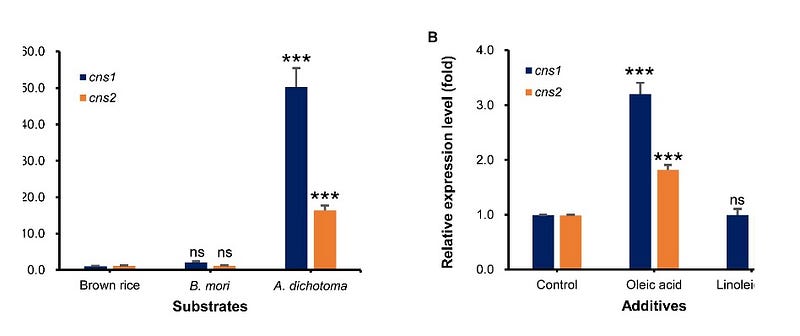
* Note: If you want to know more about how genes work and how they are expressed and regulated, this article gives you a good introduction to the topic:Next, they grew the fungus on A. dichotoma without any additional fatty acid supplied (control), or with the addition of oleic or linoleic acid. As shown in the graph on the right, only the oleic acid had a beneficial effect.
So what can we conclude from these experiments?
Conclusions
There are 4 main takeaways from these experiments:
- Some insects are much better for growing Cordyceps to produce cordycepin. Growth on A. dichotoma yielded 34 times the amount compared to growth on B. mori.
- Insects with greater amounts of fat in their bodies yield more cordycepin.
- Of the three fatty acids tested, oleic acid was the most effective for increasing the yield of cordycepin.
- Adding oleic acid to Cordyceps growth media with A. dichotoma significantly upregulated two genes, cns1 and cns2, genes important for cordycepin production.
Future directions
So what does this mean for the future production of cordycepin?
Well, using edible insects for culturing Cordyceps to produce cordycepin will probably be difficult to scale up to industrial levels.
Maybe other insects that are easier to cultivate could be used to increase the efficiency and scale of production.
Or maybe there is a way to just add oleic acid and other components and completely bypass the need for actual insects?
As always, good research like this spawns more questions than it answers!
So now you know about one fungus that attacks insects (Cordyceps species) and the ongoing efforts to use and optimize it to produce a powerful therapeutic compound, cordycepin, to treat cancers and viral infections.
Another interesting fact: Cordyceps militaris is a highly priced remedy and has been used in traditional Chinese medicine for quite a long time. Just do a search and you'll get all kinds products showing up! I hope you had as much fun reading about this fungus as I did writing about it!
Until next time,
Rich
If you’d like to get Updates from Biology4Everone, you can sign up here. The updates also include short pieces about naturalist topics and what I’m reading. They come out every few of weeks so you won’t have your inbox flooded with emails from me, I promise! 😄
Sources:
- “Cordyceps mushroom with increased cordycepin content by the cultivation on edible insects”, by Turk et al., Frontiers of Microbiology, (Oct 2022).
- “Mushroom’s Therapeutic Potential Tapped through Edible Insects” in Genetic Engineering and Biotechnology News, (Oct 2022)
- Wikipedia Cordyceps page.
- Wikipedia hypha page.
- Wikipedia mycelium page.


