
What Do Gender Identity and This Tiny Critter Have in Common?
How does the single-celled organism, Tetrahymena, manage to have 7 different sexes and tell them apart?!
You’re an alien on another planet and you walk into the local joint hoping that maybe you’ll meet someone to partner with. And you see 7 different genders and the only one you can’t successfully mate with is one that’s the same as you!
Nice! Lots of choices!
Next scenario.
You’re not an alien and you’re not walking into a bar. You’re a single-celled creature cavorting around in some pond water on planet Earth. And there’s 7 different genders and the only one you can’t successfully mate with is one that’s the same as you!
Nice! Lots of choices!
But then this question arises.
How does a single-celled creature know who's who and who it can mate with?
And that’s a very important question! Because one of the basic questions that all organisms need to answer is who are my peeps and who isn’t?
The creature featured in this article offers us the opportunity to gain new insights into how such recognition comes about.
Welcome to the fascinating world of Tetrahymena, a single-celled ciliated* organism that has been studied by biologists since the 1800s.
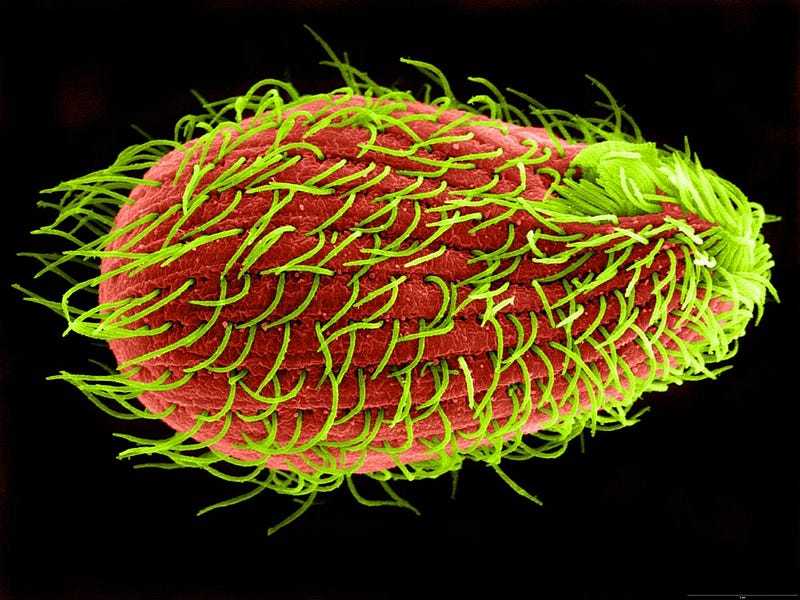
* FYI, cilia are tiny hair-like structures that stick out from cells. In the feature photo of Tetrahymena above, they are all the little green strings that look like hair. Many other organisms have cells that are ciliated, too, including we humans. I describe one such bunch of our cells in this article.In today’s article, we’ll look at several of the reasons, including its seven sexual systems, why Tetrahymena continues to be a valuable organism to study. We’ll see how studying a simple creature that is about as far removed from us on the Eukaryotic evolution tree as you can get, can help us understand some of the fundamental molecular processes that govern how we age, how we recognize infectious foreign invaders and lots more.
So let’s dive into that pond and get intimate with some of these Tetrahymena cells.
First, a little history and basic Tetrahymena biology.
Personal disclaimer: Back in the early 1990s, I did my Ph.D. research under the mentorship of Dr. C. David Allis, one of the world’s foremost Tetrahymena investigators. So I have more than a little bit of personal history doing experiments with this organism!Discovery
It is very likely that Tetrahymena was first seen in the original microscopic meanderings of Anthonie van Leeuwenhoek back in the 17th century.
Because the different species of Tetrahymena (abbreviated T. when the species name is included) all look the same physically, in the past they were originally lumped into one species called T. pyriformis. The species name, pyriformis, referred to its shape.
Pyriform, means pear-shaped (from Latin pirum “pear” and forma “shape”) and is sometimes spelled piriform.T. pyriformis was first described in 1830 by Ehrenberg under the name Leucophrys pyriformis.
Since the initial finding and naming of T. pyriformis, we have found 22 other species. Of those, T. thermophila has become the one most commonly used in modern research labs. In fact, it even has its own genome database page!
If you’re getting impatient, you know basic Tetrahymena biology, and you just want to get to the sexy stuff then skip this next section and head on down to Sex Cells below.
But, maybe you might wanna continue reading because…
Tetrahymena is a truly fascinating critter and you won’t really understand all that sex cells stuff if you don’t acquaint yourself with some important features of the beast’s biology.
Biology and Life Cycle
Physical Features
How did Tetrahymena get its name?
The genus name, Tetrahymena comes from two sources, “tetra” which is the Greek word for the number 4 and “hymen” the Greek word for membrane. In human anatomy, the hymen is the membrane that partially closes the female’s vagina and is commonly thought, although incorrectly, to indicate virginity.
So where are these 4 hymens in our little guy?
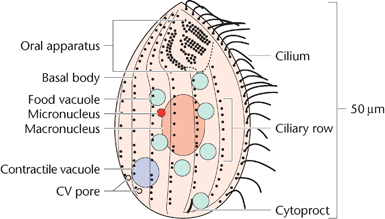
It turns out that they are in its mouth, technically called the buccal cavity or oral apparatus. In this figure, 3 membranes are in a stack on the right and one is on the left side (the tightly grouped lines of dots).
Since its mouth is also where it connects during sex, as you’ll see below, the “hymen” reference is actually quite applicable.
The thermophila species name basically says it loves (philos) heat (thermo). Thus we have an organism with 4 membranes that grows best in warm environments (from 30-35° C to be exact). Simple enough.
Tetrahymena ranges in size from 30–50 μm* in length and 20 μm in width and has around 20 rows of cilia give or take a few.
* How big is a micrometre? (abbreviated μm) A human hair is about 70-100 μm in diameter and bacteria are around 2 μm. So 3 - 5 Tetrahymena cells will fit nestled side-by-side inside a human hair.One of the really interesting features of a Tetrahymena cell is it has 2 nuclei. One is called a micronucleus and the other is a macronucleus. We’ll say a lot more about these two later.
It also has microscopic structures you commonly find in cells in other creatures including little sacs for food and wastes (food vacuoles in the picture above), a plastid type organelle called the mitochondrion that helps to produce energy, a set of linked proteins whose role is to maintain its shape and internal organization, the molecular “machinery” it needs to produce the proteins it uses to make all of the above and more.
Tetrahymena species have been found in all freshwater habitats and grow at temperatures ranging from 4° — 37° C (40°— 99° F) in all parts of the world and at elevations as high as 3000 metres (10,000 feet).
In its natural freshwater habitats, T. thermophila feeds on bacteria. But other species of Tetrahymena can be found living inside other invertebrates as parasites, including certain species of mosquitoes and snails.
Here’s a video of one Tetrahymena cell feeding on some bacteria. You can really see the cilia moving, too! Enjoy!
Growing Tetrahymena in the lab
One of the reasons it’s such a valuable research organism is because it is simple and economic to grow. You just mix up a bunch of food in a broth, add your cells, incubate them at the temperature they like to grow at and bingo, in about a day’s time you’ve got a whole whack of cells for your experiments.
Since you’re supplying the food, you have a few choices. You can give it a generalized media which contains random amounts of all the nutrients it requires or we can use a very highly defined set of nutrients. Doing that lets us control nutrient conditions to force T. thermophila to develop in very specific ways and to test the effects of specific nutrients on growth, development, replication, mating and a host of other cellular and molecular processes.
And because we’re very careful (we sterilized the flask and the broth or nutrients before adding in a pure batch of Tetrahymena cells), we can make sure that no other organisms are also growing in the same culture unless we put them there. This is called axenic culturing and is very important because we need to make sure no other contaminating organisms are playing havoc with our experiments and affecting the results (unless, of course, we want to investigate that).
Synchronized cell culture
Another one of the advantages of Tetrahymena is that if you treat the culture with heat the majority of the cells stop growing and progressing through the life cycle when they reach a certain point. Then they’re kind of in a state of suspended animation. When normal conditions are resumed, these cells all progress through the life cycle at exactly the same time. And this synchronicity is maintained through about 3 cell divisions. Each division takes about 2–3 hours for a total of 6–9 synchronized hours.
You can also starve the cells so they enter the mating cycle at the same time. If you do that in separate culture flasks with 2 or more different mating types and then mix them together, Bingo, sex!
Now you can harvest whole bunches of cells all at the same stage of mating to examine the fine details of that act both microscopically and biochemically.
But in order to really appreciate all the hot single-cell sex, we need to know a bit more about the two different types of nuclei, the macronucleus and micronucleus that I mentioned above.
Macs, Mics and Mating
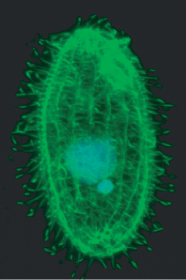
Whenever cells replicate and divide, they generate a whole new copy of their DNA and genes (commonly called the genome) to pass on to the new cells. This is another area where it gets really interesting in Tetrahymena.
That’s because of the 2 different nuclei, the macronucleus and micronucleus. They’re commonly referred to as macs and mics and is where their DNA genome is kept.
In order to understand what happens next, we need to explain the term ploidy*, which refers to the number of chromosomes.
* Ploidy- When we talk about DNA genomes or chromosomes, we often talk about ploidy which is the number of complete sets of chromosomes in a cell or in the cells of an organism. Haploid is one set and Diploid is two. Polyploid is many sets. In organisms that have only 2 mating types, like people, the sperm cell has a complete haploid genome on chromosomes from the male and the egg or oocyte has a complete haploid genome on chromosomes from the female. When fertilization occurs, the two haploid genomes's chromosomes join together and form diploid chromosomes in the new embryo.All the subsequent cells in that organism will now be diploid until it forms the next set of mating cells.Got that?! If not, try reading it again. If you still don't get it, let me know in the comments so I can improve on this for next time!So….. a mic has 5 pairs of diploid chromosomes, one set of 5 haploid chromosomes from each mating type that pair up to form the diploid chromosomes.
These 5 diploid chromosomes in the mics replicate during asexual divisions but are pretty much just along for the ride. They do not play an active role during normal asexual (commonly called vegetative) cell growth and development.
Where they spring into action is during mating. Then they are referred to as the germline nuclei because they become briefly haploid during the mating cycle.
germline- When a mating cell contains a haploid number of chromosomes and is able to unite with one from the opposite sex to form a new diploid individual, it is called a germline cell or gamete. In humans, the egg and the sperm are germline cells.A germline nucleus is one that also is haploid. In humans we have 2 germ cells, the female egg cell and the male sperm cell. Each has a germline nucleus with only the haploid number of chromosomes. Okay, enough about the mics, let’s get back to the macs!
Macs are unusual in that they have lots of copies of select pieces of the complete mic genome. And all these pieces add up to a ploidy of about 45–50!
That’s a lot of DNA!!
How this comes about during the mating cycle is quite complex. So patience dear reader, we’ll explain it in more detail below.
What happens during the mating stage?
Like most unicellular organisms, Tetrahymena has two options for reproducing. As we mentioned before, it can reproduce vegetatively by simple cell division or sexually by mating with another Tetrahymena cell. When food is plentiful and conditions are favourable, it just goes merrily about and reproduces every few hours. The single cells and all their components grow, divide, separate and produce new cells.
But when food is scarce and conditions are unfavourable, it switches into the sexual cycle.
When two cells of different mating types join together at their tips they are said to be conjugating. As you can see in the picture below, it looks almost like they are kissing!
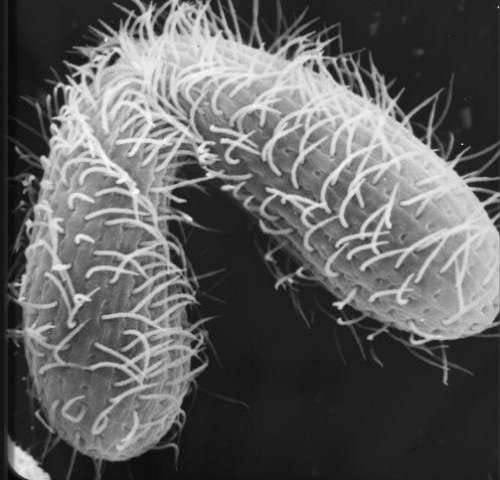
Because the details of what happens after the 2 mating cells conjugate is similar enough to events in higher, more complex organisms, much of what we learn from studying T. thermophila sexual mating applies to other creatures, including humans.
The Life Cycle Illustration below shows all the main steps during Tetrahymena mating. As you can see, it’s quite complex and we’ll gloss over many of the steps!
We’ll call the two mating types X and Y.
What I’d like you to focus on is that mating type X (with white nuclei) and mating type Y (black nuclei) go through a series of steps while conjugated to eventually form a new hybrid cell of some mating type that has a combined new hybrid genome (gray mics and macs in steps 4 through 7).
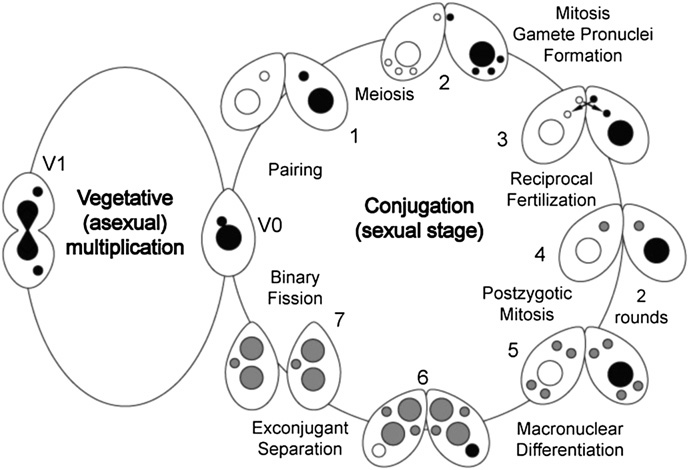
And those new gray cells can’t mate with each other because they are all the same mating type. Got that?!
Great!
How does the cell make a new mac?
It does this by replicating and breaking up one of the new 5 chromosome diploid mics into about 200 little minichromosomes. It does this in 2 separate stages.
First, by cutting and cutting and splitting the newly formed 5 diploid chromosomes into about 250 minichromosomes. Then about 50 of these are eliminated either immediately or lost after about 20 new vegetative cell divisions.
Next, it snips these new 250 minichromosomes at internal sites to remove smaller pieces but immediately pastes the chromosome back together after the piece is removed. Those sites are called internal elimination sequences and there are about 12,000 of them!
After all this, it has discarded about 1/3rd of the original genome. When this is all finished, the new mac has a ploidy of about 45 copies!
Since the macs have the DNA the vegetative cells use for all the routine daily tasks that genes normally take part in they are referred to as the somatic* nuclei.
*somatic- In cell biology the soma refers to the parts of an organism other than the reproductive or germline cells. In Tetrahymena and other related ciliated protozoans such as Paramecium, the macronucleus is not responsible for reproduction. Rather, its DNA is used for all the other operations of the cell. Hence it is called a somatic nucleus.(From New Latin, from Ancient Greek σῶμα (sôma, “body”)Without going any deeper into this, just know that now the cells can be genetically sorted and grown as subpopulations depending on which genes they have kept and are expressing and that this allows for some very sophisticated genetic mutation experiments to be performed.
Sex cells
Ok, back to the 7 sexes.
Finally!
I mean sex cells, right? (pun intended!)
Although we have known since the 1950s that Tetrahymena has 7 sexual mating types, we didn’t really know why or how they were specified.
But in March 2020, a team of biologists at UC Santa Barbara identified the mating-type genes. They “…also uncovered the unusual process of DNA rearrangements needed for sex determination in this organism. The discovery has potential human health implications ranging from tissue transplantation to cancer, including allorecognition — the ability of an organism to distinguish its own tissues from those of another — which can be a first line of defense against infection and illness.”
What they found was that each Tetrahymena germline mic had 6 or 7 mating-type genes, depending on which strain they looked at. And it has the full genome because no pieces of DNA have been snipped or removed.
But remember that when the new mac is made, DNA segments for genes are randomly sorted, snipped and rearranged?
Well, it turns out that after all that snipping, cutting, pasting and shuffling of the DNA and chromosomes, the mature mac is left with only 1 remaining mating-type gene and that specifies which sex it is.
So now we know how the mating types are specified but we still can’t predict which mating type the progeny will be. The parent cells basically throw their mating-type genes into the reproduction hat, shake it around, snip it, rearrange it and whatever comes out is what the new cells are. As far as we can tell, it’s totally random. Basically a throw of a seven-sided die.
So other than satisfying our innate curiosity about single-celled sex, why do we care about this?
Let’s talk about immune systems in higher eukaryotes like us people. The reason we can make antibodies to so many different infectious organisms is that the cells that make the antibodies use a very similar process. There are many different variant copies of the genes that are used to construct a mature antibody molecule.
During the antibody construction process, these genes are randomly sorted, snipped and rearranged to make the new prototypes. Sound familiar? Of course, there are differences between what happens in Tetrahymena and humans but some parts of the molecular machinery in both are similar enough to warrant further exploration that might lead to a better understanding of our human immune system and who knows what else!
And it’s a lot easier to use Tetrahymena for experiments than higher eukaryotes and there’s no ethical dilemmas if you kill a few million cells while you’re doing that.
If you’d like to learn more about the intricate scientific details of how Tetrahymena goes about genome rearrangement when it makes the new mac, including why this complex system might have evolved and been retained, read this article. (warning: this is a high-level, full of jargon and scientific terms article!)
And remember that I told you we would look at how the different types of mating cells knew how to recognize the different genders?
Well, I sorta lied. As far as I can determine in my personal online searching, we don’t know how they tell each other apart, yet. No sex hormones have been found, or any other signals determined.
So it’s possible that we do know and my research just missed that, OR it’s a question that still needs to be answered.
FWIW, I’m coming down in favour of the latter, a question that still needs an answer.
Value as a Model Organism
Why do I keep saying that Tetrahymena is such a valuable research organism?
Show me the data!
In the past 5 years, over 3,000 papers featuring Tetrahymena research were published in scientific journals, one-third of which were studies funded by the National Institutes of Health!
And here’s why:
“Tetrahymena has about as many genes as the human genome. For thousands of those genes you can recognize the sequence similarity to corresponding genes in the human genome with the same biological function. That’s what makes it a valuable organism to investigate important biological questions.”
Here’s a figure that shows areas of research using Tetrahymena that have contributed to our understanding of these processes in humans and other higher organisms.
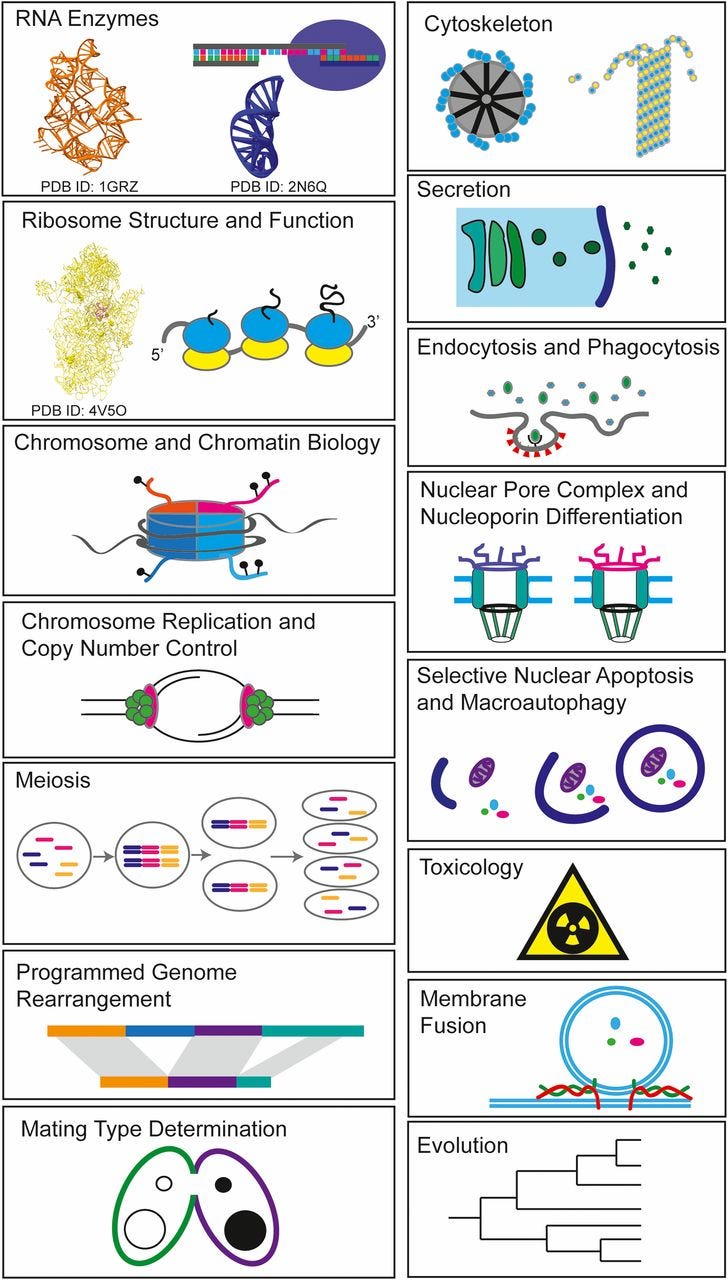
I don’t expect everyone to know what all these molecular cell biology processes are. I just want you to be impressed by how many different areas there are!
And as there are so many areas, I thought I’d pick a few important ones you might like to know about in a bit more detail.
We covered Mating Type Determination in excruciating detail. And Programmed Genome Rearrangement (the cutting and pasting of all those minichromosomes in the new mac).
Next up is some more important chromosome biology.
Telomeres
Tetrahymena was the first organism in which the enzyme* telomerase was discovered.
* Enzymes are molecules which help chemical reactions occur. In chemistry, if you see the suffix -ase at the end of a name it means the molecule is an enzyme.It was discovered by Carol W. Greider and Elizabeth Blackburn in 1984. Together with Jack W. Szostak, Greider and Blackburn were awarded the 2009 Nobel Prize in Physiology or Medicine for this discovery.
Winning a Nobel prize is no mean feat so why is telomerase so important?
Ok, some quick chromosome biology. Chromosomes are made up of long stringy pieces of DNA and each stringy piece has two ends. See the two pictures below which both show diploid chromosomes so each has four ends.
Now, there are molecules inside cells that like to chew up unprotected pieces of DNA to recycle the components for making new pieces of DNA. So the cell has to protect these DNA ends by making structures which are called telomeres*.
* telomere (/ˈtɛləmɪər/ or /ˈtiləmɪər/), from Ancient Greek: τέλος, romanized: télos, which means 'end' and μέρος,romanized: méros, which means 'part'.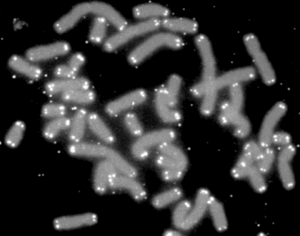
They do that by “capping” them with a specific set of short repeating DNA sequences and some proteins. Think of these “caps” as being kinda like the coating on the end of shoelaces that keeps them from fraying and unravelling. Same idea. The set of repeating sequences forms structures that “tell” the cell that this DNA is protected and needs to be left as is.
Telomerase is the enzyme that adds these repeated sequences and associated proteins to form the telomere ends.
Ok, telomeres keep our chromosomes from fraying and being chewed up by DNA-hungry chemicals in our cells.
Any other reason I should care about telomeres?
You bet!
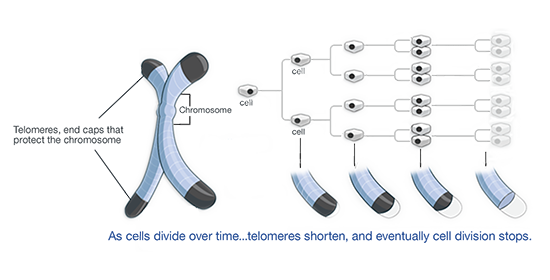
The telomeres act as ageing clocks in every one of our cells.
You see, the telomerase enzyme is only present early in development in our very young cells and tissues. It isn’t around to continue to make new telomeres in older cells.
And every time one of our cells divides, the replicating chromosomes lose a small bit of the telomeric end. So essentially, telomere length is an indication of both the number of times the cells have divided and how much time has passed. When the telomere disappears entirely, the cell stops dividing and eventually undergoes programmed cell death or is eliminated.
Remember all those minichromosomes in the mac? That’s a lot of telomeres available for studying! Which requires a good supply of telomerase. This was why the Tetrahymena and its mac was so important in the isolation and discovery of telomerase.
Functional genomics
Functional genomics is the field of research that seeks to understand what roles genes play and how they interact with one another to accomplish those tasks.
“In this era of functional genomics, Tetrahymena thermophila is emerging as one of the foremost model eukaryotes for experimental analysis.”
Remember, Tetrahymena has almost as many genes as we do. And many of them perform similar functions. Again, it’s much easier and simpler to see what similar genes do in a single-celled organism than in a mouse or a human.
So it makes sense to see how a given gene or set of genes does what it does in Tetrahymena first. Then we can ask the question: Does it do the same thing in people? If not, what’s different? If it does, then it must be a really important task to have been retained in two organisms so far removed from each other in evolutionary development.
Which sets me up for the next topic, evolution.
Evolution
This section is for nerds like me that like to know where everything came from. And I’ll keep it simple and straightforward by answering one simple question.
Where does Tetrahymena sit on the eukaryotic evolutionary tree?
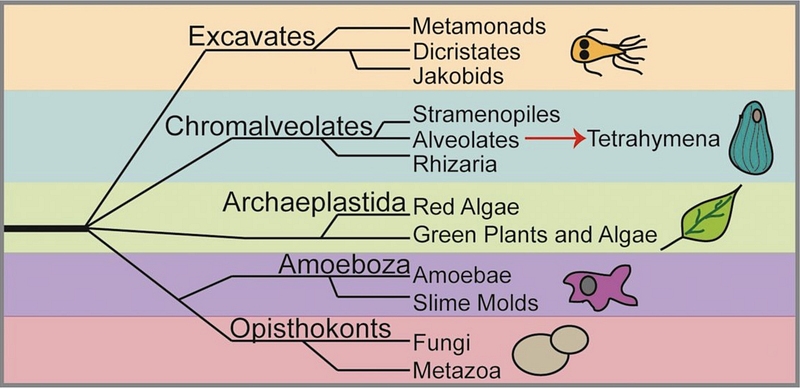
As you can see, it’s in the Chromalveolates, right above the group, Archaeplastida, a group that I featured in my recent article about Red Algae and plastids.
If you want an even bigger picture with more diverse organisms, just “Google” evolutionary trees and you’ll get tons of great images to look at.
I guess in the future I’ll have to write about the Amoeboza and the Excavates! I like that name, Excavates. Definitely makes me want to do some digging!
Pique your curiosity?
Until next time,
Rich
Hey! If you read all the way to the end of this article you need to subscribe to my newsletter and get a free fun ebook!
Sources for this article:
- How a Tiny Critter Has Seven (Yes, Seven) Sexes by Carrie Arnold, (2013).
- Tetrahymena as a Unicellular Model Eukaryote: Genetic and Genomic Tools by Marisa D. Ruehle, et al., (2016).
- Parallel evolution of histophagy in ciliates of the genus Tetrahymena by Michaela C Strüder-Kypke, et al., (2001)
- The Biology of Tetrahymena by Alfred M. Elliott, (1959).
- Tetrahymena thermophila, a unicellular eukaryote with separate germline and somatic genomes by Eduardo Orias et al., (2011)
- Whats, hows and whys of programmed DNA elimination in Tetrahymena by Tomoko Noto and Kazufumi Mochizuki, (2017)
- Selecting One of Several Mating Types through Gene Segment Joining and Deletion in Tetrahymena thermophila by Cervantes et al., (2013)
- Researchers discover how model organism Tetrahymena plays roulette with seven sexes by Public Library of Science, (2013)
- Functional genomics: the coming of age for Tetrahymena thermophila by Aaron P. Turkewitz, et al. (2002)


