avatarRich Sobel

Free AI web copilot to create summaries, insights and extended knowledge, download it at here

4811

Abstract

there were many open places under a mid-layer of medium size trees covered with mosses; the forest floor was mostly leaf litter and moss.</p><p id="e7b4">Unfortunately, it was found outside of any conservation areas and near to where massive deforestation is happening nearby.</p><p id="1f50" type="7">like a chameleon, it changed its colour from lime green to a dull orangey-brown when it was threatened</p><p id="d0bd">Putra and others are hoping they can get some kind of protection status for the areas where this lizard has been found, especially as the area is quite remote.</p><p id="c8b1">They also recommend the government <i>“protect the habitat of H. modiglianii and other such rare mountain taxa, and rigorously enforce existing laws, especially those relating to logging. <b>We have observed some attempts of trading of this species via social media applications, and the local traders offer this species for USD 100 per individual. Most of the captured individuals by the traders were fully grown adult males, captured from forested areas around Berastagi (1,300 m a.s.l.)</b>. Considering the current habitat destruction and threats from pet traders we highlight the conservation urgency.”</i> (bolding is mine)</p><p id="77b8">And how typical is this? It’s rare so let’s get as many as we can and sell it into extinction!</p><p id="bf4d">(Forgive the sarcastic rant; I don’t know the society or wages but I can guess that many people in the are are economically disadvantaged and this might help them. Even if that is the case, surely this is not the way to solve that problem.)</p><div id="c391"><pre>Interesting note: Wooden arts <span class="hljs-keyword">and</span> folktales <span class="hljs-keyword">of</span> <span class="hljs-keyword">the</span> Bataks — indigenous people native <span class="hljs-built_in">to</span> <span class="hljs-keyword">the</span> region — show that lizards have <span class="hljs-keyword">a</span> special place <span class="hljs-keyword">in</span> <span class="hljs-keyword">the</span> people’s mythology.</pre></div><div id="7447"><pre>Their houses often have gables <span class="hljs-keyword">with</span> carvings <span class="hljs-keyword">of</span> horned lion heads, snakes, lizards <span class="hljs-keyword">or</span> monsters <span class="hljs-keyword">with</span> bulging eyes <span class="hljs-built_in">to</span> protect <span class="hljs-keyword">the</span> occupants <span class="hljs-built_in">from</span> evil spirits.</pre></div><p id="dbed">And that’s all I want to say about the nose-horned dragon lizard of Northern Sumatra.</p><h2 id="b7f2">Next, the big one</h2><p id="3fcb">Freshwater giant stingrays.</p><figure id="c8f3"><img src="https://cdn-images-1.readmedium.com/v2/resize:fit:800/0*i9nK1y4dsIV_xp80"><figcaption>A giant freshwater stingray rescued in the Mekong River in Cambodia on May 5 measured 13 feet long and weighed 400 pounds.Credit…University of Nevada, Reno, via Reuters</figcaption></figure><p id="e997">If you can believe it, this stingray was caught by a fisherman!</p><p id="71a2">It turns out that this is not an uncommon event.</p><p id="6777">Luckily, this time the fisherman called Chea Seila, a coordinator for the <a href="https://www.usaid.gov/cambodia/fact-sheets/wonders-mekong">Wonders of the Mekong Project</a>. Seila and her team drove through the night to reach the site and in the morning they helped organize the release of the fish back into the Mekong River.</p><p id="8b5c">They had to be very careful, both to ensure the fish survived and to make sure that nobody was stung by it.</p><p id="4a51">Wait, they can sting me? Read on…</p><p id="90fb">So what do we know about these stingrays?</p><p id="35f2">First, its taxonomic name is <a href="https://en.wikipedia.org/wiki/Giant_freshwater_stingray"><i>Urogymnus polylepis</i></a> and its common names in English are whipray and giant stingray. It is the world’s largest known stingray species and was given its name by <a href="https://en.wikipedia.org/wiki/Pieter_Bleeker">Pieter Bleeker in 1852</a>. He was famous for the <i>Atlas Ichthyologique des Indes Orientales Néêrlandaises</i>, his monumental work on the fishes of East Asia published between 1862 and 1877.</p><figure id="baa6"><img src="https://cdn-images-1.readmedium.com/v2/resize:fit:800/0*YWmFoM9JhJsBy5BG.jpg"><figcaption></figcaption></figure><p id="f183">The whipray inhabits sandy bottoms in estuaries and large rivers and feeds on other invertebrates and fishes. It is caught occasionally in nets and longline fisheries operating in riverine and estuarine areas. People eat its meat and possibly its cartilage. It’s often sold as fresh meat after having been cut into pieces by the kilogram.</p><p id="e5f8">The disc can reach up to 8 feet in width not including the whip and

Options

it can weigh up to 1300 pounds. They breathe through holes called spiracles on the top of their body.</p><p id="d8a7">On the tail it has a sharp barb or stinger up to 15 inches long that can easily penetrate human flesh and bones and deliver toxins into the wound.</p><figure id="78b8"><img src="https://cdn-images-1.readmedium.com/v2/resize:fit:800/0*nm6y6UgEkc9RpB-G.jpg"><figcaption>By New Jersey State Museum — File:Dasyatis say njsm.jpg, Public Domain, <a href="https://commons.wikimedia.org/w/index.php?curid=69022718">https://commons.wikimedia.org/w/index.php?curid=69022718</a></figcaption></figure><p id="a7cc"><i>“Stingrays [bear] live young in “litters” of five to thirteen. During this period, the female’s behavior transitions to support of her future offspring. Females hold the embryos in the womb without a placenta. Instead, the embryos absorb nutrients from a yolk sac and after the sac is depleted, the mother provides uterine “milk”. After birth, the newborns swim away, having been born with the instinctual abilities to protect and feed themselves. In a very small number of species, like the freshwater whipray (<a href="https://en.wikipedia.org/wiki/Giant_freshwater_stingray">Himantura chaophraya</a>), the mother “cares” for her young by having them swim with her until they are one-third of her size.”</i> (from <a href="https://en.wikipedia.org/wiki/Stingray">Wikipedia</a>)</p><p id="250c">Evidence from some species of stingrays in public aquaria suggest that females can store sperm from the males and then give birth when conditions are suitable.</p><p id="2e89">Unfortunately, it is threatened due to over harvesting and pollution of its river habitats. The IUCN red-listed it as endangered.</p><p id="9e0e">And like the nose-horned dragon lizard, these giant whiprays are being captured and sold to a burgeoning aquarium trade.</p><p id="4ad0">Some countries, like Thailand, have made it illegal to fish for stingrays and we can only hope this trend spreads throughout its range.</p><p id="e7b3" type="7">You should protect it so your kids in the future will also know that we have a giant stingray in our village</p><p id="3d4e">“Seila has been working in these communities since 2005, developing trust and building partnerships between the project and the people who share the river with these species. And that work seems to be paying off. Now, when someone accidentally hauls in a giant creature, they may reach for a phone instead of a filet knife.</p><p id="7acf">She said a local leader told her that he had never seen a giant freshwater stingray. And during the release, she watched as he spoke with two young boys.</p><p id="1828">She said she heard him identify the animal to them and say, <i>“You should protect it so your kids in the future will also know that we have a giant stingray in our village.”</i></p><p id="be7b">And that’s some good advice, if I do say so!</p><p id="0969">So there you have it; a tiny horn-nosed dragon lizard and a huge freshwater whipray.</p><p id="845e">I hope you enjoyed learning about these creatures as much as I did!</p><p id="96d0">Until next time,</p><p id="2b26"><i>Rich</i></p><p id="68d3"><b>P.S.</b> Hey! If you enjoyed this article and want a heads up for the next one, you need to subscribe to my feed and <a href="http://biology4everyone.com/"><b><i>join my tribe</i></b></a>! And I’d love it if you shared this with your friends!</p><h2 id="ae92">Sources:</h2><ol><li><a href="http://www.taprobanica.org/Archives/Volume-9-14-2020-26/Volume-9-Number-1-May-2020/v9i1216.html">Rediscovery of Modigliani’s nose-horned lizard, Harpesaurus modigliani Vinciguerra, 1933 (Reptilia : Agamidae) after 129 years without any observation</a>, by C. A. Putra, et al., (2018).</li><li><a href="https://www.iflscience.com/plants-and-animals/nose-horned-dragon-lizard-found-alive-for-the-first-time-in-over-100-years/">Nose-Horned Dragon Lizard Found Alive For The First Time In Over 100 Years</a> by Rachael Funnell, (2020).</li><li><a href="https://www.sciencenews.org/article/nose-horned-dragon-lizard-lost-science-found">A nose-horned dragon lizard lost to science for over 100 years has been found</a>, by Dyna Rochmyaningsih, (2020).</li><li><a href="https://www.nytimes.com/2022/05/18/science/giant-freshwater-stingray.html">Watch a Giant Stingray’s Safe Return to Its River Home</a>, in the New York Times, (2022)</li><li>Urogymnus polylepis (Bleeker, 1852), Giant freshwater whipray in <a href="https://www.fishbase.se/summary/11693">fishbase.se</a></li><li>Giant freshwater stingray in <a href="https://www.nationalgeographic.com/animals/fish/facts/giant-freshwater-stingray">National Geographic database</a>.</li><li><a href="https://en.wikipedia.org/wiki/Stingray">Stingray page</a> on Wikipedia.</li></ol></article></body>

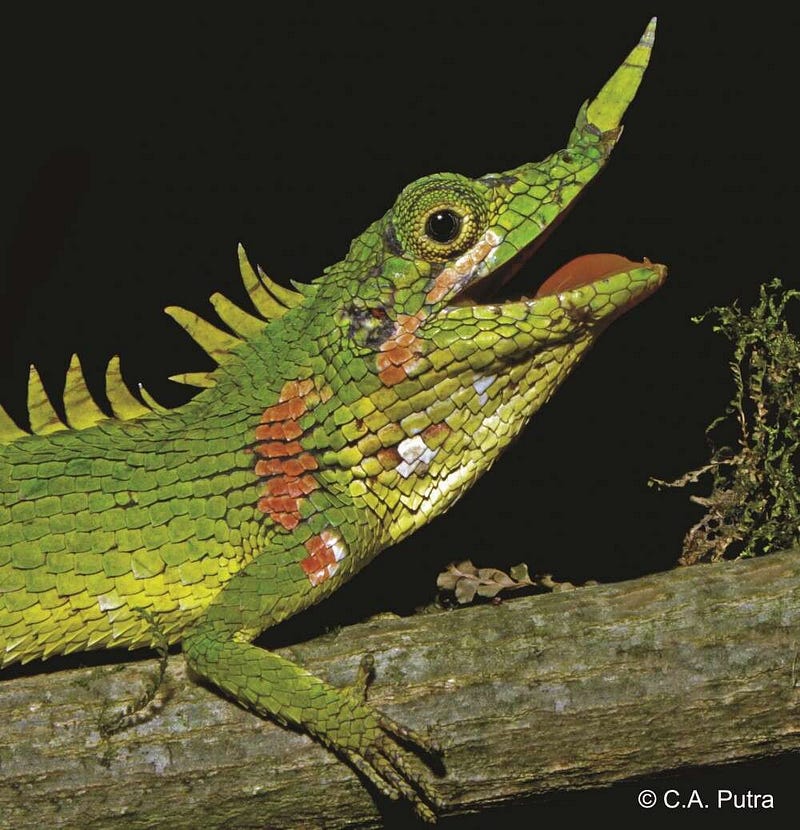
The distinctive nose spike of Harpesaurus modiglianii. Photo by Chairunas Adha Putra, 2018

A Couple of Cool Creatures

A really small, rare lizard and a really large ray fish

I don’t know about you but I find it hard to keep up with all the amazing creatures on this planet that I never heard about! Like the one in the photo headlining this post.

When I run across creatures like the two I’m going to talk about in this article, what I usually find is that the article highlights an unusual event that it tells you all about.

And then it stops there.

Usually nothing or very little about the biology of the creature of interest, just a grabber headline and a short post so you can say, wow, cool!

But that always leaves me a little unsatisfied. You introduce me to a totally cool organism and then gloss over all the interesting biology.

So that’s my job!

And that’s what you’re going to hear about in this post. The “grab” and then a lot more!

First, the little one

It’s a nose-horned dragon lizard and it was first collected and described to Western science in Indonesia in 1891 by Italian explorer Elio Modigliani.

Because he found it, his name was used for the species designation, Harpesaurus modigliani. A picture of it was included in a treatise on lizards by Vinciguerra in 1933 in which this print appeared.
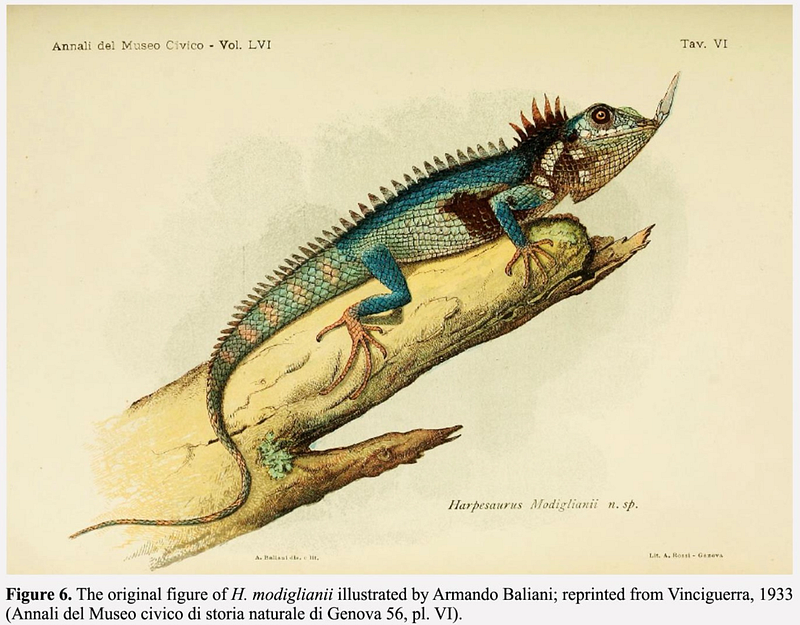
This illustration was made in 1933 based on the original lizard first found in 1891. That specimen turned pale blue due to how it was preserved.

And then it was never seen again…

Etymology and more interesting facts and speculation.
harpē: (ἅρπη) was a type of sword or sickle; a sword with a sickle protrusion along one edge near the tip of the blade. The harpe is mentioned in Greek and Roman sources, and almost always in mythological contexts. (from Wikipedia)
saurus: From Ancient Greek σαῦρος (saûros, “lizard, reptile”). The broader use, which has become standard especially for dinosaurs, follows some of the earliest non-avian dinosaur genera to be named, particularly Megalosaurus (literally “giant lizard”). (from Wiktionary)
And I can't help but wonder if the name of Tolkien's arch-villain in the Lord of the Rings trilogy, Sauron, wasn't inspired by dinosaurs and other reptilian creatures.
Wikipedia lists 6 species of Harpesaurus and all are found in Indonesia.

Until Chairunas Adha Putra came across a dead one while doing a bird survey in the mountanous region around Lake Toba in North Sumatra in 2018. He confirmed that it was H. modigliani and published an article describing it.

Since the one he found was dead, he was asked to go back into the area to see if he could find any live lizards. After 5 days of searching the area he hit paydirt!

He came across alive nose-horned dragon lizard sleeping on the branch of a tree!

He took some photos and recorded its stats. He also noticed that like a chameleon, it changed its colour from lime green to a dull orangey-brown when it was threatened.
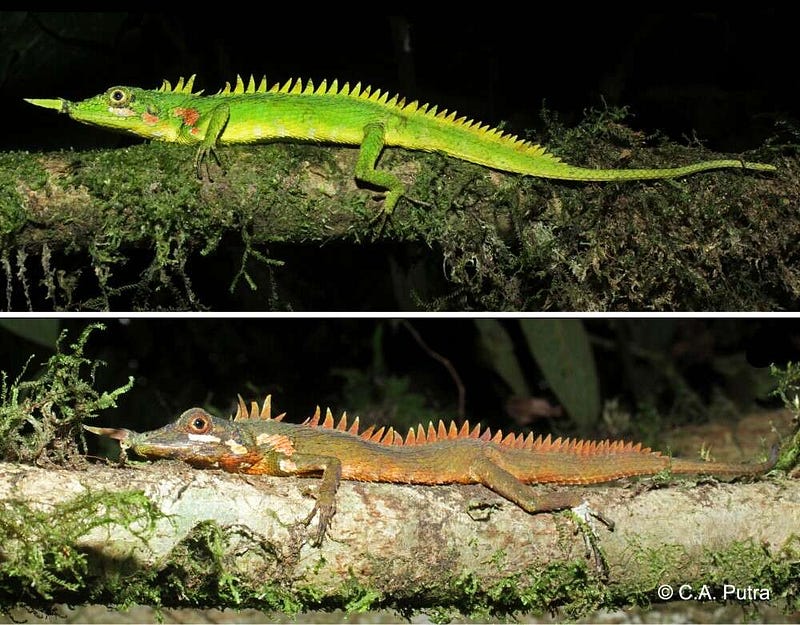
Colour change when threatened. The full-grown lizards are only about 3 inches in length.

Putra and his team found it in a moist mountainous forest area at 1675 m elevation that was wet due to it being in the rainy season (June–July). The canopy was dominated by large trees, but there were many open places under a mid-layer of medium size trees covered with mosses; the forest floor was mostly leaf litter and moss.

Unfortunately, it was found outside of any conservation areas and near to where massive deforestation is happening nearby.

like a chameleon, it changed its colour from lime green to a dull orangey-brown when it was threatened

Putra and others are hoping they can get some kind of protection status for the areas where this lizard has been found, especially as the area is quite remote.

They also recommend the government “protect the habitat of H. modiglianii and other such rare mountain taxa, and rigorously enforce existing laws, especially those relating to logging. We have observed some attempts of trading of this species via social media applications, and the local traders offer this species for USD 100 per individual. Most of the captured individuals by the traders were fully grown adult males, captured from forested areas around Berastagi (1,300 m a.s.l.). Considering the current habitat destruction and threats from pet traders we highlight the conservation urgency.” (bolding is mine)

And how typical is this? It’s rare so let’s get as many as we can and sell it into extinction!

(Forgive the sarcastic rant; I don’t know the society or wages but I can guess that many people in the are are economically disadvantaged and this might help them. Even if that is the case, surely this is not the way to solve that problem.)

Interesting note: Wooden arts and folktales of the Bataks — indigenous people native to the region — show that lizards have a special place in the people’s mythology.
Their houses often have gables with carvings of horned lion heads, snakes, lizards or monsters with bulging eyes to protect the occupants from evil spirits.

And that’s all I want to say about the nose-horned dragon lizard of Northern Sumatra.

Next, the big one

Freshwater giant stingrays.
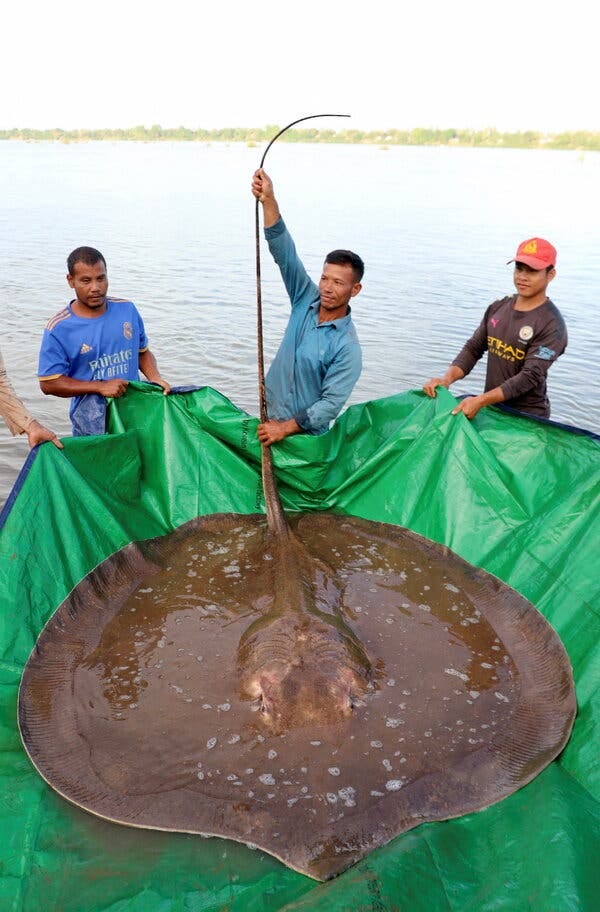
A giant freshwater stingray rescued in the Mekong River in Cambodia on May 5 measured 13 feet long and weighed 400 pounds.Credit…University of Nevada, Reno, via Reuters

If you can believe it, this stingray was caught by a fisherman!

It turns out that this is not an uncommon event.

Luckily, this time the fisherman called Chea Seila, a coordinator for the Wonders of the Mekong Project. Seila and her team drove through the night to reach the site and in the morning they helped organize the release of the fish back into the Mekong River.

They had to be very careful, both to ensure the fish survived and to make sure that nobody was stung by it.

Wait, they can sting me? Read on…

So what do we know about these stingrays?

First, its taxonomic name is Urogymnus polylepis and its common names in English are whipray and giant stingray. It is the world’s largest known stingray species and was given its name by Pieter Bleeker in 1852. He was famous for the Atlas Ichthyologique des Indes Orientales Néêrlandaises, his monumental work on the fishes of East Asia published between 1862 and 1877.

The whipray inhabits sandy bottoms in estuaries and large rivers and feeds on other invertebrates and fishes. It is caught occasionally in nets and longline fisheries operating in riverine and estuarine areas. People eat its meat and possibly its cartilage. It’s often sold as fresh meat after having been cut into pieces by the kilogram.

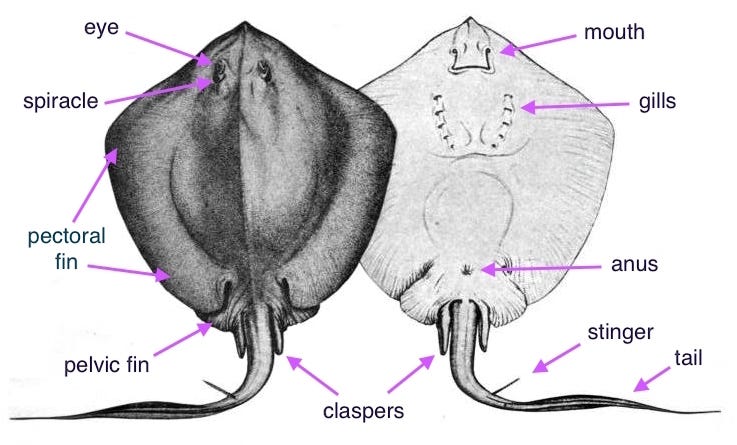
The disc can reach up to 8 feet in width not including the whip and it can weigh up to 1300 pounds. They breathe through holes called spiracles on the top of their body.

On the tail it has a sharp barb or stinger up to 15 inches long that can easily penetrate human flesh and bones and deliver toxins into the wound.
By New Jersey State Museum — File:Dasyatis say njsm.jpg, Public Domain, https://commons.wikimedia.org/w/index.php?curid=69022718

“Stingrays [bear] live young in “litters” of five to thirteen. During this period, the female’s behavior transitions to support of her future offspring. Females hold the embryos in the womb without a placenta. Instead, the embryos absorb nutrients from a yolk sac and after the sac is depleted, the mother provides uterine “milk”. After birth, the newborns swim away, having been born with the instinctual abilities to protect and feed themselves. In a very small number of species, like the freshwater whipray (Himantura chaophraya), the mother “cares” for her young by having them swim with her until they are one-third of her size.” (from Wikipedia)

Evidence from some species of stingrays in public aquaria suggest that females can store sperm from the males and then give birth when conditions are suitable.

Unfortunately, it is threatened due to over harvesting and pollution of its river habitats. The IUCN red-listed it as endangered.

And like the nose-horned dragon lizard, these giant whiprays are being captured and sold to a burgeoning aquarium trade.

Some countries, like Thailand, have made it illegal to fish for stingrays and we can only hope this trend spreads throughout its range.

You should protect it so your kids in the future will also know that we have a giant stingray in our village

“Seila has been working in these communities since 2005, developing trust and building partnerships between the project and the people who share the river with these species. And that work seems to be paying off. Now, when someone accidentally hauls in a giant creature, they may reach for a phone instead of a filet knife.

She said a local leader told her that he had never seen a giant freshwater stingray. And during the release, she watched as he spoke with two young boys.

She said she heard him identify the animal to them and say, “You should protect it so your kids in the future will also know that we have a giant stingray in our village.”

And that’s some good advice, if I do say so!

So there you have it; a tiny horn-nosed dragon lizard and a huge freshwater whipray.

I hope you enjoyed learning about these creatures as much as I did!

Until next time,

Rich

P.S. Hey! If you enjoyed this article and want a heads up for the next one, you need to subscribe to my feed and join my tribe! And I’d love it if you shared this with your friends!

Sources:

  1. Rediscovery of Modigliani’s nose-horned lizard, Harpesaurus modigliani Vinciguerra, 1933 (Reptilia : Agamidae) after 129 years without any observation, by C. A. Putra, et al., (2018).
  2. Nose-Horned Dragon Lizard Found Alive For The First Time In Over 100 Years by Rachael Funnell, (2020).
  3. A nose-horned dragon lizard lost to science for over 100 years has been found, by Dyna Rochmyaningsih, (2020).
  4. Watch a Giant Stingray’s Safe Return to Its River Home, in the New York Times, (2022)
  5. Urogymnus polylepis (Bleeker, 1852), Giant freshwater whipray in fishbase.se
  6. Giant freshwater stingray in National Geographic database.
  7. Stingray page on Wikipedia.
Conservation
Endangered Species
Biology
Surprise
Animals
Recommended from ReadMedium