
Rise and Fall of the Machine Man
Jacob Epstein’s ‘Rock Drill’ prefigured Readymades, realia-fusion, and the Futurist figure in sculpture
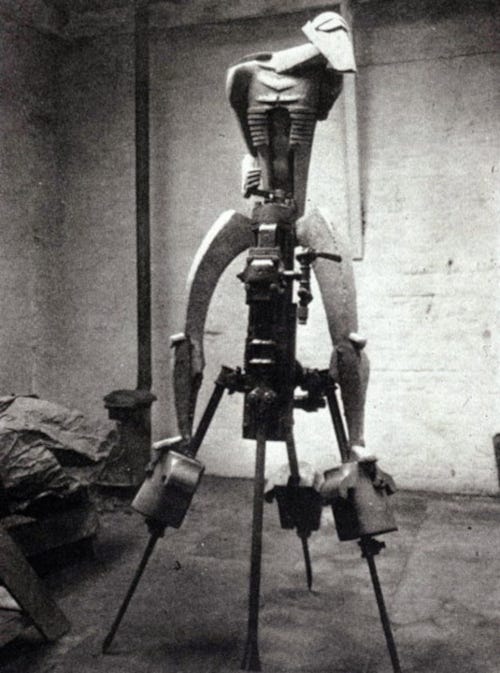
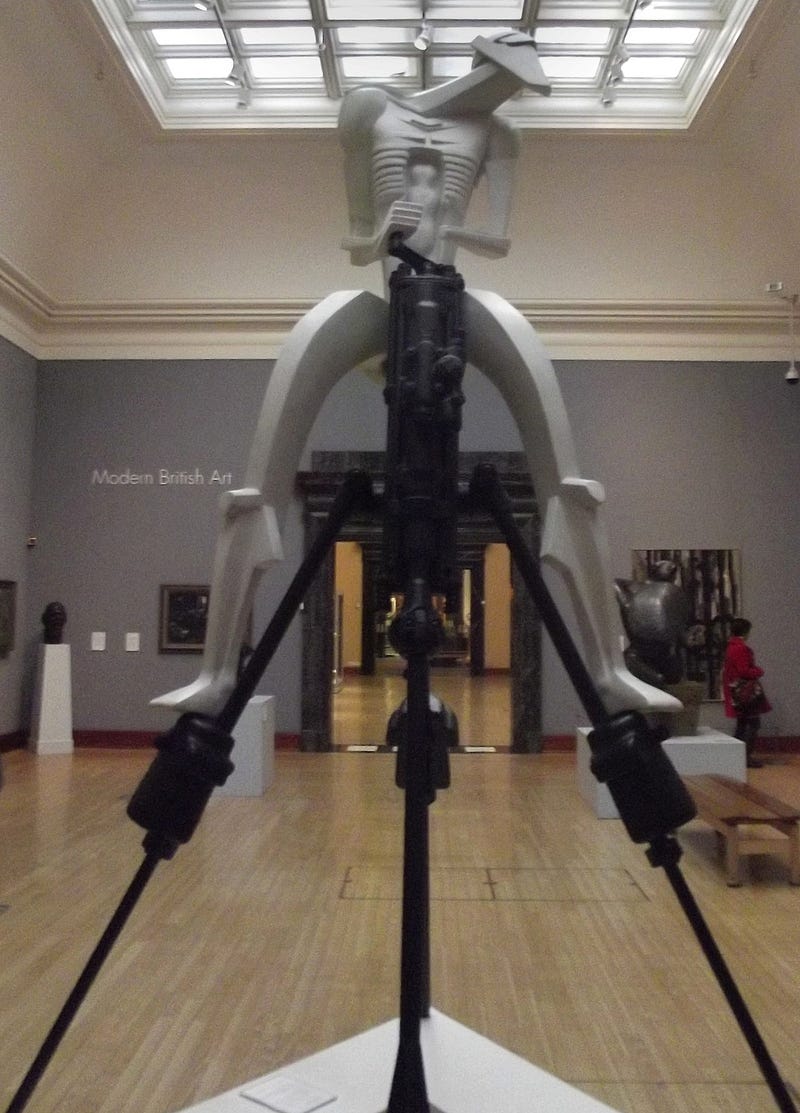
No one really knew what to make of Rock Drill, including its creator, the sculptor Jacob Epstein. In 1913, the imposing ‘monster’ was unlike anything else, perhaps more akin to a work of science fiction than fine art. A human form resembling some sort of cybernetic fusion of flesh and machine straddles a powerful drill, braced at the apex of its three shanks. A foetus-like form is carved into the humanoid’s abdomen — implying the future as well as man’s latent yearning to birth his progeny through the dynamic power of mechanised labour. It’s a totem of virile creativity, a venerable icon of mankind elevated by industrial progress. Yet, there is something sinister, imposingly inhuman, too…


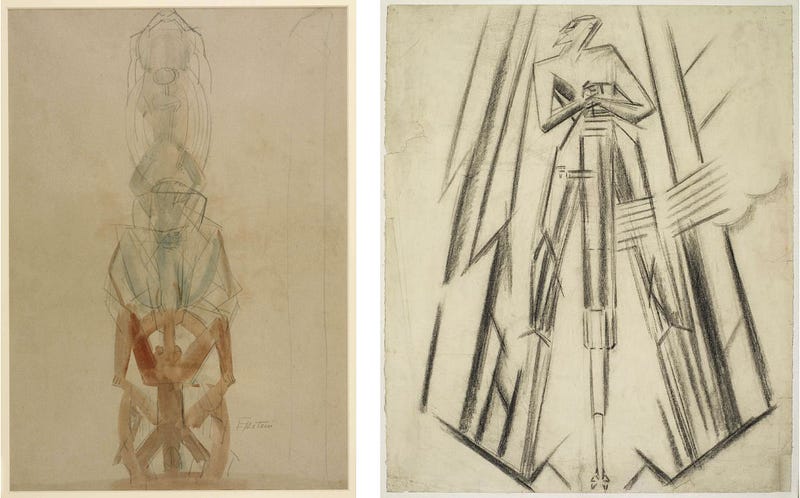
It seems from an extensive series of studies and expressive drawings that Epstein was interested in the acts of creation and procreation as lustful driving forces behind the many positive advancements, also negative aspects, of humanity as it charged headlong into the twentieth-century. A chain of drawings links his series of copulating doves sculptures to the imposing first iteration of Rock Drill. The drawings also clearly illustrate Epstein’s interest in tribal art and primitivism leading him toward a style of geometric Cubism.
In his 1913 drawing, Totem, he explored a human variation on the two doves, one on top of the other, with a drawing depicting a reductionist male figure with a female mounted above it. The drawing was a design for a large sculpture never produced and the combination of figures suggested both birth and impregnation and led directly to one of the first sketched-out ideas for Rock Drill. The cycle of life, perhaps, but also the drive to create and a subconscious desire to return to the pre-birth state of innocence through the loss of self. Another related study showed a totemic male form, this time more angular and mechanistic, with the embryo of a child within…
Rock Drill picks up on these themes and adds to them. The figure is mounted in a way that implies both impregnation and birth. Also the man is mounted upon the machine, dominating it, yet he relies on the machine for support whilst at the same time being separated from ‘mother earth’ by it. His union with the mechanistic removes him further from anything naturalistic and his form begins to resemble metal more than flesh.
In its original form, Rock Drill was exhibited in 1914 at the first exhibition held by The London Group — an association of avant-garde artists shunning tradition, heralding the Modern. The figure was carved from chunks of plaster and the drill was a piece of realia.
The use of plaster wasn’t unusual in maquettes but not often presented in finished works as it is a fragile, and not particularly durable, material. The Italian Futurists favoured it as a sculptural substance for those very reasons, believing that art should be temporary and of fleeting relevance as the world rapidly changed around them. Umberto Boccioni’s equally radical treatment of the human figure, Unique Forms of Continuity in Space, was also carved in plaster that same year. This is not the only factor that aligns Epstein’s work with the Italian Futurists and their British associates, the Vorticists, though he didn’t ascribe to the philosophies of either.
However, the use of an actual rock drill, procured from a Welsh quarry where Epstein had seen one in use, is perhaps the most striking element of the piece and an innovative use of realia. Marcel Duchamp had made his Roue de Bicyclette assemblage around the same time and would soon present his Bottle Rack as a stand-alone Readymade. Sometimes, Rock Drill is cited as among the first Readymades but the inclusion of a rock drill as a significant sculptural element is not the same as presenting an existent object as a sculptural form in itself, assigning it new context and meaning, as Duchamp did. Here, Epstein presents the rock drill as a rock drill. It’s not a re-presentation and its sculptural function is to be what it is. But that didn’t stop it accruing further, maybe unforeseen, connotations…
The First World War broke out the same year as Epstein revealed this imposing statue and although he never saw active service at the front, it changed him as a man, and artist. Friend and fellow sculptor, Henri Gaudier-Brzeska died in the trenches of France in 1915 — one of his final works had been a mother and child, carved from the wooden stock of a captured German rifle. Art critic Thomas E Hulme, who was working with Epstein on a monograph about the sculptor’s work, was killed in shelling at Flanders just before Epstein was conscripted. After his application to be an official War Artist was turned down, Epstein began military training but suffered a nervous breakdown and was finally discharged, shortly before the War ended in 1918.
Epstein had first seen the rock drill in action within a great, cathedral-like cavern that had contained the deafening echoes of its fierce rhythm. This frightening fusion of man and mechanism impressed him as a symbol of the machine age. The operator was empowered by the great, phallic power-tool, yet it was brutal and brutish. He saw that the human was becoming more closely combined with industrial technology and increasingly separated from the natural, primal world.
Following the War, it seems that the deafening noise of relentless progress had been usurped by the resounding clamour of battle. The form, function, and colour of the drill took on a chilling resemblance to a heavy machinegun. Epstein saw men, not empowered by their command of machines, but damaged or destroyed by their own creations.
He didn’t concur with the Futurist notion that there was beauty in violence nor that the rhythm of a machine gun could stir the human spirit more than any great symphony. Machinery no longer seemed like a motif of advancement toward an industrialised future, but of death and destruction — the antithesis of creativity.
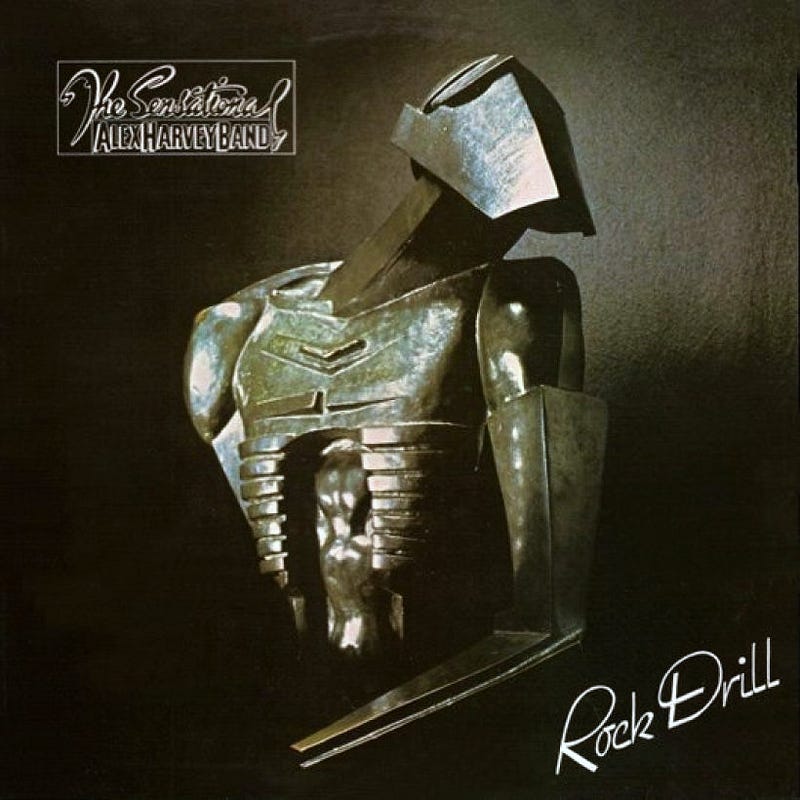
So, Epstein separated the power-mad man from the weaponised drill. He rendered the potent figure dismembered, incomplete, vulnerable, and robbed of masculinity. The final version was half its former self, retaining the torso and helmeted head, now cast in a gun-black metal. What had become armed and sinister was now injured and impotent… though still carrying within an embryonic hope for our future.
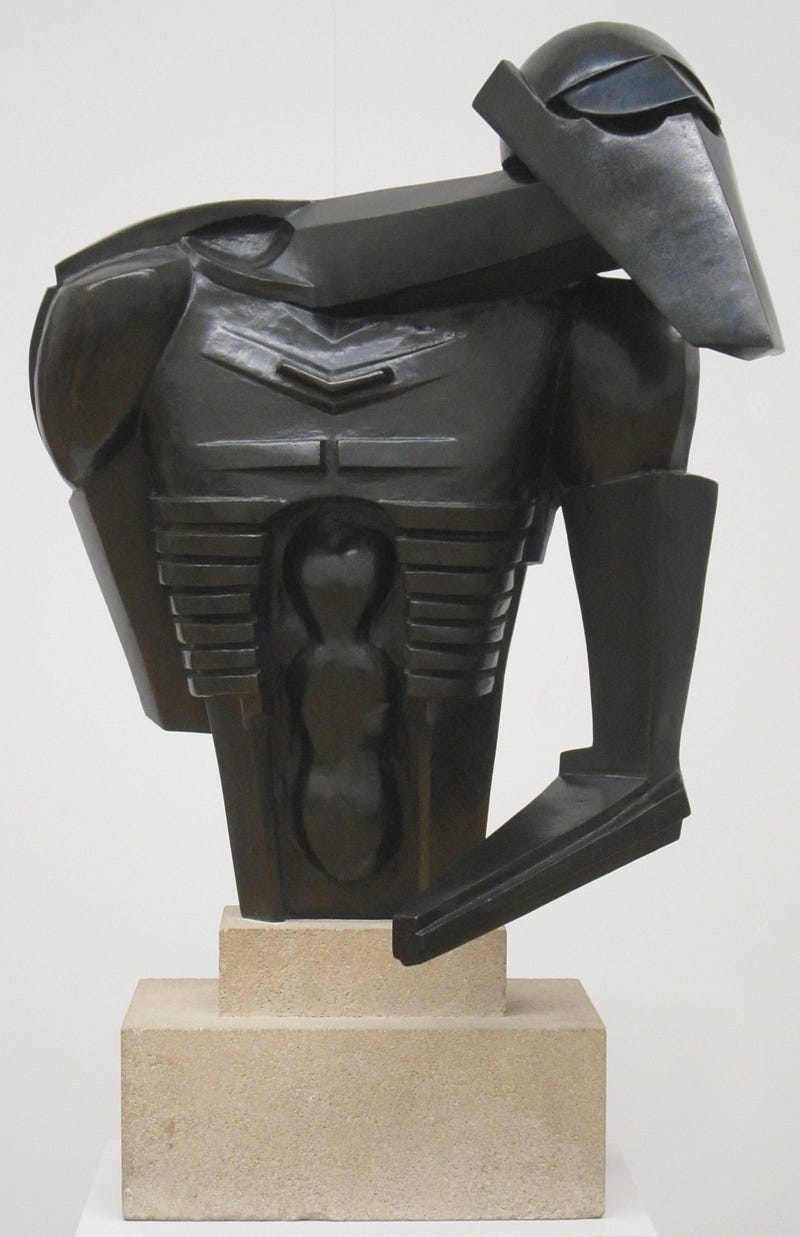

At the London Group’s fourth exhibition, in 1916, only one work of sculpture was shown. Torso in Metal was the radically altered, final version of the sculpture and a profound conclusion to the narrative that began with the series of drawings back in 1913. The monument to progress had become a memorial.
In his 1940 autobiography, Jacob Epstein would reflect on the first version of Rock Drill, writing, “It was in the experimental pre-war days of 1913 that I was fired to do the rock-drill, and my ardour for machinery (short-lived) expended itself upon the purchase of an actual drill, second-hand, and upon this I made and mounted a machine-like robot, visored, menacing, and carrying within itself its progeny, protectively ensconced. Here is the armed, sinister figure of today and tomorrow. No humanity, only the terrible Frankenstein’s monster we have made ourselves into… Later, I lost my interest in machinery and discarded the drill. I cast in metal only the upper part of the figure.”
His dystopian effigy remains a powerful statement with an enduring legacy that resonates through popular culture. A replica of the original version was produced for a 1974 exhibition at Birmingham Museum and Gallery and this appears to have brought the work back to the fore of public consciousness.
In 1978, art rockers The Sensational Alex Harvey Band released their eighth and final studio album titled Rock Drill, featuring a moody monochrome photograph of the work on the cover. In 2006, London’s Tate Modern gallery invited contemporary musicians to select and respond to a work from their collection. Big beat electro duo, The Chemical Brothers, chose Torso in Metal and wrote their track Rock Drill as their response. The concept art for the battle droids first seen in 1999’s epic Star Wars Episode 1: The Phantom Menace was based on Torso in Metal and the same helmet-like head remains evident on screen.
* All images are used with license or presented here for educational purposes under fair usage policy.