
Jacob and his Angels
Jacob Epstein was a controversial artist who introduced new aesthetics and challenged British attitudes
Epstein’s sculpture of Jacob and the Angel is a larger-than-life depiction of Jacob’s all-night struggle with an unknown assailant who finally revealed himself in the morning as an Angel of God, blessing Jacob for his courage and resistance, giving Jacob a new name: Israel — ‘one who struggles with God’.
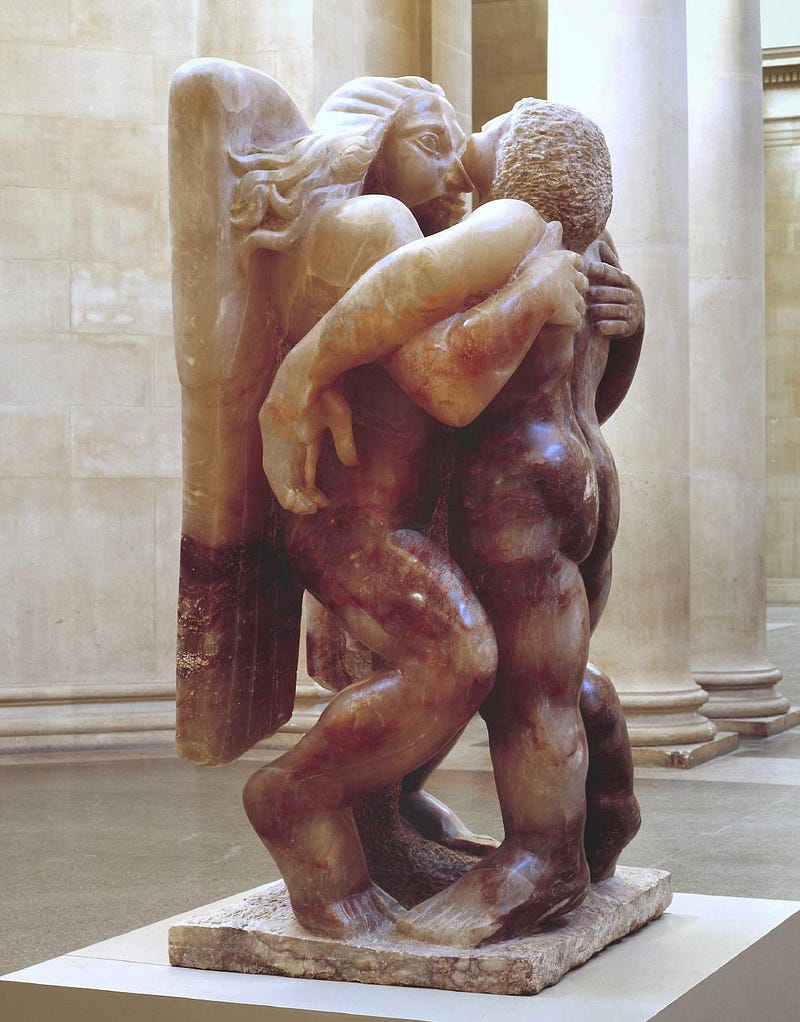
There’s no doubt that this Bible story, from the book of Genesis, resonated deeply with Epstein. Not least because his own first name was Jacob, and he was a Jew. The two-tonne sculpture, completed in 1940, documents Epstein’s continued fascination with Biblical tales and how they related to contemporary events. At the time, Britain was engaged in its own gargantuan struggle, standing alone against Nazi invasion, until America joined the war in 1941. This defining struggle seems reflected in the gigantic, visceral sculpture.
The grappling figures are angular, monumental. The angel wings are almost abstract, retaining the shape of the original huge block of alabaster from which it is carved. The proportions emphasise weight. The wrestling pose is a semi-erotic embrace between angel and man — the figure of an exhausted Jacob is supported by the Angel. Each figure partially obscures the other, inviting us to circle the sculpture as we make sense of its narrative.
The carving is primitive, almost Cubist in style. The colours of the alabaster vary, ranging from brown to pink to milky white. In turns, the textures are smoothly polished or rough, almost like hewn wood. Again, such variations lead the viewer to walk around the sculpture, inviting them to reach out and touch.
The startling embrace of the huge figures shocked many of Epstein’s contemporaries, just as his first commission — sculptures for the façade of the British Medical Association Building on the Strand — had shocked Edwardian sensibilities in 1908. However, based on these he had been commissioned by Robert Ross to design the monument for Oscar Wilde’s grave at Pere Lachaise cemetery in Paris.
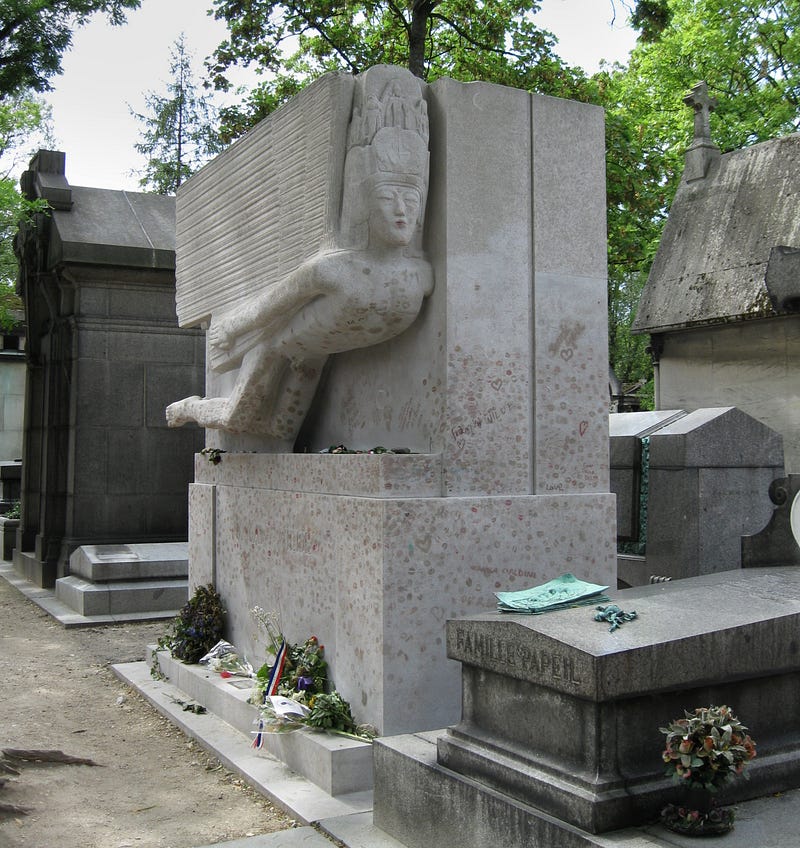

This huge, 20-tonne, limestone sculpture of a winged angel in dynamic horizontal flight with wings spread like a rectangular flag, also showed a Cubist influence and around this time, Epstein had been associated with the British Vorticists. It represents Wilde’s free thinking and was partly inspired by his poem The Sphinx, first published in 1894 after the author had ‘struggled’ with its 174-lines for two decades.
Epstein was also influenced by the monumental Egyptian and Assyrian sculptures on display at the British Museum. The monument was completed in 1912 and installed in the famous cemetery in 1914. It was unveiled at Wilde’s grave by the polymath and occultist, Aleister Crowley, amidst controversy at the size of the angel’s naked genitalia. They were first hidden by a strategically placed bronze butterfly, but the erotic connotations of this only caused more upset and eventually they were vandalised and partly broken off. Attitudes have since changed and, now, The Angel needs the protection of a glass barrier to prevent corrosive damage from the lipstick kisses of adoration being left by those who make the pilgrimage to Oscar Wilde’s grave…
Jacob and the Angel had been unveiled in 1942 and continued to shock and fascinate the public in varying degrees, reflecting Britain’s view of sexuality more than the sculptor’s talent. It was put on ‘Sensational’ exhibition in London’s Oxford Street with a sign which declared ‘What do you think?’
It was also included in a Waxwork Exhibition on Blackpool’s Golden Mile, perceived more as a sideshow oddity than a radical artwork. In this respect it entered popular culture in a way that perhaps had not been seen since Rodin’s full-size sculpture 0f 1882, The Kiss. Epstein was hurt at this reception, frustrated by the lack of understanding, but never compromised on his vision in the face of ridicule.
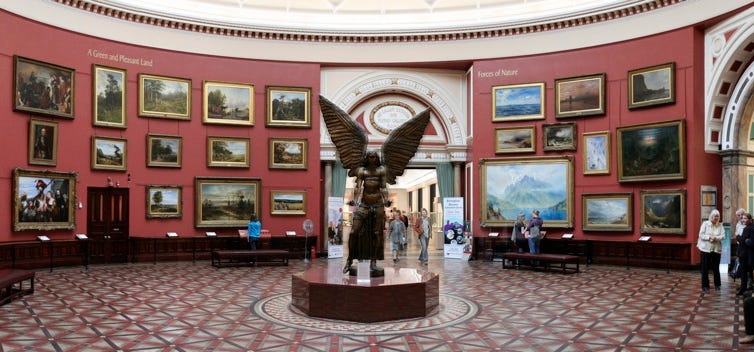

Epstein would repeatedly return to angelic subject material, notably with two monumental works featuring Lucifer. Firstly, a bronze of the Arch Angel as he was before ‘The Fall’, in his state of power and grace when he was the bringer of light, singer of praises, and most beautiful of all the angles. The statue was unveiled at Birmingham Museum in 1947 by Jacob Epstein himself.
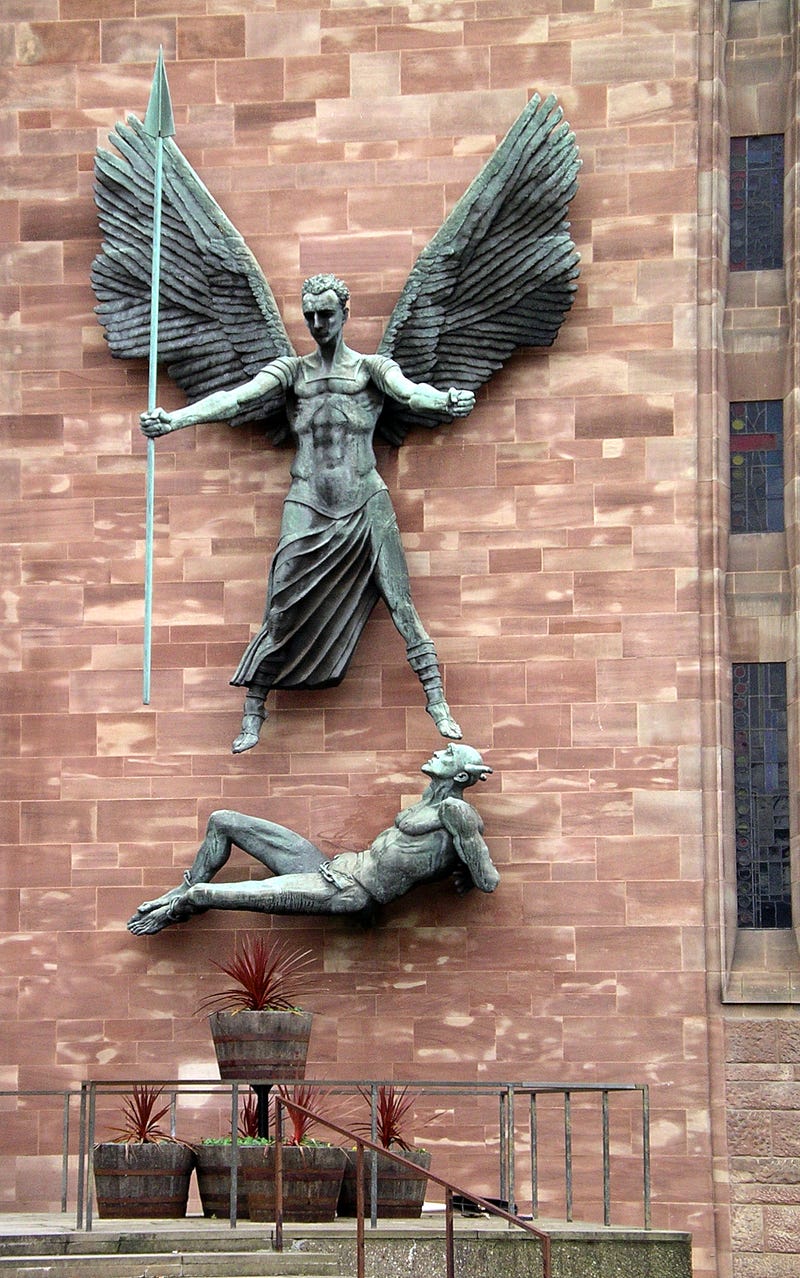
It is fitting that Epstein’s final commission in 1958 was also of an angel, a depiction the Arch Angel Michael defeating the fallen Lucifer, known as St Michael’s Victory over the Devil. The large bronze is mounted on the east wall above the steps leading up to the entrance of the New Coventry Cathedral, which had been rebuilt in the Modernist style after the original was destroyed by the Blitz during the Second World War. The stance of the victorious angel intentionally echoes the earlier statue of Lucifer, now shown wingless and defeated. How things change!
It is said that some of The Church of England Renovation Committee objected because Epstein was a Jew, but another responded, ‘So was Jesus Christ...’ The statue was unveiled, posthumously, in 1961 by Epstein’s widow, Kathleen.

Jacob Epstein had remained true to his vision and finally found the recognition he deserved. It took fifty years for his Jacob and The Angel sculpture to receive its own critical recognition. It was eventually purchased by Granada Television who loaned it to Liverpool Cathedral, and it is now owned by the Tate.
I last saw it on display at the Tate Britain Gallery, just off the main atrium, in a precarious position where it seemed Jacob may be tossed over the banister of the nearby stairwell at any moment. Jacob and The Angel has inspired many modern sculptors — indeed, Anthony Gormley has praised it as ‘an absolute vision, representing the struggle between matter and spirit.’
Long may this beautiful and ‘sensational’ sculpture signify our emotional engagement with art.
* All images are used with permission or presented here for educational purposes under fair usage policy.