
Our Obsession With Punishment & Retribution
Retribution versus restoration

Why are we, as a society, so damn obsessed with punishment and retribution?
Note that I work with children, and while I have worked in the youth justice system, I’m focusing here on everyday minor infractions, not criminal offences.
We carry this false belief that a person has to learn what they did was wrong, so they must be punished in a manner commensurate with their misdeeds.
There’s a significant flaw in our logic here.
If the person did not know what they were doing was wrong, then why is it appropriate to punish them, if their actions were done out of ignorance and without malicious intent?
If they did know what they were doing was wrong, then we don’t need to “teach them a lesson” because they already know.
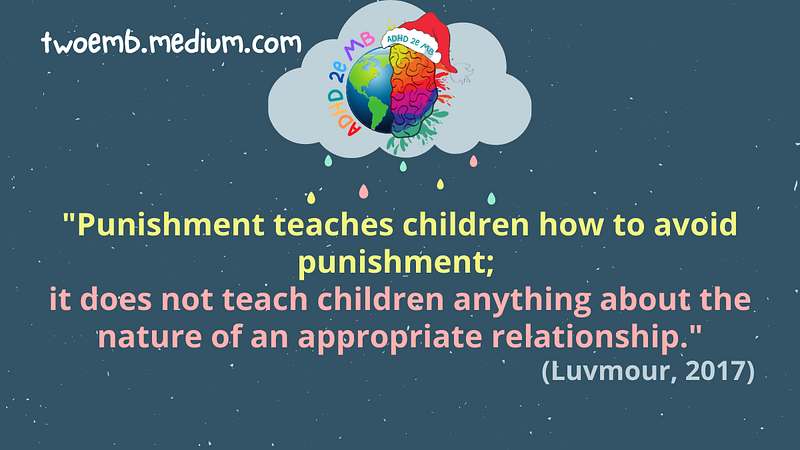
In either case, what is truly needed is education, not punishment. Either we need to teach them how and why what they did was wrong, or teach them better ways of getting what they need without infringing on the rights of others.
We also describe punishments as deterrents — If the prescribed punishment is severe enough, people will think twice before acting.
Except that assumes people’s misdeeds are done with malice aforethought, meaning it was pre-meditated, they thought long and hard while weighing the pros and cons.
It’s not usually like that. Most of us have wronged others either out of ignorance, by accident, or as an impulsive response to something that upset us or made us angry.
When I advocate for a more restorative approach, I’m told that a strong message needs to be sent, and we couldn’t possibly “bend the rules” for someone, lest we look soft.
So what exactly is our goal here, then? To wield our authority and make someone feel shame for what they’ve done, or to actually help them learn better ways of getting their needs met?
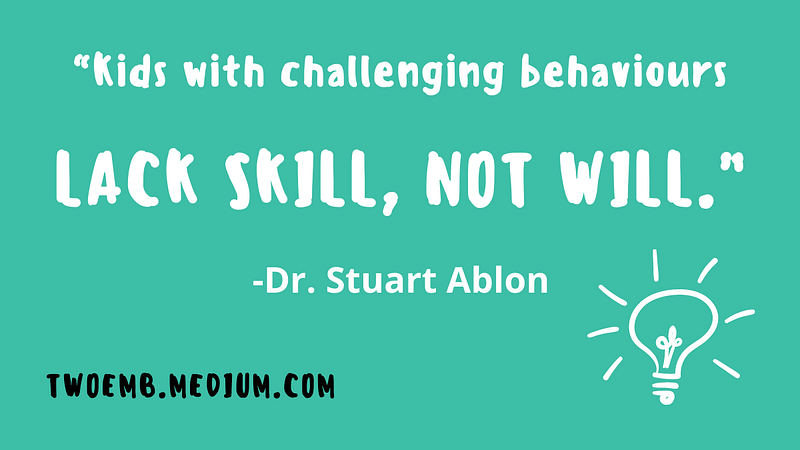
“The misguided intention to help these kids “make good choices” often results in us big people responding in ways that can be even more harmful. We’re punishing them for the lack of skill they don’t yet have, or for a psychological injury that has yet to be healed.” — Dr. Jody Carrington
What is restorative justice?
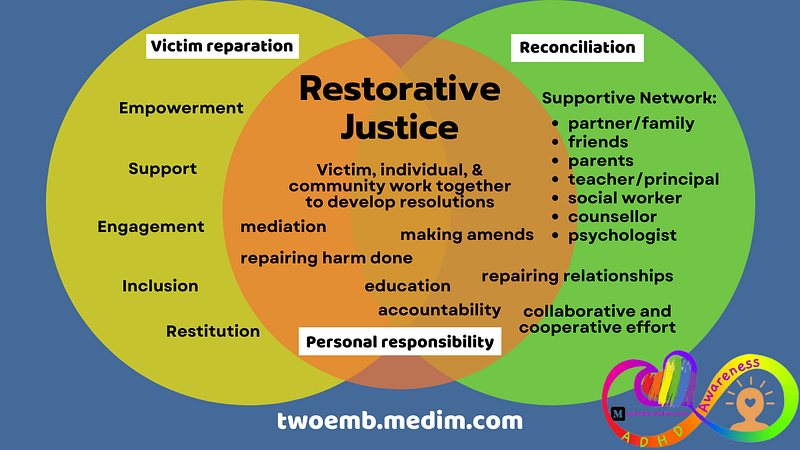
Restorative justice is a concept that began in our criminal justice system, but the ideas of restoration and reconciliation have been around for eons.
Reconciliation means “to restore to union and friendship after estrangement or variance.” Its origins come from the French verb reconcilier, and from the Latin reconcilare, which means “to bring together again”.
“Restorative justice is a paradigm shift that focuses on building community and repairing harm between people, rather than compliance and obedience based on rules.” — Alex Shevrin Venet
As an advocate for children, when I refer to restoration and reconciliation, I’m usually speaking of supporting children who have found themselves in trouble at school or in their communities.
Most adults view children’s behaviour as intentional, willful, and premeditated. This is quite often not the case, which I have outlined extensively in a number of previous articles.
“When we view behaviours as intentional, we tend to use disciplinary strategies aimed at a surface target rather than the underlying cause of the behaviour.” — Dr. Mona Delahooke
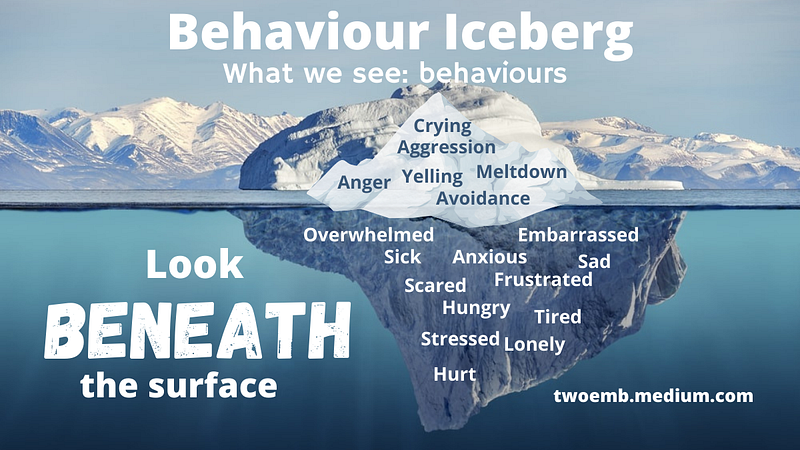
Concerning behaviour often stems from lack of knowledge or skills, stress, impulsivity, and emotional dysregulation.
Instead of focusing on meting out punishments, restorative justice practices focus on the harm caused to people, relationships, or the community — that community can be anywhere, such as a school, classroom, workplace, sports team, or family home.
The three principles of approach are:
- Repair: repairing harm done;
- Connection: the parties work together to decide how best to repair the harm done and come to a resolution;
- Transformation: this approach can lead to fundamental changes in people, relationships and communities.
In the school or community environments, I like to think of it as a culture shift or paradigm shift. We’re looking at how to support, teach, and guide people, rather than focusing on rewarding “good” behaviour and punishing “bad” behaviour.
On a personal note
When I was a kid I got myself into trouble a lot.
Like, a LOT.
Sometimes I was “willful and defiant”, but often times I was either socially oblivious, experiencing extreme stress, or reacting to the injustice and maltreatment I frequently experienced.
I had very few friends at school, and was bullied a lot. Sometimes I got in trouble for retaliating, or for simply standing up for myself. I also got in a lot of trouble for going along with things because I wanted to be accepted and included, even if it was in something I shouldn’t be doing.
Another thing that got me into trouble a lot was my big mouth and impulsivity. I have always been very opinionated, had strong feelings, and have rarely — if ever — been afraid to speak my mind.
I was (and still am) highly sensitive to anything I perceived as an injustice, and it didn’t matter to me if the person was in a position of authority, I had to stand up for what I believed was right.
A positive character trait in a lot of situations, perhaps, but at that time I had zero ability or desire to pick my battles… so I picked all of them.
I also had a rough childhood and was undiagnosed Autistic and ADHD, so not only did I not learn effective social skills, I also had divergent neurology nobody even knew about.
“It’s not about how we’re going to stop the behaviour, but how we’re going to support the kid.” — Dr. Jody Carrington
A practical example
My son once received a one-day suspension for throwing a snowball at an Educational Assistant. Suspended. For throwing a snowball. He was 6 years old and she was… a grown woman.
The children were called inside for recess, and my son and a friend of his decided they did not want to go inside (given how the school was run, I don’t blame them). The EA approached the boys, asking them to come inside.
So it became a game. The boys were giggling and running around. The EA became frustrated and angry with them, and moved toward them using a stern tone, yelling at them to “GET INSIDE NOW!”
I can tell you that to small 6 year old boys, this kind of approach would be intimidating and would cause their brains to go into fight-or-flight mode. In response, the boys said “let’s throw snowballs at her!”
They threw a few that missed her, but instead of giving them space, this EA decided it would be a good idea to continue moving closer, despite the fact that they were throwing snowballs at her, and she apparently did not want to get hit with a snowball.
One of my son’s snowballs eventually made contact, so the EA finally backed off, and guess what? The boys went inside.
I’m not saying it was okay for the boys to not listen and go inside when the bell rang, and when the EA asked them to. I’m not saying it’s okay for them to instead run around and throw snowballs.
What I am saying, though, is that the EA handled the situation poorly. She could have used skill instead of trying to use intimidation, physical presence, and yelling to force them to comply.
When the boys were throwing snowballs in her general direction, what did she think was going to happen? Why would she move closer, escalate the situation by her body language and loud voice, and then blame them when one of the snowballs hit her?
“What we tend to be punishing (with suspensions and expulsions), is actually emotion dysregulation.” — Dr. Jody Carrington
Also, why was my son suspended, and the other boy not? He got suspended for having better aim? (I don’t think either of them should have been, but it seems silly to punish the one who hit the target and not the one who missed).
Why was a first grader suspended for throwing a snowball? It wasn’t an ice ball, it was snow. He was 6. She was a grown woman. It’s not like he could have hurt her with a snowball.
Why turn it into a power struggle in the first place? You already have a staff member pulled away from their job to try to wrangle the unruly boys, why not just go inside and supervise them from a window? They would get bored of the game really fast (also cold) and come inside.
Later someone trained in Collaborative Proactive Solutions (CPS), or at least more skilled than that person was, could sit down with the boys and find out why they didn’t want to come inside.
Come to find out, they were both experiencing a lot of stress at that school. See, kids don’t sit us down and say “dear adult, I am feeling a lot of stress right now, I’m having a hard time regulating my behaviour and emotions, and could use some support.”
That would be nice, but developmentally unrealistic. When children are stressed, they tell us with their behaviour.
Most adults don’t even have those self-awareness and communication skills when we’re feeling stressed. Both of the boys were later diagnosed with ADHD and the clinical team developed Individual Education Plans (IEPs) for them.
My son no longer attends that school.
“Too often, caregivers, teachers, providers, and parents assume that a child is acting deliberately, when in fact a behaviour is actually a stress response.” — Dr. Mona Delahooke
We need to sit down with children, and instead of punishing, shaming, or guilting them, ask them what their experience was and give them room to explain themselves without being interrupted, corrected, or disbelieved.
Kids don’t sit us down and say “dear adult, I am feeling a lot of stress right now, I’m having a hard time regulating my behaviour and emotions, and could use some support.” They tell us with their behaviour.
A restorative approach does not lack accountability
This doesn’t mean there shouldn’t or wouldn’t be accountability, it means that instead of (over)reacting with swift and severe punishment, we actually take the time to do this right.
We take the time to help the child understand why their actions were problematic.
We can help them identify and empathize with the EA’s experience: they can have a conversation in which she describes what the incident was like from her perspective, to help the children understand.
We take the time to find out the cause of the concerning behaviour. Getting to the root of the issue is the only way we can identify the problems without making assumptions and jumping to conclusions. We then work with everyone involved to collaboratively come up with solutions.
“Our traditional discipline policies and protocols have been reactive and reflexive, focusing primarily on consequences.” — Dr. Lori Desautels
Instead of reactively punishing misbehaviour, we uncover the real-life causes, so as to collaboratively develop realistic, proactive, and workable solutions. Then we help the child learn skills and strategies so as to avoid similar issues in the future.
That’s how we “teach them a lesson” for real.
Y’know, by actually teaching them.
© Jillian Enright, ADHD 2e MB
This leads me to a recent piece I wrote about the dangers of demanding blind obedience:
When you join medium, as a member you’ll have access to unlimited reads for only $5 per month. If you use my referral link, I’ll earn a small commission, and you’ll earn my undying gratitude.
Related Stories
References
Carrington, J. (2020). Kids These Days: A game plan for (re)connecting with those we teach, lead, and love. IMPress Books.
Delahooke, M. (2019). Beyond Behaviors: using brain science and compassion to understand and solve children’s behavioral challenges. PESI Publishing.
Desautels, L. (2020). Connections Over Compliance: Rewiring our perceptions of discipline. Wyatt-MacKenzie Publishing.
Greene, Ross, W. (2021). Lost & Found: Unlocking collaboration and compassion to help our most vulnerable, misunderstood students, and all the rest. (2nd ed.). Jossey-Bass.
Venet, A.S. (2019). Equity-Centred Trauma-Informed Education. W. W. Norton & Company.


