
CREATING BETTER CONTENT: SEVEN-PART SERIES
Part 3. Creating Better Content: Grammar, Using The Right Words, and Online Tools
A seven-part series that explains why it’s important to create your best content, not just any content

In parts one and two of this series we’ve covered Beginning your journey, The challenges editors face, Why You’re writing, Self-publishing vs publications, The challenge of good writing, plus Language, spelling, punctuation and capitalisation.
In this, part three, we’ll look at Understanding grammar, Using the right words, and using Online tools to aid your writing

Understanding grammar
The introduction of mobile phones and text-messaging created a less-is-less mindset, where fully spelt words and punctuation served only to slow down the need for rapid communication.
It’s easier to write ‘lol’ than ‘laughing out loud’, or ‘imho’ instead of ‘in my humble opinion’, or ‘fwiw’ instead of ‘for what it’s worth’, or ‘gtfoh’ instead of… ok, let’s not go there.
Textspeak, as it became known, is not wrong, per see. It’s a creative language shaped by the people who invented it and is a sign of the times because language is, and always has been, fluid.
But that doesn’t justify poor spelling and grammar when writing anything other than a txt msg 2 yr m8s.
Off with his head
Our everyday language continues to become more relaxed and more acceptable, as it is with each passing generation.
Let’s look at split infinitives. The famous prologue narrated during each Star Trek film’s opening scene is a perfect example of when something is not correct, but we use it anyway. It begins:
“Space, the final frontier. These are the voyages of the Starship Enterprise”
and ends with:
“To boldly go where no man has gone before”
The last line is grammatically incorrect because it splits the infinitives ‘to’ and ‘go’. The rules of grammar say infinitives should [generally] remain together, so the correct wording here would be:
“To go boldly where no man has gone before.“
Splitting infinitives is not a terrible crime (I’m expecting hate mail now), mainly because the general meaning of the sentence remains clear. Putting the word ‘bold’ before or after the word ‘go’ doesn’t prevent it from adding emphasis to the sentence that tells us what they’re going to do or be — they’re going to be bold.
Nobody is expecting every writer to use perfect Queen’s English, thank goodness. I try hard to get it right, yet still, the grammar-nazis might not be overly impressed with my efforts.
If learning the correct use of grammar is important to you, there are a couple of great books you could invest in: “The Elements of Style” (Strunk & White), and “On Writing Well” (William Zinsser). They are both intensely educational and informative on every aspect of perfect grammar and punctuation.
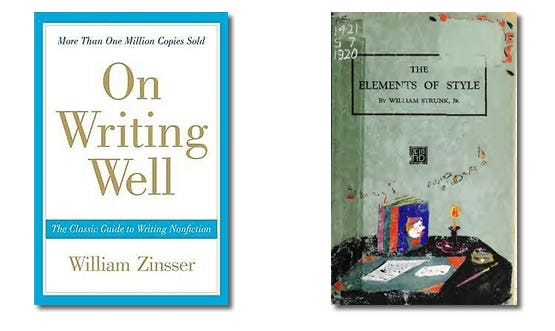
Book books are a little challenging to read because they’re so perfectly written in every way possible, and to those of us without a University education, it somehow feels a little unnatural. And yes, knowing the rules is important, especially if you want to break them.
Consider this:
Self-publishing or submitting an article that is littered with spelling mistakes, poor punctuation and lazy grammar is like wearing Bermuda shorts and a Hawaiian shirt, and to a business meeting — your [lack of] dress sense will overshadow even the best sales pitch. However punchy, shocking or important the message in your article, people may be put off reading it (or reading it all) if it’s full of errors.
Focus on making sure your text flows well and is easy to read.
Using short, simple words is fine, too. Both Zinnser and Strunk explain how using simpler words helps you reach a wider audience. There are no prizes for using extraordinarily incomprehensible and quintessentially lengthy words, as that’s just circumlocution for the sake of it.
Using the right words
The language advice in this series is not attempting to be an English lesson; it’s only there to help you understand some common traps that may result in your articles not being published, or being published and not read.
Here are some simple examples of where writers can easily get caught out:
Homographs are words that are spelt the same and usually sound the same but have different meanings. For example: bark (tree & dog), address (speak to & location), match (game & equal to), ring (jewellery & sound), spring (season and bouncy thing).
Some homographs sound slightly different, such as the word; sewer (‘so-wer’ meaning seamstress, and ‘soo-er’ meaning the sewage system).
Even more tricky are those with more than two meanings, such as the word; present, which also has two distinct sounds: “There is no time like the present to present a friend with a present.” Present (time, give & gift).
Homophones are words that sound the same, but are spelt differently and have different meanings. For examples: knight (soldier) & night (time period), right (direction or correct) & write (words), steal (take) & steel (metal), flour (ground grain) & flower (plant).
Different words are different: Another trap both native and non-native English speakers/writers fall into is swapping words that are completely different words, just because they look and sound similar.
For example: affect (to influence) and effect (the result of change), adverse (negative/opposed) and averse (dislike of), continuously (unending) and continually (occurs repeatedly), farther (distance) and further (more of), principle (rule) and principal (person), and so on.
To some, this would be like saying, “I'm going to eat an oven,” instead of saying, “I’m going to eat an apple.” The words ‘oven’ and ‘apple’ are completely different and it makes no more sense to swap those than it does to swap the words in the examples above.
Online tools to aid your writing
The above are complex examples which, unless English is native or studied, can be difficult to get to grips with. Fortunately, there’s help at hand in the form of intelligent writing tools.
These writing tools typically combine known language rules with artificial intelligence to help them understand what you’re trying to say, rather than only looking at rule-based word combinations. They do a pretty good job too and will help you learn from common mistakes.
Grammarly. It’s not perfect, but it has become the standard sense-checker for many non-formally trained writers. Grammarly is sometimes criticised for being less than perfect, but it’s because it can’t always work out the context — something we humans struggle with occasionally too. What I like about Grammarly is how it draws your attention to something you might need to edit, and most of the time, it’s correct. It’s better to know that a problem may exist than to allow it to go unnoticed.
The free version includes spelling, grammar and punctuation checking.
The premium (paid-for) version adds many additional features, such as consistency, readability, sentence variety, tone of voice, and so on. I think it’s well worth the investment (currently $11.66 per month) if you’re serious about not just writing but learning how to be a better writer.
ProWritingAid and Hemingway. These work in a similar way to Grammarly by highlighting a variety of errors, but they are seemingly more adept at helping with your writing style.
ProWritingAid includes spell checking, but Hemingway doesn't, so you’ll need to combine it with something like Grammarly.
Many people prefer ProWritingAid to Grammarly because its focus is more on the overall correctness of language use.
Both ProWritingAid and Hemingway have free and paid-for versions.
Hemingway’s own description is:
“The Hemingway app is a distraction-free writing and editing tool designed to help you polish your writing. It focuses on identifying common errors that bring down the quality of your prose: confusing sentence construction, overuse of weak adverbs, excessive passive voice, and the like.”
ProWritingAid integrates very nicely with the Google Chrome browser so it works across multiple interfaces (Google Docs, Medium, etc.). It’s a matter of personal choice, so try them all for free to start with to see which you prefer.
No software solution is the be-all and end-all, but they will go a long way to helping you spot mistakes and improve your writing at the same time.
Summary — part three
Language is complex, and it’s easy to make mistakes. If it’s something you find difficult, then put as much effort into making sure there are no obvious spelling, punctuation and grammar mistakes as you do to ensure your message is coming across well in the article. The two go hand-in-hand.
The beauty of using online tools to help with writing skills is that you can hide behind them and still create competent work, even if you don’t fully understand what’s being corrected.
The important thing is not for you to become 100% reliant on language tools but to learn from them. If the tools are telling you to restructure a line in a certain way, and that doesn't look right to you, then question it. Google it. Ask for help. I am constantly Googling words I want to use but, perhaps, don’t fully understand the meaning in the way someone else might.
If you’re part of the Illumination publications family, we have an incredible Slack community designed to provide both help and support. Never be afraid to ask questions, but learn from the answers.
Coming up in part four:
Part four of this series looks at Creating your content.
Series links:
Part 1. Your ‘Why’ Journey, Editors’ Challenges, and Why Are You Writing?
Part 4. Outline and Structure, Clichés and Jargon, Audience, Editing and Reading Aloud
Part 5. Page Structure and Styling, Main Headings and Subheadings, and Using images
About the author: Clive Wilson