
CREATING BETTER CONTENT: SEVEN-PART SERIES
Part 1. Creating Better Content: Your ‘Why’ Journey, Editors’ Challenges, and Why Are You Writing?
A seven-part series that explains why it’s important to create your best content, not just any content
The driving force behind this seven-part series is to open the eyes of writers, new writers, in particular, to understand why it’s so important to create the best content they can, not just any content.
It’s been written to help you be a better writer, not by presuming to teach you how to write, but by supporting you with help and guidance on what you need to do for publications to publish your articles.
Some content in this series relates specifically to Medium, whilst some are just good, general advice on creating better content. Overall, it will answer many questions and teach you quite a few things you’re probably not aware of.
I cover a lot of ground here, hence splitting it into seven chunks, but you will also learn an enormous amount through your own exploration of the platform and the wide variety of how-to content available elsewhere.

Here’s what’s covered across the seven-part series:
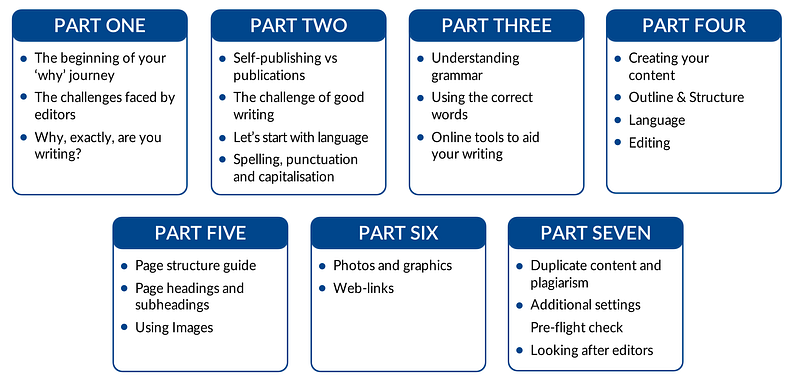
The beginning of your ‘why’ journey
Medium is the most incredible platform for writers of all abilities. From scientists and academics to college kids and home-makers, writing articles from how we landed Perseverance on Mars, to getting in shape for summer; everyone is welcome and [almost] every type of content is allowed.
What connects the authors is not what they write but how they write it. It’s the quality and attention to detail in every aspect of an article that gets them published and then noticed.
If you’re relatively new to Medium, you’ll quickly want to master creating, styling and formatting your content so that your articles can be published more quickly.
This series will help you do exactly that, but it’s not a massive ‘how to’ list. You’ll find plenty of those elsewhere that explain all the tools and features available in Medium, and perhaps none better than Casey Boticello’s excellent ‘The Best Medium Article Formatting Guide’.
I know what you’re thinking
It’s fair for you to ask why doing it properly and getting it right is important. For example, you might ask:
- Why take care with the correct use of language?
- Why be concerned about spelling, punctuation and grammar?
- Why are copyright and citation so important?
- Why bother with page layout and structure?
Think about it like this: you’ve made the decision to create new, interesting content and publish it on Medium, and that’s great for you and your potential readers. You’re reading this because you found your way to the excellent Illumination family of publications, and you’ll either have published content there already or be wanting to as soon as possible.
You probably know that to get into a publication means your content submissions are first reviewed by editors. These are real, live, actual humans, and they’re an incredible bunch who work tirelessly to help us all publish our best work. They look forward to reading new content — your articles — and genuinely want you and everyone else to do well.
But it can be challenging for a couple of reasons.
The challenges faced by editors
The first challenge is the volume of submissions they receive. As Medium’s success grows, and the Illumination group of publications, in particular, more writers will want to be published, hence even more article submissions. After all, the whole point of Medium’s existence is to encourage new writers, but whilst dealing with the huge volume of submissions is very time-consuming, it’s also what the editors are there for and it’s what they do extremely well.
The second challenge is the quality of the content they receive, as many articles submitted are not ready to be published (not that authors are aware of this), and getting them to that point takes a lot of time and effort.
That’s not to say the editors don’t want to help, of course they do, but to speed up the process of your articles being reviewed, and to increase the chance of them being published, you need to be doing as much as possible to help before you submit content for review.
That, right there, is the ‘why’. The ‘why you should make an effort to create better content.’
So, why, exactly, are you writing?
Another good ‘why’ question is, why are you writing? Perhaps you have a burning desire to tell the world what you know. Maybe you feel compelled to share your deep-felt, strong opinions on life, the universe and everything. Perhaps you just want your readers to enjoy your creative stories or poetry.
Whatever’s driving you, it’s all your content, so it should be easy, right?
It is. Well, sort of.
Like most things in life, there’s a right way and no-so-right way to do it, and it’s daunting enough when you’re new to Medium, let alone when you’re new to writing as well.
Medium has no trouble attracting writers for its platform, and publications are keen to get more writers on board. What is challenging is getting those writers to understand how the system works and the standards their articles need to attain before they consider submitting them.
And that’s where this series will help you.
Summary — part one
You may not be a full-time, professional writer, and you may have no desire to write an entire book, but you have something important to say, and you want people to read it. That’s why you started this journey in the first place.
Writing and publishing are two different things. We can all write, but actually publishing it can be a little daunting because it’s then out there for everyone to see. It will make you proud.
Creating your best work in the best format and style you can will pay dividends as it all increases your chances of being published and having people read it.
Series links:
Part 1. Your ‘Why’ Journey, Editors’ Challenges, and Why Are You Writing?
Part 4. Outline and Structure, Clichés and Jargon, Audience, Editing and Reading Aloud
Part 5. Page Structure and Styling, Main Headings and Subheadings, and Using images
About the author: Clive Wilson