
Michelle Scorziello — Interview
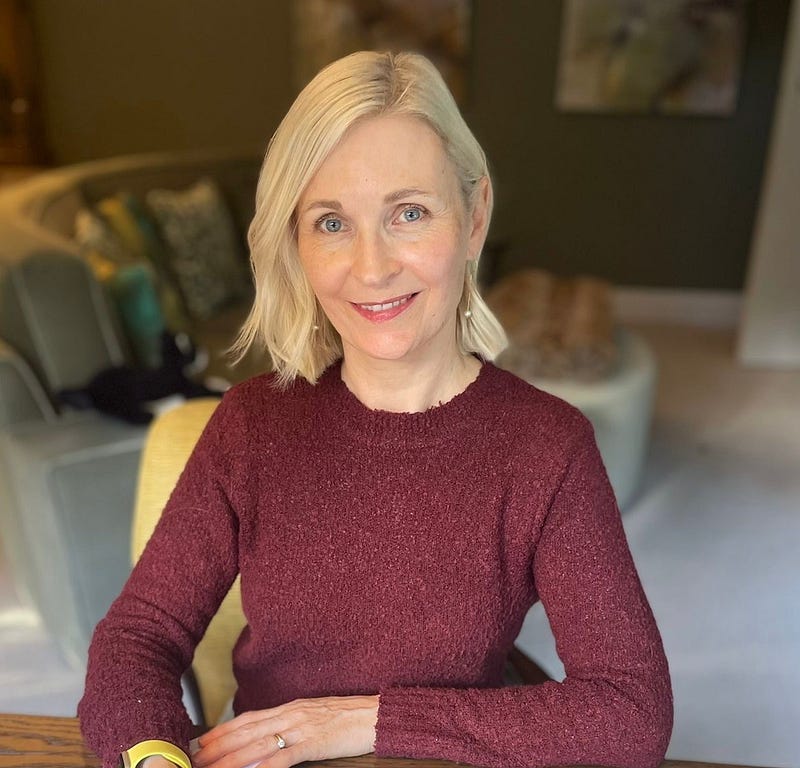
I first came across Michelle Scorziello when she wrote an article about her husband’s hypochondria that made me laugh out loud…Travels with my Hypochondriac. A. K. A. My Husband. Many of her articles have the same distinct humor about life, about what she sees and feels. Yet some of her writing also deals with the way life throws us curve balls, how we have to find our way amidst whatever happens and somehow come out intact. It is her willingness to look at it all so directly, entering the dynamic of living as it is, right before us, without fabrication or judgment, that continues to draw me to her writing now.
She also writes often with a poetic ambience, as here…
From Grasmere Journal:
“I have found a summer house with a stable door and red-tiled floor and windows with black curlicue handles. There is a wood table and five stout chairs. No view of the lake, just the tops of the rhododendrons and Helm Crag. Helm Crag is green and where the green is threadbare it is pink, the bottom half lush with evergreens. The trees sparkle with birdsong.
…We shall walk to Alcock Tarn today and return for lunch and maybe this afternoon walk to Ambleside like Dorothy: Always walking and drying linen and waiting for letters and writing letters and drinking tea, lying down with a headache and sticking peas. Wet poets arriving at the door, dried by the fire. Always in search of letters or a visit from Coleridge.”
From Dog Man:
“My mother once had a friend who she managed to keep for a while. Carol wore a communist cap and dungarees and pulled a shopping trolley full of her belongings; she was so poor that my mother said she heated her soup in a kettle. She was also a militant in the Cats’ Protection League.
One weekend, my mother was coming to stay with me and she asked Carol to look after Smokey her cat, who we called Dog Man. He was a strapping cat; the type of cat you wouldn’t want to meet down a dark alley.”
From Beans On Toast:
“A couple of friends started the keto diet. They wanted to lose weight, but not give up their Wagu steaks, hamburgers, cheese, eggs, bacon, cream and other high-calorie foods. In fact, they wanted to gorge on those foods and lose weight. They popped round to my place, and it being midday I offered them lunch, which was beans on toast.
‘Beans on toast!’ they cried.
If I’d offered them rats’ tails on a bed of snail shells, they couldn’t have looked more horrified, nor sounded more aghast. Didn’t I realise, they said, that beans on toast was the very stuff to make them fat, the very stuff to pile on the pounds, the very stuff to be avoided at all costs?
Now, I don’t know a lot about fad diets, adhering as I do to the most superior of diets and thus being that most exalted of humans: a vegan — but I was shocked at their response to my generous offer.
The way I see it, when a diet rejects beans on toast, that diet is not only on dodgy ground, it is sinking in the mire. That diet is suspect, that diet is deficient, that diet is immoral, misguided, and is on the road to diet wilderness.”
From Summer in England, Grab your thermals:
“Talking of rain and cold, if we weren’t visiting the bombs and bullets of Belfast during my childhood summers, we were sampling the delights of camping in Great Britain. And just to remind you, Scotland and Wales are not the tropics. The sound of rain on canvas is a sound indelibly wired into my brain.
It’s no wonder my parents divorced. Three kids, a tent and the rain falling all day, every day. And I’m talking Celtic rain, the type of rain that descends like a mist and rises like a mist and saturates everything, even the bones beneath your skin. You thought skin was impervious, was waterproof? No, skin is porous, and bones ache when they get damp.”
From A Small Suggestion Is a Fragile Thing:
“In the car, on the motorway, going to Southend-on-Sea, comes a sign for Costa Coffee, up ahead, only another mile. In a bright voice I say to G, who is driving, Ooh, can we get a coffee? You want coffee? says G, Sure. So I yell to the back seat in a what-a-good-idea-of-mine voice, You want coffee? Matt replies, No, that’s okay. He turns to Lois and says, You want coffee? Lois says, No, I’m good. I say to G, Do you want coffee? G says, Not really. In a dejected voice I say to G, Forget the coffee. And we sail past the turn-off for coffee.”
From I’m not saying it was the Windows’ Fault, But it was at that house our family unravelled:
“When I went to Paris a few years ago, I stayed in an Airbnb. It was a modest apartment tucked down an alley on the ground floor of a tall building. The windows were long, their lintels painted forest green, and they held so much glass it was like residing behind a shop front, which sounds bizarre but was delightfully uplifting.
And I once visited a house with a curved window seat, made more delightful for having a copy of Daphne du Maurier’s Rebecca on the seat.
…I grew up in a house with dreadful windows, quite the worst I have ever seen. The previous occupants had removed the original casements and replaced them with fixed panes and at the top of the panes were slits of louvre with aluminium levers to open the slats of glass. They were the sort of windows to send a Feng Shui running to a damp room with a dark cloth.
It was at that house where everything in our family unravelled. I’m not saying it was the windows’ fault of course, but the constant presence of those windows with their mean openings and their rigid panes must have worked their way into our souls, chipped away at our psyches, ebbed our joy and sucked away any trace of harmony.”
From Cafe Merde, Welcome to My Kitchen:
“[My husband] hails from a family of American hypochondriacs. It has taken years of vigilance and keeping my foot on any sign of malingering and quasi-illnesses to keep his hypochondria under control. Once I give in to one ache, one symptom, one sigh, show even a chink of sympathy, there’s a whole Jack-in-the-Box of illnesses ready to spring up.
For example, no sooner does someone tell him they have got a cold, a headache, upset stomach or an auto-immune disease than he fancies he has a cold, headache, stomach upset or auto immune disease; he lies on the sofa and swears he has all the symptoms.
Yet…
“One day, shortly after we got [our kitten] Rocky, I noticed our red spatula in the washing-up bowl. It was one of those with a big head, like a hand, and it was speckled at the edges with years of turning food.
‘Did you make pancakes?’ I said to my husband. (Being American, he’s good at pancakes. He’s deft of the wrist and can really flip them.)
‘No,’ he said. He was sweeping crumbs off the counter with the side of his hand. The counter was full of smear marks and thumbprints.
I grabbed the dishcloth and wiped up after him. ‘So why’s the spatula in the sink?’
‘I used it for the cat’s tray.’ Defiantly, he did the pancake wrist flick. ‘I cleaned the cat’s tray.’
‘You used the spatula?’
‘Yes.’
‘The red spatula?’
‘Yes.’
There was a spark of challenge in his eyes. As if he knew this was wrong, had known all along it was wrong and had prepared for this moment, which he knew must surely come.
‘You used the red spatula that you flip pancakes with, that I turn the veggie sausages with, that I shuffle my sweet potato wedges with?’
‘Yes.’
Welcome, Michelle!
Please introduce yourself…tell us a bit more about you and how you got into writing for Medium.
Thank you for inviting me to your blog. You have interviewed many talented writers and I am honored to be included amongst them.
I’m a teacher who specializes in teaching children with specific learning difficulties such as dyslexia, dyscalculia, ADHD, Developmental Coordination disorder and underlying speech and language difficulties as well as working memory and processing difficulties.
I got into the field when my son was diagnosed with dyslexia. I did my post-graduate training and soon got pulled into teaching. Falling into this career was one of the silver linings of my son’s diagnosis.
Literacy teaching is a great adjunct to writing because it entails constantly referring to the sounds and syllables within words as well as language and vocabulary; even teaching maths is predominately teaching language.
I have been writing for twenty years. I found Medium when I clicked on a short story link and came across articles about writing.
I toyed with a social media presence but I didn’t want a blog (who would read it?). A chance remark by a publishing agent — “Medium is well- respected” — got me looking at Medium as a writer as well as a reader.
What could I write about? What I knew best. That was teaching children how to read. My first articles were dry, pedagogical and preachy; I got bored writing them.
Inspired by the breath of topics on Medium, I revisited my store of essays. I edited and polished them and published them. Readers followed and here I am, on this wonderful writers’ platform.
What gives you your inspiration into the articles you write? How do the ideas come to you?
Memoir is my favourite genre to read and write. Often memories — seemingly insignificant — come; writing the memory reveals something bigger, a story lurking filled with emotion, and hopefully understanding; writing memoir can be a form of therapy.
Like most writers, I’m attuned to the world around me and my emotions and reactions to everyday things that catch my attention. I’m particularly fascinated by the minutiae of life, the little routine, seemingly mundane aspects of life.
What inspires you to relate to the theme and style you have, which I find are distinctive?
I am aware that memoir can be “me, me, me,” or “I, I, I,” which is as boring as being at a party, cornered by a person who talks non-stop about themselves but doesn’t ask the other person a question and isn’t interested in the other person.
In memoir, it’s important to take the reader with you, to let them in, to immerse the reader in the situation so that they feel as if they are there; they are the one experiencing the scene and are invested in the scene. To do this, I try to capture sensory impressions, particularly smell, that most powerful scent.
I love humour, especially understated, wry humour, which is why The Diary of a Provincial Lady by E M Delafield is one of my favourite books. Humour is difficult to write, so it’s an added challenge.
And I do see writing as a never-ending challenge. The goal or destination always out of reach, but the journey rich with failure and small landmarks of success. Plus, humour is a great way to underscore horror. I once read a piece of advice about writing memoir: if you want to heighten horror, don’t mention it, don’t state it, just describe and let the reader bring the horror. I would go further and say that humour further heightens horror.
I’m also inspired by newspaper columnists such as The Times’ Camilla Long, who has a satirical writing style.
What theme — or themes — engage you most of the time?
The contradictions and foibles of people are endlessly fascinating to me. As is the beauty and detail of nature.
I’m also fascinated by how similar, how alike humans are, how we share base reflexes, both good and not so good. And what we reveal with our bodies and how what we think is exposed by what we don’t do and what we don’t say. I love writers who can evoke character in just a few details, writers who are perceptive and subtle.
Are there people you feel have definitely influenced your work, no matter their field of interest and experience, or does the writing come from your own life experience and thought?
Memoir obviously comes from my own experience. And of course other writers inspire me. Jeanette Winterson’s memoir Why Be Happy When You Could Be Normal? was a revelation. Her language is conversational, close, intimate, direct and very funny. Reading that book changed my writing approach. I learned to not be ashamed of my south London voice. And I always try to adhere to Orwell’s maxim: Prose should be as clear as plate glass. Then there’s Virginia Woolf’s influence… an author I’ve only recently been exploring, but who has taught me to go deep into the universal feelings and emotions.
My mother is a big presence in my writing. She was such a dis-normal mother. Not only did she have a Belfast accent — alarming in 1970s England — but she also had a fiery, unhinged personality and a way with words. I always think of Alan Bennett’s mother saying to him, “Ee, but I’ve given you some material.” If Alan Bennett can get away with exploiting his mother…
One of the most common comments people who know me say after reading my memoirs is, “How did you turn out so normal?” That has been the goal of my life, to be normal, so I’ve succeeded. Only now I’m not sure I want to be normal.
Do you concentrate on creating an atmosphere or mood or focus for your thoughts, or does that evolve as you write each article or story or message?
Mood comes as I write, as I become aware of the sensory world around the scene. Even though I’m not a visual person, I do think in pictures and I have learned to lean into those pictures and sink deeper and go into the other senses.
Writers are always asking questions. We are always exploring the unknown. What subjects draw you into doing this?
Human relationships. The push and pull of dynamics, particularly of power. I was recently reading Joan Didion; in one of her essays she says, “Marriage is the classic betrayal.” How true. Marriage is the clash of two family cultures, cultures that can never be erased. That’s interesting to me, how we compromise and meld in a marriage, or of course, fall apart.
I have read your articles and have favorites. Do you have an article or story you like more than any other you have written?
I’m fond of “Lessons Learned from Friendship.” It’s a memoir based on a school friend I had when I was at middle school (eleven, twelve years of age). It was around this time I became aware that not everyone read books and that my family did not work as it should — what would later be termed dysfunctional. I like this article because it explores the girl I was. It was from this time that I spent much of my life trying to be “normal.”
Who are you writing for? Do you have an audience in mind, or is it just a general idea?
I write for myself, to set my voice on the shelf with all the voices I have read. I want to hear my own echo as well as Orwell’s and Mansfield’s.
And every article, essay, story is an opportunity to get better, closer to an ideal.
But of course, like any writer, I want to be read and validated. So I do think about my Medium friends when I write.
Do you like to network with other writers on Medium? If so, why? Do you have favorite writers you read often on Medium?
What astounds me about Medium is how positive it is and how quickly you find your own tribe. It makes the solitary act of writing convivial and validating. I have a core group of writers who I met in the early days and who are now like friends. It’s always a pleasure to read an article and then bump into my friends in the comments section. Although Medium is a huge platform with thousands of writers, it feels intimate. I have discovered some wonderful publications: The Howling Owl and The Memoirist being my favourites. Zay Pareltheon and Viraji Ogodapola at The Howling Owl are both everything you could want in an editor: encouraging, kind and professional. I recently signed up to The Shortform and Tea with Mother Nature.
Would you call yourself an extrovert or introvert?
100% completely, totally, incontrovertibly introvert.
What do you enjoy most about being a writer?
The solitary existence. The quietness, the simplicity of pencil and paper and the joy when a word or sentence falls into place and says exactly what I have been striving for. The missing word or correct words usually come when I am running or walking, when I am away from my desk.
How have you evolved both as a writer and in your writing after writing for a while on Medium, do you think?
Medium has been like an inexpensive journalism course. I’ve used The Howling Owl to set myself a weekly deadline for submission. It’s so easy to drift in writing, always editing and kidding myself I am progressing. Medium holds me to account because I am publishing my work. And as soon as I have published an article, I must think about my next article. As my husband says, “It puts a fire under your ass!”
The Writing Life
Now, these next questions cannot be avoided. They are the ones everyone usually wants to know about a writer, whether their focus is nonfiction or fiction, article or book.
What is your writing schedule? Do you plan your writing time or just do it when you are not at work or maybe at lunch hour? Or is your time pretty much free to create whenever you feel inclined?
I recently left the classroom, and now I teach privately in the afternoons. This has freed my mornings for writing. I write every morning. I begin by reading a page or two from an author. I just finished The Waves by Virginia Woolf and I am now reading The Collected Stories of Lydia Davis.
I write a page or two in my journal, which usually begins with the weather or the scene in my garden. Sometimes I will note difficulties I am having with an article or reflections on a book I am reading. I finish by jotting down what I will write about or work on the rest of the morning.
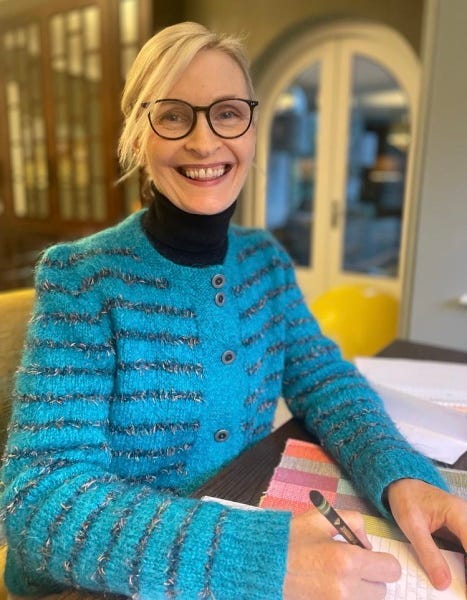
Then I work until lunch on my current memoir or article.
Do you write in a notebook by hand, ever? On your phone? Laptop?
I write always pencil on paper. Then I transfer what I have written to my laptop. I rarely write on my phone, but I find reading on my phone causes me to process my writing differently, which helps with editing.
Since writing on Medium I am starting to write straight onto my laptop, but I always write my journal with pencil. If I’m ever stuck with knowing what to write about, I will go out into the garden with my pencil and notebook, sit and observe and record my impressions.
What does your writing space look like?
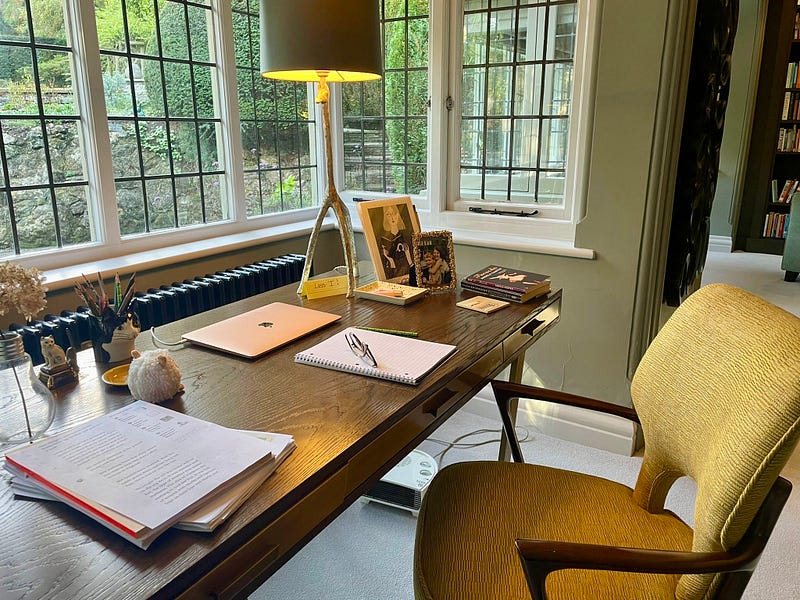
My desk looks over my garden and I am surrounded by bookcases. There’s a television, but it’s hidden in a cabinet. And I have a loud clock. There’s a drain pipe outside the window and when it rains there’s a delightful gurgle and babble of water.
Do you have any rituals to get yourself ready to write?
I have a cup of coffee and then head to my desk.
For Fun
What do you do besides writing that brings out your creative self?
I like to garden. Gardening is like writing. There’s a high chance of failure with a plant as there is with an article or essay or story. I’ve had to learn not to inflict myself too much on my garden but let the plants guide me. Plants are very stubborn things and will only flourish where they feel comfortable, not where you would like to see them. In writing, it’s important to listen to instinct and not try to impose your will on a piece of writing because then it won’t come out true and a reader will know it is a fraud and it will fail.
Where is your favorite place to spend time?
I love the Greek islands. The timelessness of the sea and the olive groves and so many cats!
What is the best advice you have ever received or read about writing?
I’ve worked a lot with a writer called Shaun Levin. He taught me so much about the importance of “place” in writing, of anchoring a scene, so that the reader can visualize and make their own picture. He also taught me to look at things as if my eyes are microscopes and then to write everything I notice. From this comes a deeper response, as if I am no longer skimming the surface but actually looking at the bones and muscle and soul beneath. To paraphrase Gertrude Stein, “A rose is not a rose.” Yes, the word “rose” taps into imagery and connotations and associations and emotions, but it’s easy to use language casually without thinking; looking closely at something like a rose really forces you to consider how it is formed with all its myriad details and that leads to deeper appreciation and somehow that makes the words you write about the rose truer (as Hemingway would say).
If you could meet several writers — time travel being no obstacle — in a coffee shop for a chat, who would they be?
George Orwell, Malcolm X, Doris Lessing, Muriel Spark, Flannery O’Connor, Edna O’Brien, P G Wodehouse, James Baldwin.
When you are not writing, what are you up to?
I teach and I lift weights three times a week and I run three times a week and I read most evenings and I worship my cats.
If you had the chance to board the Starship Enterprise for a long mission, what five books would you bring with you for the journey? Or would you assume a stunning updated version of the Holodeck (maybe crystal-driven) would suffice?
A Moveable Feast by Ernest Hemingway, Troubles by J G Farrell, Giovanni’s Room by James Baldwin, A Far Cry from Kensington by Muriel Spark, The Grass is Singing by Doris Lessing.
And finally, one last question: Who are you, Michelle, in fifteen words or less?
I’m struggling to reconcile the urge to hide with the unavoidable fact that words expose.
Where Can People Find You Online?
Where can people find out more about you or support your work, both on Medium and elsewhere?