Essay
Grasmere Journal
With apologies to Dorothy Wordsworth
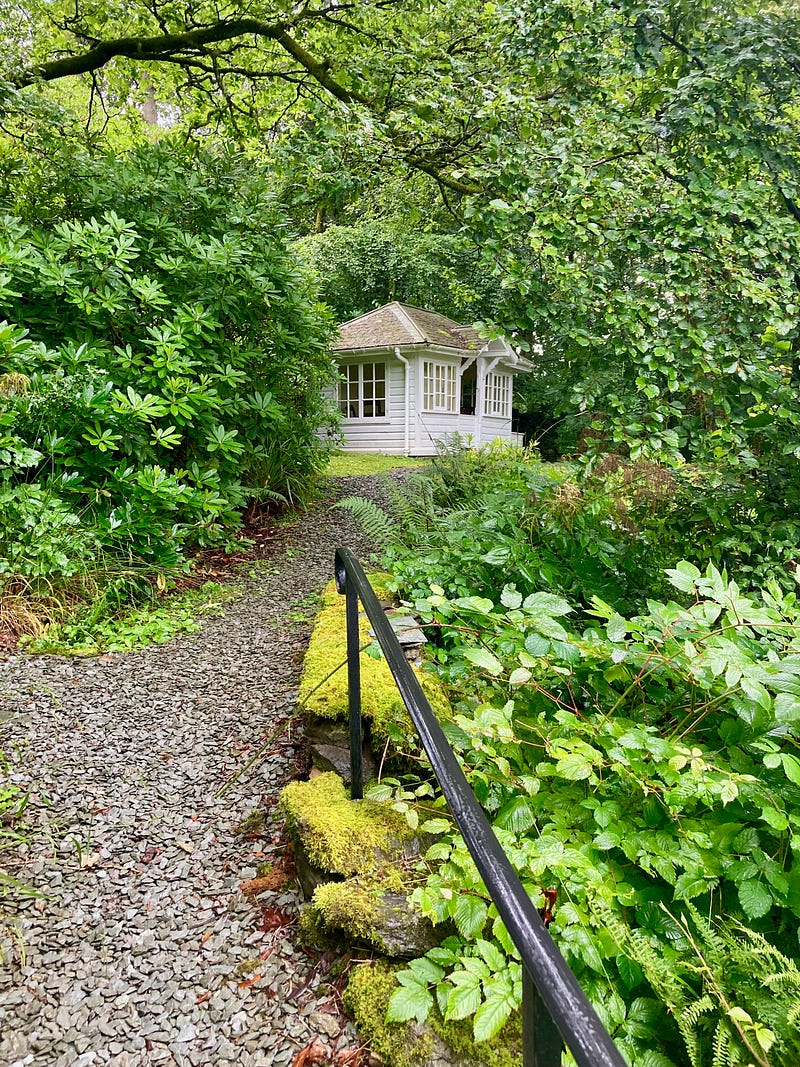
I have found a summer house with a stable door and red-tiled floor and windows with black curlicue handles. There is a wood table and five stout chairs. No view of the lake, just the tops of the rhododendrons and Helm Crag. Helm Crag is green and where the green is threadbare it is pink, the bottom half lush with evergreens. The trees sparkle with birdsong.
Yesterday we visited Dove Cottage. Our guide was a tall, thin young man with a monk haircut like a shelf jutting over his forehead. He had a nice chin and must have spent the morning in a kitchen where they sweated sacks of onions.
The cottage was sweet, especially the wood panelled kitchen with the bubbling flagstones, footstep-polished to a soft silver. In the scullery, the steep garden filled the window with ferns and rose campion and the purple loosestrife that grows around the lake. The garden by the front door was a tangle of apple trees and wild roses.
Upstairs in the drawing room, a small table set with blue cups and saucers and a quill and ink. Wordsworth’s bookcase in the corner. The room was dark and yet here Wordsworth ‘Changed the face of English literature.’
Sitting on a moss-clothed log behind Dove cottage. Here is where Dorothy and William planted broccoli and watched the lake and fished in the lake and walked to church. They lay on the moss and looked at the sky, the sycamore trees, the clouds herding till their woolly fleeces became one and blanketed the sky lumpen like the sheep who wail and bray, their horns perfectly coiled, their black mouths tugging and ripping the grass.
The ground is thick with desiccating leaves, soft and gossamer, thin fossils, gauzy, twigs lacey with design and nuts and seeds hollowed and pitted. Moss covers the stone walls, bubbles like pea soup. The trees’ toes are green, reaching into the soft leafed floor. Fallen trunks are carpets of green, rolled and spongy thick.
The sky marbles with lesions of blue amid the misty white and grey. Helm’s Crag is topped the buttery green of Lakeland painters and glows like a buttercup against the shadows of the clouds. English weather moves within such small margins that we seize on the slightest deviation. Our temperate climate forces us to notice gradations and slight changes. The heatwave in London cast us dumb. What to do with endless days of blue sky and heat?
Traffic rumbles on the Keswick to Ambleside road. Dorothy writes of wagons and carts and horses and asses and sometimes a coroneted landau, and beggars a plenty and bread much desired.
We shall walk to Alcock Tarn today and return for lunch and maybe this afternoon walk to Ambleside like Dorothy: Always walking and drying linen and waiting for letters and writing letters and drinking tea, lying down with a headache and sticking peas. Wet poets arriving at the door, dried by the fire. Always in search of letters or a visit from Coleridge.
There’s a giant oak tree in the summer house garden, like a Leonardo portrait of an old man: leafless limbs, laughter lines of leaf-full limbs, a flourish of beard and eyebrows and variegated hair. An ash tree also has an old man visage, only less gnarled, as if he took pains to comb his beard. Another ash, its empty branches like candelabra.
Yesterday outside Dove Cottage, the rose hips were big and round and red as radishes. Without the sun, a yellow potentilla’s spheres of airy blossom were soft against the green.
A cool, damp morning tangled with mist. The wood pigeons soughing their invisible mantra. The sky very early this morning above the eaves was a Tintoretto blue with pink-veined clouds. The old man oak tree fresh green.
At Beatrix Potter’s house the flagstones bubbled silver smooth. Portraits and paintings and fine ivory carvings. The garden a mass of silvery greens and mossy greens and wigwams of purple, perfumed, sweet peas.
There was a small walled garden with a large galvanised watering can. ‘This must be where Peter Rabbit stole the carrots,’ I said. Behind me, some children got excited. One young girl with long brown hair asked me about a plant. ‘It’s a giant thistle,’ I said. ‘It smells of honey.’
Outside the summer house it’s raining, a collective hiss as if the woodland is fizzing. The leaves on the old man ripple and nod and tingle, the wood pigeons once again a chorus. The garden becomes silver and Helm Crag softens against the soft silver sky. Rhododendrons have polished leaves.
At Allan Bank, two flower beds of wild flowers like confetti of pink and yellow and purple, their little petals of silk waving bravely in the breeze. Peas fluttered red flags, their young vines beginning their climb up the wood. Gunnera and verbena and Japanese anemones and saucers of moss. Willowy fennel bristled and waved its liquorice. Beyond the soft pale fields the lake was a silver mirror, a slice of flat metal, geometric in the distance.
My coffee is gone. Only a disc of cold dregs. The sky is white, and the rain continues to hiss and fizz. The grey gable of the house juts into the green. Ferns fill the steps of the garden, the stone cracks frilled with tiny leaves, slender fronds, each leaf edged with brown.
The rain is visible, heavy and splashing. A lovely thump and drum on the roof of the summerhouse. A gurgling down the walls and patting into the leaf floor. Beyond the stable door the rain casts bigger drops, the clouds descend and the leaves of the rhododendrons shake like cymbals. They did not forecast rain so we shall have to change our plans to boat on the lake.
Grey morning. Wind whipping the oak tree, causing the tops of the rhododendrons to part and shake. Yesterday, we walked from Grasmere Lake to Rydal Caves. Stepping stones into the cave, the walls hewn into parallelograms of pink and ochre and grey and blue. Along the path to Grasmere, the ferns were already browning, many on the stone path flat like fossils. Nettles of furred velvet.
We drank coffee in the delightful Heaton Cooper Art shop. Blue cups and saucers and the coffee was golden caramel and rich and strong.
We intend to walk the coffin route to Rydal for morning tea and this afternoon to Baldry’s and dinner in The Jumble Room.
Tomorrow is our last day. Dorothy’s journal: more headaches, and baking of pies and walking twelve miles to Keswick. Coleridge read Christabel to Dorothy and William. Walks to Ambleside in the moonlight, to Clappersgate and White Moss.
Last day. Blue sky among the crisp white clouds and the trees are still. In the evening I walk the lake with Liam. The slap of water on the shore. Signs of autumn: blackberries glistening black, Virginia creeper with a rash of red, an acer tawny-edged. Helm Crag disappeared.
The last night I rise to open a window and there is the plough, stretched over the lake as if to take it all. Thus how Dorothy must have seen it, timeless, permanent, patient.