
Writers Who Soothed My Teenage Angst
And still, soothe me now
Anyone who survived childhood has enough material to write for the rest of his life — Flannery O’Connor
When I was a teenager, mental health didn’t exist. My parents divorced when I was fifteen. It was a horrid, nasty divorce, unshackling my parents after eighteen years of misery. Homelife was always fraught, argumentative, negative.
I grew up a child in a permanent state of anxiety. Talking therapy hadn’t been invented. At least, not for a teenager who went to a comprehensive in south London. Back then, no one asked how you were. You were left with your thoughts chasing around in your head, trying to exist, to look normal, to feel normal, when all around you was imploding.
Fortunately, I loved to read.
Books became a parallel world, a world I did not have to navigate. If I had some money, I would send my little brother to the shops to buy me a bar of chocolate. Books and chocolate were an escape to heaven.
Through these authors, I learned it was possible to have relationships based on respect and kindness, which didn’t comprise petty point-scoring and bitter recriminations. And that joy could come in the smallest and humblest of ways.
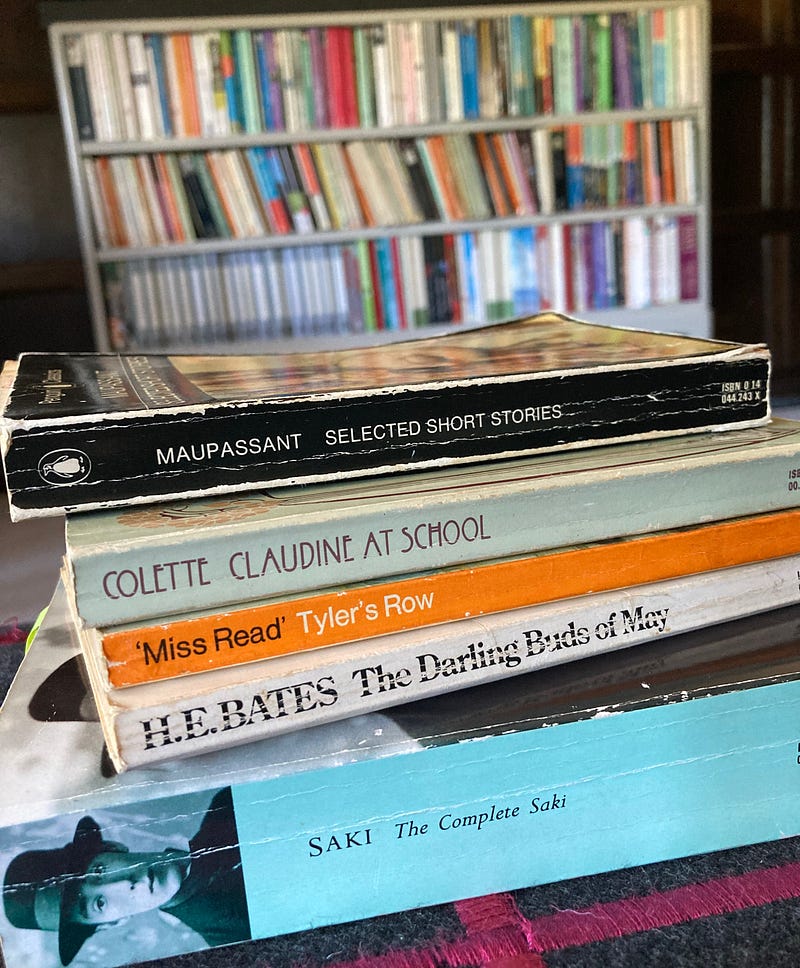
Miss Read
My high school English teacher collared me in the library one day and thrust Village School into my hands. Most of Miss Read’s books centre around the eponymous spinster schoolteacher who lives in the fictional village of Fairacre in the English Cotswolds.
Her life is bound up with the village, its characters, its changing seasons, and the church and school year ritual. Seemingly trite, boring, humdrum even, but I craved stability, and Miss Read’s sensible voice gave me that. She was an antidote to the punk-rocking, throbbing, anarchic pressures of youth, which I did not want or feel comfortable with. She consoled me amidst the desolation of my own life. In me, the future writer was already stirring; I recognised her sentences as spare and clean and direct — up there with Hemingway and Orwell.
Colette
If you could take a cat and make it into a person, I believe that person would be the protagonist of the Claudine books. French, sassy, insouciant; I loved her independence, disregard for others, and cat-like selfishness. Yes, selfishness.
Trapped as I was in home life that was disintegrating, neglected by parents who could barely attend to their own grief and misery, let alone that of a confused and frightened teenager, I wanted to be Claudine. To go through life uncaring of others, superior, smug, and trusting no one but myself. This seemed safe and sensible and attractive.
Maupassant
Some kind and perceptive friend gave me a copy of Maupassant’s short stories. Set in a time and place foreign to me, they gave me a sense of elevation and the belief that there was so much in life that was fine, that was valid if only you looked hard enough.
Maupassant showed me that life, any life, could be valid and fine. The story, Idyll, shocked, stunned, delighted me. So, many years later, I wrote a short story of my own and entitled it Idyll. Truly, the seeds of us writers are planted when we are young.
H E Bates
Bates pinched one of the most lovely lines in all of English literature for the title of his first novel about the Larkin family, The Darling Buds of May. And what a rollicking, delightful family they were, so different from my own.
A family who lived deep in the green Kent countryside, who drank champagne and cocked-a-snook at bureaucracy, at taxes, at convention. The Larkins were a family of hedonists; they lived in the now for pleasure, fun, and love. It was the largesse, the abundance, not just of food, but love and attention and hope and joy, and the belief that life was good, that appealed. I wanted to be a Larkin, and for a while, I was a Larkin in those books.
Saki
I met the short stories of Saki in high school as part of the English literature curriculum. If you’ve ever wondered what would happen if a cat could speak, read the short story Tobermory.
What irreverence, what wit, what wry comic prose. There’s something devious and thrilling about the characters in Saki’s stories; they get their comeuppance, their just retribution; they are exposed as vain, shallow creatures. And meanwhile, there’s the renegade, the character who gets the last laugh, who wins through. The sly comedy of Saki showed that the underdog can triumph.
I was a reader long before I was a writer and these books formed me. The clean sentences of Miss Read, the spunk of Colette, the richness of Maupassant, the bounty of Bates and Saki’s ability to laugh at adversity.
They soothed me and lit a spark. They showed a way of overcoming, of turning life on its head. I still reach for them when I need solace or joy.