
Dog Man
A story for Alan
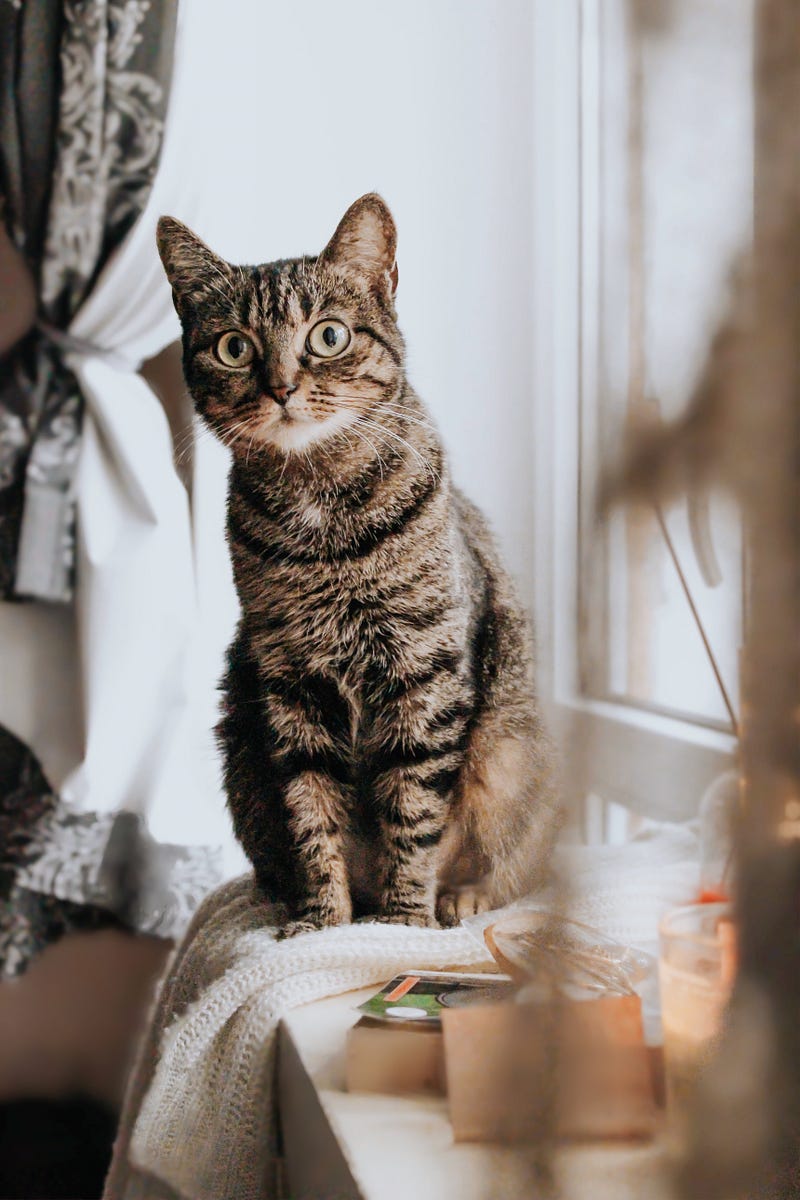
My mother once had a friend who she managed to keep for a while. Carol wore a communist cap and dungarees and pulled a shopping trolley full of her belongings; she was so poor that my mother said she heated her soup in a kettle. She was also a militant in the Cats’ Protection League.
One weekend, my mother was coming to stay with me and she asked Carol to look after Smokey her cat, who we called Dog Man. He was a strapping cat; the type of cat you wouldn’t want to meet down a dark alley.
Surbiton, where my mother lived, was a fading genteel town, fifteen miles south of London and full of tall Victorian town houses. My mother had a one-bedroomed flat, the first floor of a cowboy-converted Victorian that had originally been one house.
She had recently divorced her second husband — after lots of shouting, shredding of clothes, smashing of plates — and taken a fancy to an Arab. Sometimes I stayed with her and she would make up a bed on the sofa.
The living room was lovely if you ignored the seventies shagpile. It had a long bay window and deep skirting boards. The ceiling was high and like the surface of a cake with its piped icing cornices and fleur-de-lys central light. The chimney breast was broad, but someone had ripped the fireplace out in the hippy sixties and bricked up and papered over the flue.
A paraffin heater sat in front of the denuded fireplace and provided the only heat in the flat. Dog Man would stretch himself before it and gradually push my mother and me further from the flames. The gauge to show when the paraffin was running out had broken; only after pressing the ignition several times and the flames failing to whoosh did you know it was empty. When this happened, Dog Man glared and my mother cursed the heater and we wrapped ourselves in blankets and huddled like cold Mexicans.
In the summer, Dog Man entered the flat through the bay window. He sat on the broad sill and wailed. My mother raised the sash and Dog Man stepped onto her faux-Regency table and despite having just been outside, he would upchuck on my mother’s lace tablecloth.
‘Ach, Smokey,’ she would say in her broad Belfast accent — he was Smokey when he transgressed. Then she would cackle. ‘Nothing but a bit of lace for our Smokey to upchuck on.’
After leaving fur balls on the lace tablecloth, he would saunter to the kitchen for a late breakfast or early lunch
A skinny hall led to the kitchen. My mother tried to improve the skinny hall by hanging framed black and whites of Clark Gable, Vivienne Leigh and Betty Davis. When I asked why they hung at haphazard heights, she said the walls were digestive biscuits and it was sheer luck where a nail would hold.
The kitchen was small and L shaped and in winter was called The Russian Front. A large louvre window, like a piece of Lego, sat over the sink. There was a flat roof below the window that belonged to the extension built by Joyce and Ken, who lived in the basement.
They were a fussy little garden gnome couple, everything my mother despised: conventional, conservative, royalist and Thatcher-voting. During the Falkland’s War, she plastered a poster of General Galtieri on her bay window, just to irk them.
Joyce’s kitchen had an extractor fan which led to spats with the old man who lived next door. Fred had apple trees in his garden and on warm days he sat beneath them in a deckchair with a hanky on his head and downed cans of cider and cursed the world. Dog Man lay at his feet and blinked at the sun.
My mother would wave to Fred; she liked people who liked a tipple and turned the air blue. But Joyce’s extractor fan ruined his idyll. He told Joyce the smell of her fatty meat drifted over his apple trees, infiltrated his cider and disturbed his fruity rantings. My mother sniggered and told me Joyce had crossed her arms and said, how dare he. It was mixed veg.
Dog Man liked to stalk Joyce’s walled garden, no doubt enticed by the smell of mixed veg masquerading as fatty meat. In winter, when he was ready to call it a day, he hopped onto the flat roof and called to my mother beyond the louvre window. She would push the bottom of the giant pane and the top would swivel into the kitchen, along with a blast of air from Siberia, via Wimbledon.
As soon as she opened the window, Dog Man sat and blinked, as if he wasn’t sure after all about coming in. My mother shivered and clasped her old blue dressing gown close to her neck. ‘Ach, make your mind up, Smokey.’ Tired of waiting, frozen with the icy blasts from the steppes, she slammed the window shut, whereupon Dog Man wailed and the pantomime started all over again.
On the day of her visit, my husband went to collect my mother. While he helped her gather her bags and belongings for the weekend, Carol arrived to collect the key and learn Dog Man’s eating schedule. My mother took her to The Russian Front, where she kept the cat food on a slatted shelf along with the cat bowls.
My mother had discovered this small valuable space under the bit of counter next to the cooker and had asked my brother, who was an apprentice carpenter, to fit a shelf.
He was working on airing cupboards at the time, so he used slats of wood for the shelf. At last my mother had somewhere to store the dented cans she got as a perk from the supermarket where she worked on the checkout.
The tins wobbled and lodged catty-corner in the gaps between the slats. So not only were the tins dented, but they looked drunken too. My mother clicked her tongue and shook her head and couldn’t work out how my brother had been so remiss. Then she remembered he was a man, and that explained everything.
Smokey’s dish sat on the floor with uneaten morsels of that morning’s breakfast.
Carol pointed. ‘How long’s that been there?’
My mother frowned. ‘I put it out this morning.’
Carol looked at her watch, shook her head. ‘Cats Protection says anything over two hours must be got rid of.’
My mother sharpened her tongue. ‘Are you trying to say I don’t know how to look after my own cat?’
‘I’m telling you what the Cats’ Protection League says — ’
‘I couldn’t give a toss — ’
My husband had recently attended a conflict resolution course. He stepped between the women like Moses prepared to part the foamy tempest.
‘Mary — ’ he addressed my mother first.
My mother batted him away like a gnat.
‘Carol — ’
Carol ignored him.
‘Ladies — ’ His voice was a bleat in the rising storm of The Russian Front.
He knew when to retreat, I’ll give him that. On the sofa in the living room, he sat and tried to repair his shaken manhood and wonder where his conflict resolution had failed.
The howls continued in the kitchen.
Dog Man appeared and rubbed the side of his face against my husband’s leg as if to say, ‘It’s all over me. What a man. What a dog man.’
For Alan Asnen, so he can begin his week with a cat story.


