
I’ve Been Running a Website as a Side Hustle for 3 Years — Here’s What Works
6k organic monthly traffic and 4 figures monthly income.

If you’ve been following me for a while, you might know I run a niche website called Self Made Millennials.
I launched it as a side hustle while having a full-time SEO job, my SEO ebook, and writing on Medium part-time.
Does it sound like a lot of work? Agree! However, I was eager to work overtime and on weekends to grow my projects.
Over the past few years, I have published 300+ articles on this platform, sold over 250 copies of my SEO ebook, and grown my website to 6,000+ organic monthly traffic all by myself.
Honestly, It’s a lot of work.
Don’t trust anyone who says you can easily manage multiple side hustles and have a healthy life. It’s a lie.
Yes, you can successfully handle several projects at a time, but it always comes at the cost of your free time, family time, or friend time.
Despite prioritizing my client projects, I kept dedicating several hours per week to my website.
Can you grow your website by working on it for a few hours a week only?
I thought it was impossible.
However, since I couldn’t dedicate more time to my website, I figured out how to do it effectively.
If you want to run a website but don’t have enough time (or desire) to do it, here’s what works.
1. Targetting niche keywords
I’d say targeting niche keywords with low competition and decent search traffic potential.
I’ve been mentioning this strategy in almost every article because it’s the foundation of your website: your content will rank if you pick the right keywords!
Writing about things you want won’t work in SEO.
Targeting random topics without niche keyword research won’t help you grow your website either.
Here’s what is proven to work for my website and my clients:
- Running a niche site instead of writing about everything
- Researching easy-to-rank keywords with traffic potential
- Creating a content plan for your website with prioritized keywords
- Posting at least 1–2 optimized blog posts on your website per month
- Updating content if you notice a drop in performance
You can learn more about these strategies from my ebook, “How to write content that hits the Google front page.”
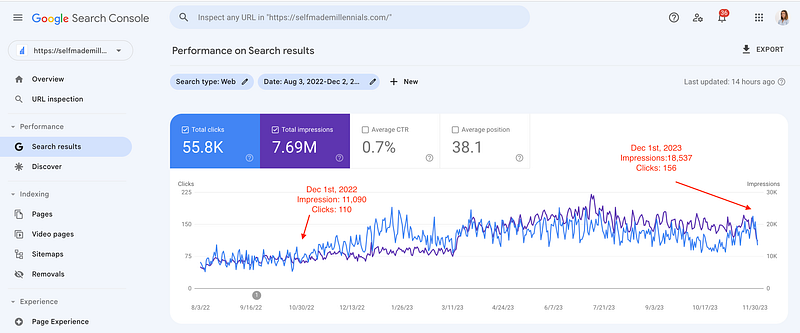
Here’s what happened to my website after implementing this strategy. My website impressions and clicks have been steadily growing despite temporary drops.
2. Prioritizing content creation over anything else
Normally, there is an entire team managing a website, including web developers, graphic designers, and marketing specialists, to name a few.
However, you’ll have to manage all website-related tasks on your own, which means you should create a website structure, write content, design images, fix technical issues, and do on-page and off-page SEO, to name a few.
Believe me, it’s a lot of work!
I remember I had so many website-related tasks on my to-do lists that I didn’t know what to start with. I thought the number of tasks would decrease after completing all design and development works. However, I was wrong.
Managing a website is never-ending work. The bigger your website, the more work you’ll potentially have.
Since I didn’t have time to work on my website properly, I decided to prioritize.
Any website can exist and rank without passing Google’s Core Web Vitals, but every website needs a keyword strategy to keep up with competitors.
A website can earn money even if it has a primitive design and some technical issues. However, it cannot exist without content.
Prioritizing content writing over other tasks is what helps me grow my website slowly but consistently.
I’ve also started using AI-generation tools like ChatGPT and Bard to speed up my work, but I only delegate some tasks to AI to avoid potential penalties from Google.
In a nutshell, you can use AI tools for SEO and content writing. However, the output will depend on the prompts you use.
If interested, you can learn more about my experiments with ChatGPT and Bard in this article.
3. Monetizing as soon as you reach 100 visitors a day
What’s the point of running a website that doesn’t make money?
Even though I launched my website as a digital environment for my SEO experiments, I wanted to make money from it.
Trust me, a well-performing website can have multiple income sources.
That’s why I always recommend site owners think about website monetization strategies as soon as their websites start generating some organic traffic.
You’ll likely earn nothing if you only have a few site visitors per day. However, you can (and should) monetize your website once you have at least 100 site visitors daily.
Even if one visitor becomes your customer, that’s already an achievement!
- I’ve made $3,407.93 from the Beehiiv review as an affiliate.
- I’m close to making $10,000 from ebook sales, where my website is among the top converting channels. (More about my Gumroad experience here).
- I sell my SEO services through my website.
- I’ve enabled Google Adsense and passively make some money.
You’ll achieve even better results if you dedicate at least a few hours a week to growing your website. I’m sure about it because SEO likes consistency. If you consistently publish optimized content, your website will rank.
Wondering how to write blog posts that hit the Google front page? Check my SEO ebook.
In conclusion
Remember that you only see the tip of the iceberg when listening to successful bloggers and content creators.
They rarely (or never) share how much time, energy, and money they invested into their growth.
They failed more than succeeded because success is impossible without setbacks.
The point of this article was to give you a realistic overview of what can help you grow your website even if you don’t have enough time for it.
Managing a website isn’t the easiest side hustle. Even though I regularly make four figures from my site, I occasionally experience traffic and income drops.
Nevertheless, that’s the game I’m ready to play long-term. Do you?
📖 Grab my guide to learn how I create blog posts that hit the Google front page.
📈 Want to learn more about SEO? Join my free email course.