
I Published a Bard-Generated Article on My Site — Here’s What Happened
You risk getting a penalty for doing this.
I bet you see at least one mention of ChatGPT, Bard, and other AI tools daily.
In fact, I see these mentions multiple times a day on social media. Content creators tirelessly try to educate me on how to make a fortune using AI quickly.
A few days ago, I stumbled upon one content creator on Twitter who claims to make $20k per month from one of his websites. His recipe for success was to publish 10+ AI-generated articles daily with some optimization.
“What bullshit,” — I thought.
An entire idea of website creation solely for monetization purposes by manipulating search rankings does not sound right to me.
Perhaps, I am naive, but that’s my point of view.
You don’t have to listen to me since I don’t make $20k monthly from my website. However, as an SEO expert, I don’t think this approach will work in the future.
I’ve already experimented with ChatGPT on my website and measured its content’s performance in organic search results.
This time I’ll share what it’s like to work with Bard and how Bard-generated content performs in organic search results.
My experiment with Bard-generated content
You might have heard of Bard chatbot as Google’s response to OpenAI’s ChatGPT.
Even though Bard is still under development, it’s open for users worldwide.
Unlike ChatGPT-3, Bard has access to the Internet and up-to-date “knowledge.”
Since I continuously use various creator tools for testing, I decided to write an article using Bard to measure how it would perform in organic search results.
Furthermore, I wanted to learn whether Bard-generated content performance would differ from ChatGPT’s articles. Spoiler alert — it’s not! But I’ll appreciate it if you keep reading the story.
As usual, I picked an easy-to-rank keyword for an experiment since I know a well-written and optimized content piece will reach the top results even on a relatively new website. If you want to create content that hits the Google front page, grab my SEO writing ebook.
I picked “Robinize” as a keyword and used Bard to generate a Robinize tool review.
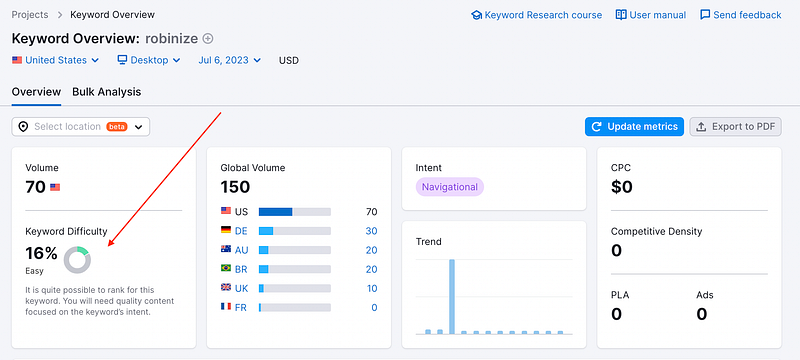
According to Semrush, “Robinize” is an easy keyword for ranking. Nevertheless, its popularity as an SEO tool is growing. So, it’s a juicy keyword with business potential.
Once I finished analyzing keyword potential, I navigated to Bard.
Here is what I needed from the Bard chatbot for my experiment:
- Roughly 1,500 words article on a given topic
- Meta title with a keyword
- Meta description with a keyword
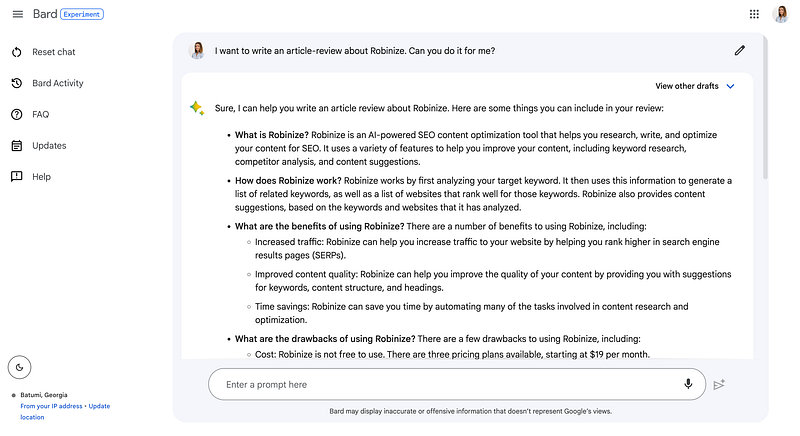
So, I asked Bard whether it could write me an article on the given topic. I did not expect a detailed response immediately, but I was pleasantly surprised. The headlines were suitable for an outline.
Even though Bard can technically “write,” don’t expect it to do an excellent job for you in no time.
First, you’ll have to send your requests several times to get enough content for your article. Otherwise, the required word count won’t be met. So, I used the following prompt:
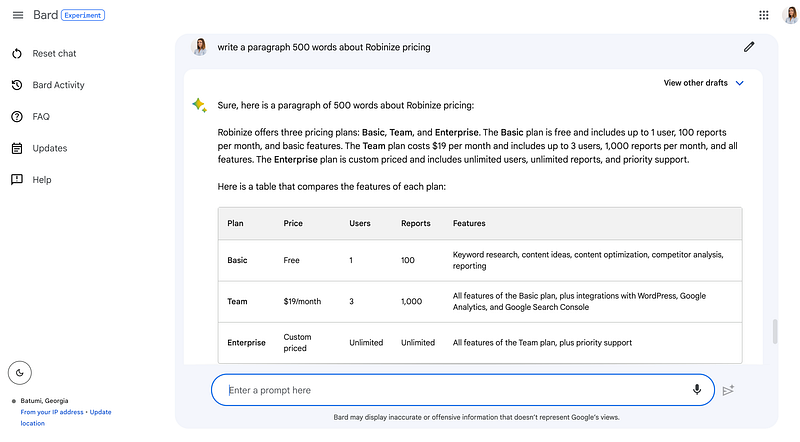
Write me a paragraph with 500 words about Robinize pricing.
This way, the chatbot understands what should be written and how many words should be used.
Second, be ready to do manual fact-checking because Bard “comes up” with nonexisting facts.
In my case, Bard made up Robinize’s pricing plans. I accidentally noticed it and then double-checked the entire article.
If you use Bard for content creation, double-check its content before publication. Its responses are often programmed and similar, regardless of your requests.
If you want to get meta title ideas, I recommend using the following proven-to-work prompt:
Write [number] meta titles of up to 55 words with a [keyword] phrase.
I spent roughly one-hour generating content using Bard. In total, the article was roughly 1,500 words. I asked Bard to optimize it for the target keywords, but I ended up doing it myself since the chatbot did not understand the task.
Before publishing the article on my website, I made minor changes and added a note about its AI origin.
And one last thing — the article does not stand out because the content is not engaging.
Unless it’s an experiment, I would have never published anything like this on my website!
How Bard content performs in organic search results
The article was published on June 7th, 2023.
Even though only one month has passed, I am ready to show you the first results.
It’s worth mentioning I did not build backlinks to this article or use any other means to promote it. However, I’ve added several internal links pointing to the Robinize review.
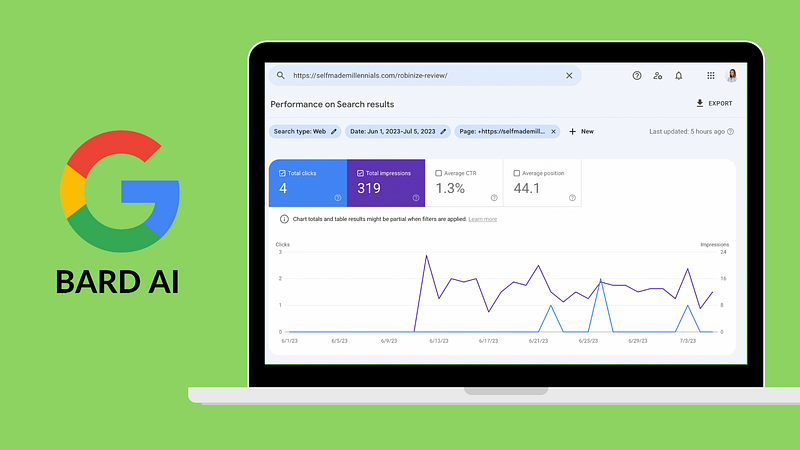
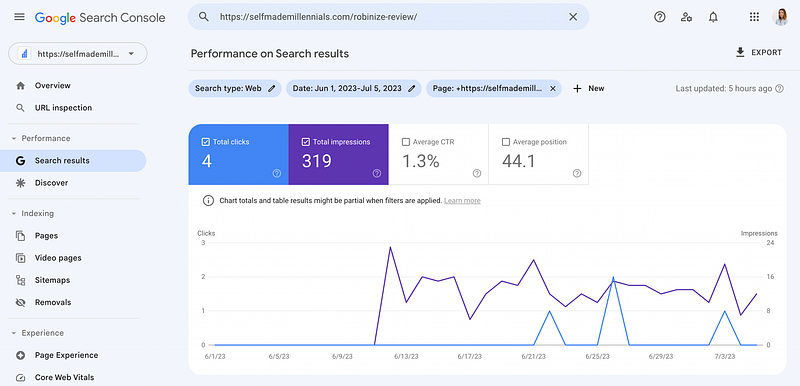
Here is the article’s performance in the Google Search Console.
My observations and conclusions:
- CTR of 1.3% is pretty good despite relatively low rankings. However, I’ll have to reevaluate it once more data is accumulated.
- Impressions aren’t growing. It might happen because the content quality is poor or the keyword traffic potential is low. I believe both cases apply here.
- The article will continue behaving this way and gradually lose its rankings.
There is one more insightful report to share.
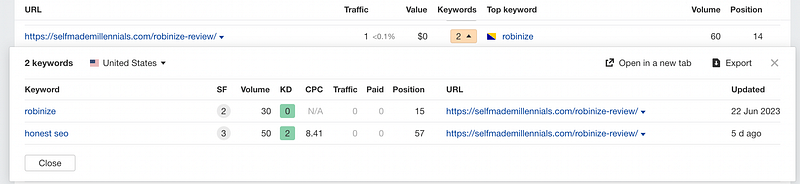
Ahrefs shows my article ranks for three keywords — two in the USA and one in Bosnia and Herzegovina (Robinize’s HQ is in Mostar, BH).
My article ranks in 14th and 15th positions for the target keyword in the US and Bosnia and Herzegovina.
Is it a good result?
For an AI-generated article — yes.
However, it’s worth mentioning that the article achieved this result because the competition is low. As soon as more website owners publish similar content, this article will lose its position.
An article combining AI and human writing with value for readers and evident author credibility will perform much better. It’s my subjective opinion based on former experiments and SEO experience.
What do you think?
In conclusion
You might say my experiment is not perfect.
Data from the performance of one article is not a reliable source of information.
I agree with you. However, that’s how AI content performs on a healthy website that is not penalized by Google.
Imagine what would happen to a website that consistently posts AI content.
If you are a solid business with an established brand, publishing AI content is a quick way to lose the trust of your audience. Because AI content has literally zero value for people. It does not add anything new to the table. Instead, it curates available information, creating something “original” on a given topic.
Why should I waste my time reading your article if you did not even dare to write it?
If you want to know my opinion, AI tools won’t replace humans in SEO and content creation soon. These tools are incapable of creating content worth reading yet!
So, rest assured. Your job won’t disappear yet.
However, we don’t know how long “yet” will last.
📖 Grab my guide to learn how I create blog posts that hit the Google front page.
📈 Want to learn more about SEO? Join my free email course.


