
5 ChatGPT Prompts I Use to Write High-Ranking Posts for My Website
They work for Google Chatbot — Bard too.

The world changed after OpenAI, an American artificial intelligence research laboratory, launched a new AI-powered chatbot in November 2022.
Every news site and social media platform mentioned ChatGPT and how it helped people achieve X, Y, and Z.
By now, the hype around ChatGPT has slightly decreased, but people's interest in the platform continues to grow.
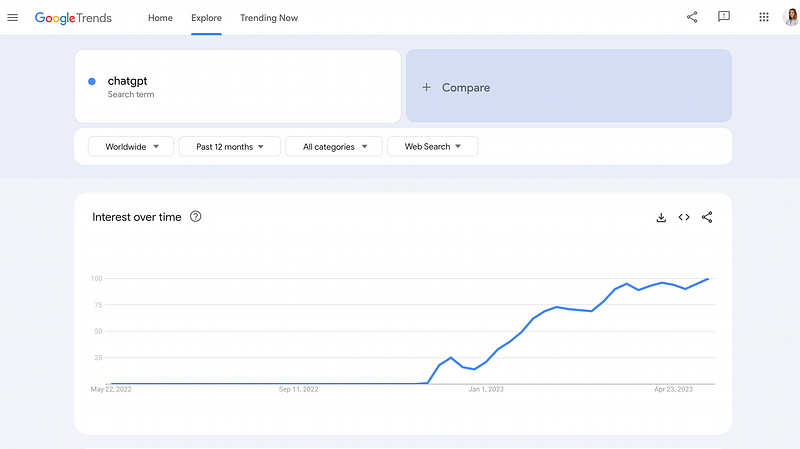
As an SEO specialist and content writer, I've been skeptical about using AI tools for content creation and SEO because of Google's negative attitude to AI-generated content and its massive spread on the web.
That's why Google implemented several helpful content updates to eliminate shallow content from top search engine results.
Besides, it has also made an official statement about AI:
“Using automation — including AI — to generate content with the primary purpose of manipulating ranking in search results is a violation of our spam policies.
This said, it’s important to recognize that not all use of automation, including AI generation, is spam. Automation has long been used to generate helpful content, such as sports scores, weather forecasts, and transcripts. AI has the ability to power new levels of expression and creativity, and to serve as a critical tool to help people create great content for the web.”
Despite Google's message on the potential adverse effect of AI-generated content, website owners continue posting AI-generated content on their websites.
In this article, I want to show you how I use ChatGPT to create high-ranking content for my website.
You won't find prompts like "generate an outline" or "give me keyword ideas" because you won't be able to create and optimize your content based on the generative AI suggestions (yet).
Multiple content writing tools for SEO can help you write and optimize content for organic search results.
Furthermore, ChatGPT content on my clients' and my own websites did not perform well in organic search results. I wrote about it earlier in this article.
Instead, I'll share prompts I use to speed up my writing and create high-ranking content. They work well for ChatGPT and Bard too!
These are a few prompts that are proven to work for me. I continuously experiment with AI tools and will share more prompts that can make a real difference.
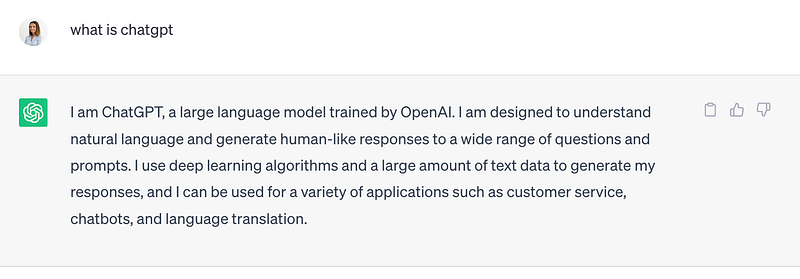
1. What is [topic]?
I've always struggled to write clear and succinct definitions. In the past, I had to review several sources before I could write a short and easy-to-understand definition.
ChatGPT and Bard can perfectly do it!
Whenever I write a new article and have to include a definition, I use generative AI to get ideas. Please, note I said "to get ideas," but not to copy and paste a definition!
If you are a content creator who struggles to write concise definitions, try this prompt!
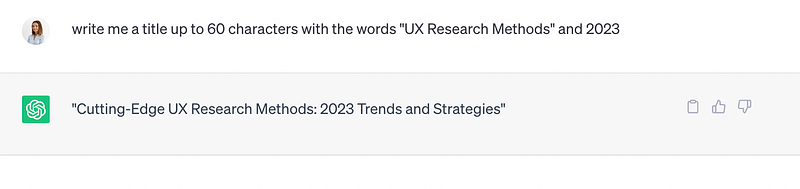
2. Write me a title of up to 60 characters with the words [topic]
ChatGPT can create meta titles and descriptions based on your requirements.
It also understands queries like "make it shorter" or "make it more catchy."
When I run out of ideas, I use ChatGPT and Bard. It's absolutely safe for your website. You won't get any penalty from search engines for using AI for this purpose.
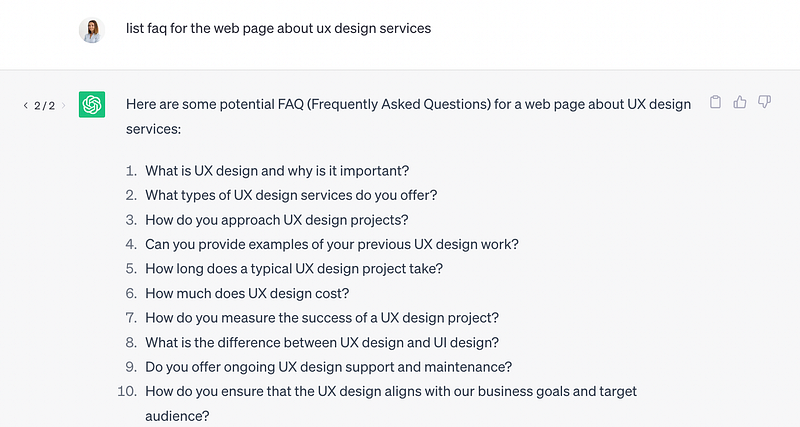
3. List FAQ for the web page about [topic]
Most blog posts I write for my website or client websites have an FAQ (frequently asked questions) section.
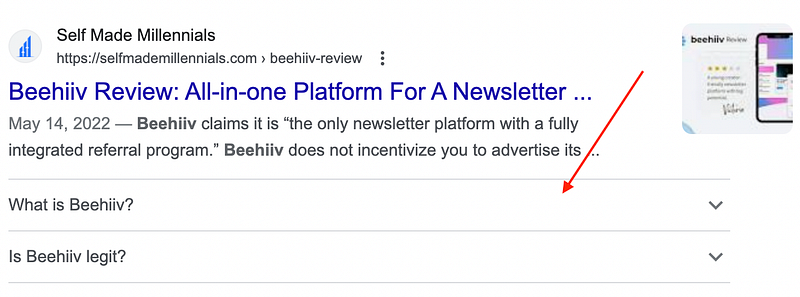
This section usually covers popular questions users search for on Google. If you write helpful answers and add schema.org markup, Google can create a beautiful snippet for your article in organic search results, like this one:
Instead of brainstorming ideas on my own or stealing them from the search results, I used ChatGPT to generate FAQ questions for one of my articles.
It's worth noting that I don't copy/paste AI content as it is! I use ideas to create human-written content!
The impact of AI-generated content on SEO is not well-studied yet. That's why I would not risk publishing a lot of AI content on a website.
4. Generate schema markup for the following question and answer
Earlier in this article, I showed you how implementing schema.org markup can help your website pages stand out in organic search results and get a higher CTR (click-through rate).
The next question should be, "How to implement it?"
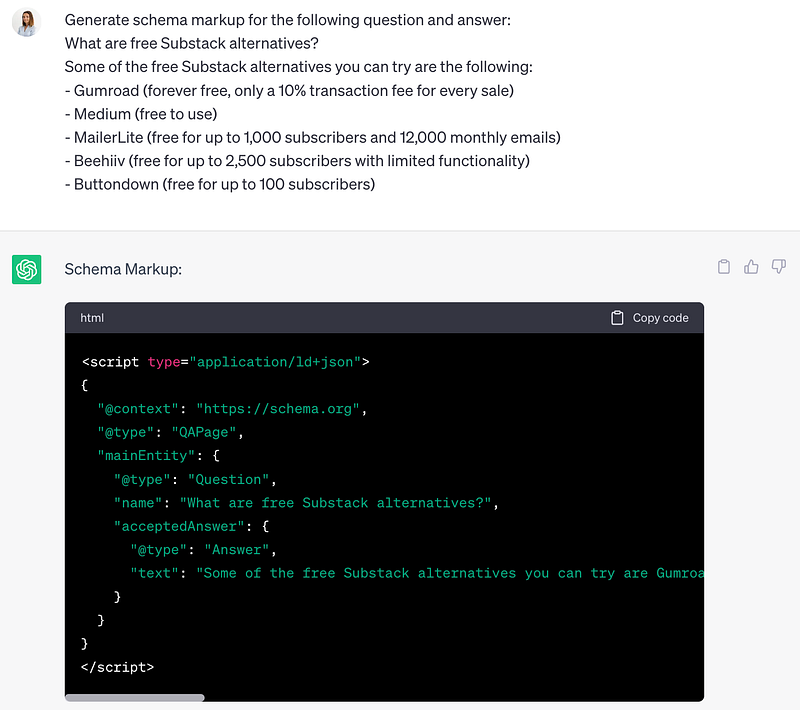
If you run a website on WordPress, some plugins, like All-in-one SEO, can help you implement schema. However, there is a free way to do it by using ChatGPT and Bard.
I use the following prompt to quickly generate schema markup for website pages:
5. Give me data about [topic] with sources
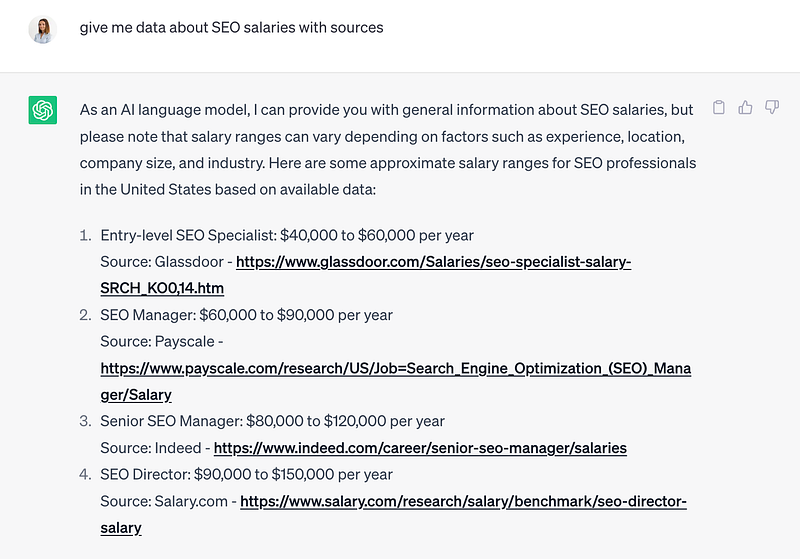
Whenever I need data to back up my statements, I must review multiple websites.
ChatGPT can speed up this process by listing numerous sources from different websites.
I recommend reviewing a list of sources since ChatGPT-3 provides incorrect links sometimes.
In conclusion
ChatGPT can significantly speed up your work if you know how to use it wisely.
That's why you stumble upon hundreds of articles with ChatGPT prompts. Most are trash and won't help you create a unique, optimized content piece to rank high on Google.
Generative AI has made tremendous progress recently but still can't create content like humans. This might change soon, but we don't know how soon.
We will slowly reach the point when most of the written content on the Internet will be AI-generated. However, we have no clue what Google and other search engines will do about it.
The impact of AI on SEO has yet to be thoroughly studied. That's why publishing a bunch of AI articles on your website is at your own risk.
There is a great question I wish every content creator asked themselves before using AI writing tools:
Why would anyone read your AI-generated article if you did not dare to write it?
Grab my guide to learn how I create blog posts that hit the Google front page. You can easily replicate my 3-step process even if you are just starting.
You can get full access to every story on Medium for just $5/month by signing up through this link.


