77.3% of My Website Pages Generate Organic Traffic — Here’s How I Do It
I only spend a few hours per week working on my website.
If you’ve been following me for a while, you might know I created a personal website in August 2021.
Back then, it was a digital environment for my marketing experiments and an opportunity to improve my SEO skills.
I quickly realized my 5-year experience as an SEO specialist in B2B and SaaS companies helped me figure out proven-to-work SEO strategies. I was ready to launch and grow my website.
I quit my full-time marketing job in July 2022 and became a solopreneur. So far, it’s been one of my best decisions ever. If you want to learn more about my solopreneur journey, here is a link.
However, my workload skyrocketed after switching to solopreneurship. I managed SEO projects for my clients, shared my experience on my Medium blog, wrote an ebook on “How to hit the Google front page,” and managed my website in between.
Guess how much time I could devote to my website while running numerous projects simultaneously? 3–5 hours per week! Nevertheless, my website has been growing consistently since 2021. Besides, it did not lose its rankings even during major Google algorithm updates.
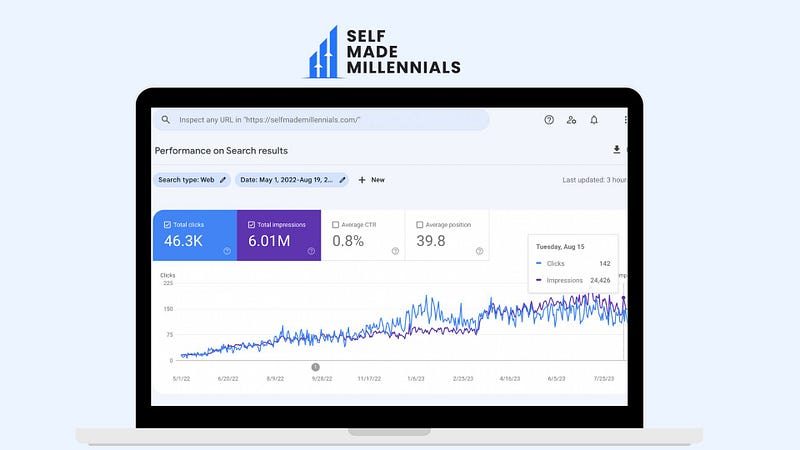
Here is how my website has been growing:
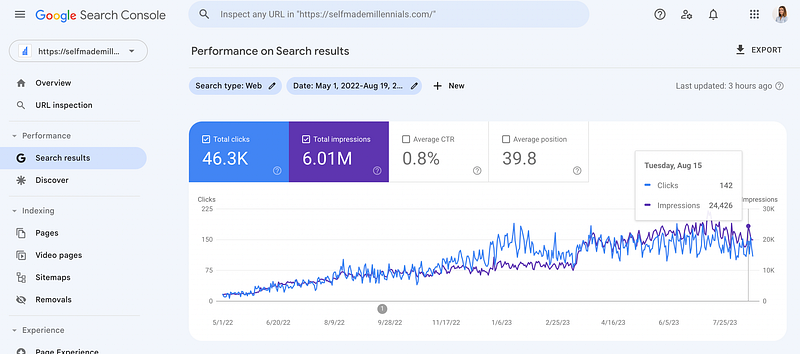
Despite my slow performance, my website has seen a 5X increase in clicks and a 10X increase in impressions in a year! I think it’s an outstanding achievement to be proud of!
Website owners can achieve these results using various strategies. Some publish a lot of content daily and see what sticks. Others post less but maintain a high-quality bar and optimize their content for rankings. That’s my case.
As of August 2023, my website has 67 indexed web pages on Google. Since I work alone, I can publish 1–3 new articles monthly. Despite having a small number of web pages, my website generates 5,000+ traffic. Besides, roughly 77.3% of all my website pages generate organic search traffic, according to Ahrefs:
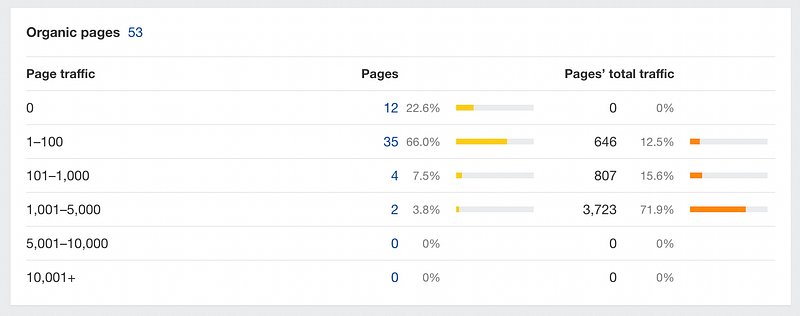
Ahrefs also shows that two web pages generate 71.9% out of all organic traffic on my website. These web pages are my in-depth and honest Beehiiv and Vocal.media reviews.
The Beehiiv article earned me $2,000+ within a few months—a pretty good result for one article and a small website.
My website proves you can make money even with a small but well-performing website.
Here is what I do to create high-ranking content.
1. Create a content strategy
Creating content without understanding why is a losing strategy.
Since my time and resources are limited, I want to use them efficiently.
My website did not have a content strategy for the first year of its existence. I tried different monetization ideas and failed miserably, but I learned what worked and what didn’t.
Eventually, I developed the following content strategy that helps me make 4-figures from my website monthly.
My website grows around three categories, where each has its goal:
- SEO writing: Shows and sells my SEO services
- Creator tools: Shares my honest tool reviews and makes affiliate commissions
- Medium writing: Shows my expertise as a Medium writer and how anyone can make money on this platform
Every content piece I publish on my website belongs to one of these categories and helps me monetize my efforts.
The content creation strategy seems straightforward now. However, it took me time to figure out my niche and structure my website to support my business goals.
Nowadays, I focus on steps 2–5, which are essential for website growth and monetization.
2. Research keywords with business potential
You may write about anything you want if you run a website as a hobby.
However, you must prioritize your audience’s needs and wants if you treat your website as a business. It means talking less about you and focusing on helping your audience solve their problems. In other words, you must know the topics people want to learn about.
How to find topics people want to read?
The answer is — niche keyword research.
Keyword research will help you discover popular topics with high monthly search volumes and low competition for your target country. This way, you’ll know what your target audience actively looks for online and create optimized content that answers their questions.
I don’t publish anything on my website without keyword research because it’s a waste of time.
I don’t want my articles to bring a few visitors and “die” forever. Instead, I want my content to rank high in organic search results for a long time, generating a steady traffic flow to my website. That’s possible if you discover topics with potential and create optimized content.
I use Semrush and Ahrefs for keyword research. However, more affordable alternatives exist, like Frase.io, Mangools, and Robinize.
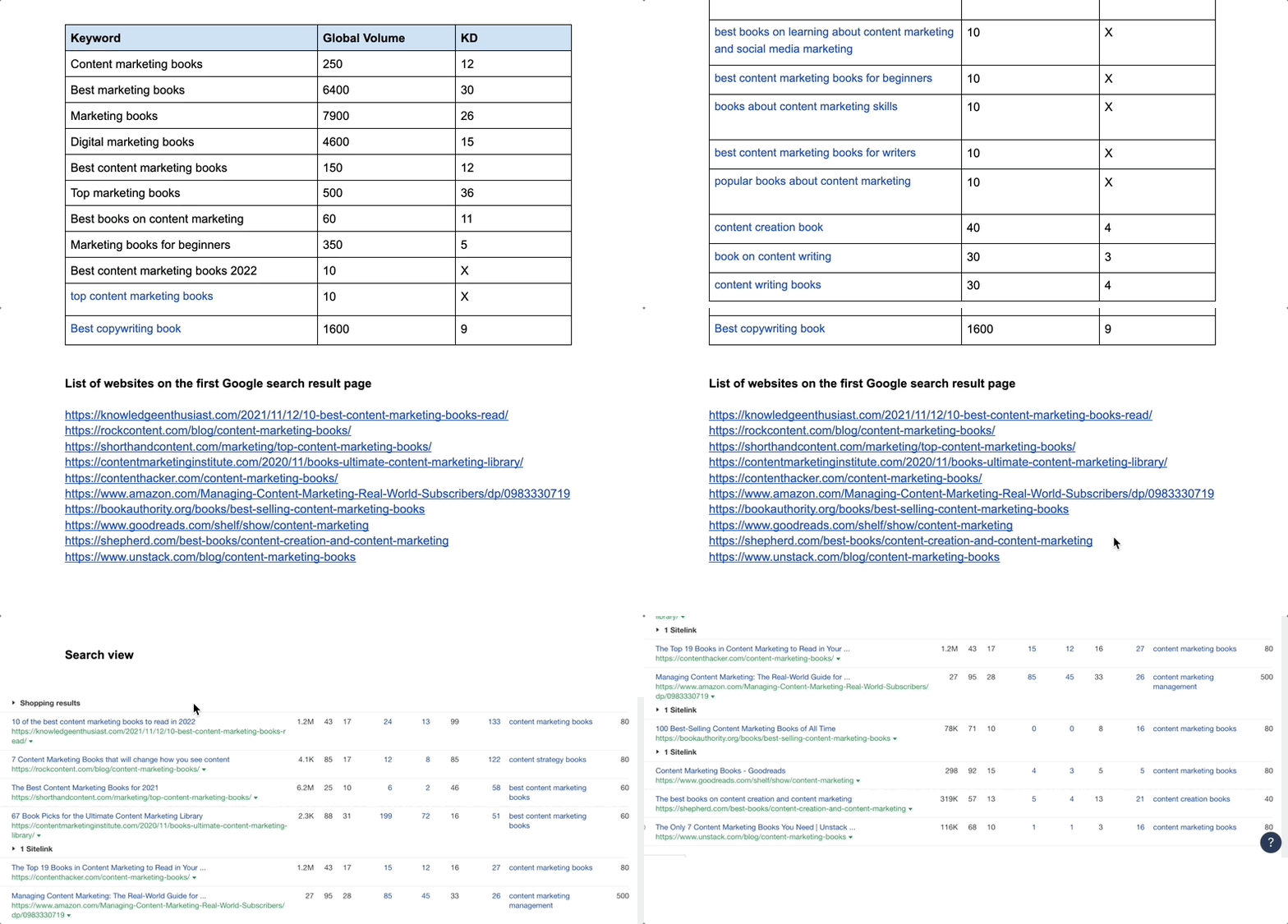
Here is a list of keywords for one of my articles about content marketing books.
Grab my SEO writing ebook if you want to learn how to conduct keyword research and create content that hits the Google front page.
3. Analyse search intent
Search intent is the why behind any search query.
In other words, this is the reason why users navigate to the search bar, type their requests, and hit “search.”
After analyzing hundreds of thousands of search queries, Google knows what users want. That’s why Google considers users’ search intent while ranking various web pages.
Unlike on-page SEO and backlinks, search intent is not among the most substantial ranking factors. However, your web pages won’t rank if you disregard it, even if you buy or build backlinks. I know it from my experience.
4. Optimize content
Here comes one of the most creative parts — on-page SEO. It’s the process of optimizing your content for a target keyword to rank in organic search results.
The following strategies can help you make your content searchable:
- Optimize meta title
- Optimize meta description
- Optimize the H1 headline with a target keyword
- Optimize the H2, H3, H4 subheadlines with related keywords
- Optimize the introduction
- Optimize the body of your article (1 keyword for 150 words, roughly)
I dedicated an entire chapter in my SEO writing ebook to explain every optimization strategy and how to apply it. If you are interested, here is a link to my ebook.
5. Content update
It’s one of the most underrated SEO strategies.
As an SEO expert, I enjoy refreshing old content because it always gives a performance boost.
In a nutshell, I regularly update my website pages that have business potential.
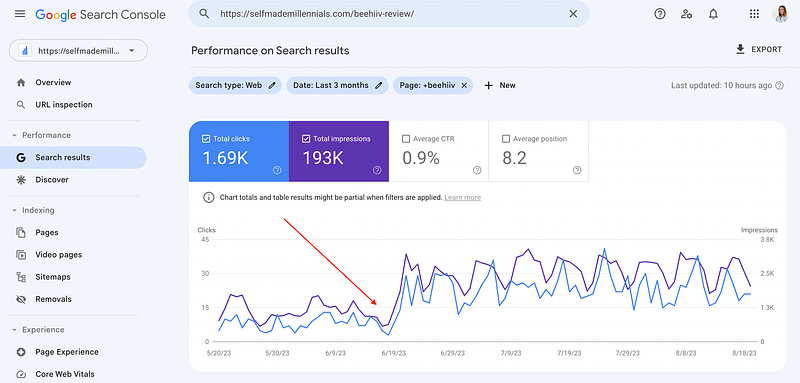
For example, this article maintained its position in the top 10 search results thanks to the content update, bringing roughly 10 leads per month versus 1–5 before the content update.
In conclusion
No worries if you hear these marketing and SEO strategies for the first time.
Many website owners disregard these simple recommendations that you will have a competitive advantage if you master SEO skills.
I published over 300 blog posts on Medium and spent hours writing daily without rest. I improved my writing skills and speed of writing, but I also learned the following:
“You will substantially decrease your working hours and improve your performance if you start writing for your readers.”
The good news is that even one well-written and optimized piece can make a difference.
What’s left for you — to act!
📖 Grab my guide to learn how I create blog posts that hit the Google front page.
📈 Want to learn more about SEO? Join my free email course.