
It’s Still Moving
Before film could become an art medium, ‘motion pictures’ had to be invented and the conventions of ‘cinema’ set-out
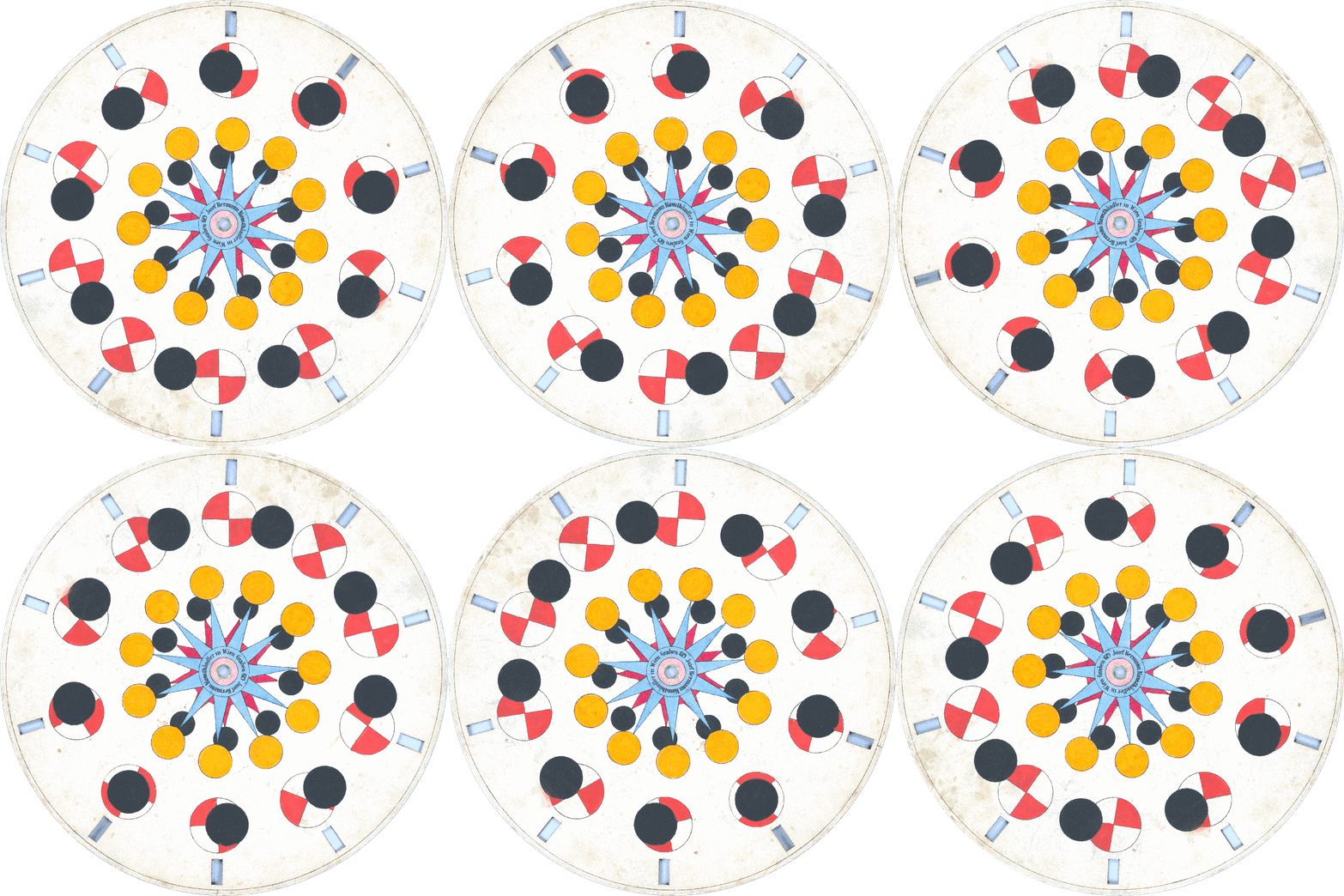
The appetite for film grew from the Victorian craze for stereograms and the ensuing pier-end Mutoscopes that used the ‘flip-book’ method to create moving pictures, often revealing ‘what the butler saw’. Cinema started out as the stuff of quick-thrill sideshows, a form of novelty entertainment having more in common with a stage conjuror or burlesque show than it did with fine art or literature. It was immediately popular, though many of its pioneers thought it was just a fad.
To begin with, photography was used to ape other formats, but faster and cheaper. Generally, it was a method of recording what was in front of the camera — documentation rather than a creative medium. Sometimes, photographers would spend time creating and staging a tableaux, often with separate elements complied within a single print — Fading Away, Henry Peach Robinson’s photograph of 1853, being a well-known example. It terms of approach, that wasn’t very different to a painter making preliminary sketches for a larger scene brought together on their final canvas. Instead of hiring an accomplished painter to make family portraits, it became fashionable to use a photographer who could produce an accurate likeness in minutes by means of this new, seemingly magical, technology.
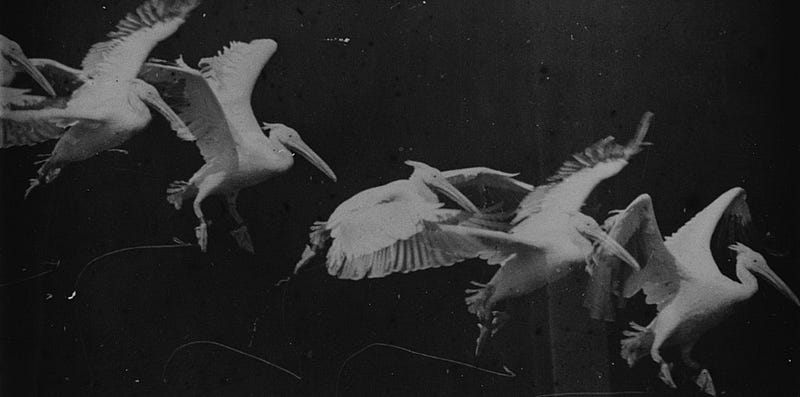
The scientific value of photography quickly became apparent and two notable photographers began experimenting with multiple, timed exposures to research aspects of motion that were too fast for the human eye to perceive unaided. They were Professor Etienne-Jules Marey, a Parisian scientist, and Eadweard Muybridge, a British-born photographer working in the USA. Both contributed significantly to advancing high-speed photography to take pictures of motion which could be thought of as early motion pictures!
The principle known as ‘persistence of vision’ had already been proven with popular rotating ‘toys’ such as the phénakistiscope and zoetrope that animated short illustrated sequences. So, if a similar mechanism could be used to capture photographic images and then play them back… Y’see, the irony is that in order to create the illusion of movement through the rapid succession of still images, first the movement has to be captured, successfully, as a series of still images.
Marey was interested in the physiology of animals and how they moved. He’d been making anatomically correct models of insects and birds to ascertain the dynamics of flight. On the whole, his findings were pretty conclusive — he worked out that some insects moved their wings in a figure-of-eight to obtain lift on both the forward and backward beats. He’d also been trying to provide a definitive answer to a question that had confounded artists since antiquity — how does a horse gallop?
It was an artist, the French neo-classical sculptor and historical painter Jean-Louis-Ernest Meissonier, who’d first tried to solve this conundrum using early photographic methods. He often painted horses and, being obsessed with accuracy and authenticity, became increasingly frustrated by how hard it was to convincingly portray a horse at a gallop.
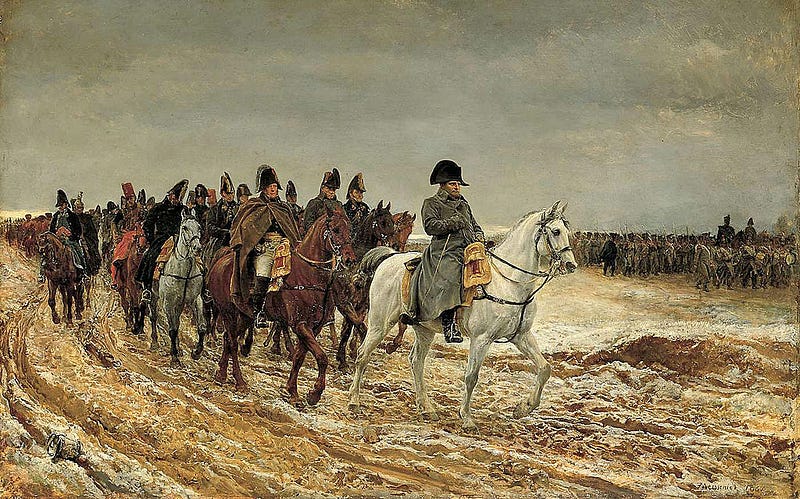
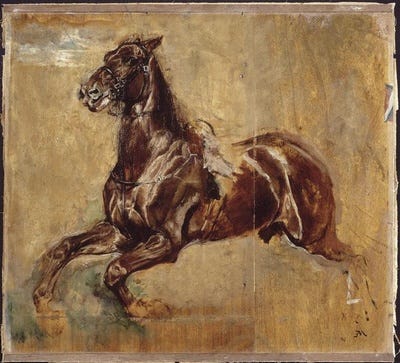
He constructed a stretch of railway track and converted a carriage into a kind of camera obscura. The carriage could roll alongside a galloping horse, matching its pace for close observation. Alas, the technology at the time wasn’t advanced enough to capture any clear images quickly enough. Though, resorting to the use of his own eyes and rapidly blinking he was convinced that his artistic antecedents had got it wrong. Thing is, he still couldn’t figure out what was going on with the horse’s legs at full pelt.
Professor Marey devised an ingenious system of pneumatic sensors, similar to a sphygmograph, that could be attached to the hooves of a horse and using the air compression of each footfall, record the rhythm. He demonstrated that a galloping horse hit a stride of three beats, instead of the expected two or four, because two of its hooves always hit the ground simultaneously. If a similar system of sensors could be used to trigger a series of cameras, then visual proof of how this happened may be obtained. When Marey’s seminal treatise Du Mouvement Dans les Fonctions de la Vie / Of Movement in the Functions of Life was published in 1868, his ideas would be taken up by Eadweard Muybridge.
Leland Stanford, a former Governor of California, had been taking bets from fellow ‘horse-fanciers’ as to whether his champion racehorse, Occident, was ever in ‘unsupported transit’ whilst galloping on the flat. He commissioned Muybridge to come up with photographic evidence to settle the matter. Which was easier said than done and required several innovations to make it possible.
Muybridge experimented with multiple techniques and finally, sometime in the spring of 1873, he managed to capture a clear photo of the horse, apparently with all four feet off the turf. This was done by means of an ingenious spring-loaded shutter system comprising two ‘boards’ transitioning in a way to allow a perfectly timed exposure of a five-hundredth of a second.
The resulting picture has not survived and shortly after this initial success, Muybridge shot his wife’s illicit lover, not with a camera but a pistol. He was tried for murder for which a defense of insanity was proposed. He had been known to be eccentric since sustaining a severe head injury after being thrown from a run-away stage coach back in the 1850s. However, the jury decided it was a passion crime and acquitted him. So, with the continuing patronage of Stanford, he resumed the quest to capture a sequence of clear images showing a galloping horse in continuous motion.
It seems no expense was spared. Stanford had a darkroom built for Muybridge at the Palo Alto racetrack along with a 12-metre ‘camera house’ with 12 made-to-order cameras evenly positioned along its length. A straight track running alongside was ‘paved’ with rubber ground sheets and a white wall erected to ensure bright illumination and provide a featureless backdrop for clear outlines. The first success came when a racing cart, known as a sulky, with metal rimmed wheels was drawn by a horse along the length of track. Pairs of parallel bare wires were laid across the rubber and as the wheels ran over them, a circuit was completed to trigger the electric shutters of each camera in sequence. After this initial proof of concept, he refined the process so that the shutters could be triggered by the breaking of wires, making the need for any metal rimmed wheels redundant.
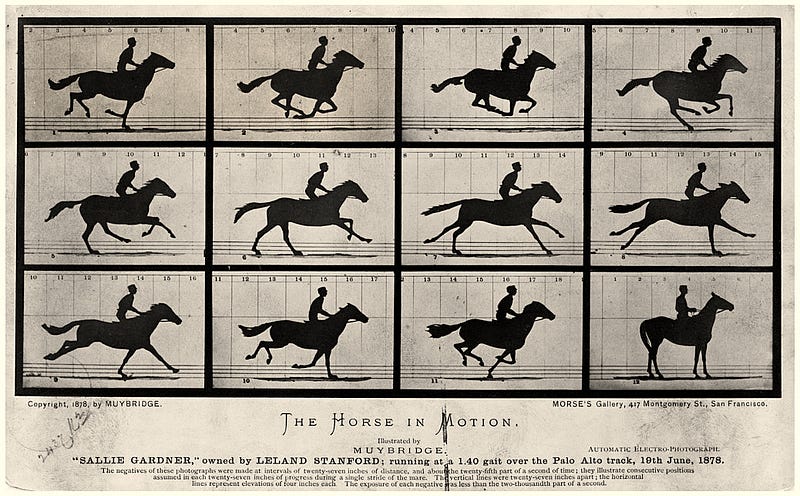
The experiment was a resounding success. In the summer of 1878, Muybridge released his findings to the press and had coined the term ‘chronophotography’. At a cost to Stanford exceeding $42,000, they had proved that no artist in history had correctly portrayed the position of a horse’s legs at a gallop. The painter, Meissonier was still living and surely happy that the conundrum had been finally resolved.
Beginning in 1879, Muybridge embarked on a lecture tour of interest to zoologists, physiologists, art historians, and fellow photographers. He showed his chronophotographs alongside famous paintings of horses, which he now proved to be inaccurate. To maximise the theatrical impact of his presentations he used a device of his own design known as a zoopraxiscope. This was based on the principles of a phénakistiscope but the use of glass discs, onto which were traced silhouettes from his photo-sequences, enabled the moving image to be projected onto a screen in the lecture theatres. In effect, this was the first movie projector and inspired the likes of Thomas Edison to pursue similar designs of their own, leading to the first commercially available film projector… and the birth of cinema.
When Muybridge’s work was published in the French journal, La Nature, the chronophotography impressed Marey who made contact. When Muybridge was touring France in 1881, he visited the Professor and they ended up working together for six months. Marey went on to perfect his portable photo-gun that captured 12 separate exposures in just half a second on one moving photographic ‘plate’ that was pulled past a rapidly firing shutter. He used this to create striking multiple exposures to analyse short lived phenomena and fast actions, famously recording a pole vault and the different gaits of runners. Eventually he refined the process to allow longer sequences to be recorded — he had effectively created the first functioning movie camera.
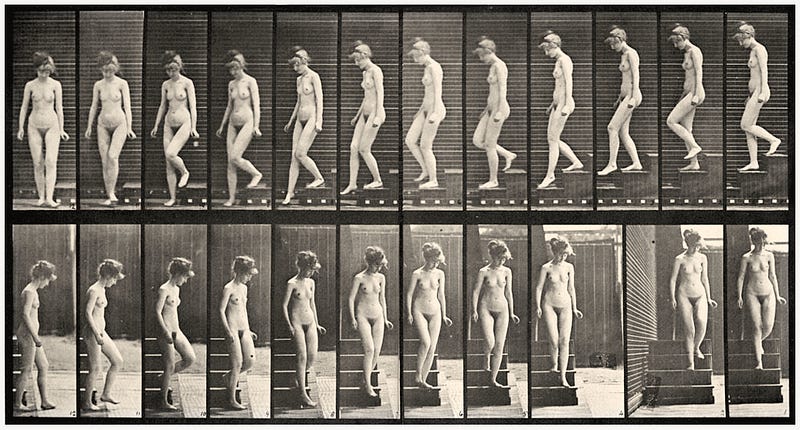
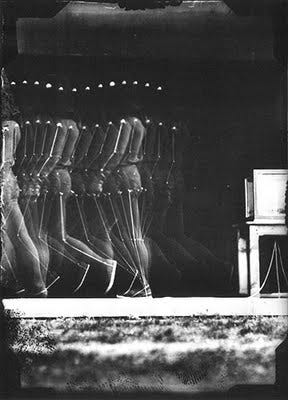
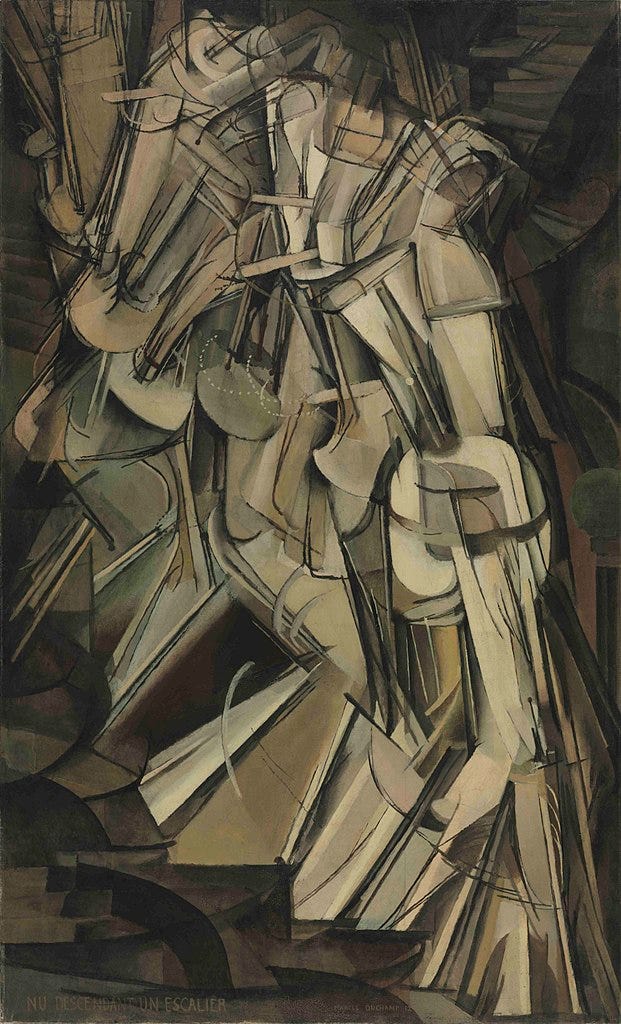
Back in the USA, Muybridge continued refining his chronophotography and turned his multi-camera process on many and varied subjects. He intended to compile a visual dictionary of animal and human locomotion and, in 1884, secured funding from the University of Pennsylvania to do just that. In addition to his groundbreaking animal sequences, he became famed for studies of human nudes performing different tasks from sports to carrying and pouring pitchers of water. These were of interest to physiologists and as artists’ reference. It’s quite fitting that the hugely innovative 1912 painting, Nude Descending a Staircase, №2, by Marcel Duchamp was inspired by Muybridge's chronophotography of the same subject and is now in the collection of the Philadelphia Museum of Art, Pennsylvania. (Duchamp would also pioneer kinetic art that included a Modern take on phénakistiscope discs that he called Rotoreliefs, produced in the mid-1930s.)
Motion pictures introduced the potential for time-base narratives, an attribute associated with the theatre stage, song, and literary reading. So film was first used to either document important events for posterity, or to mimic other established forms of narrative performance.
Made in 1903, Edwin S. Porter’s The Great Train Robbery is cited as the first publicly screened film that followed a cohesive linear narrative. It’s remarkable for employing several conventions that would establish the grammar of cinema including cuts to imply simultaneous action, close-ups for emphasis, wide-shots, pans, and choreographed action sequences. It was a silent, single reel film of just over 12 minutes duration, its story told entirely by visual means without the use of captions.
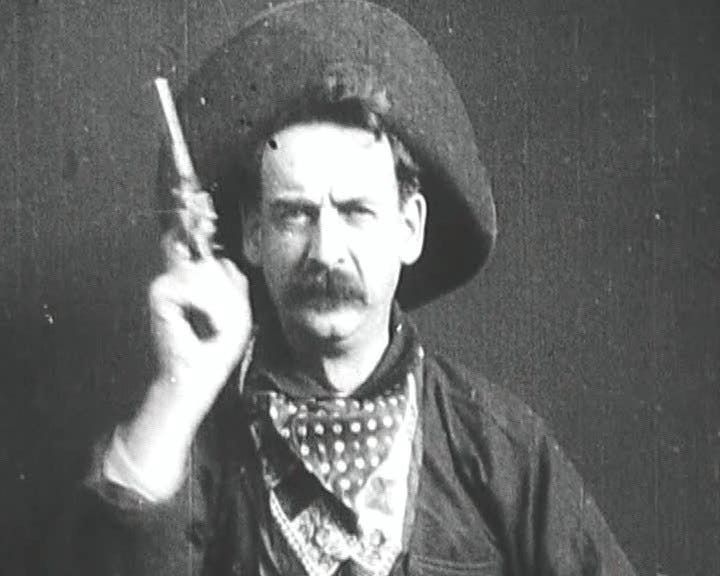
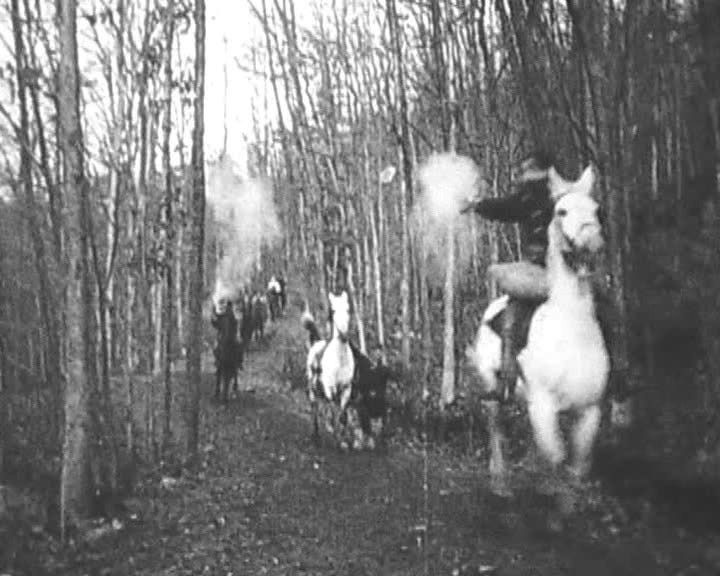
Scenes from Buffalo Bill’s popular Wild West Shows had already demonstrated demand for what would become known as westerns — the first genre of cinema. It’s worth noting that a few single reel narrative films had been made before Porter’s popular short, including Kidnapping by Indians which could also, albeit very loosely, be categorised as a western — though with zero authenticity and little of note in terms of cinematic invention. It was produced in Blackburn, England by Norden Films and shown at fairs in 1899.
Interestingly, the very first known motion picture had been made in nearby Leeds by the French artist-photographer, Louis Le Prince, who used a single lens camera with a strip of the new Kodak photoreactive paper as its ‘film’ to make several shorts in 1888. These included the oldest surviving motion picture sequence, known as The Roundhay Garden Scene, a film of his family made at Oakwood Grange.
This was just ahead of the invention of the Kinetograph in the USA by Laurie Dickson, a lab assistant at Thomas Edison’s company, who adapted a clock mechanism to control the speed that film passed through a camera by means of ratchets that engaged with regular sprocket holes punched in the reactive ribbon. The mechanism also synchronised the timing of a shutter, allowing exposure of each frame. The pace of the exposure could then be replicated by a viewing machine to play back the sequence synchronised with a shutter that allowed timed illumination to coincide with each frame as it paused, thus creating the illusion of a moving picture instead of a blur.
Two brothers who saw a Kinetoscope in action at a Paris exhibition thought it would be better if the moving image could be projected, so that instead of being viewed by one person at a time, an audience could share the experience. Auguste and Louis Lumière went on to invent the Cinématographe, the first commercially viable camera, image printer, and most importantly projector, which they first demonstrated in December 1895. It was the innovation that made what we now know simply as cinema possible.
However, the first sequences made and displayed by both the Edison Company in the USA and the Lumière Brothers in Europe were of similar material — short, unedited single scenes, often of familiar events. They were basically moving photographs, and unlike cinema. Others used these methods in modernising the ‘Magic Lantern’ show with trick photography and double exposures to create photographic illusions and novelty sideshows.
Georges Méliès was a stage magician who saw the entertainment potential of creating illusions using motion pictures and set about inventing his own camera system. He used stop-motion animation techniques to make things appear, disappear, or transform in his short, single-scene ‘trick-films’, following the same format as his stage shows. He began showing these as early as 1896 and by 1899 he was making multiple scene narratives with a set-up, short story, and ‘punch-line’ conclusion — the familiar beginning, middle and end story structure.
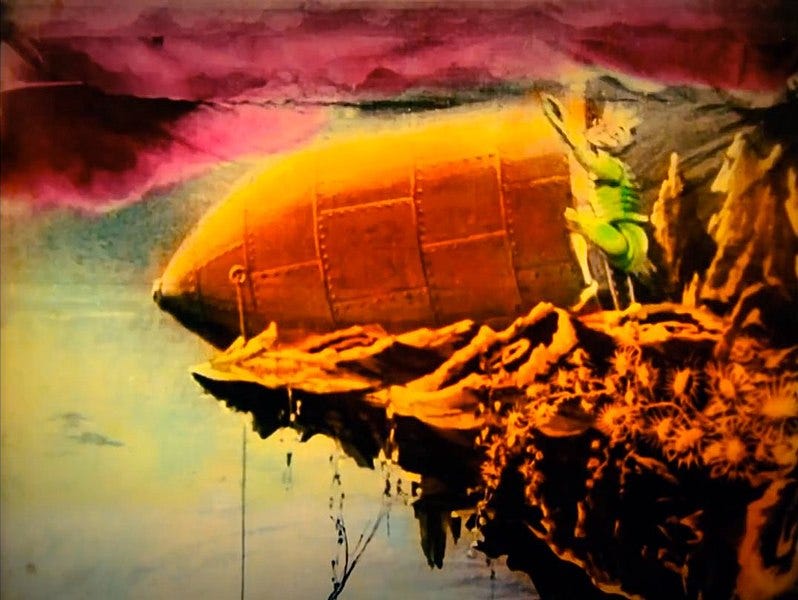
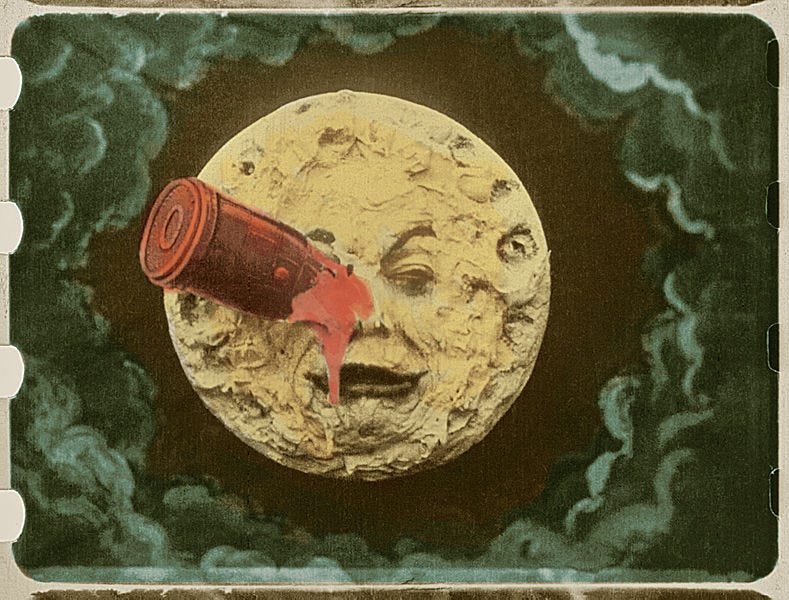
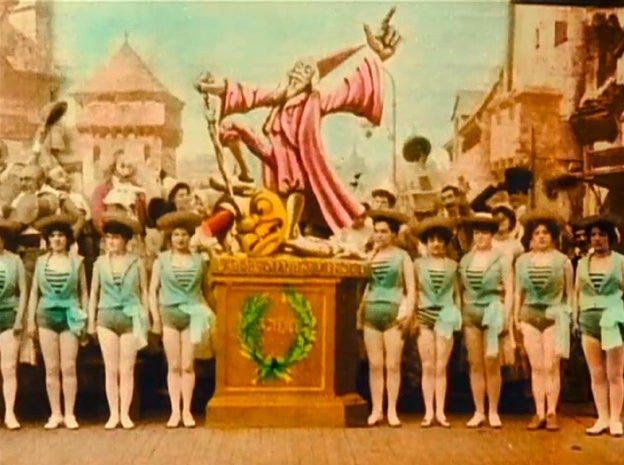
Méliès is best remembered for his 1902 film, A Trip to the Moon / Le Voyage dans la Lune, based on the novel by Jules Verne, From the Earth to the Moon: A Direct Route in 97 Hours, 20 Minutes / De la Terre à la Lune, Trajet Direct en 97 Heures 20 Minutes, published in 1865. Basically, it’s now remembered as the first science fiction movie and, though it had a run-time of just 14-minutes, it was ambitious in both content and duration.
Of course, like any film based on a book, it was very different to its source material and turned out as more of a moving illustration than an adaptation. The film-making methods of Méliès necessitated that the camera remained static, to enable scenes and superimpositions to be convincingly matched. So, as with all his films, the result resembled a filmed stage production and makes no great contribution to cinematic canon.
Surprisingly, the first film to set-out what we still recognise as the cinematic conventions of ‘the feature film’ was made in Australia, far from the medium’s technological origins. The Story of the Kelly Gang premiered at Melbourne’s Athenaeum Theatre on Boxing Day, 1906 and ran for five weeks to full-house audiences. The actors, hidden behind the screen, performed dialogue live and a team created sound effects. With a duration in excess of an hour, it was the first, multi-reel film screened as the main feature, hence the term ‘feature film’.
The Story of the Kelly Gang was an adaptation of a stage play that romanticised and, to some extend, mythologised the folk hero outlaw, Ned Kelly. It was an enterprise of the Tait family who were already stage performers and Charles Tait is credited as the writer and director, though little is known for sure about its production.
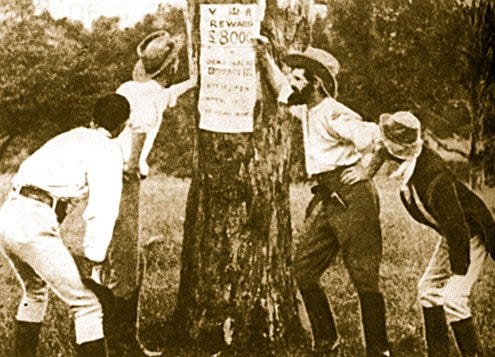
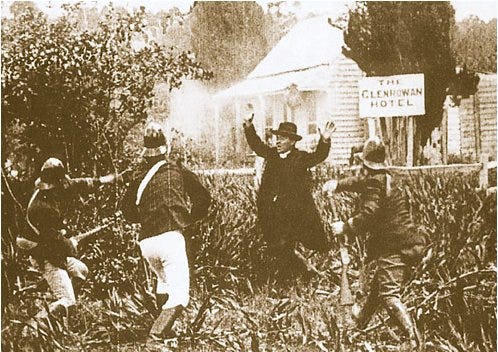
Two local chemists, Millard Johnson and William Gibson were already branching out as cinema exhibitors and were able to process the footage. They acted as producers and were said to have raised a budget of £1,000. After its initial sell-out stint in Melbourne, it was distributed to other theatres in Australia, then New Zealand, and later in England where promotional materials made much of it being the longest film ever made.
Although motion pictures were to have a lasting influence on Modernism, Modern artists were slow to embrace the medium, possibly because of budgetary and technical barriers. The Italian Futurists were hugely influenced by the dynamic motion studies of Marey and Muybridge, clearly evidenced in many of their paintings and sculptures. They were also the first to fully explore the potential of the so-called ‘art movie’, proclaiming that cinema was ‘polyexpressive’ — combining nearly all other art forms as a synthesis of literature, drama, performance, painting, sculpture, environment, installation, fashion, photography, and dynamism, all within a cohesive, time-based format.
Having said that, the cinematic output of the Futurists was limited, with Anton Giulio Bragaglia’s Thais and Vita Futurista being the most successful examples — both made between 1914 and 1916 and it would be more than a decade later before Surrealist cinema would pick up the art movie baton…
Signifier Cinema Presents:
A Trip to the Moon / Le Voyage dans la Lune (1902) public domain print via Open Culture
The Great Train Robbery (1903) archived print at the US Library of Congress
The Story of the Kelly Gang (1906) public domain print of compiled surviving fragments at Films by the Year


-R.gif)


.jpg)


