avatarRemy Dean

Free AI web copilot to create summaries, insights and extended knowledge, download it at here

3681

Abstract

.</p><p id="a72c">Throughout the 1860s and 70s, he travelled far and wide throughout California, finding and photographing many locations for the first time. These images included his first studies of ‘Grizzly Giant’, the now famous giant sequoia tree in Mariposa Grove, which would be photographed by many others who followed.</p><figure id="9b86"><img src="https://cdn-images-1.readmedium.com/v2/resize:fit:800/1*qcFvO3Mh2lO80b238chw3Q.jpeg"><figcaption><b>‘Section of the Grizzly Giant, Looking Up, Mariposa Grove’ (c.1870) a stereogram by Carlton Watkins</b> [<a href="https://commons.wikimedia.org/wiki/File:Section_of_the_Grizzly_Giant,_looking_up,_Mariposa_Grove,_Mariposa_County,_Cal,_by_Watkins,_Carleton_E.,_1829-1916_2.jpg">view license</a>]</figcaption></figure><p id="3b45">He was the first photographer to explore and document the Yosemite Valley and his spectacular landscapes templated what was to be expected from his later rivals and successors. He was known to scout out the best point of view for a scene and then camp out, often for many days or even weeks, until conditions were perfect for the best image.</p><p id="1c3a">He also invested in new equipment and began using large glass plates for better detail and bigger prints, which could be directly transferred from the glass negatives. He is the first photographer known to use so-called ‘mammoth-plates’ as large as 18" x 22" (inches) which resulted in albumin prints of unprecedented clarity.</p><p id="d550">He became friends with the painter William Keith, who accompanied him on several of his Californian excursions and relied on the photography of Watkins as the main reference for his popular paintings of the same locations. Keith’s landscape compositions were among the earliest to be directly influenced by photorealism and were seen as distinct from the Impressionist reevaluation of landscape painting in response to the new media of photography.</p><figure id="9d52"><img src="https://cdn-images-1.readmedium.com/v2/resize:fit:800/1*7tm_JEVF6FrtNQvl4zAUbQ.jpeg"><figcaption></figcaption></figure><figure id="18ba"><img src="https://cdn-images-1.readmedium.com/v2/resize:fit:800/1*vN2cYs0HrvSGTKMI911vEg.jpeg"><figcaption><b>‘Cathedral Rocks, 2600 Feet’ (1867) stereogram by Carlton Watkins</b> [<a href="https://commons.wikimedia.org/wiki/File:Cathedral_Rocks,_2600_feet,_Yosemite_Valley,_Mariposa_County,_Cal,_by_Watkins,_Carleton_E.,_1829-1916.jpg">view license</a>] and ‘<b>Yosemite Valley’ (1875) painted William Keith </b>[<a href="https://commons.wikimedia.org/wiki/File:Yosemite_Valley_by_William_Keith,_1875.jpg">view license</a>]</figcaption></figure><p id="351c">The detail and tonal range sought by Watkins would only result from long exposures of an hour or more, so he had to have good, constant lighting from a favourable angle that would pick out relief and textures. He also needed perfectly still days with no breeze, so leaves and grass would remain still. This also meant that waters would dramatically mirror their surroundings and skies would become featureless backdrops.</p><p id="e0ba">It is said that those evocative images impressed President Abraham Lincoln, confirming the beauty of the Yosemite Valley as a valuable <i>natural</i> resource — which was a new concept at the time. Lincoln then signed a bill in 1864 to protect the landscape from the infringement of damaging development. That bill, known as the Yosemite Grant, led to the establishing of Yellowstone as the first National Park in 1872.</p><p id="5336">The distinctive treatment of landscape by Carlton Watkins had also won him a medal at the 1867 Paris International Exposition, raising his intern

Options

ational profile. His work had become established as the paradigm of landscape as art.</p><figure id="bb46"><img src="https://cdn-images-1.readmedium.com/v2/resize:fit:800/1*ruZ7d9bz9qz4ITfjTes79w.jpeg"><figcaption><b>‘Bridal Veil Falls, Yosemite Valley’ by Carlton Watkins, probably photographed in the late 1870s </b>[courtesy National Library of Wales — <a href="https://commons.wikimedia.org/wiki/File:4._Bridal_Veil_Fall.jpg">view license</a>]</figcaption></figure><p id="0f17">Although Watkins lost a fortune, along with his studios, when the Bank of California collapsed in 1874, he eventually managed to rebuild his photography business. During the 1880s, he travelled extensively through Southern California and built up what was, at the time, the most comprehensive photographic record of the region’s Franciscan Missions.</p><p id="24f8">His work from then on was mainly documentary photography for a portfolio of industrial clients. Though it was the continued popularity of his landscape prints and stereograms that attracted many other commercial photographers to follow in his footsteps.</p><p id="1866">Among those ‘hot-on-his-heels’ was <a href="https://readmedium.com/its-still-moving-f7caf17ed885#cd28">Eadweard Muybridge</a> who sought to reproduce his predecessor’s best-selling views in his own style. To this end, he went to the same locations and positioned his camera to capture the same scenes. The blank skies and mirror clear waters of Watkins, though graphically striking, were not to everyone’s tastes so Muybridge employed darkroom trickery to add clouds by combining multiple negatives whilst attempting retain landscape clarity through long exposures.</p><p id="6984">This approach fell into the broad category of Pictorialism — a trend in which photographers deliberately imitated the feel and finish of classical landscape paintings. The results were often idealised ‘postcard’ impressions of the place that composited different times and lighting, therefore failing to capture the distinctive ever-changing conditions evoked by Carlton Watkins. Muybridge would be better known, and remembered to this day, for his photographic studies of motion and for pioneering the moving image.</p><p id="e3b2">The famous Mount Watkins, of Yellowstone, was named to commemorate the photographer’s instrumental role in establishing the first National Park and the conservation of the Yosemite Valley and environs.</p><figure id="c4a3"><img src="https://cdn-images-1.readmedium.com/v2/resize:fit:800/1*B_iqpgL52GtKCpTuj7uXTQ.jpeg"><figcaption><b>‘Mount Watkins, Fully Reflected in Mirror Lake, Yosemite’ (c.1865) by Carlton Watkins</b> [<a href="https://commons.wikimedia.org/wiki/File:Carleton_e_watkins_mount_watkins_fully_reflected_in_mirror_lake_yosemi024656).jpg">view license</a>]</figcaption></figure><p id="da1c"><a href="https://readmedium.com/lady-of-light-d663b72632d1">The pioneering photography of Clementina, Lady Hawarden, is also discussed by Remy Dean in Signifier</a></p><div id="3564" class="link-block"> <a href="https://medium.com/signifier/key-works-stray-dog-by-daid%C5%8D-moriyama-3161aae639c"> <div> <div> <h2>Daidō Moriyama’s ‘Stray Dog’</h2> <div><h3>Considering how this iconic photograph embodies the past, present and future of Japanese culture…</h3></div> <div><p>medium.com</p></div> </div> <div> <div style="background-image: url(https://miro.readmedium.com/v2/resize:fit:320/1*tj2ccl24Kr1gJ0cmV1ycqQ.jpeg)"></div> </div> </div> </a> </div></article></body>

First Photographer of the American West

Carlton Watkins and the pioneering photographers of the virgin territories nurtured a desire to conserve the natural beauty of America’s majestic West

The painters and poets of the Romantic era had made the sublime beauty of natural landscapes attractive, creating an ever-increasing demand for fresh views of ‘untouched’ wild places. With the technological advances in photography and stereoscopy came the popularity of prints and stereograms, making them commercially viable — and a lucrative pursuit for adventurous photographers at the western frontier. It’s also a positive example of tech-led consumer demand driving creative innovation and resulting in profound real-world change...
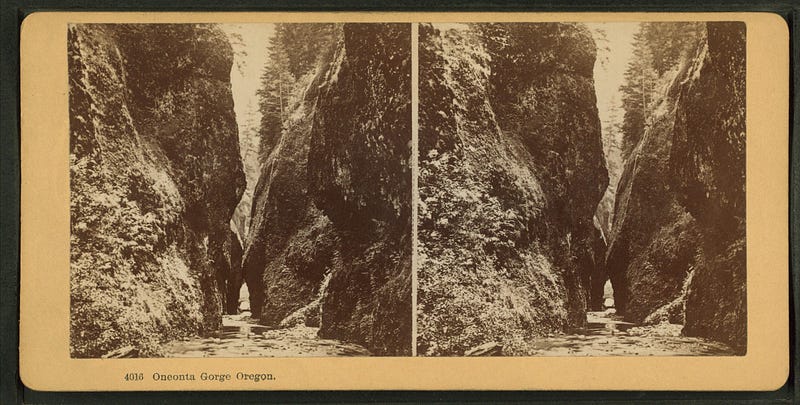
stereogram by Carlton Watkins of Oneonta Gorge, Oregon [view license]

When gold prospecting and mining opened up the Californian wilderness, Carlton Watkins was soon following in the pioneers’ footsteps to photograph the virgin territories. He may not have been the first to set eyes on these places, he was often following tracks mapped by fellow prospectors, but he was the first to really look at them and appreciate the compositional potential of their beauty. Many of the majestic places he photographed had yet to be named — so he did that, in order to title his pictures! This included the first photographs of Oneonta Gorge and Cascades (shown above) which Watkins named after his hometown.

Watkins left New York state and headed out west in the hope of striking it rich in the gold rush. Failing to stake a claim, he instead delivered supplies to the mining camps and settled in San Francisco as a bookstore proprietor. His interest in photography began when Robert Vance asked him to assist at his nearby daguerreotype studio where he trained ‘on the job’ and was left in charge of the business when Vance was away.
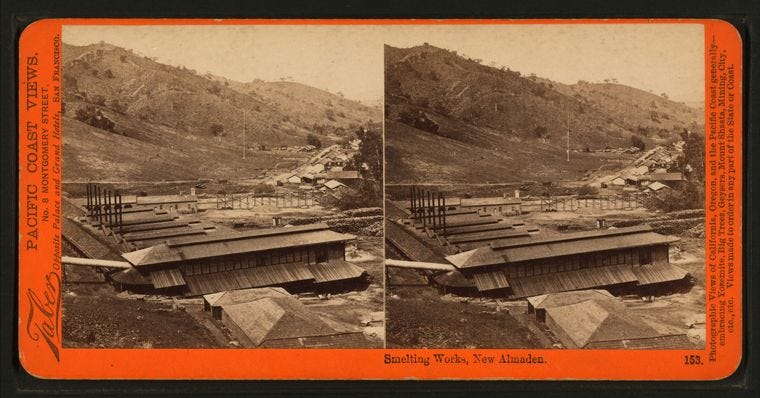
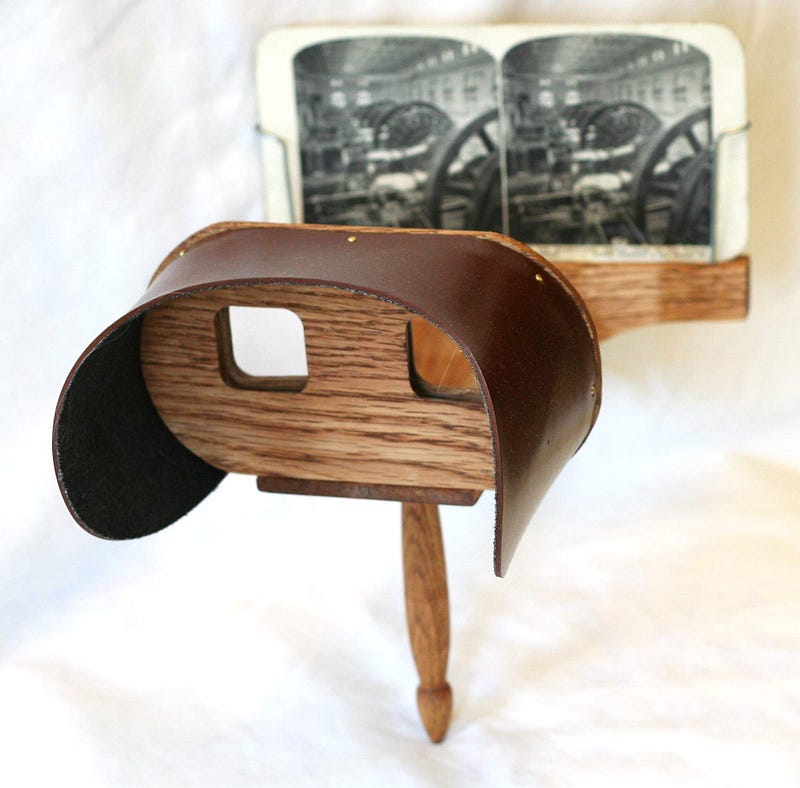
stereogram of the New Almaden smelting works (c.1863) by Carlton Watkins [view license] and replica of a stereoscope designed by Oliver Holmes, the most model during nineteenth-century [image courtesy Dave Pape — view license]

By the end of the 1850s, Watkins had his own studio and was known for portraits. Making use of his contacts in the mining industry he became a successful commercial photographer, documenting assets and real estate for industrial corporations, initially using stereography.

His commissions led him back into the western wilderness where he honed his skills in landscape photography. Stereograms were already fashionable and there was an insatiable demand for exotic scenes and landscape. Watkins made the most of his access to new views and his unique images quickly found an eager audience across the USA and overseas.

Throughout the 1860s and 70s, he travelled far and wide throughout California, finding and photographing many locations for the first time. These images included his first studies of ‘Grizzly Giant’, the now famous giant sequoia tree in Mariposa Grove, which would be photographed by many others who followed.
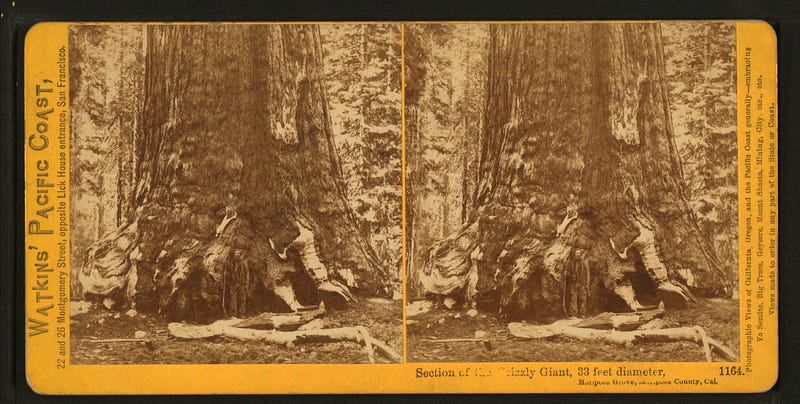
‘Section of the Grizzly Giant, Looking Up, Mariposa Grove’ (c.1870) a stereogram by Carlton Watkins [view license]

He was the first photographer to explore and document the Yosemite Valley and his spectacular landscapes templated what was to be expected from his later rivals and successors. He was known to scout out the best point of view for a scene and then camp out, often for many days or even weeks, until conditions were perfect for the best image.

He also invested in new equipment and began using large glass plates for better detail and bigger prints, which could be directly transferred from the glass negatives. He is the first photographer known to use so-called ‘mammoth-plates’ as large as 18" x 22" (inches) which resulted in albumin prints of unprecedented clarity.

He became friends with the painter William Keith, who accompanied him on several of his Californian excursions and relied on the photography of Watkins as the main reference for his popular paintings of the same locations. Keith’s landscape compositions were among the earliest to be directly influenced by photorealism and were seen as distinct from the Impressionist reevaluation of landscape painting in response to the new media of photography.
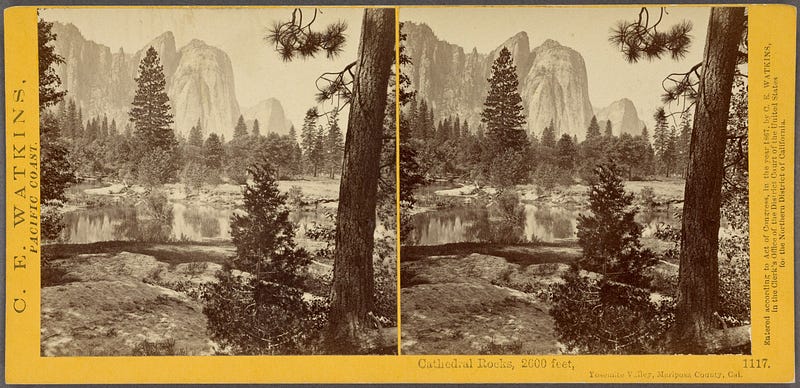
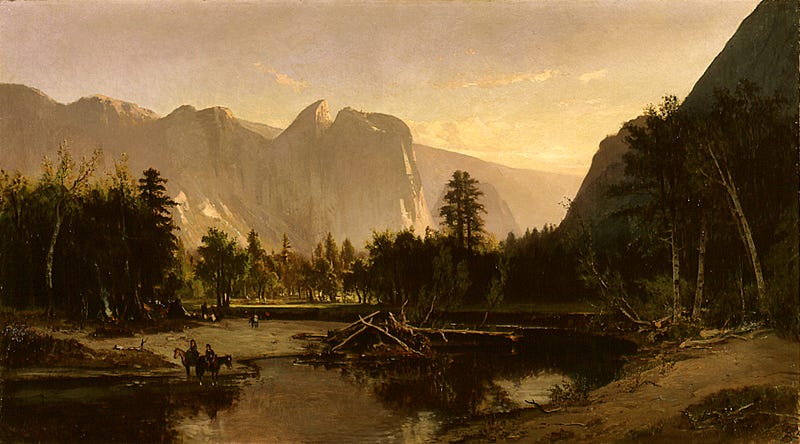
‘Cathedral Rocks, 2600 Feet’ (1867) stereogram by Carlton Watkins [view license] and ‘Yosemite Valley’ (1875) painted William Keith [view license]

The detail and tonal range sought by Watkins would only result from long exposures of an hour or more, so he had to have good, constant lighting from a favourable angle that would pick out relief and textures. He also needed perfectly still days with no breeze, so leaves and grass would remain still. This also meant that waters would dramatically mirror their surroundings and skies would become featureless backdrops.

It is said that those evocative images impressed President Abraham Lincoln, confirming the beauty of the Yosemite Valley as a valuable natural resource — which was a new concept at the time. Lincoln then signed a bill in 1864 to protect the landscape from the infringement of damaging development. That bill, known as the Yosemite Grant, led to the establishing of Yellowstone as the first National Park in 1872.

The distinctive treatment of landscape by Carlton Watkins had also won him a medal at the 1867 Paris International Exposition, raising his international profile. His work had become established as the paradigm of landscape as art.
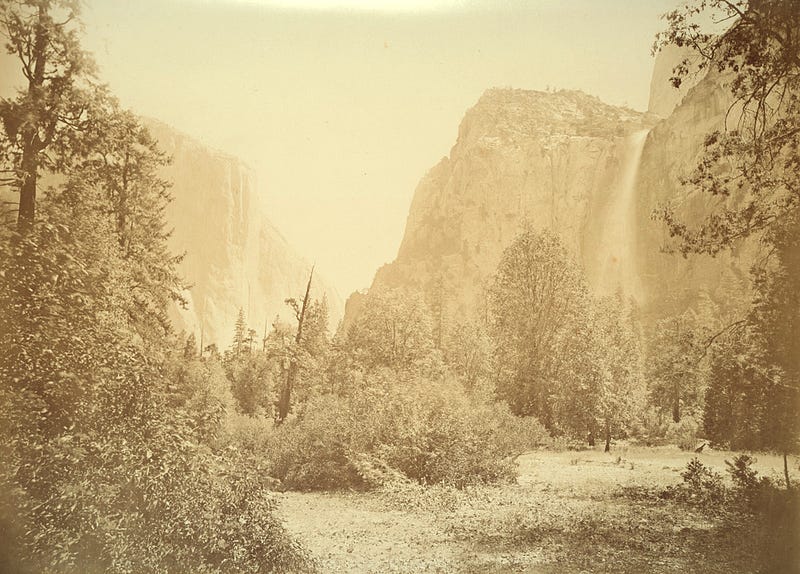
‘Bridal Veil Falls, Yosemite Valley’ by Carlton Watkins, probably photographed in the late 1870s [courtesy National Library of Wales — view license]

Although Watkins lost a fortune, along with his studios, when the Bank of California collapsed in 1874, he eventually managed to rebuild his photography business. During the 1880s, he travelled extensively through Southern California and built up what was, at the time, the most comprehensive photographic record of the region’s Franciscan Missions.

His work from then on was mainly documentary photography for a portfolio of industrial clients. Though it was the continued popularity of his landscape prints and stereograms that attracted many other commercial photographers to follow in his footsteps.

Among those ‘hot-on-his-heels’ was Eadweard Muybridge who sought to reproduce his predecessor’s best-selling views in his own style. To this end, he went to the same locations and positioned his camera to capture the same scenes. The blank skies and mirror clear waters of Watkins, though graphically striking, were not to everyone’s tastes so Muybridge employed darkroom trickery to add clouds by combining multiple negatives whilst attempting retain landscape clarity through long exposures.

This approach fell into the broad category of Pictorialism — a trend in which photographers deliberately imitated the feel and finish of classical landscape paintings. The results were often idealised ‘postcard’ impressions of the place that composited different times and lighting, therefore failing to capture the distinctive ever-changing conditions evoked by Carlton Watkins. Muybridge would be better known, and remembered to this day, for his photographic studies of motion and for pioneering the moving image.

The famous Mount Watkins, of Yellowstone, was named to commemorate the photographer’s instrumental role in establishing the first National Park and the conservation of the Yosemite Valley and environs.
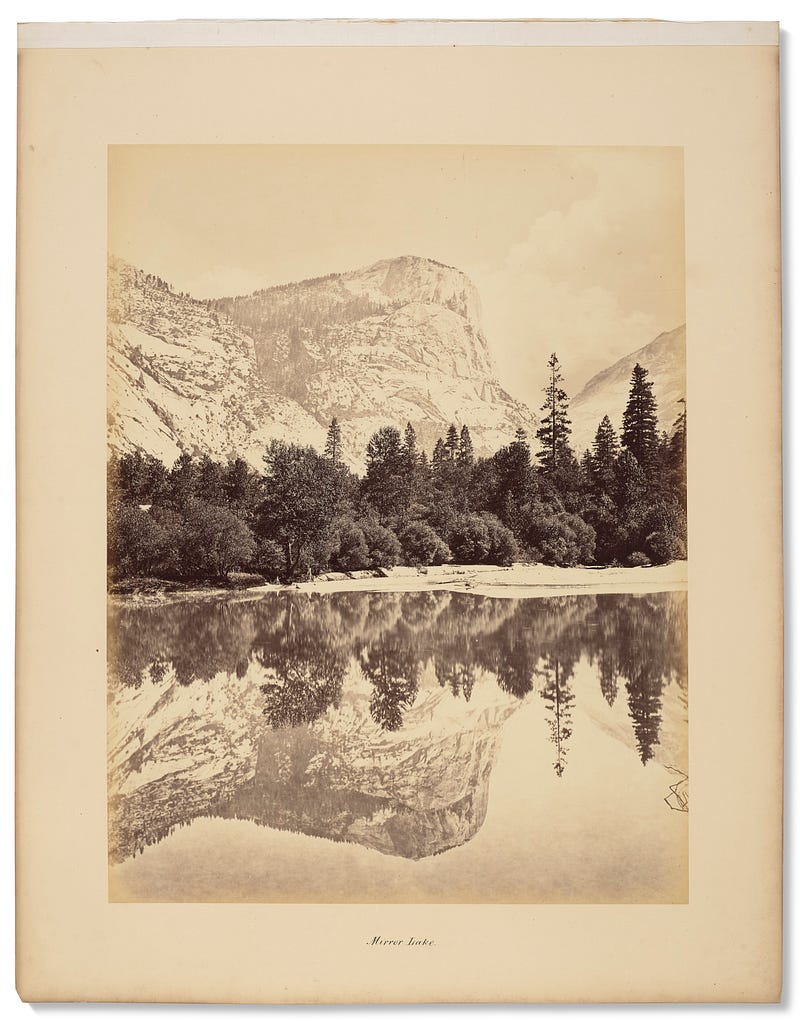
‘Mount Watkins, Fully Reflected in Mirror Lake, Yosemite’ (c.1865) by Carlton Watkins [view license]

The pioneering photography of Clementina, Lady Hawarden, is also discussed by Remy Dean in Signifier

Photography
Art
Art History
Conservation
Landscape
Recommended from ReadMedium