

It’s not impostor syndrome, it’s all the years of internalized bullying and criticism!
Some of the worst coping mechanisms we can have to trauma are to internalize it and make it our inner voice!
If you’ve experienced being bullied or verbally abused and criticized as a child, you probably told yourself at least a few times that what people tell you must be to some extent true if they have a stronger voice than yours. The more vulnerable you are to these situations, the more likely that you internalize the voice of those who abused you in the first place. As time passes you become an adult with the same strong voice towards others as you experienced when you were a child. But the most important part about this process of becoming the abuser yourself as a result of that trauma is that you will also internalize the message about yourself.
There are many coping mechanisms that can fit this pattern. Some of the associated way in which children register the bullying might be by :
- Idealizing
- Being perfectionists
- Escapism
- Rationalizing
- Overcompensating
- Radicalizing
- Dissociating
The results of the trauma can be seen in many aspects of our lives.
From not being able to progress in your career because you have the impostor syndrome and you don’t feel good enough to the fact that you sabotage yourself by not being able to be present in a relationship with a partner that you consider of higher value than yourself, all can have the same route cause.
How to identify unresolved trauma
Trauma is inherently a boundary violation!
Unresolved trauma can show up in many ways, but the most common is the avoidant attachment style. When someone was wounded or has loved with a traumatized nervous system, the idea of getting close to someone can be terrifying because that person might uncover the trauma and force you to relive what you’ve initially experienced.
Some of us have dealt with the trauma by burying it under a rock or making sure that it’s so mixed with other events that it will never be identified and separated to be treated individually.
The result is a chain of coping mechanisms that hide the initial root cause but have produced themselves other traumas that stand as the first contact with the emotional mind. As such, even if we heal the ones at the top of the pyramid, we never really get to the bottom of things because some of us are intelligent enough to sabotage themselves by building up impressive walls and protection mechanisms to stand between the outside world and the trauma we’ve initially had.
The solution is a series of steps that might require working with professional help from a psychotherapist which might even take years. But here are the main touch-points:
- Pay attention to your intentions when you react to something that triggers your emotionally
- Look at the patterns that match your current situation with situations in the past
- Disassembly the situation that triggered you in 2 categories: facts and feelings
- Read the connections between the feelings triggered now and similar feelings in your past.
- Go back to how you’ve experienced the initial trauma and have your adult today calm down the little traumatized child and help him soothe his emotions and teach him better coping mechanisms to what he experiences when he is triggered by current events
- Find ways in which you are able to connect to your inner child and soothe the needs he has and make peace with your past through acceptance and letting go of all the burdens you’ve carried with you
- Now revise the facts that triggered you again and see if the intensity of your reaction to it is the same
If the answer to the last step is less intense than at step 3, then you know that you’ve found a gateway to your trauma from the past that is still unresolved and may cause new reactions if triggered again in the future. If you see no difference, then it means you’re not on a good path with identifying the route cause of your strong reaction in the present.
Strong reactions to something are only caused by relived or triggered pain.
There is no reason why someone who has never experienced something before would react negatively to it because we simply don’t know if that kills us or not. Prior experience is inevitable with most situations though so up to a certain degree, the a priori knowledge will determine a reaction in us. And then the “gut” or instinct will also dictate a second filter followed by the somatized embodied knowledge which the less reactive but more instinctual and thus most hard to control of all.
To simplify, think of it in terms of thinking fast, thinking slow just like the book of Daniel Kahneman. The long term thinking ( or slow) and planning are connected to the gut feeling because it is stored in the limbic brain which registers emotions. The short term ( or fast) will be produced by feelings that can be controlled with the intervention of the cognitive brain which brings new information and perceptions so we can change very fast from one feeling to another by letting go of the ones that don’t serve us.
As an overthinker myself, I consider this past coping mechanism to be my strength today because I can have a pretty flexible approach and change my mind fast in the most rational way not letting my feelings bypass my cognitive and start looking for past emotions that can trigger unexpected reactions. By being grounded and present I manage to make sure I no longer feel like sabotaging myself with reactions that can make me relive my past wounds.
The impact of self-doubt and rejection
Coming back to the ways in which having the impostor syndrome affects us, we manage to make these internalized thoughts part of our identity to the point that we associate ourselves with failure. Failure is seen as a gateway to the past memories and their consequences on an emotional spectrum. That blocks us from being able to see failure as a learning curve and take in the feedback and work with it in our favor.
The ability to regenerate and transform after suffering from a failure in any area of your life comes from your ability to stop the mechanism of allowing self-doubt to become your primary modus operandi.
The more you tell yourself that part of you is real, the more you give power to that thought to become part of your identity.
Jenniffer Lopez famously acknowledges in an interview in 2018 that she has told herself all these stories that were not helping her change and she just decided she will not allow the rejection and self-doubt ruin her chances to succeed.
Our brains work with language programming. We program our brain to process information by feeding it with words. The more you feed yourself with words of affirmation, the more likely you are to be able to create a framework of positive energies around because your thought has the power to attract situations. The only problem here comes when we have limiting beliefs. This article I found talks in-depth about how to overcome those limiting beliefs.
The Dunning-Kruger effect
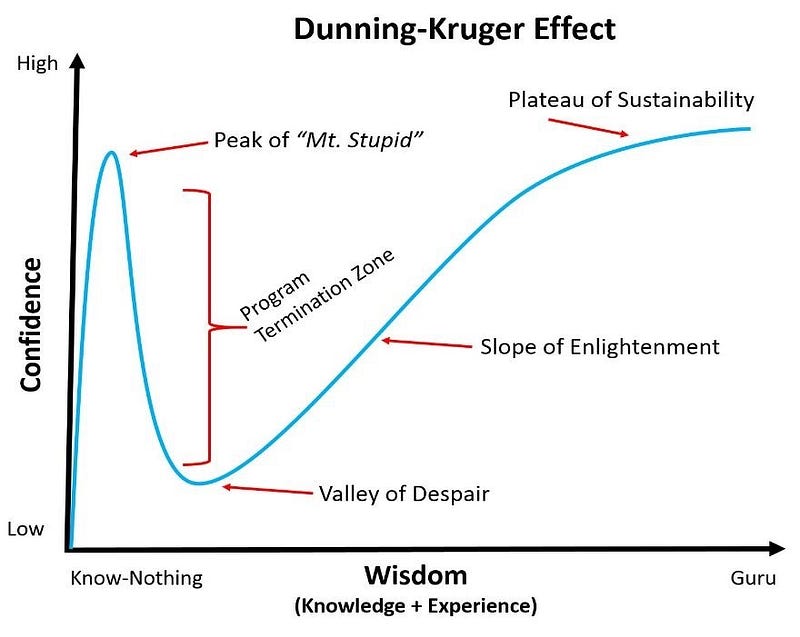
As part of my healing journey, I started going to coaches and therapy and figured out that their “onboarding” process also heavily relies on this psychological concept.
We come in therapy with a “need”. It’s not as obvious or life-threatening as an emergency room situation but it pretty much seems like that because as soon as the therapist starts asking us questions “we think we know everything about it”.
Actually, what we see in the graph describing the way we acquire knowledge about what we know and what we think we know describes pretty accurately the similar process of going through therapy. You need to understand that knowledge accumulation is the same in both situations.
The steps to acquire self-awareness over our patterns could be categorized as follows:
- You’re reaching out to a therapist/ coach, specialist because you notice something if off about yourself and your mood
- You’re in the process of explaining to your therapist what you feel and they start asking you more questions
- The moment they notice you’re in a bad place, they would try to make you feel a bit better on the moment so they can maintain and preserve the connection and you can continue to work on the real issues
- By this point, you are addicted to the dopamine and endorphins of “feel good” vibe from going for a few sessions to therapy. You are not at the highest peak of the Dunning-Kruger effect. You’re the impostor here!
- But as you progress, you start slowly revealing more information that will help the therapist connect the dots so they can actually work with your trauma and help you heal from that. You’re doing into the valley of despair!
- In a couple of months time, you might reach the rock bottom because the work in therapy doesn’t bring you any immediate results anymore and you are shaking off the grounds of every belief you had. But this is not bad! This is change! That’s how I found purpose again ( see link above on that topic).
- Now if you find the proper way to stay afloat from this new situation in your life, you will slowly rise on the enlightenment slope. Nobody that hasn’t reached rock bottom for real would ever be able to really be on that path because it doesn’t have to do with height.
- The right balance now is to find the sustainability plateau where you have enough information about how you work, but you still don’t know everything, yet the “machine” is working and the loops in which you might fall into if you come across trouble and hit rock bottom again are much shorter. Basically, you’ve acquired enough resilience and plasticity ( neuroplasticity) to handle complex situations with grace and elegance.
Looking back at you you’ve tried to hide in different ways the self-sabotage about feeling not good enough and the impostor syndrome, what would your story sound like?


