

Are you hiding and waiting to be rescued?
As a kid, I’d be building up forts and tents in my house to create a space to hide from the overwhelming outside world. As an adult, I sometimes hit rock bottom in vicious circles and wait to be rescued. See how these things connect
Psychologists say that secret hiding spots and treehouses and tents help kids escape from a reality they don’t want or overwhelm them into an imaginary one where they can be in charge. There is more to this than just a need for independence. I wrote in another article about the concept of daydreaming and how that hides trauma. In the same way, building forts hide a type of trauma. But it is very different than daydreaming despite being just like the fort building the expression of a need to escape reality.
Let’s see why.
In daydreaming, we engage with a phenomenon of expectation building whereas in tent-building we deal with emotional neglect.
Emotional neglect or emotional deprivation is one of the less obvious life traps we can fall into and carry with us our entire life if we are not aware of what is missing from us. It also manifests and looks very different for each individual later in life. But it starts in the same basic way in childhood and that’s where my research started.
Looking at how nurturing, empathy, and protection were offered to you as a child you can map the history of your emotional neglect origin.
Here are some reasons why kids develop the need to build these tents and forts and how you can learn to re-parent yourself if you’ve been doing this or to be a better parent if your kid does this now:
- As a child, you needed to feel nurtured, loved, and soothed. If you did not get that you would retreat into space where you can be alone and wait for someone to prove they love you by coming to get you.
- As a child, you needed to hear less criticism and nagging and get more empathy from your parents about your flaws and mistakes. As a result, you would retreat into a world where you can control the outcome and feel nobody will disrupt your privacy and boundaries.
- As a child, you needed to feel protected from the world that was overwhelming you and needed to get a sense of safety from your parents. The way to get that if your parents did not respond to this was to build a safe place where you can retreat. This way you learned to isolate yourself from the dangers of the world.
Dr. Nicole LePera, a psychologist working on re-parenting talks about a way to overcome emotional neglect by taking ownership of the emotions you have. Here’s her simple guide to re-frame such thoughts:
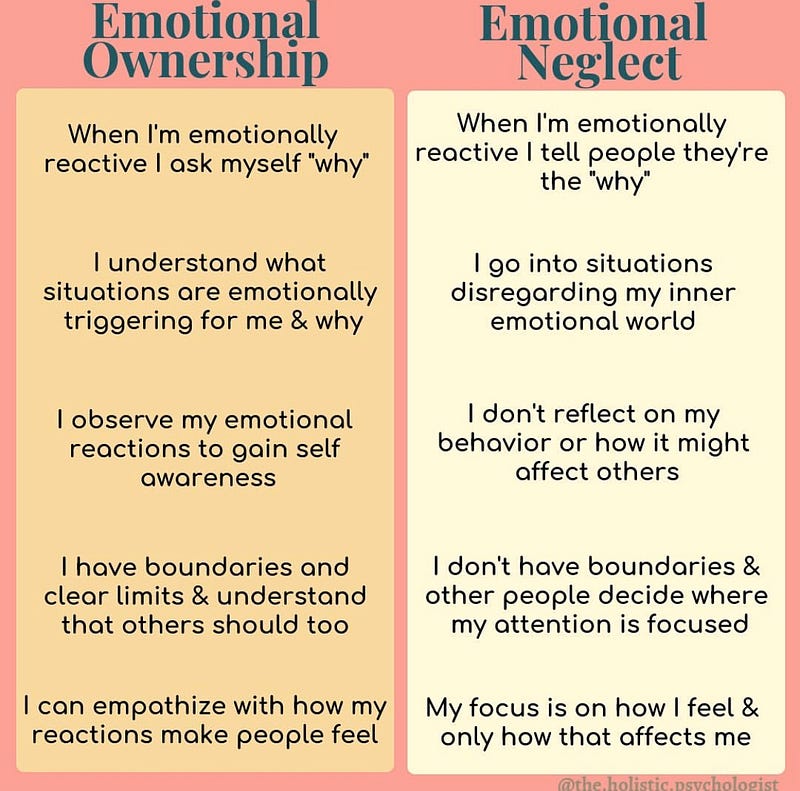
We see that there are multiple ways to deal with things to correct the adult responses to the need to retreat and recreate boundaries, but being able to go down memory lane and heal the old wounds is most often the best way to deal with the consequences of wanting to be rescued from your hiding place by someone as an adult.
How do we spot adult schemas of „hiding” and need to be saved?
Looking back at how we formed these coping mechanisms for the initial trauma we can see how those would evolve into adulthood in different forms.
1. Neglect from lack of nurturing
As a child, you would hide and wait for someone to prove love by coming to get you.
As an adult, you will:
- Ask for people to do the extra mile for you
- Be skeptical of others' intentions and often not give the benefit of the doubt
- Fear people will not accept you, reject you, and will not play out to your expectation level
- Look for overcompensating mechanisms ( binge eating, cheating, alcohol or drug abuse, etc) for the lack of love you feel from your partners
- Look for incompatible partners in the hope they would change for you to prove their love
And the list of things that make the others in a relationship with you has to prove themselves to you can go on as you will essentially develop a bottomless pit feeling in any relationship until you learn to soothe yourself, to notice your craving for attention, affection, and love and learn to express it and satisfy it yourself when possible and needed.
2. Neglect from lack of empathy
This manifested in childhood as a response to the fact that your parents were not responsive to your growth needs with positive words of affirmation and empowerment to go through challenges and failures. Since then you coped by learning to take control of the outcome to take things into your own hands, the distant adult behavior transformed by this trauma could be:
- You’re either controlling every aspect, perfectionist, and self-reliant to the point you don’t know how to allow anyone to help you in your struggles or even to delegate things
- Or you’re overwhelmed by the number of things you needed to handle as a child ( that often comes when the child needs to take responsibility for the parent’s emotions as well on top of his own) and you are looking for someone to save you by taking over some of that burden from your shoulders
- You’re cruel and enforce a mask of cold temper so that you will not have to take care of anyone else’s feelings and you can deal with your own
- You’re rejecting others' needs and problems and you distance yourself from people who would need your help
- Or you consider people who need help to be weak and you belittle them for not being able to handle their own because you suffered from having to deal with that as a child and now you project that weakness and lack of comfort from the struggle on people around you.
- You don’t encourage, empower or show affection because you consider that to be a weakness or shallow affirmation and you distrust such behavior in others ( I often see this trauma in Dutch people or other low-context societies because they didn’t have enough empathy build in their educational system and that leads to an overall coldness and rejection of high context forms of bonding that usually include words of affirmation and empowerment. Most Dutch people find the US people to be extremely shallow in their way of encouraging one another ).
This list is mostly about the result of wanting people to cross over their limit of empathy for you to put themselves in your shoes first before they get to evaluate situations from their position. The need to be rescued here manifests by expecting others to see your behavior as justified because you were in this emotional neglect as a child and you need to compensate it with their extra empathy now as an adult about the behavior you put on display. In time this becomes the primary source of narcissism.
3. Neglect from lack of safety and protection
As a child, you live life in a constant hyper-alert state where your safety was at threat or you felt you weren’t securely protected by the parents and as a result, your developed coping mechanisms connected to either isolation and introversion, or you became reactive and pulled tantrums waiting to be rescued from your situation.
As an adult, you’ll probably manifest some of these effects:
- You’re very shy or unable to speak up about your needs and let people know what you want in work or relationships
- You feel people want too much from you and you struggle to hold boundaries of how you give your energy.
- You are highly sensitive and you are not able to validate yourself when you need help or support in accomplishing something. That’s mostly the result of your parents denying your reality and your emotions and you not feeling safe to open up about it because you couldn’t find protection there.
The biggest need for people with this type of emotional neglect is that they feel invisible. They need to be seen and rescued from feeling unseen and not understood by people. Often this is a long process of reinforcing the fact that their emotions matter and that they are not alone and should not isolate themselves to fall into a trap that they are not visible to others.
If you’ve felt you’re waiting for someone to rescue you from one of these types of neglect you’ve experienced, try giving yourself some time to observe which are the areas where they have the most impact and how you could give yourself the emotional validation and support to overcome the need to get that from others and see how things will change for you.
My personal experience with this trauma was that I see its impact both in the workplace and in my emotional life.
In the workplace, I expect that people will see my struggles and would validate me which means people need to do the extra mile in a relationship with me to make me feel good about my self-worth in the team. Expecting to be rescued this way can be energy-draining in teams as I often saw and as a consequence, I had to learn to give myself more of that validation instead of expecting it from others. In romantic relationships, I often see that I struggle with being highly sensitive and blaming myself for things that happen instead of attributing some of the mistakes to my partner as well when that’s the case. It also means that I look for validation that I was not the only one to blame to feel that my emotions are seen and taken into consideration by my partner. That is also energy-draining and ends up with a lot of resentment for both partners. I learned to deal with this by looking at what my emotions are when I feel unseen and giving myself space to feel those separate from my partner and not let the entanglement between us cloud my love for my partner.
If this article was not enough, the next one will deal with specific wounds from mother and father and inner child. That will help us get even more clarity on the initial source of our problems from our basic „programming”.