
How self-sabotaging yourself attracts narcissists
Are you cautious or defensive about how you allow people in your life and still get to be abused? There might be some hidden trauma that’s causing the self-sabotaging behavior that you are unaware of!

Last week I started a project about abundance and the first task was to write down a list of 50 important people in my past which made me change my life direction or had a huge impact on me in a positive or negative way. Needless to say that if you think 50 is too much, I reached 120 and I am only 30 years old. So I started looking at the data I collected in an objective way.
Who are the people who brought good change vs bad change?
The bad ones were all in a group and most of them at a specific time of my life: between 17 and 24. My life radically changed after this age and I didn’t allow people like that into my life anymore. However, the trauma is not healed and the past is not forgotten. But, why did I allow that in the first place?
After years of therapy and a lot of self-help and psychology books, I finally have some answers about this. Here’s what I discovered:
We might have lost the trace of the initial trauma and not be able to connect with it anymore in the present because it has been too long a part of who we are that we no longer distinguish between a twisted reference system and a healthy one.
My aim with such articles is to bring justice to you, the self sabotaging one without having to blame the narcissist.
I also am aware that this will make me less popular than other writers because I will not help you feel relief over the fact that you are a victim of a narcissist and you don’t need to change a thing. Somehow this offers peace of mind and comfort on the short term but blows up on the long run.
Also, in my many years of therapy, I had a few different stages.
- The first was blaming situations. Then my therapist brought awareness over the people in my life who did the wrong things in their attempt to „help”.
- That was the rage phase. I ranted out people for what they did to me.
- Then I also went through the longest stage of self-blame. This was by far the worse. The more zen I wanted to be for others, the worse it was for me.
- But I am currently at an acceptance stage with understanding which things are in my power to change and what should be my priority and availability to change at the request of others around me. I stand my ground and question less often my own instinct about the optimal amount of reaction or zen I should have.
But one thing that came up during the self-blame period was that I was also a narcissist in some relationships. Some moments when my narcissism was reflected look like this:
- At 17 I dated a guy who was 6 years older. I went with him on a holiday and I was expecting he would be more „mature” because of his age and would want to take a couple of photo. However, he was eating obnoxiously from a bag of chips at a touristic spot we visited when all the other couples in our group were taking photos together. I remember telling him on a very arrogant tone that „you might wanna stop chewing like a jerk from that bag and stop to take a photo with me”. First of all, the need for attention and the preoccupation for keeping a superficial side of the relationship perfect on a picture was wrong and a narcissist and then my approach to asking for that was a total asshole even more.
- Around the time my grandpa died, I completely lost my moral compass about dating guys and I went full option into a toxic relationship where I was using the sexual energy of my partner in order to heal from my own wound. I did the same a few years later when my grandma died. I knew those guys were not going to be able to make me slow down for them. I was using their energy to fuel my work and to get back on my feet from my lose.
- I noticed how bringing awareness about my empathy towards my partners in relationships was a process that only started consciously since I started therapy. There is nothing more rewarding than to be able to see how that opens up your relationships as soon as you pay enough attention to your partner’s needs. But that usually never happens if you’re a narcissist because you don’t feel the guilt about not being there for your partner and you pretty much take them for granted as I did for a while in my life. It comes down to being aware of your unconscious patterns, observe them and bring change into your operational autopilot.
The purpose of seeing these types of narcissistic behaviors is not to label a person as a narcissist but to really go one level deeper into understanding why this behavior occurs. The difference between someone manifesting narcissistic traits and being one is very big. Here are the 2 main paradoxes of narcissistic people:
- Under indulgence: they had a family environment where they were emotionally neglected. If you are not sure what that means, there’s an article I wrote about hidden trauma in little details of your childhood you might have missed understanding holistically. Emotional neglect manifests in many homes where things look perfect from the outside. Which makes the point for my next schema.
- Overindulgence: the family environment focuses on promoting grandiose achievements but without a foundation. They praise achievements while they might not really have moral value in the deeper meaning. A family where the child is receiving words of affirmation for every little thing they do and the parents go over their way to praise the child will learn that the performance is rewarded with attention and will keep on seeking opportunities to be praised for that.
While the first is clearly based on the trauma of emotional neglect, the second has more types of traumas it can connect with, a few being subjugation scheme and the entitlement trap.
As such, looking back at my behavior but also at my family environment, I see I was not praised for my performance and only developed coping mechanisms in the narcissistic way of the overindulgence as an adult to cope with the emotional neglect. Therefore, not all narcissistic behavior can connect to an actual narcissist. Which leads me to the reason why we choose to date a narcissist in the first place: our trauma looks the same on one side as we both suffered from emotional neglect. However, the true narcissist will have more than these traits. His main traits are:
- Lack of empathy
- Entitlement
- Grandiosity
- Superficial
- Unable to regulate emotions
- Sensitive to criticism
The other truth about the connection between a narcissist and its victims is that they not only have a similar trauma in their past about emotional neglect but they also will reinforce they current bond through going together through another trauma.
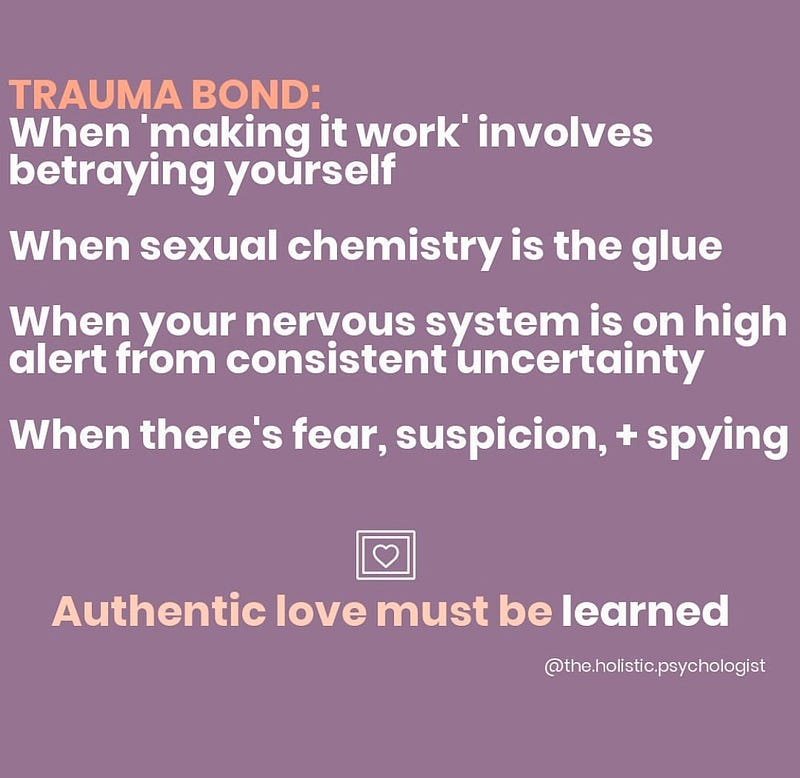
The Trauma Bonding is described by psychologists as a series of events that combine ups and downs on the emotional scale that trigger multiple neurotransmitters in the brain which eventually become an addictive way to form an attachment to someone. The „glue” described by Dr Nicole LePera is the mix of Oxytocin, dopamine, cortisol, adrenaline, and serotonin all at the same time. For example, this is how a few such intense connecting moments look like for a narcissist:
- Love bombing and not having enough time to process the relationship in the „fire” and excitement of the first dates.
- Sex from the first date and then an intense first few weeks or months of a relationship and then a sudden disengagement or abrupt cutting off
- Unprotected sex with a new partner on a first date followed by conversations about future plans and kids.
- They please you at the beginning of the relationship and shower you with gifts and attention out of a need to be the perfect partner and you feel it’s too much but go on anyway but now you also feel guilty or responsible to give back the same way
- You get into some sort of trouble together and you survive the incident together which makes you connected over an intense experience ( this is also a way to „stage” a strong connection together with someone, not just a narcissist)
- You go fast from one emotion to another during the first dates and you keep it an adventure throughout the relationship if you are in a long-distance or online connection that lives it’s short in-person time in the time span of a few hours or days when you can meet
- It’s a forbidden love or something illicit where you are bending rules or moral principles and living on the edge together
And even someone who manifests these traits separately or on a specific degree will not be a narcissist until you ask if they do does some of the following:
- Did they manifest the behaviors with a bad influence only for themselves?
- Are they consistently gas-lighting?
- Are they looking to use you to feel better about themselves?
- Does the narcissistic behavior happen when the person is feeling down or is it a consistent behavior regardless of the context?
One of the main reasons why narcissistic people are fundamentally different than other people with an emotional neglect trauma is that they lack the good balance of the guilt about their actions.
In the work of psychologist Robin Stern and his book on The Gaslight Effect, we see a very clear way in which self-sabotaging based on hidden trauma is reflected in our daily interactions:
1. Lack of self-worth
The stage in which we start developing self-worth is around 5–6 months old when we start walking or being able to move on our own and we see how that influences the behaviors of our caretakers. The more we consider that our moves determine how parents feel about us and themselves, the more likely to develop a lack of self-worth and attribute other people’s behaviour as a result of our actions and thus feel extreme guilt.
2. Control management issues
We tend to want to control a lot of the outcomes in our environment in order to avoid being blindsided, but by doing so we tend to sabotage the chances that we allow non-reactions to speak for us and take a different course of action than by reacting all the time.
3. Perceived fraudulence
People with this trait usually feel that others are constantly looking to mistreat them or the opposite, they constantly feel they are an impostor in their own life.
4. Familiarity
The most common way to self-sabotage is to go with experiences that are familiar to you and you seem to know how to navigate them. I remember that for the 7 years I was still in love with my ex after we broke up, I was telling myself that “at least I know him well enough now to know what to expect from him”. And by telling yourself that what you know best, is the best, you only give the opportunity to reenact the trauma you had when you were a child because the reference system you have was not brought up to date and is still part of your old hardwiring.
5. For the handy scapegoat
Looking for someone else to be in charge of your life is usually a codependent behavior of the self-sabotaging people. By hoping that the decisions of others about your life you will be able to blame them if things go wrong, you are looking for a scapegoat to blame instead of taking charge of your life.
6. Sheer boredom
Whenever you engage in behavior just for the sake of adrenaline you basically self sabotage your self because you’re getting on a roller-coaster journey. High-intensity moments are balanced by low moments and whenever you sign up for a cool promise of the narcissist to take you over the moon and back, know that re-entering the atmosphere will come at great cost of self-destruction and the landing might crush you. Narcissism usually comes wrapped up like a Trojan horse so be aware of people who over promise and under deliver. Your need for excitement can be filled with other things.
In Bowlby’s attachment theory there’s an interesting chapter about ambivalence and how to regulate that in the mind of a child. This chapter basically explains how our guilt is a natural response to contradictory impulses that prevent us from acting upon our instinct and control the outcome so that we can obtain a balance and tolerate the ambivalence and uncertainty. Truth is that most adults cope really poorly with uncertainty still because of these issues from their early childhood which they are unable to tap into and heal because they already belong to the subconscious and they are hardwired into our meta patterns of behavior.
Ultimately, the self-sabotaging behavior is all about what we are familiar with and how we view the world through the lenses of our hardwired patterns. The same way narcissists sabotage themselves by reproducing their childhood trauma of being abandoned because they never learned to trust people, the empaths will also sabotage themselves by choosing partners who will eventually abandon them and thus confirming their familiar pattern. The difference though between how these traumas were formed can also help you get rid of your vicious circle whichever that may be.
The self-sabotaging and its trauma
The empath is the one who is stuck in the empathy circle because he grew up in an environment where the mother or main caretaker was unable to deal with their own emotions and would frequently rely on the ability of the baby to adapt to their moods in order to regulate their own emotions. On a rational level, this looks rather unworthy of attention but if you get into the mechanics of these symbiotic relationships we have with our caretakers, this all starts to make sense. A mother who is constantly tired, complaining, unhappy and with a bad marriage maybe will project all that on their child. As a result, the child wants to please the mother as a way to get her attention. This learned behaviour since an early age becomes the modus operandi for the individual for the rest of his life. The way the child will support the needs of the mother will look very different in each case, however, their ability to empathize does divide into 3 scenarios:
- The empath who is stuck and automatically just feels everything the other person feels. This one had really poor parenting and they learned this as a surviving mechanism. Now they see this as their baseline for interacting with people. They sometimes take so much emotion that they feel overwhelmed and unable to cope with things so they need long times of withdrawal. The longer the withdrawal, the more high chances that he is also on the autism spectrum.
- Highly Sensitive. This one will please because he is afraid his needs will not be met and he is more likely to do this type of empathy mirroring because they want to be able to calm down situations and be able to meet their own needs which are very important to them.
- The true empath who feels deep responsibility for their parent’s emotions and takes guilt and fault on their own for the feelings of others. This is the one most likely to become a codependent as their baseline is the same: they feel guilty if they don’t support the parent.
The narcissist and its trauma
While we saw that the trauma of the self-sabotaging is connected to wanting to meet the needs of the partner because of their hardwired behavior to empathize with their mother’s emotions, the narcissist does acknowledge the emotions of the mother but chooses not to make that his problem. While the empath doesn’t know what’s their emotional situation as opposed to the other person’s emotions, the narcissist clearly sees the difference and decided to disconnect completely and get their needs met first. One of the main triggers for this trauma is again emotional neglect and a mother who is intensely preoccupied with her own emotional life while caring for a baby at the limit of meeting basic survival needs. As such, the baby decided that in order to get his needs met he will rage, cry and hopefully get attention from anybody willing to help them regulate their own emotions. In most cases, mothers of narcissists are women who suffered from emotional abuse. I personally met a few of these situations and statistics confirm it. The women who raised the narcissists where mothers overwhelmed by their own burden and could not cope with the screaming and demands of the newborn and as such only provided the basics or allowed other people to step up and help in the process of raising that child. That is one story I also share because I had a time when I was a few months old when my dad left to another country for a few months to work and while he was abroad my mom was home alone with me and my grandparents had to bring in a nanny to help out with raising me because she was emotionally overwhelmed after giving birth. The postpartum problem is a frequent trigger for mothers to become for a short period of time emotionally unavailable for the newborn and causes great distress for the baby. But still, in order to become a narcissist, the trauma needs to happen with more than one caretaker. If the baby does get attention from other nurturing people around like grandparents or nannies, then they have a higher risk of becoming codependent as a result of the abandonment when that replacement caretaker leaves ( like it was my case with my nanny who left when my dad came back). The rejection of giving attention gives the baby more self-righteousness to demand more and more attention from others and ultimately transforms them into life long narcissists.
The reason why most narcissists are men is also a very interesting topic which has a biological explanation really. The mothers who raise a boy might have problems in dealing with their own sexuality and thus will be distant from their boys.
The way to put an end to your self-destructive behavior is to go back in time to your initial trauma and understand the context of your upbringing to be able to separate the reference systems you got hardwired into through that from the healthy ones that enable you to reach your full potential. By looking at things in a holistic way you are able to heal the trauma and reinvent your life and update your hardwired meta patterns. Self-actualization is a process that goes through these life reframes and puts things into perspective initially from a rational standpoint and ultimately allows you to also heal that wound on an emotional level for all the things you did wrong in your life because you had this reference system.


