avatarRemy Dean

Free AI web copilot to create summaries, insights and extended knowledge, download it at here

4413

Abstract

figure id="8477"><img src="https://cdn-images-1.readmedium.com/v2/resize:fit:800/1*BEUWmyxNuEl_M8TXA-RRtQ.jpeg"><figcaption><b>two tokonomas, one unusually wide and incorporating a minimal chigai-dana, the other including a candle, as featured in ‘Tokonoma: Alcoves of Reverence and Welcoming Beauty’ part of the NHK documentary series ‘Core Kyoto’</b> [<a href="https://www3.nhk.or.jp/nhkworld/en/ondemand/video/2029161/">view souce</a>] *</figcaption></figure><p id="7510">To understand the basic aesthetic of the tokonoma, it’s helpful to grasp three sets of three concepts that run through many aspects of Japanese art and culture. They are triadic asymmetry, triadic perspective, and triadic narrative. Hey, it’s a triad of triadic principles!</p><p id="0c98">Firstly, the best way to define <b>triadic asymmetry</b> is in opposition to rational triadic, or threefold, symmetry, which is the basis of many repeating patterns. For example, those found in Celtic knotwork designs expanding from the <a href="https://remydean.medium.com/this-that-and-the-other-folklore-of-the-three-realms-88de09c983aa#cfc6">triskelion</a> motif — a shape that fits neatly within an equilateral triangle and is identical when rotated around its centre point by one third of a full turn. The ancient symbol of three interlocking hares, or the three-legged emblem of the Isle of Man are clear examples. Triadic asymmetry, therefore, does not fit this equal triangulate geometry and the pattern will look different from each point of view. In any set of three design elements, no two will be identical. This creates visual interest and progression as well as helping each thing define itself in relation to its neighbours.</p><p id="1579">Secondly, <b>triadic perspective</b> is a way of representing depth without vanishing point or parallel perspective, which are both western conventions. Perpendiculars and vanishing points don’t often occur in the natural world where there are few straight lines. So, the eastern aesthetic often implies three-dimensional depth through representations of foreground, mid-distance, and backdrop. Usually this is achieved by placing objects in the immediate foreground to emphasise the middle space between this and the more distant background. Selecting the sizes of the three objects can create an illusion of greater distance, or poetically suggest this. Think of a theatre stage or animation set with the performance space behind foreground scenery and in front of a flat background. Triadic perspective was a huge influence on early Modern painting, perhaps most clearly present in the works of <a href="https://readmedium.com/the-latter-days-of-vincent-dbe90d9d1a86">Vincent Van Gogh</a>, <a href="https://readmedium.com/klimts-tree-paintings-6806d679b5f6">Gustav Klimt</a>, and <a href="https://readmedium.com/wild-beast-of-art-27b407cb1d26">Henri Matisse</a>.</p><p id="641a">Thirdly, <b>triadic narrative</b> isn’t that hard to understand for western audiences used to the standard three-act structure of most plays and films. Basically, it’s the beginning, middle, and end of a story or journey. In traditional Japanese arts, though, a feeling of transience rather than conclusion is received as poetically refined. So, there should be a sense of being in <i>the moment between</i> what has been and what is about to be. Not necessarily between a defined beginning and ending. The three-line haiku poem is one of the best illustrations of this ideal and a successful one should comment on what just occurred in a way that implies what comes next. It’s a concept closely associated with the Zen moment we exist within as we pass through life.</p><figure id="87ba"><img src="https://cdn-images-1.readmedium.com/v2/resize:fit:800/1*feMTMZ9IGj7iJTzCK2twbw.jpeg"><figcaption><b>tokonoma with chigai-dana, illustration from the book ‘Japanese Homes and Their Surroundings’ (1885) by Edward S. Morse</b> [<a href="https://commons.wikimedia.org/wiki/File:JapanHomes127_GUEST-ROOM_OF_DWELLING_IN_TOKIO.jpg">view licesne</a>]</figcaption></figure><p id="ecea">Ideally, the harmonious arrangement within the tokonoma should convey a poetic scene. If the hanging scroll is a calligraphic phrase, then the other items should illustrate, evoke or extend its sentiment. If it depicts an element of landscape, then the items before it should continue that theme, suggesting a journey or simple narra

Options

tive through the imagined land.</p><p id="a24d">For example, if the painting shows a mountainside with a waterfall cascade, then the river should be imagined flowing out of the background picture, past a suitable <i>bonsai</i> in the mid-space, and around an interestingly eroded <i>suiseki</i> at the foreground. These three objects provide triadic perspective and should be arranged to create a naturalistic asymmetry as well as suggesting a slice of landscape.</p><p id="a2a6">All these features are key to defining <i>shoin </i>style domestic architecture, so named after a third alcove feature — the study recess. <i>Shoin</i> makes efficient use of limited space whilst keeping it uncluttered and aesthetically pleasing, striving for a sense of the spiritual along with the practical. Buddhist monasteries are the antecedents of the style which went on to have a palpable influence on modern western architecture, showcased in the 1939 <a href="https://readmedium.com/bauhaus-barcelona-and-beyond-4be8e2af46f1">Barcelona Pavilion</a>, designed by Ludwig Mies van der Rohe and Lilly Reich, cited by many architects as the most influential single building in twentieth-century architecture.</p><p id="db58">Another important western architect to embrace the Japanese aesthetic was <b>Frank Lloyd Wright</b>, perhaps the foremost Modernist of the USA. The far east is evident in his signature ‘Usonian’ houses, designed through the 1930s. Typically, they were low, detached dwellings that responded to the lay-of-the-land. The showiest of his residential designs from the period may be the Kaufmann House, completed in 1935. Better-known as ‘Fallingwater’, its structure features a canter-lever design overhanging a waterfall and was made famous by its starring role in Alfred Hitchcock’s <a href="https://readmedium.com/d45ee6b2f915"><i>North by Northwest</i></a> (1959).</p><p id="a3c7">The tokonoma is thought of as the ‘spiritual heart’ of the home and Wright drew clear parallels with the fireplace, or hearth — another word for ‘heart’. He expressed this connection through the use of clean lines and asymmetric layouts, showcased in many of his grand and more modest fireplaces alike. Wright saw these as the western answer to the tokonoma — a place were art is hung and fine objects displayed. It may not be immediately obvious to the ‘untrained eye’ but when one understands a few of the key features of a tokonoma they can be easily recognised in his domestic interiors, built around a central reception room with a feature fireplace as its social, and perhaps spiritual, focal point.</p><figure id="e68e"><img src="https://cdn-images-1.readmedium.com/v2/resize:fit:800/1*ICkFiXS7df93v5fABNBmUg.jpeg"><figcaption></figcaption></figure><figure id="5d54"><img src="https://cdn-images-1.readmedium.com/v2/resize:fit:800/1*6ozvYok8hjjEr1RxDtGCtQ.jpeg"><figcaption><b>exterior view of ‘Fallingwater’ and interior showing obvious Japanese influences including the hearth referencing a tokonoma along with chigai-dana feature</b> [view license<a href="https://commons.wikimedia.org/wiki/File:Fallingwater3.jpg"> 1 </a>and<a href="https://commons.wikimedia.org/wiki/File:Frank_Lloyd_Wright_-_Fallingwater_interior_5.JPG"> 2 </a>]</figcaption></figure><p id="4459"><a href="https://readmedium.com/when-east-met-west-a-new-art-grew-5b4cb9928d74">Christopher Dresser</a>’s promotion of Japanese visual culture in the nineteenth-century was probably the most profound influence on early Modernism and has been <a href="https://readmedium.com/when-east-met-west-a-new-art-grew-5b4cb9928d74">discussed by Remy Dean previously in Signifier</a>.</p><p id="e012"><i>* All images are used with license, or presented here for educational purposes under fair usage policy.</i></p><div id="464f" class="link-block"> <a href="https://medium.com/signifier/reborn-in-fire-j%C5%8Dmon-pottery-685acc6e6fcd"> <div> <div> <h2>Reborn in Fire: Jōmon Pottery</h2> <div><h3>What can the ancient culture of Japan teach us about living in harmony?</h3></div> <div><p>medium.com</p></div> </div> <div> <div style="background-image: url(https://miro.readmedium.com/v2/resize:fit:320/1*ghRfYp5f7AYzsNDRqdj3vg.jpeg)"></div> </div> </div> </a> </div></article></body>

In the Recess of the Heart

To understand a Frank Lloyd Wright fireplace, you’ll need to know about the traditional Japanese tokonoma.
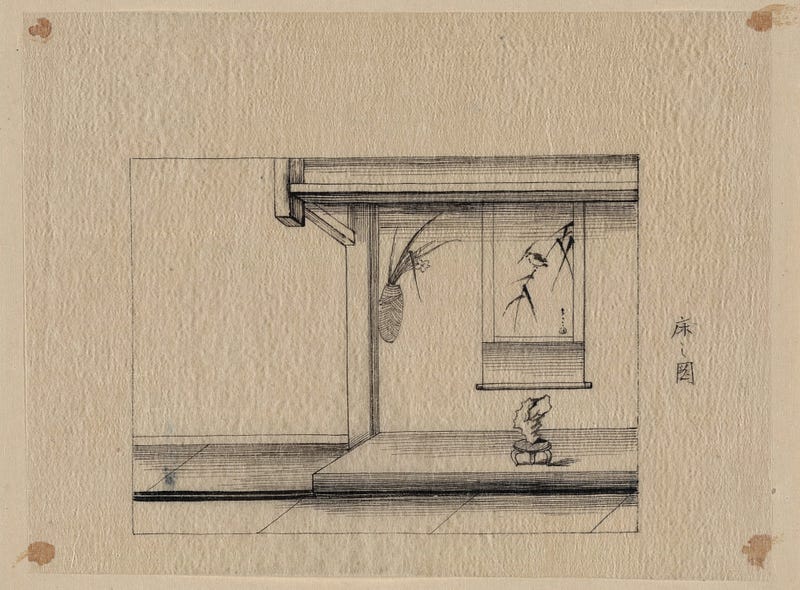
Japanese print attributed to Kano (c.1878) of a tokonoma alcove with customary ornaments [view license]

A tokonoma is an alcove dedicated to displaying a set of things that complement each other in both aesthetics and meaning. The traditional form grew from a fusion of Zen shrine design, traditional Tea House architecture, and Samurai culture. Although their design has developed over the centuries, they retain their spiritual and social importance.

In its simplest form, it can be a wall hanging above a small, raised platform or low table. Originally, the hanging scroll may have carried a Buddhist spiritual quote in fine calligraphy, or a Zen brush painting of a natural subject. The table below could’ve presented votive candles, an incense burner, a significant figurine, or an arrangement of flowers.

Tokonoma style alcoves are the centrepieces of Tea House architecture and, at significant junctures during the long Tea Ceremony, items may be added and substituted. Though always an arrangement of seasonal flowers or foliage is included at some point. During the Edo period, the tokonoma became a status symbol incorporated as a permanent, built-in feature in the homes of the nobility. Later, it became a widespread feature in domestic reception rooms and places of business.

The scale and precise dimensions of tokonomas vary greatly but they are always proportioned harmoniously within their setting. They are often situated next to a companion alcove known as a chigai-dana which usually has a set of staggered display shelves and cupboards where books, scrolls, and resting ornaments are stored.
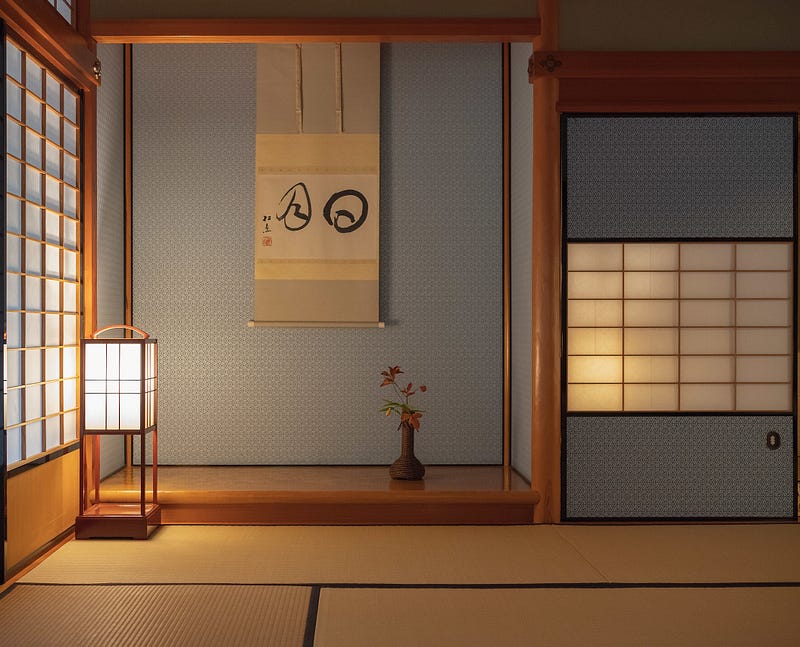
tokonoma alcove and tatami mats in the Shiguretei Tea House, Kanazawa, Japan (photographed by Benh Lieu Song, 2018) [view license]

The size and shape of the room was often governed by the layout of woven tatami mats, which came in two standard forms: a square and a larger rectangle the dimension of two square mats placed side by side. Tokonomas did not necessarily align directly to these measurements but responded to the layouts.

Traditionally, the tokonoma recess is framed by a wooden post on each side. The posts should not be matching. One post is elegant and finished to a high standard, smooth to the touch, whilst the other is rough-hewn, chunkier, often retaining an area of original bark or the bend of the bough. Both are placed in the orientation in which they grew — root end down, branch end up. (The wrong way up would upset your local yōkai!)

The refined tokonoma contains a combination of just three items. There is always the kakejiku — a hanging scroll at the back which generally sets the tone and theme for the display. The other two items are of different sizes and commonly combine two of the following: bonsai tree, ikebana flower arrangement, suiseki viewing stone, okimono small statuette, a small pot plant. The selection and arrangement of objects within the tokonoma are regularly changed to express the mood of the resident, to honour an expected guest, to reflect a change in season, or to tie-in with festivals and celebrations.

Sometimes, especially if the tokonoma is intended for prayer, a candle or temple lantern is also added to enliven the space with light and warmth. The placement of this fourth element must also become part of the balanced composition.
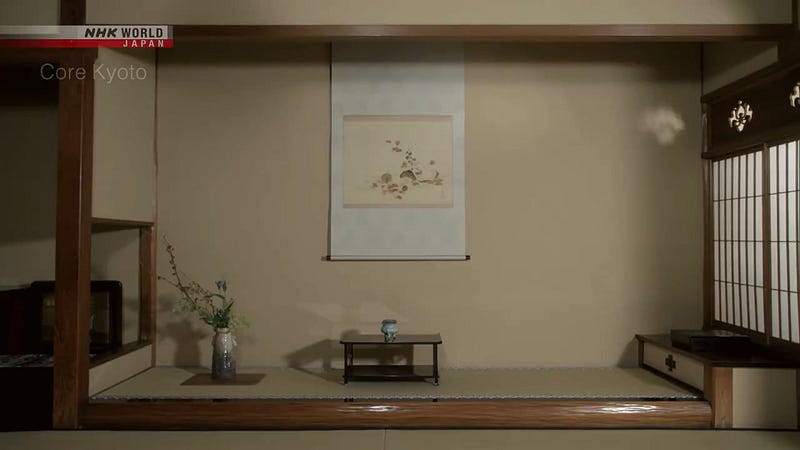
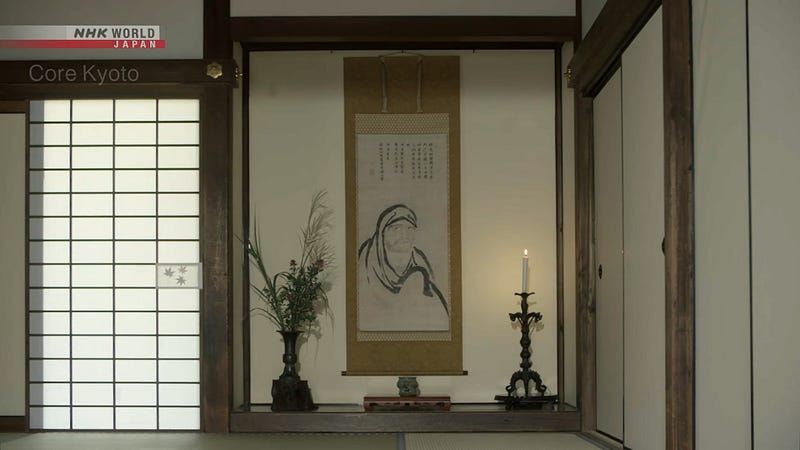
two tokonomas, one unusually wide and incorporating a minimal chigai-dana, the other including a candle, as featured in ‘Tokonoma: Alcoves of Reverence and Welcoming Beauty’ part of the NHK documentary series ‘Core Kyoto’ [view souce] *

To understand the basic aesthetic of the tokonoma, it’s helpful to grasp three sets of three concepts that run through many aspects of Japanese art and culture. They are triadic asymmetry, triadic perspective, and triadic narrative. Hey, it’s a triad of triadic principles!

Firstly, the best way to define triadic asymmetry is in opposition to rational triadic, or threefold, symmetry, which is the basis of many repeating patterns. For example, those found in Celtic knotwork designs expanding from the triskelion motif — a shape that fits neatly within an equilateral triangle and is identical when rotated around its centre point by one third of a full turn. The ancient symbol of three interlocking hares, or the three-legged emblem of the Isle of Man are clear examples. Triadic asymmetry, therefore, does not fit this equal triangulate geometry and the pattern will look different from each point of view. In any set of three design elements, no two will be identical. This creates visual interest and progression as well as helping each thing define itself in relation to its neighbours.

Secondly, triadic perspective is a way of representing depth without vanishing point or parallel perspective, which are both western conventions. Perpendiculars and vanishing points don’t often occur in the natural world where there are few straight lines. So, the eastern aesthetic often implies three-dimensional depth through representations of foreground, mid-distance, and backdrop. Usually this is achieved by placing objects in the immediate foreground to emphasise the middle space between this and the more distant background. Selecting the sizes of the three objects can create an illusion of greater distance, or poetically suggest this. Think of a theatre stage or animation set with the performance space behind foreground scenery and in front of a flat background. Triadic perspective was a huge influence on early Modern painting, perhaps most clearly present in the works of Vincent Van Gogh, Gustav Klimt, and Henri Matisse.

Thirdly, triadic narrative isn’t that hard to understand for western audiences used to the standard three-act structure of most plays and films. Basically, it’s the beginning, middle, and end of a story or journey. In traditional Japanese arts, though, a feeling of transience rather than conclusion is received as poetically refined. So, there should be a sense of being in the moment between what has been and what is about to be. Not necessarily between a defined beginning and ending. The three-line haiku poem is one of the best illustrations of this ideal and a successful one should comment on what just occurred in a way that implies what comes next. It’s a concept closely associated with the Zen moment we exist within as we pass through life.
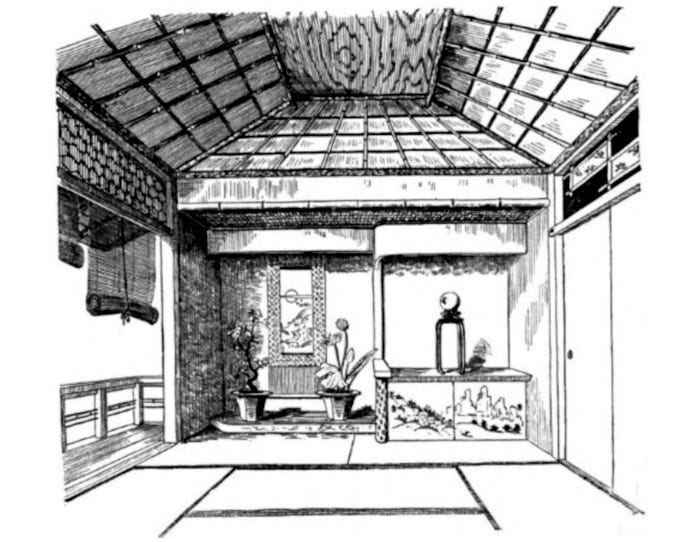
tokonoma with chigai-dana, illustration from the book ‘Japanese Homes and Their Surroundings’ (1885) by Edward S. Morse [view licesne]

Ideally, the harmonious arrangement within the tokonoma should convey a poetic scene. If the hanging scroll is a calligraphic phrase, then the other items should illustrate, evoke or extend its sentiment. If it depicts an element of landscape, then the items before it should continue that theme, suggesting a journey or simple narrative through the imagined land.

For example, if the painting shows a mountainside with a waterfall cascade, then the river should be imagined flowing out of the background picture, past a suitable bonsai in the mid-space, and around an interestingly eroded suiseki at the foreground. These three objects provide triadic perspective and should be arranged to create a naturalistic asymmetry as well as suggesting a slice of landscape.

All these features are key to defining shoin style domestic architecture, so named after a third alcove feature — the study recess. Shoin makes efficient use of limited space whilst keeping it uncluttered and aesthetically pleasing, striving for a sense of the spiritual along with the practical. Buddhist monasteries are the antecedents of the style which went on to have a palpable influence on modern western architecture, showcased in the 1939 Barcelona Pavilion, designed by Ludwig Mies van der Rohe and Lilly Reich, cited by many architects as the most influential single building in twentieth-century architecture.

Another important western architect to embrace the Japanese aesthetic was Frank Lloyd Wright, perhaps the foremost Modernist of the USA. The far east is evident in his signature ‘Usonian’ houses, designed through the 1930s. Typically, they were low, detached dwellings that responded to the lay-of-the-land. The showiest of his residential designs from the period may be the Kaufmann House, completed in 1935. Better-known as ‘Fallingwater’, its structure features a canter-lever design overhanging a waterfall and was made famous by its starring role in Alfred Hitchcock’s North by Northwest (1959).

The tokonoma is thought of as the ‘spiritual heart’ of the home and Wright drew clear parallels with the fireplace, or hearth — another word for ‘heart’. He expressed this connection through the use of clean lines and asymmetric layouts, showcased in many of his grand and more modest fireplaces alike. Wright saw these as the western answer to the tokonoma — a place were art is hung and fine objects displayed. It may not be immediately obvious to the ‘untrained eye’ but when one understands a few of the key features of a tokonoma they can be easily recognised in his domestic interiors, built around a central reception room with a feature fireplace as its social, and perhaps spiritual, focal point.
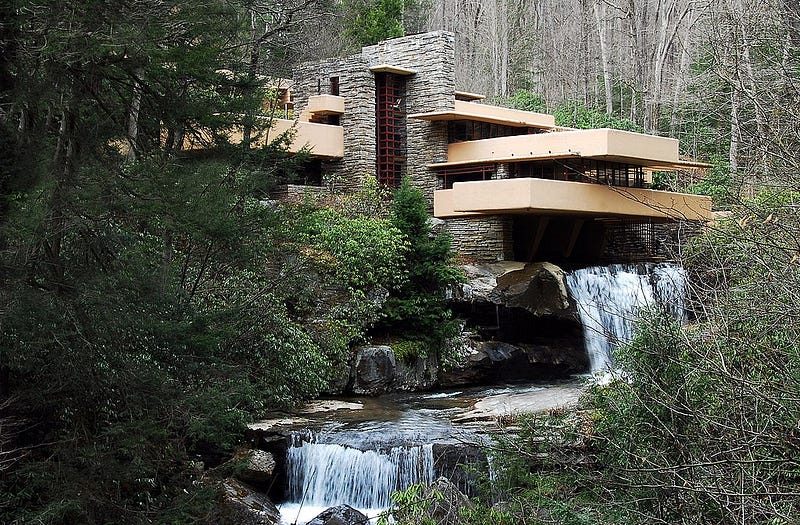
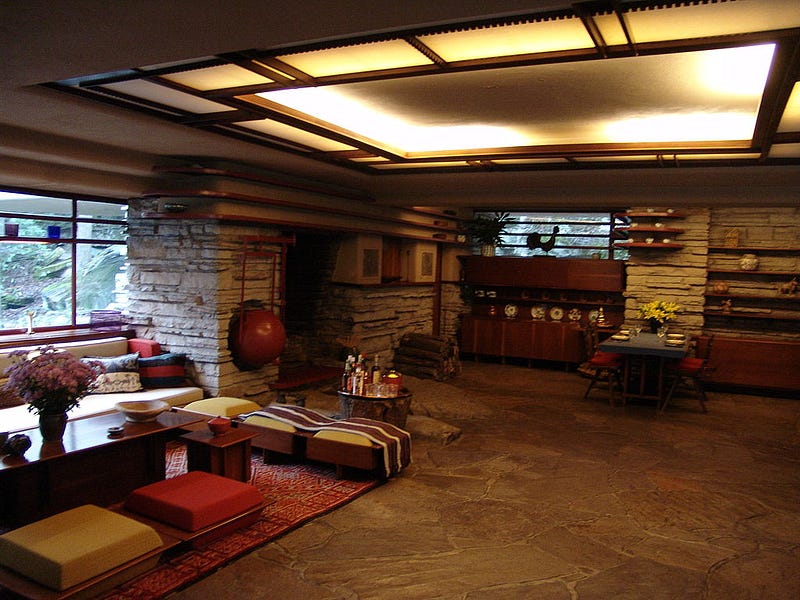
exterior view of ‘Fallingwater’ and interior showing obvious Japanese influences including the hearth referencing a tokonoma along with chigai-dana feature [view license 1 and 2 ]

Christopher Dresser’s promotion of Japanese visual culture in the nineteenth-century was probably the most profound influence on early Modernism and has been discussed by Remy Dean previously in Signifier.

* All images are used with license, or presented here for educational purposes under fair usage policy.

Art
Art History
Architecture
Interior Design
Japan
Recommended from ReadMedium