
SELF-IMPROVEMENT
I’m Not Wrong, Your Face is Wrong
Day 42, 50 questions for deep self-reflection
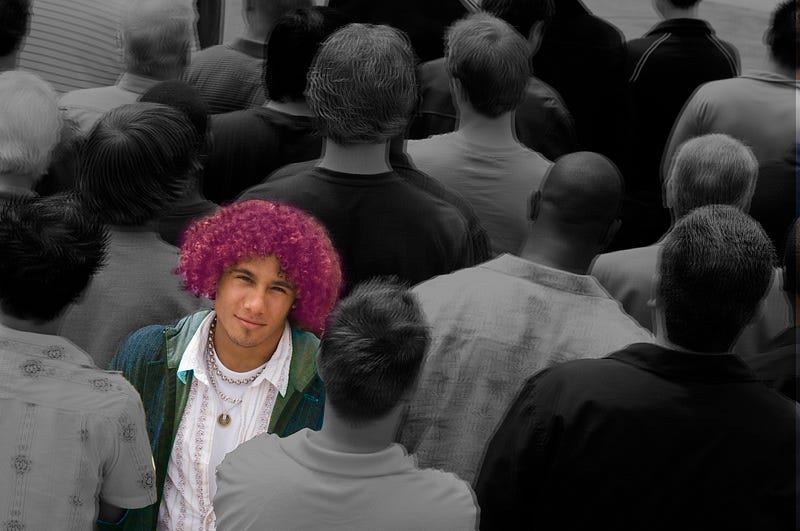
How do you interpret the words right and wrong? It is moralist integrity? Is it correctness? It is just something you feel? However you interpret them, have you ever considered the fluidity of rightness and wrongness? One person’s right may be another person's wrong and vice versa. Who decides which is right is ‘right’? And how can we release ourselves from the burden of ‘always being right’?
This is day 42 of the 50 Questions for Deep Self-Reflection challenge from Know Thyself Heal Thyself created by Diana C.
DAY FORTY-TWO: How can you become more willing to be wrong?
There are two rusty spurs jutting out of today’s question and both are just waiting to get under my skin and dig in.
So let’s go!
Wrong? What’s Wrong?
I could not possibly answer this question without first breaking down the construction of wrongness. There are so many levels to wrongness and what is considered wrong.
Here’s a hot take for you: right and wrong is not a binary system!
“But KP, 2 plus 2 is 4, that is right or wrong.”
No, that is correct, or incorrect. That is a binary. But right and wrong are based on arbitrary definitions of morality or human-defined laws. I’m sorry (not really), but if you need a law (or a god) to prevent you from stealing or murdering, then you are a pretty crappy person at the core. But even that statement is based on the binary of right and wrong because of the nuances of context.
Is it wrong to steal food to feed the starving?
Is it wrong to kill someone who is trying to kill you?
The fact that two people can have very different responses proves that right and wrong are not on some elusive moral binary.
Eg/ Is polyamory right or wrong?
Firstly, if you just answered that, sorry, you fell into my trap! Your answer doesn’t matter as much as the fact that I don’t know what your answer ̶s̶h̶o̶u̶l̶d̶ would be. There is no correct or incorrect answer, only potentially right or wrong in the eyes of someone who has self-important selective moralistic judgment. Whether you would or wouldn’t consider polyamory for yourself has nothing to do with correct or incorrect and nothing to do with right or wrong. Judging another for polyamory also has nothing to do with correct or incorrect nor right or wrong.
Let's try another somewhat more gritty example. Get your teeth into this.
I’m not going to get into the politics of morality except to say that some countries have the death penalty. Some do not. Countries that do, define which crimes are worthy of such a penalty and which are not. Most countries have different opinions of such crimes and penalties. So how the hell is right and wrong possibly defined when it’s not based on correct and incorrect?
Wait, so, right and wrong is a social construct?
Seems that way!
Merriam-Webster's definition of social construct
an idea that has been created and accepted by the people in a society
I swear there was a point here somewhere
Why have I spent half of this article explaining that right and wrong is a social construct? Because this fluid morality is the core of my response to today’s question:
How can you become more willing to be wrong?
Now we can rephrase the question — remember how much I love doing that? This rephrasing is taking shape in the understanding that ‘wrong’ is an external assumption and judgment. Someone’s idea of wrong is simply a representation of their (current) moral indignity within the framework of their experiences and understanding of the world. And our own ideals of right and wrong are the same.
Remember those spurs I mentioned? Well, here they are in rephrased question form:
How can I become more willing to ‘not be correct’?
How can I be okay with being judged wrong?
How can I become more willing to ‘not be correct’?
- This is about dropping our own judgments, assessments, and assumptions.
- This is about accepting that our own moral wrong and right are not correct or incorrect and that no one must abide by our guidelines.
- This is about accepting that we don’t know everything — or perhaps anything much at all.
- This is about understanding that we act and react based on our experiences and perceived reality, just as everyone else does.
I explored this concept on day 32 of this challenge when I was asked: What if no one else knows what they’re doing either?
I’m proud to know nothing... I don’t know what I’m doing. I have no idea. And isn’t that amazing?
How can I be okay with being judged wrong?
It’s going to happen, it’s unavoidable. The only way to get close to always being judged ‘right’ in society is to abide by the hetero-normative neurotypical expectations of conformity. Now, even if you are a neurotypical cishet white man (because let’s ‘other’ everyone that isn’t in that narrow band of human supremacy), you still need to work out which hetero-normative neurotypical rules determine your societal right and wrong moral compass direction. Good luck with that. And so, each person is judging everyone else on their own moral compass direction that has been calibrated by their life, experience, location, gender, sexuality, privilege, etc.
The only way to get close to always being judged ‘right’ in society is to abide by the hetero-normative neurotypical expectations of conformity.
In the simplest terms, your wrong and my wrong, are inherently different.
With this in mind, how can I possibly give a flying raccoon scat burger about someone else’s opinion of how I live my life?
As a trans-masc non-binary person, this is highly relevant because plenty of people out there would be quick to judge me against their highly held moral rightness and deem me ‘wrong’. Rock on with that. I haven’t met any of them in person (and only a few online — it’s the Transphobic Trolldemic) because I surround myself with people who are open-minded and understand this simple concept that right and wrong can not be quantified.
Let’s bring it all together y’all
How can I become more willing to be wrong?
- By remembering that my right and wrong does not dictate yours
- By considering when I find myself thinking, “That’s wrong”, am I judging another based on societal expectation? Likely!
- By remembering that your right and wrong is not a reflection of my heart, soul, or being.
- By knowing that those that judge me are simply showing me their experiences rather than considering mine.
Do you agree, or disagree, with anything at all in this article? Is it because you deem me right, or wrong? What if there was no such thing as right and wrong? What if we didn’t need to be told which direction to point our moral compass? What if we trusted our own hearts and instincts? Maybe we’d all be happy. And maybe we’d all be happy to allow others to be happy — whatever that means for them.
If you are interested in the journey so far — all the days that came before, I’ve collected all the article links here:
Don’t miss out on anything! Follow/subscribe for notifications and be the first to catch my latest articles. Run out of free reads? Click here to join Medium now for access to everything. Please note, this is an affiliate link and I receive a financial reward if you follow the link to join. Thank you for feeding the author!