
I’m a Feminist And Didn’t Even Know It
My stories related to misogyny, sexism, and gender issues
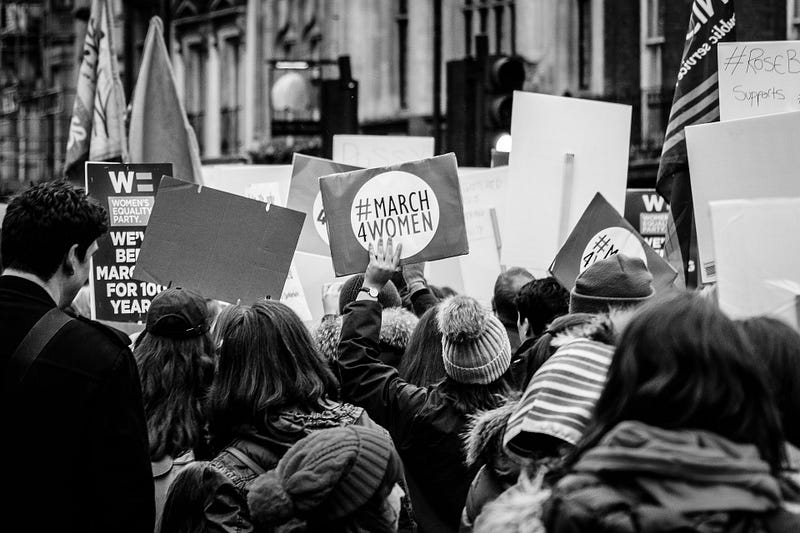
I’m a feminist and I didn’t even know it
Feminism is defined as “the advocacy of women’s rights on the basis of the equality of the sexes.” I believe in human equality, regardless of gender identity or presentation, but I wouldn’t describe myself as an advocate for women’s rights.
Not because I don’t want to fight for gender equality, but because I am so busy advocating for neurodivergent and disabled people (like myself and my son), I don’t have the time, resources, or emotional energy to dedicate to the many other worthy causes I wish to support.
Advocacy, by definition, is active, not passive. Advocating means taking action, it’s “action that argues for a cause, supports or defends, or pleads on behalf of others.”
Intersectionality
Over the past several months of reading, writing, and learning about social issues, I’ve come to realize all these issues overlap and intersect with each other. They are inextricably connected.
Intersectionality is defined as:
“the interconnected nature of social categorizations such as race, class, and gender as they apply to a given individual or group, regarded as creating overlapping and interdependent systems of discrimination or disadvantage.” — The Oxford Dictionary
Many, if not all, of the issues impacting one marginalized or oppressed group also impact other marginalized and oppressed groups.
When I am advocating for neurodivergent and disabled people — for basic human rights, equality, and fair treatment — I am advocating for all who have been discriminated against. I am advocating for anyone who has experienced (and continues to experience) prejudice and bigotry.
With that said, I will share some of my stories that have touched on gender inequality, feminism, and related social issues.
A realization
I was looking at my stats this morning and noticed that one of the top interests of those reading my stories is feminism. I have not once tagged a story under feminism (until now)…. but why?
Once I thought about it, I realized that I write about feminism quite a bit, especially when discussing how gender biases interfere with female-presenting people receiving adequate mental health supports.
I write about neurodiversity as it relates to ADHD and autism. Gender biases play a key role in assessing, identifying, and providing supports for Autistics and people with ADHD, because they have both historically been seen as “little white boy problems”.
They’re very much not.
These gender biases include delays in, or denials of, referrals for assessment and services, as well as rampant misdiagnoses.
I was not diagnosed with ADHD until I was 36, only after my son was diagnosed, and I self-identified as Autistic last year, at the age of 38.
Growing up undiagnosed likely contributed to being ostracized and relentlessly bullied throughout my entire childhood, and even into early adulthood.
Females with ADHD and female-presenting Autistics are much more likely to mask, or try to hide, our neurodivergence, which can cause significant mental health issues.
For these, and many other reasons, many in the Autistic community want people to understand that Autistic self-diagnosis is entirely valid. Sometimes it is the only way a person will ever have their autism recognized and acknowledged.
Ironically, when little boys behave in a boisterous, hyperactive, playful manner, it’s often considered “boys being boys.” Yet when these little boys have ADHD, they’re the most likely to receive early and accurate diagnoses.
When little girls are loud and energetic, they’re (we’re) considered tomboys, which is really a euphemism for a female-presenting child who does not follow the social norms of femininity.
Yet when we are socialized and corrected to the point of masking our neurodivergent traits, we are then dismissed when seeking assessment, because we don’t behave like stereotypical Autistics or ADHDers.
We don’t behave that way because society!
Circling back to that “tomboy” label for a moment
I recently learned something new: Not only is tomboy a sexist label, it also has its roots in white-supremacy, making it both sexist and racist. At the beginning of the abolition of slavery (which is ongoing, by the way), women were encouraged to begin leading more active, outdoorsy lifestyles.
Why? Because an increase in immigrants moving to North America made racist white folk worried about white people becoming a racial minority.
In an attempt to prevent this, white supremacists wanted white women to be healthier, to ensure they would bear many children, and would be fit for the demands of being wives and mothers.
Final thoughts
I certainly don’t hold myself up as an activist, and I will mostly be quiet, listen, and learn from those who are truly on the “front lines” of feminism. I will continue to advocate for all marginalized groups, and when the group is one of which I am not apart, I will move aside and do what I can to lift their voices.
© Jillian Enright, Neurodiversity MB
When you join medium, as a member you’ll have access to unlimited reads for only $5 per month. If you use my referral link, I’ll earn a small commission, and you’ll earn my undying gratitude.

For more great reads about neurodiversity, parenting, and advocacy, follow Neurodiversified.
We’re always on the lookout for more educational, informative, and well-written articles about ADHD, Autism, mental health, twice exceptionality, neurodiversity, parenting, advocacy, and education.
Want to write for us? Check out our submission guidelines.

References
Abate, M. A. (2008). Tomboys: A literary and cultural history. Temple University Press.
Carr, C. L. (1998). Tomboy Resistance and Conformity: Agency in Social Psychological Gender Theory. Gender and Society, 12(5), 528–553. http://www.jstor.org/stable/190119