How Your Unconscious Mind Rules Your Behavior
The essence of a psychologist's experiment and the paradox of his research

Attitude is a little thing that makes a big difference. ~Winston Churchill
Predicting people’s actual behavior is not an easy task. However, psychologists are continually investigating the factors that should be considered when predicting people’s behavior.
In 1934, Richard LaPierre, a psychologist at Stanford University, conducted an experiment that established the socio-psychological phenomenon of a discrepancy between a person’s actual behavior and the attitudes, intentions, and values expressed by them, which he considered inherent in them.
There is a paradox here:
The attitudes a person claims to adhere to do not correspond with their actual behavior in situations where these attitudes should be realized. Considering these settings, it is impossible to predict the actual behavior of this individual.
The researcher studied social attitudes, which are realized when we communicate with others and interact with them. The psychologists of that time believed that people’s declared positions were reflected in their actions, and therefore they developed questionnaires designed to measure social attitudes based on this belief.
However, it is quite evident that they also expected people to behave in the same manner as they described in their statements. According to LaPierre, the subject’s attitude should only be understood as a “symbolic response to a hypothetical situation”.
As he demonstrated quite convincingly, an individual’s answers regarding how they would behave in a hypothetical situation are not predictive, and “symbolic behavior” is not necessarily representative of their true behavior. As LaPierre pointed out in his experiment, “People say one thing but they do something entirely different”. Social attitudes expressed verbally are not related to real behavior or are only weakly related.
LaPierre’s experiment consisted of two separate steps:
- The research of real behavior
- The study of symbolic behavior
The first part of the experiment (The research of real behavior)
LaPierre and his Chinese friends, a newly married couple, made two road trips across the US. They traveled all over the Pacific coast. During the journey, they covered about 16 thousand kilometers. The young couple was no longer the first generation of Americans (active assimilation of the Chinese began in the United States in the middle of the 19th century).
LaPierre didn’t put his friends on notice that during his wanderings he studied the attitude towards them and the people who served them in various establishments. Since LaPierre’s friends didn’t know about his goal, they were therefore quite direct in their manifestations.
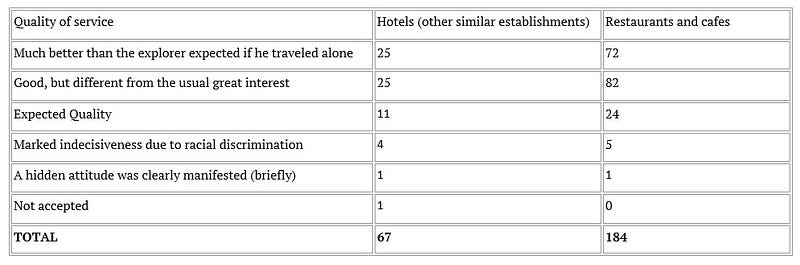
Between 1930 and 1933, LaPierre and his friends visited 67 hotels (tourist bases, motels) and ate at 184 restaurants. During the study, the researcher observed and meticulously recorded the reactions of clerks, bellboys, maids, and elevator operators to the presence of the married Chinese couple.
In terms of the research goal, LaPierre used specific situations to reinforce it; he attempted to go to a restaurant after his friends; allegedly followed their luggage, so they went to the hotel to handle settlement paperwork on their own.
The second part of the experiment (The study of symbolic behavior)
Six months after his trip, LaPierre sent out letters containing a questionnaire to the institutions the travelers visited. During such a period, the researcher believed the attendant’s visits were no longer relevant and no specific impressions would remain.
According to the study, 81 restaurants and 47 types of hotels responded to this question, representing more than half of the establishments visited:
“Do you accept members of Chinese nationality as guests in your establishment?”
At the same time, LaPierre sent out the same questionnaires to establishments in other regions that travelers did not visit. He received responses from 32 hotels and 96 restaurants.
In general, the collection of all necessary data concerning the relationship between social attitudes and social behavior took approximately three years to complete. It should be noted that negative attitudes towards immigrants from Asia were prevalent in the United States during the 1930s.
LaPierre was even concerned before the journey began. As an example, when he and his friends arrived at a small hotel in a city known for its strict fanatical prejudice against Asians, they were immediately welcomed and served quite politely and promptly.
LaPierre returned two months later and requested a reservation for a respectable Asian gentleman. He was surprised to discover that he had been denied. This personal experience, along with the surprise he experienced at that time, motivated him to conduct research.
The results of the LaPierre experiment
A total of 251 hotel visits were conducted during the trip, but only one hotel rejected LaPierre’s friends because of their ethnicity. According to the researcher, this hotel in a small town in California was of poor quality. Upon seeing the travelers in the car, the owner of the hotel announced:
“I will not accept Japanese.”
This was the only instance of a direct refusal by the hotel owner.
However, the researcher observed that in some cases the behavior of the staff regarding unusual visitors displayed certain peculiar characteristics (interest, attention, and consideration). The interest of people, according to LaPierre, can be explained by the fact that not only the inhabitants of the Pacific coast, but also the inhabitants of Chicago and New York in 1930 almost never communicated with immigrants from Asia, but in general, they were rarely seen.
The results of Table 1 indicate that, in most cases, the quality of service was as high or even better than expected when compared with LaPierre traveling alone. In general, the staff did not differentiate between LaPierre’s service and that of his friends.
The following table summarizes the responses to questions sent out 6 months after the trip. As you can see, almost 90% of the owners of campsites, tourist bases, restaurants, and cafes that LaPierre visited with his Chinese friends do not serve Chinese. Answers were distributed in the same manner for establishments that travelers had never visited before.
Since both groups of responses were the same, it can be concluded that the results obtained are independent of the establishments visited. However, one of the letters, in which the Chinese were accepted, was sent by the manager of a small hotel. The reply was accompanied by an informal letter describing a “wonderful visit to the hotel by a Chinese gentleman and his lovely wife” last summer.
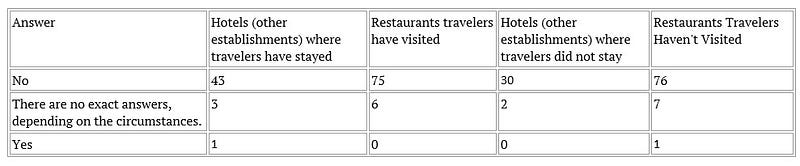
The researcher showed a discrepancy between attitude and actual behavior. The rejection letters indicated a negative attitude towards Asians, but the actual behavior of the people seemed to be based on a positive attitude.
Conclusions of the psychologist
Having received the results of the study, LaPierre expressed his opinion that
a questionnaire cannot accurately predict a person’s actions in real-life situations
The researcher noted that if his friends had been aware of the survey, they might have opted to return home instead of making the trip.
Nevertheless, they were not aware of all the details of the study; rather, they simply enjoyed the trip and did not encounter any signs of discrimination. They felt at ease during the journey, were assured that their service would not be denied, and were not expected to encounter any problems. Chinese young people have become accustomed to a completely different social situation.
As for LaPierre, he believed it was inappropriate to abandon the questionnaires completely, as they provide information about social attitudes and “symbols”, and therefore the results are merely symbolic. In addition, LaPierre stressed that responses regarding political attitudes should not be equated with the possible behavior of individuals.
When researchers learn how people are planning to vote, they cannot predict their actual actions during voting. They also cannot predict how they will communicate with the candidate on the street or at some type of reception. In an interesting twist, LaPierre believed that questionnaires could provide reliable information about religious beliefs (attitudes).
Conclusions are drawn from LaPierre’s study
In general, verbal responses to symbolic situations (i.e., attitudes derived from questionnaires) cannot be used to predict how an individual will behave in a real-life situation.
A person’s true attitude can only be determined by observing their behavior in a real-life situation
For modern researchers, questionnaires (“cheap, simple and mechanistic,” as LaPierre assessed them) have not lost their value. But, LaPierre’s data were ignored by professional psychologists. They have rehabilitated the use of questionnaires far more than the method deserves. Despite Richard LaPierre’s example, scientists do not always strive to get as close to reality as he did.
LaPierre’s experiment is widely known and often referenced, especially when discussing the relationship between attitudes and behavior, discrimination, and racial bias. As a result of this experiment, a new wave of research was initiated.
Several scientists have attempted to refute LaPierre’s conclusions through critical reviews. Other researchers have tried to explain the discrepancy between expressed attitudes and actual behavior. They have attempted to discover what factors should be taken into consideration to more accurately predict real behavior based on social attitudes.
In particular, the following criticisms were made:
- The methods used by LaPierre were rather simplified. As an example, the letters contained questions that had to be answered either “yes” or “no”. Based on such “trimmed” information, critics have argued that it is difficult to understand meaningful attitudes about specific groups of people. Perhaps, but this has not been established in the study, the respondents did not have any information about the representatives of the national group. They could portray the representatives of this ethnic group in a very different manner from the real attractive young people with whom they had to interact.
- Only half of the establishments LaPierre visited with his friends responded to his letter. These results may indicate that those who chose to respond had rather “specific” negative attitudes toward Asians.
- The study did not take into account who answered the letters: either the people who met with the travelers or other employees. He believed that he was receiving answers from those he met with, but after six months, completely different individuals could work there.
LaPierre’s experiment focused on issues related to discrimination in American society and racial and ethnic stereotypes. Though the study was quite simple in concept, it took the researcher a considerable amount of time to conduct.
During the 1930s, the US exhibited a rather prejudiced attitude toward other national groups. As a result of the unfavorable economic conditions of the Great Depression, such sentiments were also prevalent. In addition, there were cases of severe discrimination, including black and colored individuals being prohibited from riding public transportation next to white individuals.
In organizing his research, Richard LaPierre displayed courage. Throughout a long period, he traveled in a private car and stayed in hotels along the way.
People of the third millennium may find it difficult to comprehend the discrimination that existed in American society during that time. However, negative attitudes towards such content have not yet disappeared.
While LaPierre did not become a well-known theorist, his research was included in all textbooks on social psychology. In the course of this study, a unique aroma emerges — that of the era, the time, sincerity, truthfulness, interest, and genuine human warmth.
“The study of human behavior is a difficult, intellectually tedious process, the success of which depends on the ability of the researcher”
— Richard LaPierre, 1934
A person’s words and behavior diverge. Individuals display these characteristics as part of their socio-psychological makeup. Sticking to your word is socially acceptable behavior. However, people tend to speak out in a way that is appropriate for representatives of a certain social circle.
In a real situation, a person is more influenced by specific people and circumstances than by some abstract views. How to predict people’s behavior from their attitudes is an ongoing problem. In one way or another, attitudes are indeed the determinants of our behavior. Scientists only need to determine how this actually happens.
Takeaway
LaPierre’s study was the first in a series on this topic. As individuals, we need to be aware of the extent to which our words and deeds coincide. People examine their behavior carefully to determine whether it corresponds to the expectations of those around them.
Psychology research often ignores this dimension of social behavior, and most scientists ignore LaPierre’s study. Perhaps the most significant aspect of LaPierre’s research that has remained outside the scope of his research is the notion that
Societal attitudes are a means of regulating behavior
In addition, they are a means of altering social behavior.
Social attitudes describe the behavior of individuals within a social group. Although LaPierre fixed the phenomenon, the parameter used to determine the correspondence between “words and deeds” is determined by factors that are not individual. Individuals utilize their positions to establish, develop, or break relationships. Therefore, the manifestation by a person of their thoughts, which is a manifestation of their attitudes, serves as a means of identifying with a group or expressing the opposite of the group.
We cannot assert that ordinary employees and attendants oppose the norms of society through their behavior. LaPierre’s research, however, is perhaps one of those heroic protests that all of us go through to make our lives a little more honest and truthful. Perhaps humanistic psychologists are right when they say that as soon as people get an opportunity, they immediately take advantage of it.
LaPierre’s experiment was a modest protest against social pressure and depersonalization and not a manifestation of chaos in human behavior. In addition, this study demonstrated that the prevalence of certain views and the knowledge that these views are generally accepted are not decisive factors. Oddly enough, LaPierre’s experiment is a testament to the non-conformity of human behavior.
Human behavior remains a fascinating mystery as a result of LaPierre’s experiment. This is why this study is considered a classic study in social psychology.
Thank you for reading!
If you found this article helpful, consider subscribing to my email list to get my stories delivered straight to your inbox whenever I publish on Medium!
If you’re new to Medium and wish to support my work, consider being a Medium member through my page and get unlimited access to all current posts from me and hundreds of other writers! Your membership fee directly supports me as I get a portion of your membership without any extra cost to you.
If you enjoyed reading this, you might also like:


