PSYCHOLOGY
The Karpman Drama Triangle
How to escape it and take full responsibility for your life

“The Victim is not really as helpless as they feel. The Rescuer doesn’t really help, and the Persecutor doesn’t really have a valid claim.” ~Claude Steiner
In 1968, the transactional psychologist Stephen Karpman published an article describing a model of human relationships later called the Karpman Triangle. It includes three roles:
- The Persecutor
- The victim
- The Rescuer
The subjects of this triangle form the so-called co-dependent relationship. In psychology, this term refers to a destructive type of relationship. The Karpman triangle is a prime example of such a model.
This is a closed mutually beneficial system of figures dependent on each other:
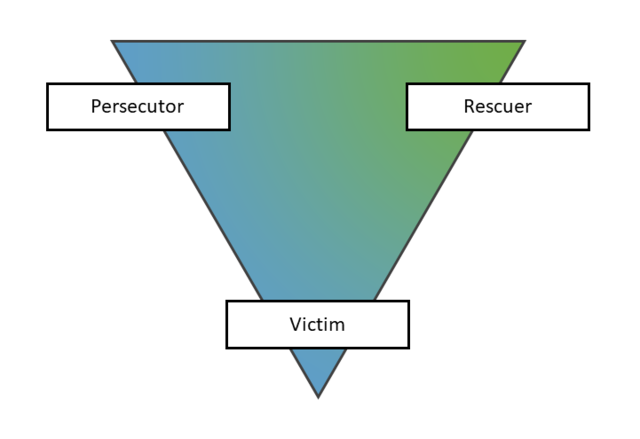
The Persecutor is prone to controlling, blaming, and threatening others with a false sense of superiority. They have a subject on whom they can pour out their negativity, on whom they can win back, and at the same time blame this person for their troubles. As a way of concealing their fear of failure, they put on a grandiose act and get defensive when things don’t go as planned.
The Victim gets rid of responsibility for their life, shifts decisions to others, receives help, and also sympathy and support. When a person plays the victim role, they believe they are “at the mercy of” someone or something. They are prevented from taking responsibility for their condition when they believe others or something else beyond their control is at fault. This undermines their ability to make changes to their circumstances.
The Rescuer looks like a hero in their own eyes and the eyes of other people. While helping others, they feel good and worthwhile about themselves, neglecting their own needs in the process. The truth is that it’s not a genuine concern for others that drives their actions, but rather a desire to feel good about themselves by doing the act. As long as they validate the perspective of victims and confirm and reaffirm their state, they thrive. Therefore, they encourage dependency instead of helping the victim take responsibility for their own choices.
All participants are in a low-resource state, each of them lacks basic support, trust, and self-love.
Plunging into one of these roles, a person begins to dissolve in illusions and ignore reality. Gradually they lose themselves, energy, personality, and life. Getting out of such a relationship and resetting the role taken on is not easy, but possible.
Participants in a triangle can periodically change roles, as well as change roles within other triangles — consciously or unconsciously. As hard as it is to believe, each of the participants gets their own “benefit” in such a destructive relationship. The game tends to drag on and on, destroying lives. Let’s take a look at exactly how this happens and what “benefits” the players are looking for.
Role #1 — Victim
- Motto: “Why does this happen to me?”
- Feelings: suffering, helplessness, shame, envy, fear.
- Motive: to be in the position of a child, not to take responsibility for their life.
- Repressed: Aggression.
- Quotes: “Poor me”, “It’s not my fault, it’s them…”, “because of you I have…”, “I’m not appreciated”, “you have no idea how much I suffered”, “no one loves me”, “I feel helpless”, “If only others cared for me”…
Description of the victim
It is believed that the triangle begins with the victim. It is the one that provokes the reaction of others, and they occupy one of the two poles — the side of pity or anger. The victim has not matured inside — this is a child who is not ready for making decisions, choices, or taking responsibility for them. Hidden aggression gradually accumulates behind external helplessness, and the victim turns into a persecutor: “help” — “you don’t help well”, “it’s all because of you.” The victim put themselves in a position that lacks freedom and is under control. The “benefit” that the victim seems to receive is the opportunity to feel sorry for themselves, to do nothing, and not change anything for the better.
Role #2 — Rescuer
- Motto: “I’m fine, you’re not okay” (“You are helpless and hopeless, nevertheless I will try to help you”).
- Feelings: guilt, pity, pride.
- Motive: the desire to assert itself, to be needed, “good.”
- Repressed: helplessness.
- Quotes: “he/she can’t do it without me”, “how will I leave her/him”, “I advise you …”, “I feel sorry for you”, “Let me help you”…
Description of the lifeguard
No matter how paradoxical it may sound, the rescuer here seeks to save not the victim at all, but themselves. Rushing to help, they recognize themselves as stronger, capable, kind, and knowledgeable. They are engaged in the other’s life, and this allows them not to think about their own life, problems, plans, etc.
Salvation helps them to rise, assert themselves, and take a place “above” in these relationships. They want to play the role of a “good boy/girl” to earn the recognition of others, but in reality, they seek their parents’ missed recognition which they could never feel.
Without receiving due gratitude, the rescuer is in a low-resource, tired state and, having strengthened control, can move into the role of a persecutor.
Role #3 — Persecutor
- Motto: “I’m OK, You’re Not OK” (“You’re helpless and hopeless, and it’s your fault”).
- Feelings: anger, irritation, fear.
- Motive: the desire to assert itself, to gain the upper hand.
- Preempted: vulnerability.
- Quotes: “You are to blame”, “You don’t understand in a good way”, “You provoked me”, “I didn’t expect this from you”, “I should have never trusted you”…
Description of the persecutor
Often people who were offended, scolded, and severely punished in childhood become persecutors. They received this impulse of cruelty and pass it on, subconsciously trying to compensate for the feeling of helplessness and shame. Offending, persecuting, humiliating, reproaching, they become in a position “above”, they feel above the victim.
The “joy” from such self-affirmation is painful and destructive because deep down cruelty does not help cure pain. The persecutor is unhappy and feels like a victim.
How to understand that you are in a Karpman Drama Triangle?
Just make yourself these questions:
- How often do you complain about life, husband, neighbor, boss, or government?
- How often do you discuss bad news in conversations with friends and acquaintances?
- How often do you help and advise, even if you have not been asked or asked for it directly?
- How often do you blame other people (both close and not so, for example, the government) for your problems?
- How often do you catch yourself thinking that others are more fortunate than you?
If you answered “Often” to at least one of the questions, most likely you are in the game. And not necessarily in a relationship with a spouse or family members. You can walk in circles of this triangle endlessly, but to get out, you need to be psychologically mature.
Transcending the Drama Triangle
Our predisposition towards these roles is formed during our childhood and through our interactions with our primary caregivers. We then construct an image of ourselves, which is centered on our self-belief about our identity and our role in the world. According to a 2020 study, people caught up in the Drama Triangle are more likely to have non-secure attachment styles, high anxiety, stress, depression, and negative emotions.
Transcending the Drama Triangle is only possible through connecting with the adult-ego state and understanding the conditioning, personal history, and past experiences and relationships that led to the involvement within the Drama Triangle. The transformation process is described by Karpman using a framework of creativity:
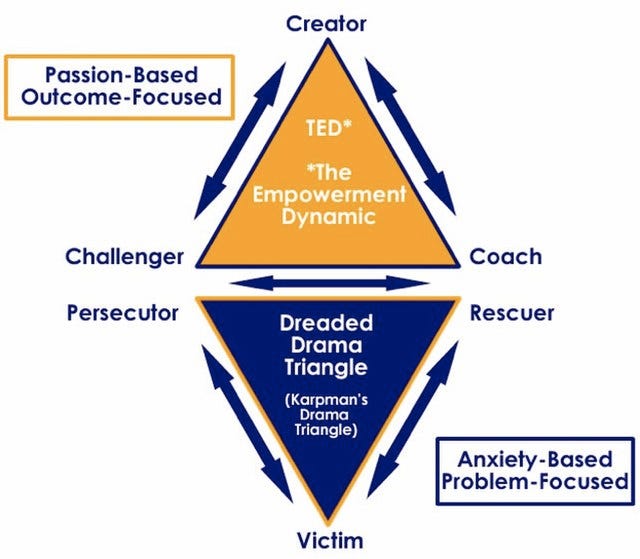
- The Victim shifts to the Creator: Possessing self-confidence, problem-solving skills, and personal responsibility.
- The Persecutor becomes the Challenger: Motivating their actions by focusing on altruistic intentions provides meaning and purpose.
- The Rescuer must become the Coach: Teaching others, encouraging them, and motivating them rather than becoming embroiled or controlling.
When we accept responsibility for our part in perpetuating drama, we can recognize and accept our actions. Through therapy, we can learn how to hold ourselves accountable, apply awareness, respond creatively, and facilitate healing. By moving from our Child-Ego into our Adult-Ego with a trusted therapist, we can take control of our sense of self, our perception of self, and our relationships with others.
When we transcend the cyclic nature of the Drama Triangle, we can create joyful, loving, and positive relationships at home, at work, and across all kinds of social interactions.
Thank you for reading!
If you found this article helpful, consider subscribing to my email list to get my stories delivered straight to your inbox whenever I publish on Medium!
If you’re new to Medium and wish to support my work, consider being a Medium member through my page and get unlimited access to all current posts from me and hundreds of other writers! Your membership fee directly supports me as I get a portion of your monthly fee at no extra cost to you and it will go a long way in helping me keep on delivering valuable content to you.
References
- Lac, Andrew, and Candice D. Donaldson. “Development and Validation of the Drama Triangle Scale: Are You a Victim, Rescuer, or Persecutor?”. Journal of Interpersonal Violence, 2020, p. 088626052095769. SAGE Publications, doi:10.1177/0886260520957696. Accessed 1 April 2022.
- Nielsen, Sara Kerstine Kaya et al. “Adult Attachment Style, and Anxiety — The Mediating Role of Emotion Regulation”. Journal of Affective Disorders, vol 218, 2017, pp. 253–259. Elsevier BV, doi:10.1016/j.jad.2017.04.047. Accessed 2 April 2022.
- Karpman Drama Triangle, the official website of Dr. Stephen Karpman’s Drama Triangle
- “The Three Faces of Victim — An Overview of the Drama Triangle” by Lynne Forrest.
- Breaking the Drama Triangle by John Goulet, MFT
- Berne, E. (1972). What do you say after you say hello? The psychology of human destiny. New York: Grove Press.