SELF IMPROVEMENT
How Quanta Correlate With Your Thoughts
How a dead-end experiment leads to conscious behavior
Have you ever heard about the Double-Slit Experiment? This is the most famous experiment of modern physics that has led scientists to a dead-end. According to Wikipedia
“The double-slit experiment is a demonstration that light and matter can display characteristics of both classically defined waves and particles; moreover, it displays the fundamentally probabilistic nature of quantum mechanical phenomena.” — Wikipedia
But before explaining that, let’s talk about another experiment conducted almost 2 centuries ago.
Let there be light!
Young’s experiment is the first experiment in the history of physics to demonstrate the interference of light. Thomas Young presented the results of his research in 1803 at a meeting of the Royal Society of London.
In the language of modern physics, the essence of the experiment is formulated as follows. The bright light of the sun’s rays is directed to the first opaque screen with a small slit to create a monochromatic light source, that is, a beam of light with a small frequency spread. Then the resulting beam falls on the second screen, on which two narrow slits were made at a small distance from each other.
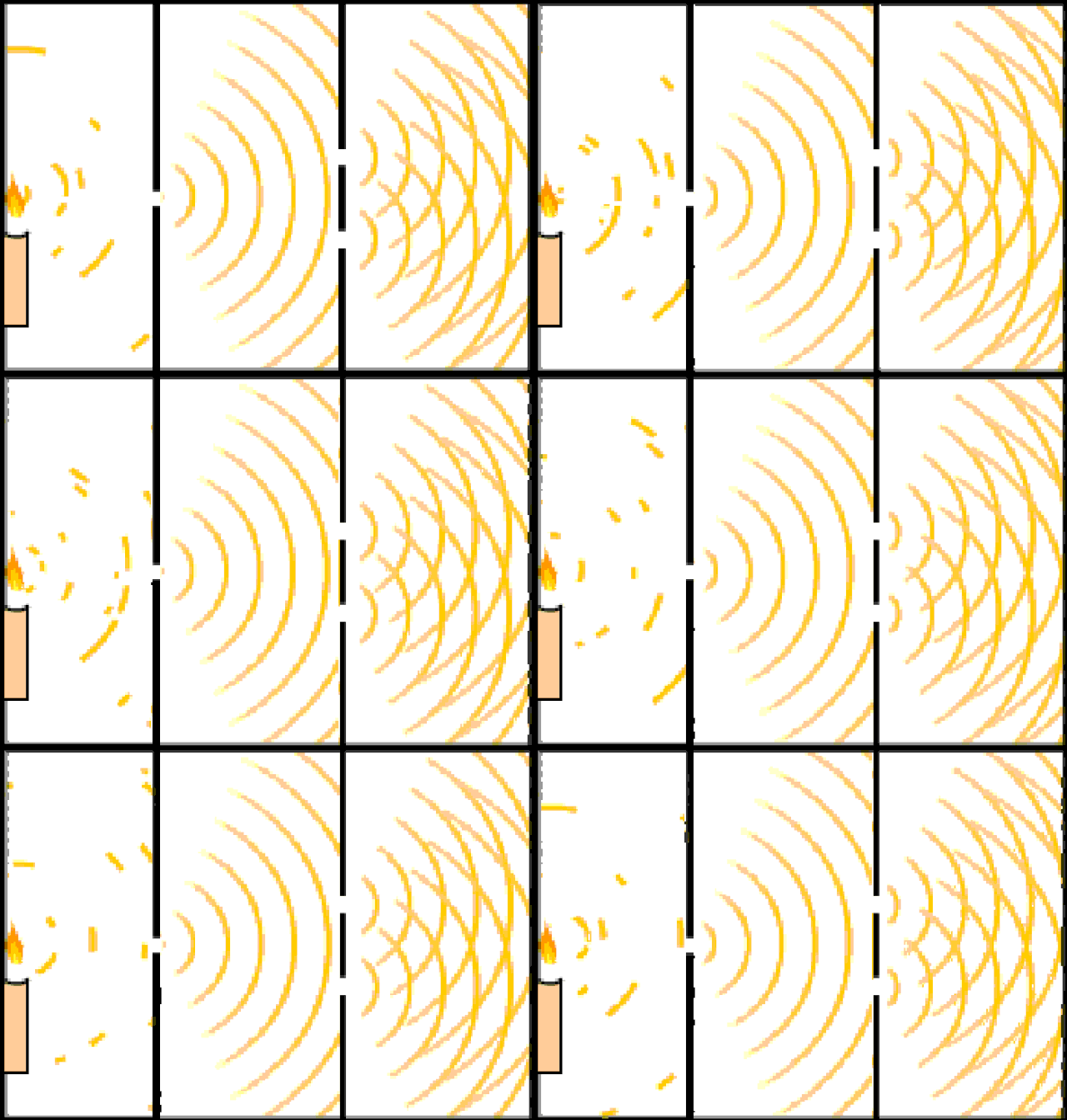
In this case, the size of each slot approximately corresponds to the wavelength of the light emitted by the first slot. As a result, two coherent light sources are formed with the same frequency and a common phase difference of the oscillation. The waves from these sources begin to overlap each other, which leads to their mutual amplification or weakening in different areas, that is, a stable pattern of maxima and minima of the oscillation amplitude is formed.
This phenomenon is called interference. As a result, a series of light and dark bands can be observed on the third screen. Dark bands will appear where the waves from the two slots have extinguished each other, light bands where they have intensified.
Young’s experience is a classic illustration of the fallacy of theories that consider light solely as a stream of particles. If the photons exhibited exclusively corpuscular properties, then the screen would have two brightly lit areas behind the slits and a dark area between them. Thanks to Young’s experiment, physicists were forced to take into account the wave properties of light.
The double-slit experiment
The physicists thought as follows: Suppose we do this experiment again with a double slit, but this time instead of sending a ray of light, we’ll send the bullets of a firearm. So they did it.
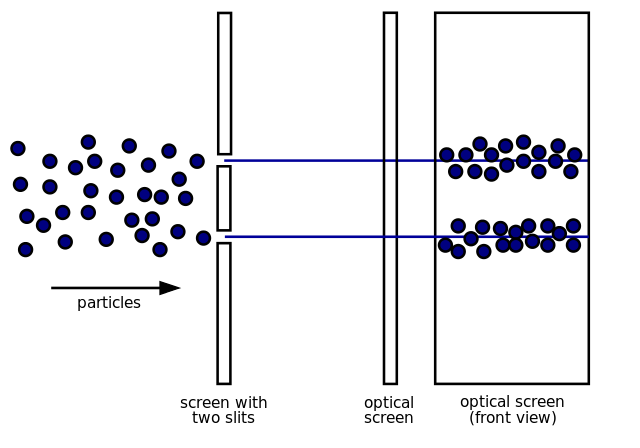
They placed a firearm, a screen in front of it, and between them inserted an obstacle that had two slits. The firearm started firing bullets at this double slit, so apparently, some of the bullets went through the upper slιt and some went through the lower slιt. The result on the screen was as in the figure below, ie the bullets appeared to have been distributed in the two areas.
Ok, so far things sound logical and the results are as expected. So, the physicists thought of the next step: Suppose we go to the quantum world, the subatomic world, and instead of sending bullets from a firearm, we’ll send particles, such as electrons. So they put an electron emission source opposite this slit and thought that since the particles are like very small balls moving at very high speed, the result will be the same as in the previous experiment.
The experiment was done and the result was like what is shown in the picture below
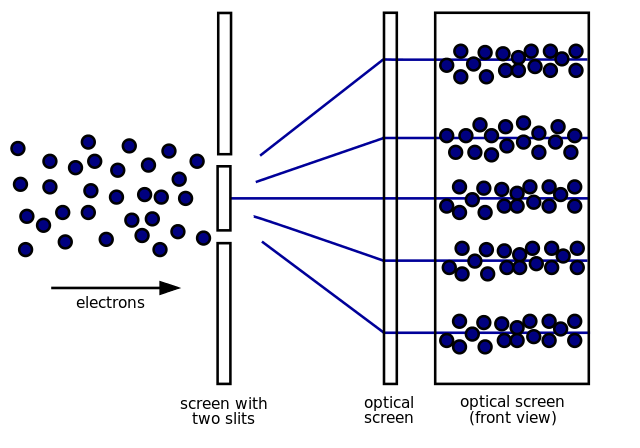
Indeed, some of the electrons passed through the upper slit and some through the lower one, but the display on the screen was that of a wave. That was, areas where the electrons were displayed, then there was a gap, then electrons were displayed again, and so on.
Wow! How did this happen? Did the electrons interact with each other, collide with each other in some way, and finally displayed this pattern? And if they collided with each other, why did they plot such a symmetrical pattern?
But as physicists are smart people they thought as follows. Ok, instead of sending the electrons all together against the slits, we’ll send them one after the other. This will result in collapsing the above experiment and eventually seeing two traces on the opposite screen.
So they started firing the electrons one after the other and after a while, to their surprise, they noticed that the electrons behaved in just the same way as before. In other words, they displayed on the opposite screen the same image as the waves. How can one explain this now? Physicists found themselves at a dead-end.
Then physicists thought of this. We’ll put a “spy” device in one of the two slots and we’ll start firing the electrons one after the other. Each time an electron passes the device will send a sound, a beep, so we’ll be sure the electrons will have passed through the top slot. So they did it.
To their surprise, the following paradox happened. The electrons, as if they possessed a kind of spy radar, behaved completely differently, and in particular behaved like the bullets of a firearm, that is, to display on the opposite screen the traces of the following image. That is, with the spy device (“the observer”) activated, the system collapsed. The mere fact that they simply tried to observe what was happening, without any interference, resulted in the system collapsing and the electron “deciding” to behave as physicists would expect.
There is a video on youtube that demonstrates the double-slit experiment. I recommend you watch this so that this experiment becomes more understandable. Here it is
Final Thoughts
Ok, now what? What’s the point of all this?
Well, there is a scientific hypothesis that human beings have an “energy system” inside their body.
Our bodies are a kind of energy field.
Our mental energy attracts what we think. There are many times when things happen around us and we try at all costs to influence them to become as they please us.
— Our actions and choices are what fires the electrons of the experiment. It’s our thoughts that trigger a sequence of events that occur in our lives.
— Our anticipation and eagerness to get the results we expect at the moment we want are the spy device. These give rise to thoughts and feelings that affect the outcome. In other words, as long as we wait and flood our lives with anxiety, uncertainty, insecurity, the result will be contrary to the expected and equal to our thoughts.
Thoughts that pay homage to frustration, attract frustration. When you say or think something like “I can do nothing, I have lost control of my life and I am trapped”, this is exactly what you will attract. That is, resistance to your greatest desires!
With every thought of frustration, it is like buying a ticket for more frustration.
Every thought that confirms that you are trapped, asks the Universe to send you even more than that glue that keeps you stuck.
We produce what we think. The space around us is a reflection of our thoughts, feelings, and expectations.
If we think everyone hates us, we’ll attract in our lives people who hate us. If we believe that we won’t succeed, that will be exactly the result. If we are afraid that we’ll break up, that’s gonna happen in the end.
Our desire to exist and live with greatness is an aspect of our spiritual energy. To gain balance in this area of our life, we must use the energy of our thoughts to harmonize with what we desire. Our mental energy attracts what we think.
The most important tool for gaining balance is the awareness that you alone are responsible for the imbalance between what you dreamed of your life to become and your daily habits that drain your life from that dream. You can re-align with your mental energy so that you have opportunities to correct this imbalance.
You can control nothing but your thoughts!
So do what you have to do, let things go as they should, let them happen, and the results will come when the time is right to come.
Thank you for reading!


