avatarAntonis Iliakis

Free AI web copilot to create summaries, insights and extended knowledge, download it at here

5521

Abstract

ted by the police. The police do not have sufficient evidence to find the culprit, and, after having locked the two prisoners in two different cells, interrogate both of them offering them the following perspectives: if one confesses (C) and the other does not confess (NC), who does not he confessed will serve 10 years in prison, while the other will be free; if both do not confess, then the police will sentence them to just one year in prison; if, on the other hand, they both confess, the sentence to be served will be equal to 5 years in prison. In any case, however, neither of the two suspects will be able to know the choice made by the other.</b></p></blockquote><p id="e270">How to act? Observing the question from a purely individualistic perspective, the optimal choice for both would be to confess: at best, the years to be served will be 0, at worst 5. According to the Theory, this solution would constitute the so-called “<b>dominant strategy</b>”, as it is considered advantageous regardless of what the opponent does.</p><p id="a6ee">However, many problems arise.</p><h1 id="7edd">The paradox of the prisoner’s dilemma</h1><p id="40fb">The mutual accusation, as we have seen, would be the least risky. And it would also guarantee what has been called “<a href="https://en.wikipedia.org/wiki/Nash_equilibrium"><b>Nash equilibrium</b></a>“, named after the mathematician and Nobel laureate, <b>John Nash</b>, who made an essential contribution to Game Theory and its evolutions.</p><figure id="7c82"><img src="https://cdn-images-1.readmedium.com/v2/resize:fit:800/1*UMF0-y_ypajdNSbEAYO7gQ.jpeg"><figcaption>John Forbes Nash — Photo from <a href="https://commons.wikimedia.org/w/index.php?search=John+Nash&amp;title=Special:MediaSearch&amp;go=Go&amp;type=image">Wikimedia Commons</a></figcaption></figure><p id="2f97">According to the <a href="https://en.wikipedia.org/wiki/Nash_equilibrium">Nash equilibrium</a>, the two prisoners would adopt a rational and useful behavior to their close social circle, because the latter would allow obtaining something that is in the interest of both participants involved.</p><p id="34bd">This option, however, immediately tickles a paradox: if the choice of confessing, therefore betraying and not collaborating, would be the least dangerous on an <i>individual</i> level, from a <i>collective</i> perspective not speaking would guarantee the <b>least sentence of all</b> (1 year against 5 or, even, 10) and, above all, an equal and supportive attitude.</p><p id="8f1f">Too bad that such a scenario would never be feasible. Although the choice to confess-confess leads to “<b>fictitious rationality</b>“ even if the two prisoners agree on the common conduct not to confess, neither would have the guarantee that the other will act in this way. Indeed, this could induce even one of the two to betray, thus ensuring total freedom.</p><h1 id="2145">Prisoner’s Dilemma: Solutions and Strategies</h1><p id="c7fd">For the two suspects to accept the less selfish option, it would be necessary for both of them to have an “<b>almost perfect logical capacity</b>“, such as to lead them to make the same choice, that is, the most advantageous from a cooperative perspective.</p><p id="f044">If both adopted logical reasoning, it follows, therefore, that the only possible decision would be that of not confessing, thus stabilizing the <b>period of detention at 1 year each</b>. In this case, the so-called “<a href="https://en.wikipedia.org/wiki/Pareto_efficiency"><b>Pareto efficiency</b></a>” would be reached: the condition in which no player can improve his situation, if not at the expense of the other.</p><p id="f8a9">But is it really that simple? Of course not. To investigate the implications of the prisoner’s dilemma, alternative solutions and strategies have been studied over the decades. One of these is the “<b>repeated dilemma</b>“, that is, repeating the game an indefinite number of times.</p><p id="09b7">In this scenario, the two players would become aware of the choice of the other at the end of each trial, but, given the indefiniteness of the number of games, the initial equilibrium would be subject to <b>unpredictable mutations</b>, demonstrating the advantage of a possible collaboration in the long term.</p><p id="b3e5">Another tactic is the non-cooperative “<a href="https://en.wikipedia.org/wiki/Trigger_strategy"><b>trigger strategy</b></a>“, under which, again as part of a repeated game, when one player does not respect the pact of cooperation (<b>defection</b>), the other punishes him by violating him and, therefore, punishing him.</p><p id="fb5a">There are many variations of this strategy. Among the best known are:</p><ul><li>the “<b>tit for tat</b>“ (“<b>eye for an eye</b>“), in which the punishment lasts as long as the player who first violated the pact continues in his defection. When the latter cooperates again, the punishment ceases.</li><li>the “<b>tit for two tats</b>“, where the punishment lasts a few more turns than the one immediately following the betrayal, and ends when the incorrect player maintains solidarity for several consecutive moves.</li><li>the “<b>grim trigger</b>“, in which the punishment can last indefinitely over time, even if the player who first deviated from the collaboration agreement should return to cooperate.</li></ul><p id="d8e3">The purpose of the “trigger strategy” is to <b>encourage cooperation between the parties</b>, the advantages of which are evident in the long term and only i

Options

n repeated shifts. Those who do not respect the agreement know they are facing certain punishment.</p><p id="a86d">A bit like it happens in our lives, outside of games and strategies.</p><p id="27d0"><b><i>The video below illustrates the prisoner’s dilemma in real-life situations:</i></b></p> <figure id="7d75"> <div> <div> <img class="ratio" src="http://placehold.it/16x9"> <iframe class="" src="https://cdn.embedly.com/widgets/media.html?src=https%3A%2F%2Fwww.youtube.com%2Fembed%2Femyi4z-O0ls%3Ffeature%3Doembed&amp;display_name=YouTube&amp;url=https%3A%2F%2Fwww.youtube.com%2Fwatch%3Fv%3Demyi4z-O0ls&amp;image=https%3A%2F%2Fi.ytimg.com%2Fvi%2Femyi4z-O0ls%2Fhqdefault.jpg&amp;key=a19fcc184b9711e1b4764040d3dc5c07&amp;type=text%2Fhtml&amp;schema=youtube" allowfullscreen="" frameborder="0" height="480" width="854"> </div> </div> </figure></iframe></div></div></figure><h1 id="214a">The prisoner’s dilemma and its applications</h1><p id="6bcf">Due to its <b>simple and versatile structural system</b>, the prisoner’s dilemma is often used to frame also phenomena belonging to contexts different from that of Game Theory. The constant is always the same: the need to face different strategies and solutions, conducting reasoning on the most optimal choice to make.</p><p id="aa3c">For this reason, the dilemma has lent its study models to <b>the most diverse disciplines</b>, from economics to politics, from sociology to biology, thus revealing its importance at the community level.</p><p id="43a9">In <b>the 1950s</b>, for example, the prisoner’s dilemma, in its original form, was used to explain the <b>arms race by the United States of America and the Soviet Union</b>, at the height of the Cold War that involved them. The crossroads consisted of: <b>arm yourself or not arm yourself</b>. For both nations, just as in the case of the two suspects, the most advantageous decision was represented by the increase of their nuclear arsenal, to minimize the risks and not suffer the enemy attack, despite the enormous expenditure of energy of the two. superpowers.</p><p id="68af">Another field of application is that of the <b>economy</b>, where the choice to cooperate or betray can concern two companies (in the context of greater or lesser profits), a company and a consumer (quality/price ratio) or, again, a creditor and a new debtor (as regards the granting of credit and the possible repayment of the debt).</p><p id="5b3d">Moreover, contexts such as <b>sport</b>, <b>respect for social norms</b> (from violations of the highway code to, as mentioned, a simple bus ticket) or <b>biology</b> are not exempt from the prisoner’s dilemma. A case, in the latter sense, is offered by the same <b>restrictions from Covid-19</b>: in the last year’s course, some individuals have often found themselves faced with the choice of respecting (therefore “collaborating”) the prescriptions or, on the contrary, to transgress them.</p><p id="482b">Every decision has its consequences, and each choice will inevitably be connected to that of other people. If<b> no one cooperates</b>, the contagion does not stop and continues undisturbed; <b>if everyone works together</b>, the risks decrease drastically and the sick can receive adequate care; but if some cooperate and others do not, thus creating a <b>condition of imbalance</b>, the latter will turn into “<a href="https://en.wikipedia.org/wiki/Free-rider_problem"><b>free riders</b></a>” and will therefore benefit from the former. Thus feeding the chain of contagion and decreasing the beneficial impact of the sacrifices made by those who respect the rules.</p><p id="9019">If you enjoyed reading this, you might also like this:</p><div id="ee95" class="link-block"> <a href="https://readmedium.com/5-simple-tips-for-better-decisions-4e0421db5457"> <div> <div> <h2>5 Simple Tips For Better Decisions</h2> <div><h3>Follow these 5 tips that will help you make the right decisions</h3></div> <div><p>medium.com</p></div> </div> <div> <div style="background-image: url(https://miro.readmedium.com/v2/resize:fit:320/1*W0tp9FhZ6LIWy-51pL4uvg.jpeg)"></div> </div> </div> </a> </div><p id="c51f">Read this wonderful article by <a href="undefined">Saif Farooqi, PhD</a> about human judgment</p><div id="527e" class="link-block"> <a href="https://saif-farooqi.medium.com/the-inaccuracy-of-human-judgment-media-influencing-thought-processes-8a7dc98cce37"> <div> <div> <h2>The Inaccuracy of Human Judgment: Media Influencing Thought Processes</h2> <div><h3>Humans are said to be rational beings. Compared to any other living beings, humans are considered to be much more…</h3></div> <div><p>saif-farooqi.medium.com</p></div> </div> <div> <div style="background-image: url(https://miro.readmedium.com/v2/resize:fit:320/1*Y1TtLAcacvECzNYhYqRuQg.png)"></div> </div> </div> </a> </div><p id="a89b"><i>Access <b>unlimited high-quality </b>content on Medium by subscribing <a href="https://antonisiliakis.medium.com/membership">here</a>. Your subscription directly supports Antonis Iliakis and other writers you read.</i></p></article></body>

PSYCHOLOGY

How The Prisoner’s Dilemma Affects Your Decisions

The effect of Game Theory on cooperation and social welfare

Photo from photobyphotoboy on Adobe Stock

Every day, in the small or big issues of our existence, we are faced with a dilemma: to pursue our interests or to cooperate with other members of society.

In these cases what is the best thing to do? Analyze the possibilities and opt for the choice that allows you to run the least possible risks and, at the same time, to guarantee the highest result. This often means not obtaining the best result ever, but the best among those that allow you to limit risks.

But most of the time the game is infinite, or at least as over as a human being can be. And then the game gets complicated: the heats are many, but everyone is not interested in winning the battle, but the war.

In Game Theory, this critical dichotomy has a specific name: the prisoner’s dilemma. Extremely versatile and intuitive, the latter can be applied to any area of community life, offering stimulating food for thought about our way of relating in different group contexts.

It can really be a modern-day war or a spiteful virus couple or a reckless Saturday night car ride or any relationship between two people.

Yes, because the prisoner’s dilemma is all of this.

The “rational” keystone to solve all dilemmas.

Which often hides a certain amount of “irrationality” …

Let’s make an experiment. John gets on a tram in the evening rush hour, settling into the crowd of people who, with him, occupy the narrow space. He has a ticket with him, the last of his booklet, but, as a precaution given future eventualities, he decides not to stamp it: “I will do it only if I see the inspectors get on”, he says reassuring himself.

Out of the corner of his eye, however, he notices that Mary getting on with him, at the same stop, validates her ticket promptly and without second thoughts. The sense of guilt begins to proliferate, but John, regardless of the obvious disparity of attitude, continues in his unfair behavior.

John and Mary, after about ten stops, find themselves in front of the door, ready to get off. The inspectors did not get on, therefore John saves his ticket, while Mary obliterates it — apparently — meaningless. If everyone thought like John, however, the transport companies would go bankrupt in a short time and evasion would become the typical conduct of all passengers.

John was faced with a nuance of the “prisoner’s dilemma”: Should he “betray” other travelers by not validating his ticket and acting slyly, or “cooperate” with them, making his contribution and respecting what is required to legally carry out the trafficking?

Interesting dilemma, don’t you think?. Let’s keep reading…

What is the prisoner’s dilemma?

The prisoner’s dilemma is perhaps the most classic example given by Game Theory, the branch of mathematics that studies how individuals make decisions when they interact with others, investigating their chosen strategies and solutions to get the maximum benefit possible.

Formulated in 1950 by the mathematicians of the RAND Corporation Merrill Flood and Melvin Dresher and then taken up and made official by Albert William Tucker, the dilemma fits into the category of “ non-cooperative games “, that is, those which, unlike “ cooperative games “, they do not provide for the possibility of prior agreement and the elaboration of joint and functional strategies between the players involved.
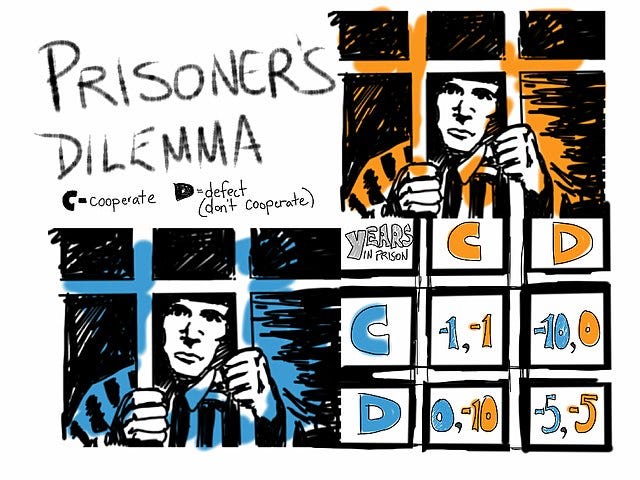
Prisoner’s Dilemma — Photo from Wikimedia Commons

The scenario proposed is as follows:

Two suspects, A and B, are arrested by the police. The police do not have sufficient evidence to find the culprit, and, after having locked the two prisoners in two different cells, interrogate both of them offering them the following perspectives: if one confesses (C) and the other does not confess (NC), who does not he confessed will serve 10 years in prison, while the other will be free; if both do not confess, then the police will sentence them to just one year in prison; if, on the other hand, they both confess, the sentence to be served will be equal to 5 years in prison. In any case, however, neither of the two suspects will be able to know the choice made by the other.

How to act? Observing the question from a purely individualistic perspective, the optimal choice for both would be to confess: at best, the years to be served will be 0, at worst 5. According to the Theory, this solution would constitute the so-called “dominant strategy”, as it is considered advantageous regardless of what the opponent does.

However, many problems arise.

The paradox of the prisoner’s dilemma

The mutual accusation, as we have seen, would be the least risky. And it would also guarantee what has been called “Nash equilibrium“, named after the mathematician and Nobel laureate, John Nash, who made an essential contribution to Game Theory and its evolutions.

John Forbes Nash — Photo from Wikimedia Commons

According to the Nash equilibrium, the two prisoners would adopt a rational and useful behavior to their close social circle, because the latter would allow obtaining something that is in the interest of both participants involved.

This option, however, immediately tickles a paradox: if the choice of confessing, therefore betraying and not collaborating, would be the least dangerous on an individual level, from a collective perspective not speaking would guarantee the least sentence of all (1 year against 5 or, even, 10) and, above all, an equal and supportive attitude.

Too bad that such a scenario would never be feasible. Although the choice to confess-confess leads to “fictitious rationality“ even if the two prisoners agree on the common conduct not to confess, neither would have the guarantee that the other will act in this way. Indeed, this could induce even one of the two to betray, thus ensuring total freedom.

Prisoner’s Dilemma: Solutions and Strategies

For the two suspects to accept the less selfish option, it would be necessary for both of them to have an “almost perfect logical capacity“, such as to lead them to make the same choice, that is, the most advantageous from a cooperative perspective.

If both adopted logical reasoning, it follows, therefore, that the only possible decision would be that of not confessing, thus stabilizing the period of detention at 1 year each. In this case, the so-called “Pareto efficiency” would be reached: the condition in which no player can improve his situation, if not at the expense of the other.

But is it really that simple? Of course not. To investigate the implications of the prisoner’s dilemma, alternative solutions and strategies have been studied over the decades. One of these is the “repeated dilemma“, that is, repeating the game an indefinite number of times.

In this scenario, the two players would become aware of the choice of the other at the end of each trial, but, given the indefiniteness of the number of games, the initial equilibrium would be subject to unpredictable mutations, demonstrating the advantage of a possible collaboration in the long term.

Another tactic is the non-cooperative “trigger strategy“, under which, again as part of a repeated game, when one player does not respect the pact of cooperation (defection), the other punishes him by violating him and, therefore, punishing him.

There are many variations of this strategy. Among the best known are:

  • the “tit for tat“ (“eye for an eye“), in which the punishment lasts as long as the player who first violated the pact continues in his defection. When the latter cooperates again, the punishment ceases.
  • the “tit for two tats“, where the punishment lasts a few more turns than the one immediately following the betrayal, and ends when the incorrect player maintains solidarity for several consecutive moves.
  • the “grim trigger“, in which the punishment can last indefinitely over time, even if the player who first deviated from the collaboration agreement should return to cooperate.

The purpose of the “trigger strategy” is to encourage cooperation between the parties, the advantages of which are evident in the long term and only in repeated shifts. Those who do not respect the agreement know they are facing certain punishment.

A bit like it happens in our lives, outside of games and strategies.

The video below illustrates the prisoner’s dilemma in real-life situations:

The prisoner’s dilemma and its applications

Due to its simple and versatile structural system, the prisoner’s dilemma is often used to frame also phenomena belonging to contexts different from that of Game Theory. The constant is always the same: the need to face different strategies and solutions, conducting reasoning on the most optimal choice to make.

For this reason, the dilemma has lent its study models to the most diverse disciplines, from economics to politics, from sociology to biology, thus revealing its importance at the community level.

In the 1950s, for example, the prisoner’s dilemma, in its original form, was used to explain the arms race by the United States of America and the Soviet Union, at the height of the Cold War that involved them. The crossroads consisted of: arm yourself or not arm yourself. For both nations, just as in the case of the two suspects, the most advantageous decision was represented by the increase of their nuclear arsenal, to minimize the risks and not suffer the enemy attack, despite the enormous expenditure of energy of the two. superpowers.

Another field of application is that of the economy, where the choice to cooperate or betray can concern two companies (in the context of greater or lesser profits), a company and a consumer (quality/price ratio) or, again, a creditor and a new debtor (as regards the granting of credit and the possible repayment of the debt).

Moreover, contexts such as sport, respect for social norms (from violations of the highway code to, as mentioned, a simple bus ticket) or biology are not exempt from the prisoner’s dilemma. A case, in the latter sense, is offered by the same restrictions from Covid-19: in the last year’s course, some individuals have often found themselves faced with the choice of respecting (therefore “collaborating”) the prescriptions or, on the contrary, to transgress them.

Every decision has its consequences, and each choice will inevitably be connected to that of other people. If no one cooperates, the contagion does not stop and continues undisturbed; if everyone works together, the risks decrease drastically and the sick can receive adequate care; but if some cooperate and others do not, thus creating a condition of imbalance, the latter will turn into “free riders” and will therefore benefit from the former. Thus feeding the chain of contagion and decreasing the beneficial impact of the sacrifices made by those who respect the rules.

If you enjoyed reading this, you might also like this:

Read this wonderful article by Saif Farooqi, PhD about human judgment

Access unlimited high-quality content on Medium by subscribing here. Your subscription directly supports Antonis Iliakis and other writers you read.

Dancingelephantspress
Psychology
Mindfulness
Science
Phylosophy
Recommended from ReadMedium