How Much Do You Know About Dunning-Kruger Effect?
Just look around for some alleged experts and their overconfidence

You can fool all the people some of the time, and some of the people all the time, but you cannot fool all the people all the time. — Abraham Lincoln
You’ve certainly met someone in your life who, with total conviction, wanted to give you the impression that they’re an expert in a particular field. On closer inspection, however, it quickly becomes clear that the person has absolutely no idea what they are talking about. This is actually a psychological syndrome known as the Dunning-Kruger effect. So, let’s dive in and find out what this is all about, how can we recognize such people, and what the opposite effect is called.
— The definition
In short, the Dunning-Kruger effect is a phenomenon in which people completely overestimate their personal performance. They consider themselves real experts, although at best they only have dangerous half-knowledge.
This phenomenon is named after the two US psychologists David Dunning and Justin Kruger, who carried out the relevant experiments in 1999 and discovered this effect. These were some tests designed to examine the mental abilities of students at Cornell University.
The two psychologists came to two special conclusions, which resulted in the phenomenon known today as the Dunning-Kruger effect:
- Students who did extremely poorly rated their success significantly better than their peers
- The students with outstanding results, on the other hand, felt that their performance was below average.
The Dunning-Kruger effect can be summarized in four different levels, which also help to better identify affected people. These four stages also represent a kind of vicious circle from which those affected by the phenomenon find it very difficult to break out.
— The four stages of the Dunning-Kruger effect
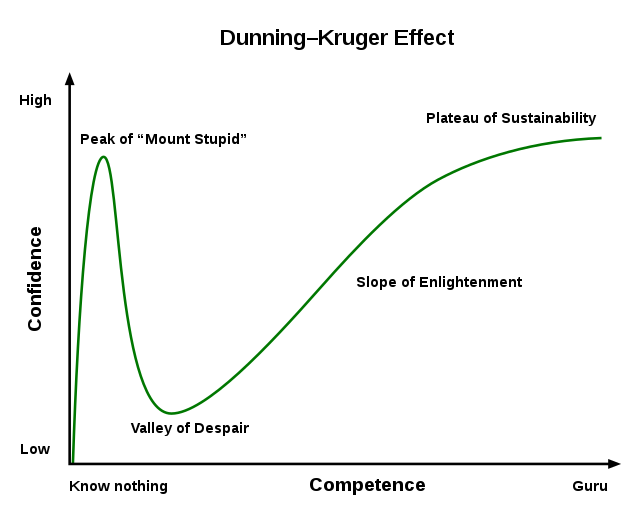
- People with a high level of incompetence regularly overestimate their own abilities.
- They are unable to recognize their own incompetence, which makes it very difficult or impossible for them to break out of this vicious circle.
- People who suffer from the Dunning-Kruger effect show a certain ignorance and resistance to advice, they don’t let anyone correct or improve them.
- The result of this is that they in turn clearly underestimate the clearly superior abilities of other people.
— Examples of the Dunning-Kruger effect
As this psychological observation is more of a popular scientific phenomenon, the effect can, unfortunately, be observed very often in everyday life. Therefore, here are some everyday examples of people who suffer from chronic overconfidence:
- When driving: A classic example of the Dunning-Kruger effect is above all drivers. You’ve probably already noticed that it’s the drivers who drive the worst who think they are the best drivers.
- Donald Trump: One of the best-known people who obviously suffers from the Dunning-Kruger effect is probably former US President Donald Trump. The reasons should be obvious.
- Conspiracy theories: Especially in the corner of conspiracy theorists, you see many people who represent this phenomenon in the current pandemic situation. The classic refusal of scientifically verifiable facts is a clear indication of this.
- Football fans: An equally well-known prime example of the Dunning-Kruger effect are many football fans. They are often of the opinion that they have more tactical understanding and a clue about the game than professional trainers.
- Arthur McWheeler: One of the best-known examples of the Dunning-Kruger effect is the bank robber Arthur McWheeler. He was caught at the time because he was firmly convinced that lemon juice would make him invisible. Since he was fully convinced and walked past the surveillance cameras completely unmasked with a few packets of lemon juice, his arrest was not long in coming.
— The Opposite of the Dunning-Kruger Effect — The Impostor Syndrome
There is actually another psychological phenomenon that is understood as the opposite effect of the Dunning-Kruger effect, the so-called impostor syndrome. The impostor syndrome, also known as the imposter syndrome, is about the people concerned doubting their personal skills far too much. They think of themselves as impostors and live in constant fear that other people will notice that they don’t really have any skills.
Classic thoughts that affected people have are the following:
- “What exactly am I doing here?”
- “People will soon realize that I can’t do anything.”
- “I won’t make it.”
However, these thoughts by themselves are nothing special. Each of us will have had such thoughts at least once in our lives. However, if this feeling that you are an impostor and that you are pretending to those around you keeps manifesting, then these are clear signs of impostor syndrome.
The truth is that people who suffer from this syndrome are usually not as incompetent as they personally believe. As with the Dunning-Kruger effect, the problem lies in an incorrect self-assessment. However, in the case of the impostor syndrome, the skills that are actually good are doubted, whereas, in the case of the Dunning-Kruger effect, the skills that do not exist are encouraged. Both phenomena are therefore major obstacles to everyday life and, above all, to everyday work.
— What can be done about the Dunning-Kruger effect?
As already mentioned, affected people are very difficult to get convinced of their half-knowledge. Breaking out of this vicious circle is anything but easy. However, there are some things you can do to avoid the Dunning-Kruger effect:
- Be humble: You can take a well-known quote from Socrates as a leitmotif: “I know that I know nothing”. This should make you aware of your own limits.
- Self-reflection: One of the most important skills that sufferers of the Dunning-Kruger effect lack. You should always question your personal achievements and skills and always have a certain self-criticism. However, this should be done at a healthy rate because consider impostor syndrome.
- Discipline: We never stop learning. This is not an empty phrase, but a fact. So always stay inquisitive and disciplined and keep expanding your personal skills.
- The Opinion of Others: A distorted self-perception is more common than you think. Therefore, often get feedback from people in your immediate environment who really know you. This can sometimes be extremely helpful and help you avoid certain mistakes.
— Are you susceptible to the Dunning-Kruger Effect? — Do the self-test
Finally, you can carry out a small self-test. If you suspect you’re suffering from the Dunning-Kruger effect, this test can give you a little more certainty. Note, however, that this is not an official psychological test that provides a definitive diagnosis. The test is only intended to help you as a kind of guideline.
Just answer the following five questions with yes or no:
- People often ask you for advice when they get stuck.
- If you ask people in your immediate environment about your best skills, then the answers will match your personal assessment.
- When you’re performing a task and something goes wrong, you first blame yourself and don’t blame the instructions, the product, or anything else.
- If you are interested in a topic, then you inform yourself about it regularly and educate yourself further in this area.
- You have already been able to help many people in your environment with smaller tasks and they have come back to you with further problems.
Did you answer all questions with yes? Then we can congratulate you that you suffer from the Dunning-Kruger effect is extremely unlikely.
If you answered yes to at least three questions, then it is also unlikely that you suffer from this phenomenon.
On the other hand, if you say yes twice or less, you should consider whether your personal self-assessment is correct. If so, check out the above tips on avoiding the Dunning-Kruger effect again. Ask your close friends or family and get feedback. Be open to criticism and try to work on yourself.
Thank you for reading!
If you found this article helpful, consider subscribing to my email list to get my stories delivered straight to your inbox whenever I publish on Medium!
If you’re new to Medium and wish to support my work, consider being a Medium member through my page and get unlimited access to all current posts from me and hundreds of other writers! Your membership fee directly supports me as I get a portion of your monthly fee at no extra cost to you and it will go a long way in helping me keep on delivering valuable content to you.
If you enjoyed reading this, you might also like: