
How to Improve Your Emotional Intelligence in 4 Questions
Master your emotions, master your life.
“Realize that now, in this moment of time, you are creating. You are creating your next moment based on what you are feeling and thinking. That is what’s real.”
— Doc Childre
You will always experience emotions. No matter how much of a rational thinker you are, you’ll always have them.
Unless you are a sociopath, suffer from Alexithymia, or went through something traumatic that made your subconscious shut off your feelings, they’ll always be there.
When you land a killer new job, you feel accomplishment, confidence, and happiness.
When you hit your toe on a table, you feel pain and anger.
They are your brain’s feedback mechanism. Whenever you interact with the world, they tell you how you feel about the interaction.
Dealing with this feedback can be complicated at times. Emotions can be overwhelming, short-lived, and sometimes very far from the real world. They’re a great feedback mechanism but terrible decision-makers.
Have you ever been angry, jealous, or sad for seemingly no reason? Have these emotions led to bad reactions and destructive behaviors? Did you wish you could make sense of these feelings instead of being ruled, overwhelmed, or confused by them?
To become the best version of your true self, you need to understand your emotions and deal with them in a healthy way. This ability is otherwise known as emotional intelligence, and the more of it you have, the better and easier your life will be.
Emotional intelligence is the ability to be aware of, understand, express, and reflect on your emotions. It helps you to manage your emotions and make better decisions.
Here are four simple questions that will help you improve your emotional intelligence.
#1 What Are the Facts?
Imagine for a second you’re a pilot flying an A320 from New York airport on your way to Charlotte, flight US 1549. A few minutes after takeoff, you hit a flock of geese, and after a few loud bangs, both engines shut down and fail to restart. All the lights start to blink and beep, and the cockpit looks more like a 90s rave party than anything else.
That’s your brain when you experience a strong emotion — anger, love, or hurt. Emotions call for immediate attention with loud and blinking lights, screaming “Hey, look at me! I’m important right now!”
To improve your emotional intelligence, you first have to be able to distinguish the situation from the emotion. If you don’t, you’ll miss tiny but important details because your mind is screaming at you.
Two weeks ago, I got upset with my roommate because of what I thought was an extremely dirty kitchen. In the end, we got into a fight over a few breadcrumbs and two spots on the countertop.
Why? Because I was hungry, and I don’t deal with hunger well. Once I had eaten, I realized how inappropriate my behavior was and apologized.
Hunger isn’t the only catalyst for emotions. You fight with your spouse when you’re both exhausted after a long workday. You spontaneously fall in love when you’re on a carefree vacation. You take an innocent comment the wrong way after a big presentation at work tanked.
It happens to all of us — we focus on feelings and overlook small but important factual details. Here are four short questions that can help you take a clear look.
- When did I first feel the emotion?
- Where was I when it happened?
- Who did I interact with before and during?
- What led to the situation and what happened when I felt the emotion?
Flight US 1549 became later known as the “Miracle on the Hudson.” The two pilots made “the most successful ditching [water landing] in aviation history.” Despite being lucky, their achievement mainly came from their ability to stay cool and look at the facts. They didn’t give in to their emotions and didn’t panic at the sight of the hundreds of blinking lights — and in turn, they saved all of the 155 lives at stake.
#2 What Do I Feel Underneath?
Not all emotions are created equal — there are primary and secondary ones.
Primary emotions are your reactions to a situation.
You’re angry because someone hurt you, you’re anxious about an upcoming meeting, or happy because the sun shines.
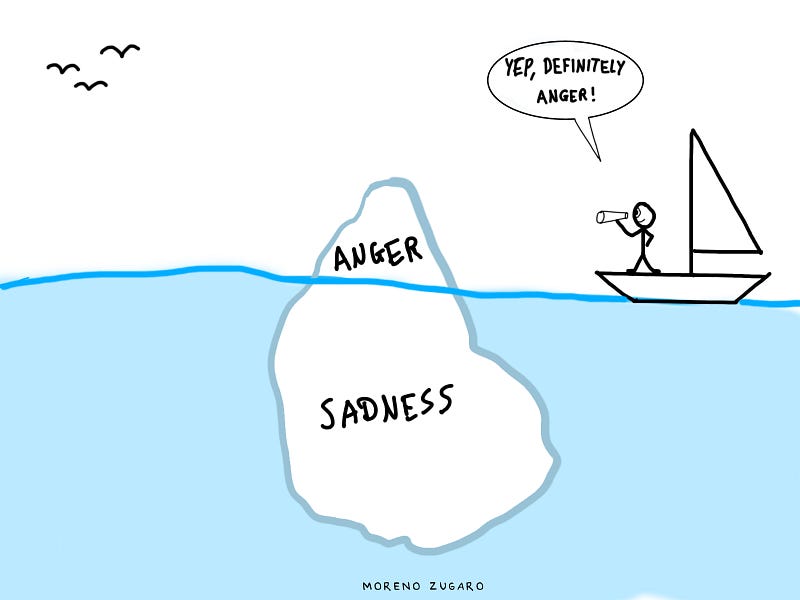
Secondary emotions arise as reactions to your primary emotional reaction.
You initially feel sad about the fact your girlfriend broke up with you, which is a primary emotion. But this sadness might be hard for you to experience. You’ve been told “men don’t cry” or you don’t want to admit the other person holds that kind of power over you. You react to your sadness with anger or frustration.
In our society, men tilt towards anger to mask more vulnerable feelings like sadness, weakness, or shame. Women tend to go the other way around and mask anger with sadness or guilt.
Typical primary emotions are usually basic, like fear, anger, joy, shame, and sadness — although all of these can also be secondary.
Secondary emotions are more focused on the manifestation of primary ones. Examples are irritation, agitation, depressed mood, aggression, hopelessness, anxiety, or emptiness.
I guess you can already see the problem here. Secondary emotions are like a paint job for your primary ones. They cover-up what’s underneath and make working on yourself tilting at windmills because you focus on symptoms instead of causes. This is not to say that there will always be another underlying emotion, but it’s always worth investigating.
To improve your emotional intelligence, you need to look beyond the layer on top and explore what’s beneath.
There’s a quick focusing exercise that can help you distinguish between your primary and secondary emotions. I’ve used it many times to overcome negative feelings.
Sit down in a comfortable position. Close your eyes. Take a few deep breaths. Get a feeling for your body. Then, ask yourself “How do I feel right now?”
The crucial part is to not answer this question with your mind but with your body. As soon as your rational thoughts kick in, your ego will come up with all sorts of explanations, cover-ups, and excuses. Instead, give it some time and focus on how your body feels.
Don’t look for an answer but let your body present it to you. Suppressed emotions are like shy, anxious animals in a corner. They need time to come out and let you look at them.
Don’t judge, just observe. Feel with your body, not your mind.
#3 Why Do I Feel This Way?
Now that you are aware of the facts and the primary emotions you experience, you can take the final step to understand them better.
To learn why you feel a certain way, you first have to understand how emotions come to be.
Your emotions are always the result of an external event and your internal story.
This explains why the same event can lead to different emotions depending on your story.
When I’m pushed into a pool or tugged underwater by a friend for fun, I laugh and play along because I’m an adept swimmer and associate it with hot summers and endless fun.
If you’ve had an experience during which you nearly drowned, being pushed into a pool can be enough to trigger a panic attack.
Same event, different story.
To answer why you feel a certain way, you have to take apart your emotion equation.
Event + Story = Emotion
Your brain creates emotions by taking sensory information about an event, like what you see and hear. Then it interprets these facts and creates emotions based on your story — what you have experienced so far.
Funny enough, the average emotion lasts only 90 seconds — everything beyond that is a revival based on the story you tell yourself.
See, your story is a bit of a self-fulfilling prophecy keeping itself alive. If you view yourself as a screw-up with a messed-up life, your brain will create emotions based on that. A joke designed to make you laugh can quickly rub you the wrong way. Forgetting to buy something at the store can make you feel like a good-for-nothing. Whenever an event comes up in your memory, it recreates an emotion based on your story. It’s a vicious cycle made of 90-second blocks, and it’s hard to break out of.
If you know the facts and the emotion, you can find out about your story. Then, you can ask yourself if this story makes sense or if you need to adopt a new way of thinking.
- How do I feel and think about myself?
- Does my story fit the facts, or does my brain make up something irrational based on my past experiences?
- Is there another story that fits the facts better?
You might tell yourself the story you’re lazy, and every time you mess up, you attribute it to your laziness and feel worthless because of it. Well, what if things didn’t go south because of you not doing enough but because of external circumstances out of your control? If you don’t review the story you tell yourself, you’ll always be stuck in it, true or not.
To improve your emotional intelligence and how you deal with emotions, you have to understand why you feel them in the first place. You have to find out about your story.
#4 How Can I React Better?
Because your emotions are ubiquitous, learning to react better to them is the keystone to creating the life you want.
Understanding and reacting to your emotions are both sides of the same emotional intelligence coin. Unfortunately, most people only ever look at one.
Your typical reaction to an emotion happens without much rational thought.
You hit your toe, you feel pain, you get angry, you curse.
Emotions are great feedback mechanisms but terrible decision-makers.
They are like lights on your car’s dashboard. They tell you if something’s wrong but ultimately, your reaction is up to you.
When the check engine lights up on your dashboard, you have three options. You can decide not to care, to not use your car anymore, or to have it looked at.
If you don’t care or put some tape over the light to cover it, you’ll be able to drive your car for a while, but it will eventually break down. This is akin to suppressing or ignoring your emotions. Sure, you can pretend everything is fine and ignore the painful feeling of hurt, but you’ll either break down at one point or carry the issue forever.
If you stop using your car altogether because you’re afraid of what might happen, you cripple and restrict yourself. You overreact, panic, and have to walk instead of drive. That’s what happens when you give in to your emotions without any rational thought — you become enslaved by them. Worry turns into paralyzing fear or crippling anxiety, being upset becomes thoughtless anger or rage, and sadness becomes a deep, dark hole of grief.
The last option is to check your oil, so to speak. Instead of ignoring it or reacting without thought, you investigate and decide rationally what the best response is. That’s exactly how a person with high emotional intelligence reacts to a feeling. They acknowledge it’s there, feel it, explore it, and try to understand how this feeling came to be. But their reaction is based on their insights and rational thought.
Don’t suppress or ignore your emotions. Don’t let them master you either. Instead, acknowledge and explore them, but make decisions and act based on rational thought.
This idea isn’t entirely new. In fact, almost 2000 years ago, the Stoic philosopher Epictetus said the following:
“It’s not what happens to you, but how you react to it that matters.”
This is especially impressive if you consider the fact Epictetus was a slave from birth. His real name is unknown, the word epíktētos simply means “acquired” in Greek.
Had Epictetus given in to his emotions, he would’ve been miserable his whole life. He would’ve complained and become grief-stricken about his enslavement, without any perspective for improvement. Instead, he practiced distinguishing his emotions from his thoughts and actions — a feat on which he later advised powerful emperors such as Hadrian.
Neither giving in to your emotions nor ignoring or suppressing them is sustainable. Instead, practice distinguishing between emotion and reaction.
When your boss treats you like a slave and forces you to stay longer, you feel sadness, frustration, or anger. But you can decide if you give in to the emotion and snap at him, or if you stay calm and think about a plan to free yourself from his grip.
That’s the real power of emotional intelligence. You not only understand your emotions but also react better to them — and in turn, you create a better life for yourself.
The Takeaway
Building emotional intelligence helps you to become aware of and understand your emotions better. You will understand what you feel and why — and in turn, you’ll be able to make better decisions and react with better actions.
The next time you feel a strong emotion, hit pause, take a deep breath and a step back, and ask yourself the four questions:
- What are the facts?
- What do I feel underneath?
- Why do I feel this way?
- How can I react better?
“Your emotions make you human. Even the unpleasant ones have a purpose. Don’t lock them away. If you ignore them, they just get louder and angrier.” ― Sabaa Tahir
Improving your emotional intelligence requires a lot of reflection, which is best done via journaling. Don’t know how to start? Have a look here:
Get The Authentic Man 5–3–1 Newsletter
5 minutes to read. 3 ideas, quotes, and questions to help you become a more Authentic Man. 1 biweekly challenge to get you closer to your dream life. Become the best version of your true self in under 5 minutes!


