
How to Appreciate Yourself Gamefully and Kindly
By developing your very own appreciative game feedback systems and playing the “Appreciation Game.”

I like saying that when I turn a challenge, project, or activity into a fun game, then it becomes a self-motivational game because, as a result, I experience motivation and creative drive as freely available resources on tap.
Each main component is important to keep in mind when designing your self-motivational games, in other words, when you turn your life into fun games.
A quick reminder of the main game components:
“When you strip away the genre differences and the technological complexities, all games share four defining traits: a goal, rules, a feedback system, and voluntary participation.” — Jane McGonigal, Reality is Broken
In this article, I want to draw your attention to feedback systems in your self-motivational games because they will help you learn and develop a habit of appreciating what you do and who you are gamefully and kindly.
My gamebooks
I call all of my feedback systems and recordings, be it a calendar or to-do list or the various places I record my gameful awards, “gamebooks.” Referring to my to-do lists and calendars that way changes my attitude towards the tasks and appointments I have recorded there. I addressed this topic in detail in my books Self-Gamification Happiness Formula and Gameful Project Management. I won’t repeat all that here.
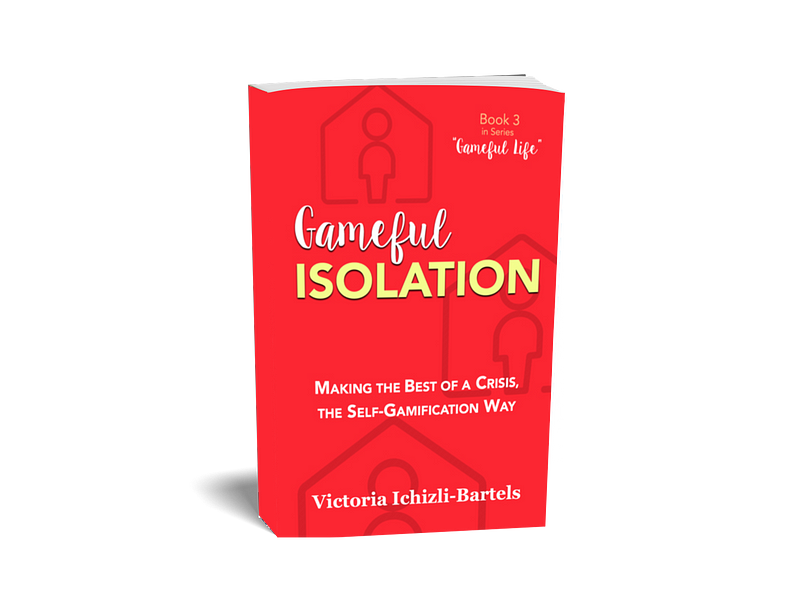
Instead, I will share the epiphanies I had when I worked on a little book, the excerpt of which you are reading now, Gameful Isolation.
Serious games and gamification
I re-discovered and experienced how feedback systems in Self-Gamification differ from those of games (either traditional games or serious games) or gamified solutions created for others.
Serious games are “full games that have been created for reasons other than pure entertainment.” — Andrzej Marczewski, Even Ninja Monkeys Like to Play: Unicorn Edition
In gamified solutions, leaderboards and other score systems are often used to increase motivation and productivity and keep people accountable and assess performance.
Serious games are often created to teach about a specific topic, and the score systems in them show, among other things, how far you’ve come in learning the skill you acquire while playing. In other types of serious games (such as solving real-life puzzles in medicine with the help of gamers, such as Foldit, see below), and in traditional games, feedback systems show you how far you are from solving the puzzle or from the win-state in a game.
Good to know
“Foldit is a revolutionary crowdsourcing computer game enabling you to contribute to important scientific research. Foldit attempts to predict the structure of a protein by taking advantage of humans’ puzzle-solving intuitions and having people play competitively to fold the best proteins. Since proteins are part of so many diseases, they can also be part of the cure. Players can design brand new proteins that could help prevent or treat important diseases. Foldit is encouraging people to start playing the game as they believe that this will speed up the process of finding a cure for the novel coronavirus. After downloading and running Foldit for Windows, Mac or Linux at https://fold.it/portal/,players may select Science Puzzles, and subsequently the Coronavirus active puzzles.” — Eliane Alhadeff, April 16, 2020, Serious Game Market
“The feedback system tells players how close they are to achieving the goal. It can take the form of points, levels, a score, or a progress bar. Or, in its most basic form, the feedback system can be as simple as the players’ knowledge of an objective outcome: ‘The game is over when . . .’ Real-time feedback serves as a promise to the players that the goal is definitely achievable, and it provides motivation to keep playing.” — Jane McGonigal, Reality Is Broken
Win-state: “A condition or state within a game or level which designates successful completion of a predetermined task or goal.” — IGI Global
Self-appreciation
In Self-Gamification, in other words, when you turn your life into games, there is all that there is in games, too, of course. Still, there is also something else, which is much more important than accountability, assessment of your progress, or rewards.
And that is the appreciation of every step you take in your life. Yes, it is about self-appreciation, which
“is about turning the kindness you give to others inwards. Instead of blaming yourself for making mistakes or forget to do things, self-appreciation is about saying ‘thank you’ to yourself for all the things you have done but taken for granted.” — Nerdy Creator
By recording points for each completed task, especially the small ones, or ticking off each day you exercise or maintain another healthy habit, you take a little moment to appreciate your effort. We often rely on the appreciation of others, but we won’t be genuinely able to accept such praise if we can’t appreciate what we do ourselves.
Recording your rewards in self-motivational games is not about keeping a strict account. It is about appreciation, awareness, and having fun.
A seeming paradox about your game score
An observation I made: If I notice myself discussing in my mind whether I deserve a point for something or not, then I am procrastinating about the next step, taking the whole thing too seriously, or both. Meaning I have stopped having fun, and the whole “thing” ceases to be a game.
Thus, don’t worry too much about recording your points precisely. Remember that although points, badges, and leaderboards provide a fun and effective reporting system, their primary role is to increase the fun you experience (such as, for example, the warm fuzziness you feel), not to keep an exact account. Keeping a precise account and fretting about the score will tear you out of the game and the fun experience.
Playing with rewards
I like sharing that I give myself donuts for my “Well-Being Games.” These include enough sleep, exercising (both for the whole body and my eyes, due to my eye condition), not eating what I can’t tolerate, and enough movement to keep my joints pain free, or at least to reduce the pain.
At some point, I updated my gameful feedback system and added another reward to my “Well-Being Games” — cupcakes. I got a cupcake if I accomplished a once-a-day activity or a check-mark type achievement, such as not consuming any meals or drinks that I don’t tolerate well. I then collected donuts for activities I wanted to attend to several times a day, such as doing brief exercises related to my eye condition or osteoarthritis.
I love the fact that I have complete freedom to switch the places of these “Well-Being Games” and make a once-a-day activity into a “donut-earning” one if I wish. I can also replace the current ones and create new “Well-Being Games” for myself. Here is the most brilliant feature of being both the designer and the player of my self-motivational games. It is the ability to adjust my game design as I make progress in playing my challenges, projects, and activity games, and as my interests shift with every new thing I learn.
Trying to identify the highlights
A few days before writing the text you are reading now, I learned something that gave me the idea to modify the feedback system of my “Creativity and Gratitude Game.” This game is about anything I need to do for work, family, or home.
Until that enlightening moment during the Gameful Isolation project, I chose five projects and activities I attended to during the day to get a star for having worked on them. I even described it in Book 2 of the “Gameful Life” series, Gameful Healing.
I called this area of my life, which was connected to what I wanted and needed to do (excepting those that contribute directly to my well-being), “Creativity” because I realized I could be creative in whatever I was up to. It was also its name before I added “Gratitude” to the title. I added “Gratitude” because at the end of the day, or during the day, I chose five areas I’ve been active in, of which I was particularly proud and which I thought deserved a star.
Finding the “bug” in the game design
But there was a small “bug” with this approach. By choosing only five projects to get a star on any given day, I regarded them as worthy, and those that didn’t get any, as unworthy, of a star. So, several days before writing these words, I sat late at night and worried that not much of what I did that day was worthy of a star.
Was I proud of what I had done? Did I have the right to be proud? Would someone judge me if I was? Unable to answer any of these questions, I sat late into the night in front of my computer and watched videos on YouTube.
I slept little that night, but during the evening routine before going to bed, I had an idea of adjusting the scoring system on my “Creativity and Gratitude Game” so that I could appreciate everything I did during the day.
The “Appreciation Game”
I decided to enhance my “Creativity and Gratitude Game” with another game I sometimes play, the “Appreciation Game,” which is just a regular notebook where I record each little step I accomplish during the day. That way, I make sure that I move in small steps and not in big jumps. After writing down what I just did, I immediately cross it out. For me, it closes the move, and I can then go on to the next one.
You might wonder what this detailed recording can achieve, besides slowing down and interfering with progress on what I want or need to do. In fact, it has the opposite effect. By taking several seconds to record each little self-contained step, I slow down enough to appreciate what I have just done. I also interrupt possible dwelling thoughts such as “That is not what I wanted to do” or “That is not good enough.” I simply record what I have done, appreciate that I am progressing with my day, and then by crossing out the record, I free myself up for anything else I want to do that day.
This striking through each record stops me from mentally going back to what I just did and trying to reiterate it in my thoughts. In games, too, you can’t go back (as in a browser) either if you made the “wrong” move. In many games, you have to start anew. So basically, you play a new game round or a new game altogether. Looking at my to-do list for the day, or anyone or anything that comes my way or requires my attention, helps me to identify that next challenge, project, or activity “game.”
Everything deserves appreciation
So on that day, when I found myself frustrated about not being able to decide which of the things I’d done deserved a star and which didn’t, I realized that everything I do deserves my appreciation.
Many of the tasks I accomplished were ultimately different. You couldn’t compare putting moisturizing cream on my daughter’s dry hands with making a video for the Gameful Isolation project and judge one better or worse than the other. Putting the anthropologist’s hat on made that obvious. So, I decided to call on the help of the “Appreciation Game” and link it to my “Creativity and Gratitude Game,” where I recorded my stars.
Thus, instead of choosing five things from this “Appreciation” list that were worthy of a star for the given day, I now logged a star for every five occurrences of those little steps, appreciated and closed. At the end of each of these recent days, I counted how many stars I had gathered.
What are the points really about?
At first, I thought that these points and stars showed me how much I achieved during the day or how many different things I attended to. I even recorded each YouTube video I watched and noticed that I chose another project to do, like writing the book, the excerpt of which you are reading, before watching another video. But this positive by-product was not the biggest epiphany.
The number of entries in the “Appreciation Game” and the stars recorded in the “Creativity and Gratitude Game” didn’t only show me what I had achieved that day, but they also taught me something more important. They revealed how many times I stopped on that day to appreciate what I did, whatever that was.
Suddenly, I understood why I felt so much more calm and relaxed and not thinking of my day as wasted even if I didn’t manage everything I planned in the morning or the previous day. In the past days, when I used this approach, I stopped what I was doing more than one hundred times on each of these days.
This awareness was a blessing. And interestingly enough, I expected others to praise me less and less for what I did. I simply had a great feeling that I could do it myself. And every time I felt insecure or stressed, I stopped and appreciated what I had done by writing down even the smallest thing.
Appreciate, don’t manipulate
Appreciation is critical in Self-Gamification because the latter is not about accountability, increasing your productivity, or manipulating you in any way. You are already perfect and brilliant as you are, and you’ve achieved amazing things in your life, which others could only wish for. It is about helping you get back into the state of flow.
“There is virtually nothing as engaging as this state of working at the very limits of your ability — or what both game designers and psychologists call ‘flow.’ When you are in a state of flow, you want to stay there: both quitting and winning are equally unsatisfying outcomes.” — Jane McGonigal, Reality is Broken
When to play the “Appreciation Game.”
Sometimes I don’t manage to record every little task or step right after I’ve done them. Instead, I do several tasks in a row without registering their completion. You could say I am simply in the flow of my day.
But as soon as my upset indicator (like a little red light-emitting diode, or blue light and a loud siren) goes off, and I observe myself feeling stressed and entering the idling and worrying state, I stop, take my “Appreciation Gamebook,” and record from memory everything I did since the last recording. Playing the “Appreciation Game” helps me to interrupt my upset and get back into the flow.
Final words: How to play the “Appreciation Game.”
You don’t have to play the “Appreciation Game,” the way I do it. You don’t have to record everything. For example, I sometimes use a simple feedback system (usually a tally on a scrap of paper) to get my work flowing, and as soon as it does, I stop recording the points and just enjoy doing the work. I call this quick and fun self-motivational game design the “Project Booster.” Find your own way to give yourself small rewards recognizing each of your small steps, especially when you feel stuck.
But I strongly recommend that you find and continuously adjust your self-motivational and appreciative game feedback systems. They will add to your confidence, empower you, and simply brighten your day one moment at a time.
A note on this story
This is a modified excerpt from Gameful Isolation: Making the Best of a Crisis, the Self-Gamification Way (Gameful Life Book 3).
Thank you for reading!
If you liked this article and the ones I referred to above, then you might also enjoy these:
P.S.
To stay in touch and keep updated on the possibilities of turning life into fun games offers, join my e-mail list, Optimist Writer.