
How to Turn Something or Anything into Games

Self-Gamification is a lifestyle
The question is how to turn something or anything into games.
The answer is multi-faceted, and in a way, the “how?” embraces the answers to all the “W” questions: “who?”, “what?”, “when?”, “where?” and “why?”.
But the most important facet of how to turn our lives into games is that the gameful approach to life, Self-Gamification, just like those for our health, well-being, and happiness, is not a one-time pill to fix a problem once and for all, but a lifestyle. Because:
“Happiness is not a destination. It is a way of life.” — Anonymous
What is Self-Gamification?
So, what is this new approach to increasing self-motivation and bringing ourselves back on our happy path? And why the need for a new term?
First of all,
Self-Gamification is the art of turning our own lives into games.
Self-Gamification is not the same as gamification, although, as the name suggests, the former is based on the latter.
Gamification has become a buzzword, but many people, especially non-gamers but sometimes gamers as well, are still confused when they hear it. They recognize the “game” part, but not the word in its entirety.
One of the most common gamification definitions is
“the use of game design elements in non-game contexts.” — Deterding, S., Dixon, D., Khaled, R., & Nacke, L. (2011). From game design elements to gamefulness: defining gamification. In Proceedings of the 15th international academic MindTrek conference: Envisioning future media environments (pp. 9–15). ACM
Following on from this, therefore,
Self-Gamification is the application of game design elements to one’s own life.
You could also say that,
Self-Gamification is a self-help approach showing you how to be playful and gameful.
I felt the need to coin this new term for gamifying one’s life when I realized through self-observation that there is more at stake here than just learning from games and game design.
One of the gamification pioneers, Yu-kai Chou, pointed this out when he said that gamification is
“more than points, badges, and leaderboards.” — Yu-kai Chou, Actionable Gamification
The same applies to Self-Gamification.
Beyond this, there is an essential feature that distinguishes Self-Gamification from gamification as it is currently known. Here it is:
In Self-Gamification, you are both the designer AND the player of your self-motivational games.
So as a designer you take responsibility for how the game is developed. On the other hand, as a dedicated and highly interested player, you are responsible for playing the game, as well as giving the designer feedback on how it could be improved.
The design part is critical — which is taking responsibility for how fun and engaging your games are for yourself as a player. Without judging the player, you must create the best games for them, i.e. for yourself.
This is the primary difference between the Self-Gamification approach and the games and gamification frameworks designed by others. In Self-Gamification YOU, and no one else, have to develop your short (minutes or hours long), also daily, weekly, monthly, yearly, etc. games. You’ll do well playing other people’s games, but you will inevitably give your personal touch to each of the games when you play them, and it is your choice and responsibility for how you mix these games with those of your own design. Nobody else could do it for you even if you or they wanted to.
Now, let’s consider the three approaches Self-Gamification brings together to help you turn your life into fun games and have fun with everything or anything you are up to.
Three components of Self-Gamification
Self-Gamification brings three well-known and popular techniques together.
The first is being here and living in the moment. There are various approaches to being present and living in the present moment. But for me, the most straightforward and most fun approach is to study myself anthropologically and then learn from it. I discovered this possibility through the work of award-winning authors Ariel and Shya Kane, who have dedicated many books to the various aspects of living in the moment.
For over ten years they have hosted the radio show Being Here (the popularity of which grows steadily all over the world), as well as offering many free and paid resources on how to enjoy our lives moment by moment. They suggest that we study ourselves, those around us, and the circumstances we are in, the same way that anthropologists would do while exploring a foreign culture — without judgment.
Here is what they say in their award-winning book How to Have A Match Made in Heaven,
“Practice your anthropological approach. Pretend you’re a scientist observing a culture of one — yourself. The trick is not to judge what you see, but to neutrally observe how you function, including your thought processes. Awareness and kindness are key.” — Ariel and Shya Kane, How to Have A Match Made in Heaven
The second approach is kaizen. One of the most popular interpretations of kaizen is continuous improvement, and it is a philosophy and method by which set goals can be achieved by making very small, effortless steps.
In the spirit of kaizen, you break anything, either a challenge or a task or whatever you are paying attention to, down into small and effortless steps. And you give each of these small bits your full attention, which is easy if the task is small enough to solve with little effort.
If that small bit is still too hard to master, then here is the reason for it:
“Even the small signs that you are resisting the small step are an indication that the step is too big.” — Robert Maurer, One Small Step Can Change Your Life
Isn’t that amazing? Do you see how awareness and kaizen sit brilliantly together?
Together they show that feeling off-balance, overwhelmed, or in resistance to something is not bad. In fact, it is a helpful indicator. It is an indicator that you are trying to jump too far (or too high) to reach what is out of “the limits of [your] own endurance.”
“The research proves what gamers already know: within the limits of our own endurance, we would rather work hard than be entertained. Perhaps that’s why gamers spend less time watching television than anyone else on the planet.” — Jane McGonigal, Reality Is Broken
And finally, gamification itself: that is the application of game design principles to everyday life. And especially one of the four main elements of games, voluntary participation.
“Voluntary participation requires that everyone who is playing the game knowingly and willingly accepts the goal, the rules, and the feedback. Knowingness establishes common ground for multiple people to play together. And the freedom to enter or leave a game at will ensures that intentionally stressful and challenging work is experienced as safe and pleasurable activity.” — Jane McGonigal, Reality is Broken
For Self-Gamification, that means a will to see various real-life activities as games, to make games out of them, to play them, be curious about and inspired by existing games, to improve your own self-motivational games, and to eventually embark on the continuous development of these from one round to another. This development means defining the feedback systems for your games, which will help you to establish the habit of appreciating and enjoying every step you take toward your goals, however small (such as an entry on the to-do list) or big (such as your dreams) they might be.
Why these three approaches together and not just one of them?
You might ask, why the need to apply these three approaches together? People have been developing and using them for decades in some cases. Isn’t each one enough on its own?
Absolutely. But together these techniques allow amazing synergy to take place. This synergy and the potential resulting from it can help you to emerge from any upset or challenge not only as a winner, but as a winner enjoying your life, and each step in the process.
There are several articles addressing gamification and kaizen together. Many scholarly and business articles discuss how gamification can facilitate the application of kaizen in the corporate world. An example of such an article is “GamifiKAIZEN — Gamification and Kaizen — using gamification for continuous process improvement,” Gal Rimon, Game Effective, April 23, 2013.
But I haven’t seen any article or book addressing all of the three approaches together. I have found mentions of being present in separate books on kaizen and gamification, but it was described more as a byproduct of the two approaches.
On the other hand, I think it is crucial to emphasize living in the moment. In fact, I am convinced that being here, living in the now and observing ourselves and the world around us non-judgmentally is not part of the outcome or a byproduct of kaizen or gamification, but rather the starting point, without which neither kaizen nor gamification is possible in the long run.
I might be the first to write about bringing these three well-known techniques together, but I doubt I am the first to apply them all. Applying the anthropological approach to living in the moment, making tiny, effortless steps, and appreciating each of them in a humorous and gameful way, is fundamental wisdom held by happy and successful people. They probably just never thought to define what they do in this way.
Self-Gamification is like building a house
When you apply the three approaches together, they become mutually supportive. When you look non-judgmentally you might find your thought processes amusing, since they often go in very unexpected ways when we feel unsettled. Humor lets you be more playful and bring at least some lightness to difficult situations.
In addition, when you strive to see a task as a game, you are reminded to look non-judgmentally at what is happening. This can help you to become aware of whether the next step toward your goal is too big, in which case you might break it down further so that it becomes effortless. This will boost your motivation and
“shift your thinking into this frame — I’ve started being productive, so I’m going to keep being productive.” — Tim Herrera in “Micro-Progress and the Magic of Just Getting Started,” Smarter Living at The New York Times, Jan. 22, 2018
The small steps can help you to find your way back into the flow and the current moment and make whatever you are doing feel like a fun game.
Each of the three approaches could remind you or help you to practice the other two, but in my experience, Self-Gamification always starts with awareness. It continues with the ability to concentrate on what you can do effortlessly, right now, and with what you have at hand. And it ends with making and appreciating that step in a fun way, and celebrating the achievement as you would in a game (by gaining points and a fist pump with a cheerful “Yes!”, or similar).
When I was preparing the online course Motivate Yourself by Turning Your Life Into Fun Games, I contemplated how I could visualize this relationship, and a picture of a beautiful house with turrets and intricate roof-line appeared in my mind.
I realized that Self-Gamification is like building a beautiful house.
It starts with awareness, which is the foundation of it all. Without seeing yourself non-judgmentally, you won’t be able to identify how many bricks (i.e., small steps), of what size and shape, you need to build your house.
Then the building of the walls follows, while you continually remain aware, so that you don’t build your walls in the wrong place (such as, for example, beyond the foundations), or as crooked as the Leaning Tower of Pisa. So you build your house brick-by-brick, step-by-step while being aware of every step along the way.
And then finally, you add the fun bits to your house, which make it appealing, cozy, and just perfect to enjoy. This is where you design your projects and how to manage them as games. Don’t dismiss this as unnecessary. You wouldn’t want to live in an ugly house. So why omit these final touches to the way you do what you need or want to do? This last part is significant to your well-being.
But neither building the walls nor adding the fun elements would work without the foundation being in place. Learning and practicing Self-Gamification start with awareness; that is observing yourself, your thought processes, the world around you and how you react to it, non-judgmentally.
Fun is the compass and the measurement for Self-Gamification
Ariel and Shya Kane, and many who have been inspired by their work and discovered the magic of living in the moment, claim that:
“Fun really is the way to access enlightenment.” — from a short story “Fear Not, Just Dance” by Simon in Being Here…Too by Ariel and Shya Kane
Emulating this statement, I would dare to say:
Fun is an access point to Self-Gamification, that is to truly and repeatedly turning our lives into exciting and engaging games.
To take this even further, I am convinced that fun is the only compass you can use to turn your life or parts of it into exciting games.
But it is also the ultimate measuring tool for success in your self-motivational game design. The amount of fun you feel can be a valuable tool when designing and prototyping your games. And your life in general.
I still wonder why fun is often forgotten and underestimated, although it is truly one of the prerequisites and indicators for success. Both having and not having fun, show.
Is it because we are in too much of a hurry to have fun, and don’t notice when we experience it?
Here awareness and kaizen can help us again. Let’s pause, see where and how we are, identify the next little step that we recognize as fun, and take that step.
But what if you can’t identify that fun step? As we’ve seen above, it might be an indicator of your resistance and fear of the task at hand. Instead of being curious, you are having a discussion in your head about why this task and the whole project don’t make sense. So, if you can’t come up with an idea to bring the fun factor into a task, then you’re merely saying “No” to that task, which is neither good nor bad. It simply is.
Here is one of my favorite quotes about observing ourselves:
“Self-discovery isn’t meant to be painful. If it is, then you’re working on yourself, lost in the story of your life, or simply resisting what is.” — Ariel and Shya Kane, Practical Enlightenment
As soon as you non-judgmentally see that you are resisting and saying “No” to the task at hand, as well as experiencing fear towards it, you will become aware of a threefold choice, to either:
- continue resisting (often along with complaining),
- let the task go, along with the guilt of not doing it, or
- think of a game and other fun elements you know and like and see how they could help you become excited about doing it.
Let’s take the example of cleaning. Many of us consider — or learned to consider — cleaning to be anything but fun. But if you look at it as a game and find ways to make the activity fun, it can become tremendously so. For example, you could put on music before wiping the floor, and make specific movements for each type of cleaning.
You could “play” with the sequence of steps in your routines. I discovered once that I usually started cleaning our house in my daughter’s room. There wasn’t a specific reason, or at least not one I can recall now. So every time I notice myself marching automatically (and immersed in various thoughts) into my daughter’s room with the vacuum cleaner, I turn around and ask myself, “What room do I want to clean first today?” Funnily enough, there is always an answer, and I discover a little spark of curiosity and delight in cleaning a specific room first. Sometimes it is my daughter’s room, and other times it is not. But the choice becomes deliberate and fun.
Here is another example, and one of my favorites as a writer.
About a year after turning writing into a game for the first time, I read an article by Rachel Aaron called “How I Went From Writing 2,000 Words a Day to 10,000 Words a Day”. This article addressed her productivity as a writer. [A side-note: Later she turned this material into a book for writers.] One of the three criteria that best enhanced her productivity and increased her word count was that twin of fun, enthusiasm.
Here is what Rachel Aaron wrote in the section of her article (and the book based on it) titled “Side 3: Enthusiasm”:
“The days when I broke 10k were the days when I was writing scenes I’d been dying to write since I planned the book. They were the candy bar scenes, the ones I wrote all that other stuff to get to. By contrast, my slow days (days when I was struggling to break 5k) corresponded to the scenes I wasn’t that crazy about.
“This was a duh moment for me, but it also brought up a troubling new problem. If I had scenes that were so boring I didn’t want to write them, then there was no way anyone would want to read them. This was my novel, after all. If I didn’t love it, no one would.
“This discovery turned out to be a fantastic one for my writing. I trashed and rewrote several otherwise perfectly good scenes, and the effect on the novel was amazing. Plus, my daily word count numbers shot up again because I was always excited about my work. Double bonus!” — Rachel Aaron, 2k to 10k
I uncovered this effect of fun in everything I do. The more fun I have with the activity, the more productive I become, and the happier I am with the outcome. The more creative I am in bringing joy to whatever I do, the more I feel in control of my life, and the happier I feel.
Yes, we are designers and players of our games. Let’s remember that fun is always at our disposal, we just need to take it out and apply it.
So how can we live gamefully?
“To lead a more gameful life, you simply have to be open to learning about the psychology of games — and be willing to experiment with new ways of thinking and acting that can help you increase your natural resilience.” — Jane McGonigal, SuperBetter
And there’s more to it.
Living a gameful life means practicing being honest, kind, and of service to all those around you, and yourself. You identify the most appropriate next steps towards your goals and dreams. You design your own self-motivational games (= your projects and activities turned into games), independent of whether you think you love doing or just “have to” do them. You have more and more fun in the process and, at some point, discover how much you enjoy “playing” and further developing (designing) them.
If you get frustrated and stuck again, you can repeat the following:
- Become aware of where you are and where you want to head in any given task or project.
- Identify the next smallest step that you can take with the least effort and resources to move forward.
- Take and appreciate that step in whatever way you find fun and exciting.
Another great thing about Self-Gamification is that almost everyone around you becomes your ally in various projects and activities, not someone to resent or resist, and instead, they become someone to learn from, cooperate with, share your experiences, and play with.
This was an excerpt from my book The Who, What, When, Where, Why & How of Turning Life into Fun Games: A Compressed Version of the Self-Gamification Happiness Formula. I hope you enjoyed it, and it inspired you to turn something into fun, for you, games. I invite you to check out the other resources on Self-Gamification here: victoriaichizlibartels.com/self-gamification/.
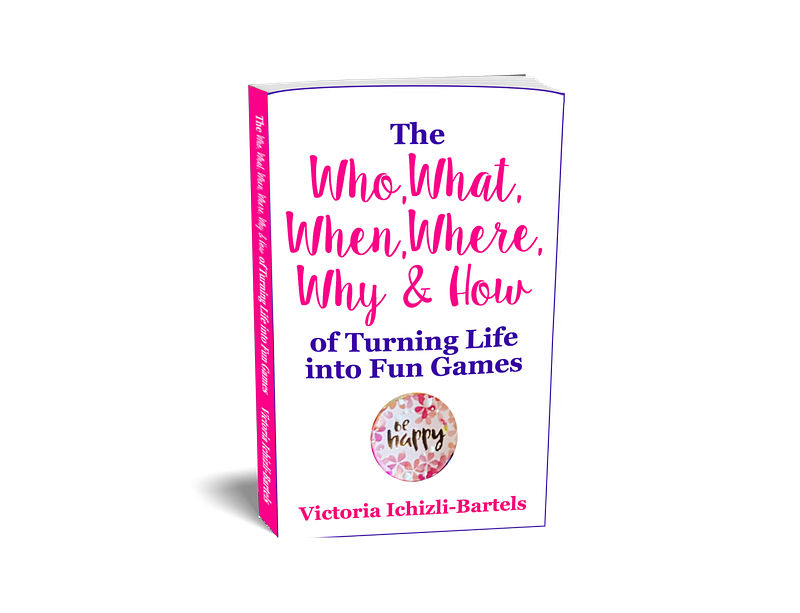
Discover the Who, What, When, Where, Why and How of Turning Life into Fun Games
Self-Gamification, a unique self-help approach to implementing game design elements into each of our lives and uniting anthropology (awareness), kaizen (small steps), and gamification (gamefulness) is gathering growing interest.
Self-Gamification Happiness Formula described the Self-Gamification approach in detail and in multiple contexts.
This book has been created in response to those interested in reading a short summary of the approach, rather than a longer discourse.
The Who, What, When, Where, Why and How of Turning Life into Fun Games is a short, compressed, and reworked version of Self-Gamification Happiness Formula, which was reorganized to answer six essential questions:
- Who is responsible for turning projects, activities, and whole lives into games?
- What can be turned into games?
- When does it make sense to turn something into games?
- Where could or should projects and activities be turned into games?
- Why does it make sense to turn projects, activities, and even our whole lives into fun games?
- How can we turn projects, activities, and our lives into games?


