
Fun is Not a Bonus; It’s a Must for Success

We all grew up in cultures that taught us to be serious about life and what we wanted to achieve in it. Otherwise, we wouldn’t survive either literally or figuratively, or both.
If we wanted to achieve anything in life, we had to work hard. And to underline this seriousness and determination, we learned to complain and surround whatever we wanted or had to do with drama.
Somehow, the opinion that having fun got in the way of achieving anything in life became established in many human minds.
But interestingly enough, the opposite is true. And thanks to globalization, and the internet increasing connectivity, we have become more and more aware of the fact that having fun does not impede success, but rather leads to it.
This is easiest to see in the entertainment industry. When talking about fun, I love quoting Heidi Klum, a German-American supermodel and television personality, and one of the four judges on America’s Got Talent (AGT).
After the results show of the AGT 2017 finals, a reporter asked Heidi what advice she would give to the winner, Darcy Lynn, a twelve-year-old ventriloquist. Without hesitating, Heidi answered,
Always to have fun. If you don’t have fun, it shows in your performance. That is always the key number one. — Heidi Klum
But also in other areas, including the most technical and business ones, the experience of fun sets you on the path toward success.
Fun is an extraordinarily valuable tool to address serious business pursuits like marketing, productivity enhancement, innovation, customer engagement, human resources, and sustainability. — Kevin Werbach and Dan Hunter, For the Win
Here is another brilliant thought about fun, which is worth remembering every once in a while. It is one of my favorite quotes by my favorite authors on living in the moment, Ariel and Shya Kane:
We have come to realize if we are not having fun, we are moving in the wrong direction. — Ariel and Shya Kane
But how to find this “right” direction? What is fun anyway?
Fun is a complex term made up of just three letters.
What is fun for us might not be fun for someone else. What we find fun is not only subjective to various persons but even to the same person in different circumstances. We might enjoy playing a game one day and not so much on another.
But there is a great thing about fun.
However difficult it is to define in words. I counted, for example, more than ten definitions of fun in just a few chapters of the acclaimed book Theory of Fun for Game Design by Raph Koster.
Here are just five of the shortest ones:
“Fun is light, energetic, playful and…well…fun.” — Will Wright in the foreword
“Fun is all about our brains feeling good — the release of endorphins into our system.”
“Fun is the act of mastering a problem mentally.”
“Fun is contextual.”
“Fun is another word for learning.” — Raph Koster, Theory of Fun for Game Design
But still, we all know what it feels like for us.
Fun can show in different ways. One time while we have fun and enjoy something we might laugh, and at other times, while fully engaged in a video game or fantasy novel, we might frown and appear quite tense. But we are still having fun!
There is another excellent feature of fun. You can discover it anywhere and in anything. Even in those activities you initially claim not to be fun.
We can discover fun when we give that project or activity a chance, approach it with curiosity and without prejudice, while being open to recognizing the fun factors in there, or we can bring fun elements into the project deliberately. Or all of these together.
How can we do this?
Curiosity and passion can help us here. I call them the siblings of fun in this inspirational trio, one preceding and the other succeeding the birth of fun in each moment. These triplets helped us, humans, to choose and pave previously unfathomable paths.
Here is one of my favorite stories on how curiosity leads to passion and fantastic success:
“I was in the cafeteria and some guy, fooling around, throws a plate in the air. As the plate went up in the air I saw it wobble, and I noticed the red medallion of Cornell on the plate going around. It was pretty obvious to me that the medallion went around faster than the wobbling. I had nothing to do, so I start figuring out the motion of the rotating plate. I discovered that when the angle is very slight, the medallion rotates twice as fast as the wobble rate — two to one. It came out of a complicated equation! I went on to work out equations for wobbles. Then I thought about how the electron orbits start to move in relativity. Then there’s the Dirac equation in electrodynamics. And then quantum electrodynamics. And before I knew it… the whole business that I got the Nobel prize for came from that piddling around with the wobbling plate.” — Richard P. Feynman, Surely You’re Joking, Mr. Feynman!
Fun has also led me to initially unexpected but utterly rewarding places. I wouldn’t have become an author if I hadn’t let myself “taste” writing out of curiosity, and let myself follow what felt healing, rewarding, rejuvenating, but most of all, fun for me. I have tried various art forms in my life, including singing, playing guitar, painting, making jewelry, and decorations. But it was writing that turned out to be the best way to express myself.
Through all those experiences, I discovered that fun equaled wholehearted and rewarding engagement. And that is precisely what defines successful projects and those involved in them. The latter are wholeheartedly engaged, and experience this engagement as utterly satisfying.
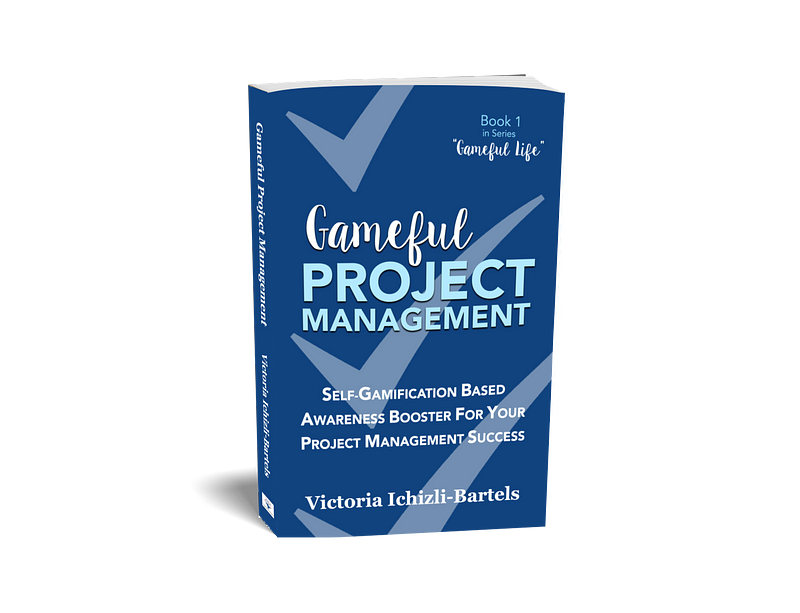
That was an excerpt from my book Gameful Project Management: Self-Gamification Based Awareness Booster for Your Project Management Success. I hope you enjoyed reading it, and it inspired you to use fun as a multifaceted tool. To view a video series based on this book click Gameful Project Management.
P.S. To keep in touch, subscribe to my newsletter, Optimist Writer. For blog posts on turning life into fun games, tick the Optimist Writer’s Blog.
About the author:
Victoria is a writer, instructor, and consultant with a background in semiconductor physics, electronic engineering (with a Ph.D.), information technology, and business development. While being a non-gamer, Victoria came up with the term Self-Gamification, a gameful and playful self-help approach bringing anthropology, kaizen, and gamification-based methods together to increase the quality of life. She approaches all areas of her life this way. Due to the fun she has, while turning everything in her life into games, she intends never to stop designing and playing them.


