avatarVictoria Ichizli-Bartels

Free AI web copilot to create summaries, insights and extended knowledge, download it at here

5404

Abstract

sion than anyone else on the planet. — Jane McGonigal, Reality Is Broken: Why Games Make Us Better and How They Can Change the World</p><p id="d0eb"><a href="https://readmedium.com/what-is-the-best-starting-point-for-the-next-step-e71281bdfda7">So if you feel overwhelmed by the next task, then first become aware of that.</a> Then identify the smallest step that won’t overwhelm you, but will take you in the same direction as what you want or set out to do. Make that step. Appreciate it. And after that, continue with your day. And whenever you feel overwhelmed, simply <a href="https://readmedium.com/how-to-play-the-turn-your-life-into-fun-games-game-134de71e313f">repeat the process</a>.</p><h1 id="3928">Preferred versus effortless</h1><p id="b30f">I observed an interesting pattern with all activities. The more I felt a step in a project to be effortless — even if I thought that I didn’t like the activity very much — the more I made progress in it and the more points I gathered in my <a href="https://readmedium.com/what-are-self-motivational-games-and-their-types-e2cb86fdcf5d?source=---------5------------------">self-motivational games</a>.</p><p id="fa89">Here comes anthropology again. Become aware that you often intuitively choose to do small, effortless things first.</p><p id="96ae">We escape to certain activities because they appear effortless to us. It is much easier to push the button and scroll down in the Facebook app than to walk away from a computer, brush your teeth and get ready for bed. It is much easier to watch YouTube videos than write a sentence for a report.</p><p id="d39c">Or at least this is how we judge them. We think it is easier. It might not be in reality, because the effects of watching and scrolling might not be uplifting or as easy as initially perceived after all. We might just be sticking with the labels we put on those activities, rather than finding out how they really feel in that moment.</p><p id="d5e7">And sometimes you might find yourself leaving the watching and scrolling on social media for the things you always thought tedious, such as cleaning or laundry or working out or something else. You might find that the things you used to claim you didn’t like doing are now effortless to accomplish, and you instead observe yourself escaping into them. This awareness is priceless!</p><p id="457b">That means we can do anything, whether we think we like it or not.</p><p id="87a0">But we have to approach it <a href="https://readmedium.com/what-is-kaizen-and-why-it-matters-for-living-a-gameful-life-72c4bd4ec071">the kaizen way</a> and break whatever we set out to do in small, effortless steps.</p><p id="da06">And continue practicing <a href="https://readmedium.com/how-to-be-aware-that-you-are-your-own-anthropologist-c03f89b727e4">seeing ourselves non-judgmentally, like anthropologists</a>.</p><p id="68d8">Let’s take a look at the to-do list we drafted above:</p><ul><li>Write a report, an article for a magazine, a blog post, a master or Ph.D. thesis, a non-fiction book,</li><li>Study for an exam,</li><li>Write a novel,</li><li>Learn a language,</li><li>Renovate a house,</li><li>Lose weight (or exercise to lose weight, to become healthier, to get in better shape).</li></ul><p id="5e8a">Here is a suggestion: title your current to-do list “Goals in my <a href="https://readmedium.com/what-is-the-best-about-games-and-projects-6fc7ab5f2d28">Project Games</a>” and create a new list for the next steps.</p><p id="2efb">The clue: these steps should be the smallest and most effortless you could possibly make.</p><p id="613f">And another tip: try to make the smallest step as specific as possible.</p><p id="fb7c">The to-do list above could then look like this:</p><ul><li>Write a paragraph for my report, article, blog post, master or Ph.D. thesis, non-fiction book (An alternative: choose a topic for the article, blog post, section of the thesis to address next),</li><li>Identify the material that covers the first topic in the list of areas to revise for the exam,</li><li>Choose the genre for the novel or the reader’s age,</li><li>Learn one phrase in the language of my choice and try to use it in various situations, either out loud or in my thoughts,</li><li>Choose one room in my house that I would like to renovate first,</li><li>Replace my afternoon snack with a glass of water or unsweetened tea (or do one yoga/stretch exercise before bed or in the morning before taking a shower).</li></ul><p id="755d">How do these sound to you?</p><p id="d2a4">If they still sound too big to accomplish in one go, break them down further. Do so until you are eager to address each of these tasks — and can’t wait to do them — not because you want to be finished with them, but because they do not overwhelm you anymore and are easy-breezy and even fun to do.</p><p id="ed42">Let’s concentrate on small steps, and enjoy each of them. And even if you are taking those small steps to train for a real stunt or an acrobatic act, then the final feat itself won’t be something that gigantic and dramatic, but just another one of these steps that is as easy and fun as all the others were along the way. Or at least much more straightforward than you anticipated at the start of your preparation.</p><figure id="8e65"><img src="https://cdn-images-1.readmedium.com/v2/resize:fit:800/0*cE7i8f_Addm1kA_X"><figcaption>Photo by <a href="http

Options

s://unsplash.com/@churrbroskii?utm_source=medium&utm_medium=referral">Liam Shaw</a> on <a href="https://unsplash.com?utm_source=medium&amp;utm_medium=referral">Unsplash</a></figcaption></figure><h1 id="824b">What is all this bureaucracy good for?</h1><p id="1a53">You might be appalled by my suggestion of how to record your to-do list items. You might argue that by marking them in such detail, the only thing you will be doing is recording all the items and not actually doing them. And you might become even more appalled when you find me adding to this bureaucracy with the recommendation that you design various feedback systems for your self-motivational games and make sure that you record the progress of your projects with points, badges, stars and/or others.</p><p id="709e">Here is a quick reminder of <a href="https://readmedium.com/the-goal-of-turning-ones-life-into-fun-games-1c065ce8384b">the goal of turning your life into fun games</a>. It is also a self-help approach. So, if you don’t need help and your work is progressing well, and you are enjoying what you are doing — in other words, you are on your happy way — then you don’t need to write everything down. Don’t stop the flow when you are in it.</p><p id="3fb9">But if there is no flow, if you stepped off your happy path and feel lost, then you can use these tools to help you. <a href="https://readmedium.com/how-to-turn-something-or-anything-into-games-7bd8746e5958">Self-Gamification with the three approaches it embraces</a> helps you to return to the flow. And to do so gently and kindly to yourself.</p><p id="b381">So if you observe that you are continually forcing yourself to move in leaps (especially mental ones) that you can’t do, and suffer because of it, then stop.</p><p id="5630">Next, be your own anthropologist by observing the situation you are in, your state of mind, and what there is to do.</p><p id="c6c4">Then, as a designer, adjust your game-design so that you as a player enjoy your project game.</p><p id="fd0a">And finally, as an avid player, identify your next, small, and effortless step in the game and take it.</p><p id="0bf4">In order to maintain balance, you need to move one small step at a time. This applies both to our physical state (when we’re awake) and our mental one.</p><p id="86eb"><b><i>A note to this article:</i></b><i> The article is an updated compilation of excerpts from <a href="https://www.amazon.com/dp/B07SV46VPP">Self-Gamification Happiness Formula: How to Turn Your Life into Fun Games</a>.</i></p><h1 id="94eb">Related articles:</h1><div id="fd0d" class="link-block"> <a href="https://readmedium.com/how-i-became-aware-of-the-magic-of-a-small-effortless-step-8889891862c3"> <div> <div> <h2>How I Became Aware of the Magic of a Small, Effortless Step</h2> <div><h3>An unforgettable discovery of the power of kaizen</h3></div> <div><p>medium.com</p></div> </div> <div> <div style="background-image: url(https://miro.readmedium.com/v2/resize:fit:320/0*WsLmlCrYXlpLpYXr)"></div> </div> </div> </a> </div><div id="79bf" class="link-block"> <a href="https://readmedium.com/what-is-the-best-starting-point-for-the-next-step-e71281bdfda7"> <div> <div> <h2>What Is the Best Starting Point for the Next Step?</h2> <div><h3>How to appreciate each moment regardless of our preferences</h3></div> <div><p>medium.com</p></div> </div> <div> <div style="background-image: url(https://miro.readmedium.com/v2/resize:fit:320/0*wWXRKbloGeTwgqM4)"></div> </div> </div> </a> </div><div id="d2b0" class="link-block"> <a href="https://readmedium.com/what-is-kaizen-and-why-it-matters-for-living-a-gameful-life-72c4bd4ec071"> <div> <div> <h2>What Is Kaizen and Why It Matters for Living a Gameful Life</h2> <div><h3>With insight on how the human brain functions and how that causes procrastination</h3></div> <div><p>medium.com</p></div> </div> <div> <div style="background-image: url(https://miro.readmedium.com/v2/resize:fit:320/0*ykj5d8YFIvQsulln)"></div> </div> </div> </a> </div><p id="7fcb"><b>P.S. </b>To stay in touch, join my e-mail list, <a href="https://www.victoriaichizlibartels.com/subscribe-to-victorias-blog/">Optimist Writer</a>.</p><h1 id="80b6">About the author:</h1><p id="3c9f"><i>Victoria is a writer, instructor, and consultant with a background in semiconductor physics, electronic engineering (with a Ph.D.), information technology, and business development. While being a non-gamer, Victoria came up with the term <a href="https://www.victoriaichizlibartels.com/self-gamification/">Self-Gamification</a>, a gameful and playful self-help approach bringing anthropology, kaizen, and gamification-based methods together to increase the quality of life. She approaches all areas of her life this way. Due to the fun she has, while turning everything in her life into games, she intends never to stop designing and playing them.</i></p></article></body>

Here is Why You Need to Rewrite Your To-Do List
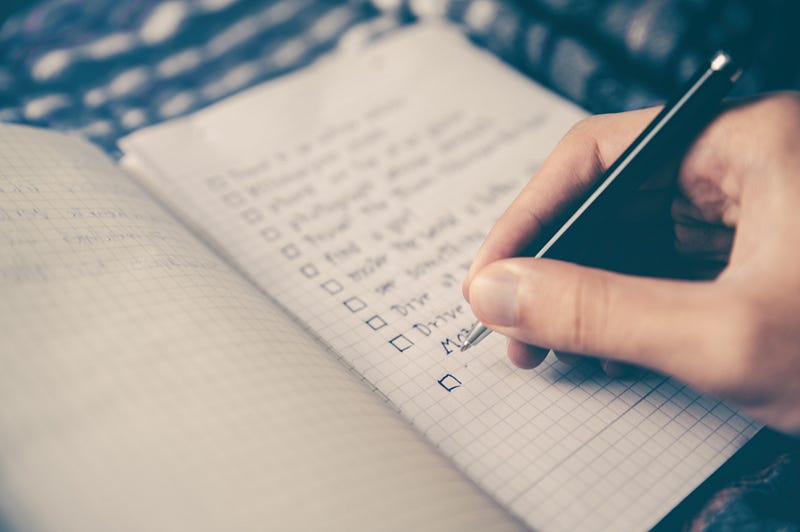
Photo by Glenn Carstens-Peters on Unsplash

If you take care of the small things, the big things take care of themselves. — Emily Dickinson

Take a non-judgmental look at your to-do list

Let’s practice seeing ourselves and what we are up to non-judgmentally.

When we do so, we will be able to identify whatever we are up to as our escape-from and escape-to tasks. And above that, we will become aware that these can switch places. That escape-from tasks can become escape-to tasks and vice versa.

We will also realize that as long as we don’t give them up completely, all escape-from tasks are those we want to complete, independent of whether we think (or say) that we want to do them or not.

We all have many tasks on our to-do lists. To be more efficient we tend to record the end-results of each task on those lists. So, those tasks often end up being as huge as New Year’s resolutions. Which could be one of the main reasons for our procrastination and our escape from them to doing something else.

Do you have something like the below on your to-do list?

  • Write a report, an article for a magazine, a blog post, a master or Ph.D. thesis, a non-fiction book,
  • Study for an exam,
  • Write a novel,
  • Learn a language,
  • Renovate a house,
  • Lose weight (or exercise to lose weight, to become healthier, to get in better shape).

I had most of the above on my to-do list at one point or another.

After practicing Self-Gamification for some time, I realized that itemizing the tasks in this format sounded to my mind as though they had to be completed in one step.

But attempting to accomplish these tasks on my to-do lists in one go felt as overwhelming as jumping between rooftops without any preparation. No parkour master or stunt-person would ever try something like that in one go.

No wonder I ran away from these tasks!

Photo by Jennifer Bedoya on Unsplash

If a stunt-person concentrated only on that final jump, he or she would never be able to do it. Any stunt requires both physical and mental preparation. I remember how I watched children being trained in parkour. They didn’t jump between rooftops; they learned to jump from the floor onto a small bench first, then from the bench onto a table. Later the bench was moved a bit farther from the table, then a slightly taller table was added. One step, one small change at a time. All that training involved the repetition of the previous level, plus one little step more.

So why do so many of us push ourselves to do the challenging stunts (especially mental ones), either in one go or in just a few giant leaps?

Is it surprising then that we try to escape, either into complaints, or to activities we didn’t want or plan to engage in at that moment?

What size step to make next

So, what should you do? Robert Maurer and many others who have experienced the magic of making progress with tiny steps recommend making the smallest and most effortless steps possible.

Robert Maurer said something quite revealing, and for me, perspective-changing. I quote it often. Here it is:

Even the small signs that you are resisting the small step are an indication that the step is too big. — Robert Maurer, One Small Step Can Change Your Life: The Kaizen Way

Isn’t that amazing? Do you see how awareness and kaizen sit brilliantly together?

Together they show that feeling off-balance, overwhelmed, or in resistance to something is not bad. In fact, it is a helpful indicator. It is an indicator that you are trying to jump too far (or too high) to reach what is out of “the limits of [your] own endurance.”

The research proves what gamers already know: within the limits of our own endurance, we would rather work hard than be entertained. Perhaps that’s why gamers spend less time watching television than anyone else on the planet. — Jane McGonigal, Reality Is Broken: Why Games Make Us Better and How They Can Change the World

So if you feel overwhelmed by the next task, then first become aware of that. Then identify the smallest step that won’t overwhelm you, but will take you in the same direction as what you want or set out to do. Make that step. Appreciate it. And after that, continue with your day. And whenever you feel overwhelmed, simply repeat the process.

Preferred versus effortless

I observed an interesting pattern with all activities. The more I felt a step in a project to be effortless — even if I thought that I didn’t like the activity very much — the more I made progress in it and the more points I gathered in my self-motivational games.

Here comes anthropology again. Become aware that you often intuitively choose to do small, effortless things first.

We escape to certain activities because they appear effortless to us. It is much easier to push the button and scroll down in the Facebook app than to walk away from a computer, brush your teeth and get ready for bed. It is much easier to watch YouTube videos than write a sentence for a report.

Or at least this is how we judge them. We think it is easier. It might not be in reality, because the effects of watching and scrolling might not be uplifting or as easy as initially perceived after all. We might just be sticking with the labels we put on those activities, rather than finding out how they really feel in that moment.

And sometimes you might find yourself leaving the watching and scrolling on social media for the things you always thought tedious, such as cleaning or laundry or working out or something else. You might find that the things you used to claim you didn’t like doing are now effortless to accomplish, and you instead observe yourself escaping into them. This awareness is priceless!

That means we can do anything, whether we think we like it or not.

But we have to approach it the kaizen way and break whatever we set out to do in small, effortless steps.

And continue practicing seeing ourselves non-judgmentally, like anthropologists.

Let’s take a look at the to-do list we drafted above:

  • Write a report, an article for a magazine, a blog post, a master or Ph.D. thesis, a non-fiction book,
  • Study for an exam,
  • Write a novel,
  • Learn a language,
  • Renovate a house,
  • Lose weight (or exercise to lose weight, to become healthier, to get in better shape).

Here is a suggestion: title your current to-do list “Goals in my Project Games” and create a new list for the next steps.

The clue: these steps should be the smallest and most effortless you could possibly make.

And another tip: try to make the smallest step as specific as possible.

The to-do list above could then look like this:

  • Write a paragraph for my report, article, blog post, master or Ph.D. thesis, non-fiction book (An alternative: choose a topic for the article, blog post, section of the thesis to address next),
  • Identify the material that covers the first topic in the list of areas to revise for the exam,
  • Choose the genre for the novel or the reader’s age,
  • Learn one phrase in the language of my choice and try to use it in various situations, either out loud or in my thoughts,
  • Choose one room in my house that I would like to renovate first,
  • Replace my afternoon snack with a glass of water or unsweetened tea (or do one yoga/stretch exercise before bed or in the morning before taking a shower).

How do these sound to you?

If they still sound too big to accomplish in one go, break them down further. Do so until you are eager to address each of these tasks — and can’t wait to do them — not because you want to be finished with them, but because they do not overwhelm you anymore and are easy-breezy and even fun to do.

Let’s concentrate on small steps, and enjoy each of them. And even if you are taking those small steps to train for a real stunt or an acrobatic act, then the final feat itself won’t be something that gigantic and dramatic, but just another one of these steps that is as easy and fun as all the others were along the way. Or at least much more straightforward than you anticipated at the start of your preparation.

Photo by Liam Shaw on Unsplash

What is all this bureaucracy good for?

You might be appalled by my suggestion of how to record your to-do list items. You might argue that by marking them in such detail, the only thing you will be doing is recording all the items and not actually doing them. And you might become even more appalled when you find me adding to this bureaucracy with the recommendation that you design various feedback systems for your self-motivational games and make sure that you record the progress of your projects with points, badges, stars and/or others.

Here is a quick reminder of the goal of turning your life into fun games. It is also a self-help approach. So, if you don’t need help and your work is progressing well, and you are enjoying what you are doing — in other words, you are on your happy way — then you don’t need to write everything down. Don’t stop the flow when you are in it.

But if there is no flow, if you stepped off your happy path and feel lost, then you can use these tools to help you. Self-Gamification with the three approaches it embraces helps you to return to the flow. And to do so gently and kindly to yourself.

So if you observe that you are continually forcing yourself to move in leaps (especially mental ones) that you can’t do, and suffer because of it, then stop.

Next, be your own anthropologist by observing the situation you are in, your state of mind, and what there is to do.

Then, as a designer, adjust your game-design so that you as a player enjoy your project game.

And finally, as an avid player, identify your next, small, and effortless step in the game and take it.

In order to maintain balance, you need to move one small step at a time. This applies both to our physical state (when we’re awake) and our mental one.

A note to this article: The article is an updated compilation of excerpts from Self-Gamification Happiness Formula: How to Turn Your Life into Fun Games.

Related articles:

P.S. To stay in touch, join my e-mail list, Optimist Writer.

About the author:

Victoria is a writer, instructor, and consultant with a background in semiconductor physics, electronic engineering (with a Ph.D.), information technology, and business development. While being a non-gamer, Victoria came up with the term Self-Gamification, a gameful and playful self-help approach bringing anthropology, kaizen, and gamification-based methods together to increase the quality of life. She approaches all areas of her life this way. Due to the fun she has, while turning everything in her life into games, she intends never to stop designing and playing them.

Self
Productivity
Life Hacking
Ideas
Gaming
Recommended from ReadMedium