
What is the Best about Games and Projects?

Every Game is a Project
When beginning to create anything, you start a project.
The same applies to games.
If you want to create a game, you are taking on a project that contains many parts to it, both creative and management matters.
Here is how Thomas Schwarzl introduces his book Game Project Completed, which among many others addresses the management aspects of a game project:
“This book deals with the underserved topic of how to finish a game project. Technical and artistic work are just the ingredients of the overall process. What makes them stick together and how to manage specific tasks make up the secret sauce to success.” — Thomas Schwarzl, Game Project Completed
To create a game and make it a finished product, you will need to follow in one way or another the following processes defined by the Project Management Institute (PMI).
“Founded in 1969, the Project Management Institute (PMI) sets standards for the project management profession. It has 454,000 members in 180 countries.
…
According to the PMI, there are five ‘process groups.’ Technically, they’re not supposed to be ‘steps’ or ‘phases’ in managing the project, but it might be easier to think of them that way. They are the following:
1. Initiate
2. Plan
3. Execute
4. Monitor and Control
5. Close”
— Kory Kogon, Suzette Blakemore, James Wood, Project Management for the Unofficial Project Manager
If you look at these five processes more closely and recall that we have the ability and the will to see and approach anything we do as games, you will recognize (or at least be able to imagine) that these processes can be seen as quests in your “game project game” or as separate games on their own.
Every Project is a Game
To be able to recognize that projects are games too, we need to take a look at the components of games, and determine whether projects consist of these too.
For me, the most revealing definition of game components was the following:
What defines a game are the goal, the rules, the feedback system, and voluntary participation. Everything else is an effort to reinforce and enhance these four core components. — Jane McGonigal, Reality Is Broken
Before I read this definition, I hadn’t been able to see the parallels between my projects and games. I might have used a metaphor like “it’s a tough game” or similar, but I rarely considered my every-day projects to be games.
Let’s repeat the quote by Jane McGonigal and put the components into bullet points. The primary elements of a game are:
- The goal,
- The rules,
- The feedback system,
- Voluntary participation.
I am a business owner, so after reading this, I could immediately see parallels between the projects I was working on for my customers, and games. A contract or an agreement, which my customer and I both sign, contains all four of these components. Each project has a goal, there are specific rules, like how I shall do it and by when. There are reporting and evaluation systems in each contract, which is indeed a feedback system even if the progress is not recorded by getting points or badges. And finally, when my client and I sign the contract and make an agreement, we both demonstrate the free will to participate in that project’s “game.”
The same applies to job contracts which lead to your job “games,” with their goals, rules, feedback system (the regular meetings you most likely have with your boss, before or after which you and your employer provide some kind of evaluation of each other), and both sides demonstrating the voluntary participation by signing the employment contract.
Other activities, like sports to stay in shape, also have all four components. The goal could be to live a healthy life. The rules are then the allocation of time you commit to it; the feedback system might be your step counter or an app where you record your workout results every day. Some people take on thirty, one hundred or another amount of days challenges and have social media as their feedback system. Each post recounting a successful workout session is cheered about by their friends and followers.
Voluntary participation might be challenging to see in such cases when we think we don’t want to do sports or to develop other healthy habits. However, if we end up working out or doing yoga without someone forcing us, then that is still voluntary participation.
So any project or activity is already a game. We just rarely see them that way.
Why do we need to see and treat what we do as games? If we don’t want to see, call, and embrace what we are up to as games, then we won’t be able to “play” them and enjoy them in a similar way to games. Only when you become open to seeing your project as a game, can you identify how you can modify its design to make your “project game” exciting and fun.
That was an excerpt from my book Gameful Project Management: Self-Gamification Based Awareness Booster for Your Project Management Success. I hope you enjoyed reading it, and it inspired you to see your projects in a new, exciting, and gameful light. To find out more, check out the Gameful Project Management.
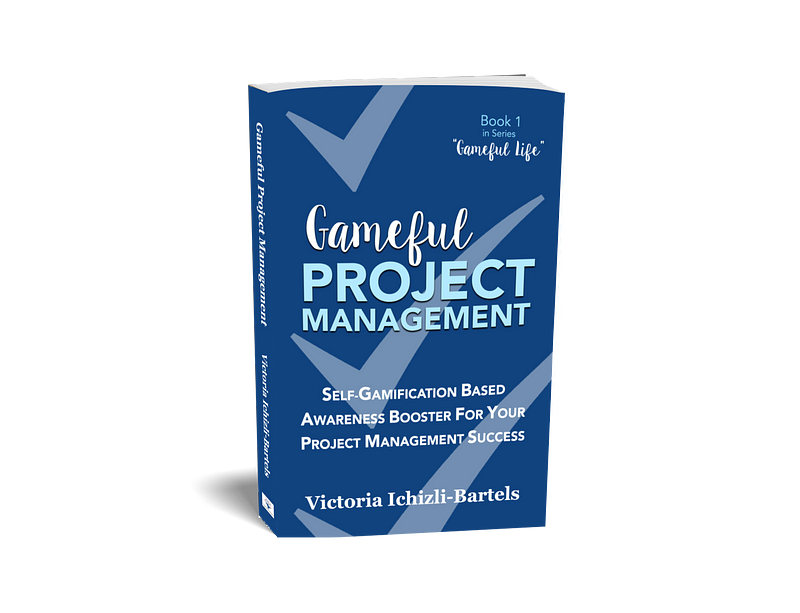
Turn your project management into Gameful Project Management by applying Self-Gamification, a unique approach uniting anthropology, kaizen, and gamification
Projects are the building blocks of our professional and personal lives. So, to live joyfully, we need a joyful approach to our projects.
You might currently enjoy your projects and be utterly motivated by them. But what do you do when there is no flow, and you feel stuck? It happens to all of us from time to time.
Turning projects and project management into fun games can help.
This little awareness booster shows you how to recognize that projects and project management tasks are already games, and that you are both the designer and the player of them.
It points to the tools you already have at your disposal, but are unaware of, to help you turn your project management into Gameful Project Management.
It explains how to use games, game thinking, and gamification along with awareness and small-step progress, to improve performance in your project management, without considerable investments in expensive technology or new personnel, and without the aim of these goals or forcing change.
This book offers actionable advice on how to use the power of fun as the tool and the compass for turning your project management into engaging games, for you and everyone else involved.


